

User-generated content has become a powerful part of performance marketing.
In fact, according to Bazaarvoice's 2025 consumer research, 75% of shoppers find UGC useful when making purchase decisions.
Yet putting a creator in front of a camera does not guarantee clicks, leads, or purchases.
A user-generated video can feel authentic, earn views, and entertain your target audience while still producing weak conversion metrics.
From our experience, this gap usually starts before production.
Creators may receive detailed instructions about video length, product shots, and content formats. However, they get little context about what should move the customer toward action.
This makes the quality of your UGC brief critical to campaign performance.
In this guide, we'll break down how to create UGC briefs that help creators turn attention into measurable action.
Why Most UGC Briefs Fail to Produce Business Results
Before we get into what a strong creative brief looks like, let’s understand where UGC ad briefs go wrong.
A brief can look detailed on paper and still leave a creator without the direction needed to produce effective UGC ad creative.
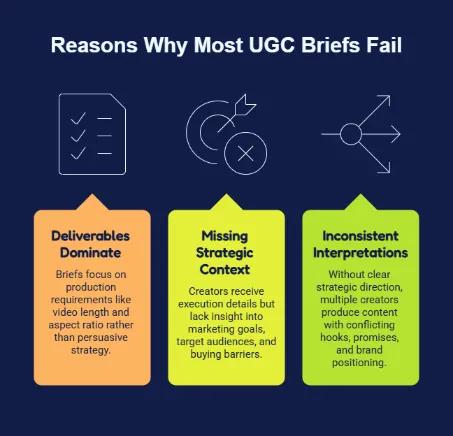
Deliverables Dominate the Brief
Many ad briefs are packed with production requirements. You might specify:
- Three user-generated videos
- A 9:16 aspect ratio
- A 30-second limit
- Two revision rounds
- Several asset formats
These details keep production organized. However, they do not tell the creator what needs to persuade the viewer.
A creator can meet every deadline and deliver polished video content while the UGC ad creative still falls short of your campaign goals. The brief has covered production, but it has left the strategy unclear.
Creators Receive Execution Details Without Strategic Context
Creators are usually told what to make. But they get much less context about:
- Who needs convincing
- Why that person might buy
- What could hold them back
Creators themselves are asking for more context.
According to Influencer's 2025 Creator Perspectives research, 64% of creators want deeper insight into brands' overall marketing goals so they can better align their content strategies.
Even an experienced creator cannot infer your full creative strategy from a list of deliverables.
For example, “Create a 30-second product demo” explains the production task. It says nothing about why the product should matter to the viewer or what could influence their decision.
When that context is missing, creators have to fill in the strategic gaps themselves.
Every Creator Interprets the Campaign Differently
Those gaps become more visible when several creators work on the same ad campaigns.
One creator may lead with price. Another may focus on convenience. A third may make a completely different product promise. Hooks and CTAs can vary just as widely.
Each piece may work on its own, but the campaign can start pulling in different directions.
As per our experience, this makes it harder to maintain clear brand positioning across your social media campaigns.
Define the Customer Decision Before Drafting the UGC Brief
Before you open a creative brief, get clear on the customer decision you want the content to influence.
At 9AM, our team usually starts with three important questions:
- Who are we trying to persuade?
- What is holding them back?
- What decision do we want them to make?
Below, we break down each question and what you need to clarify before drafting the brief.
1. Identify the Person the Content Needs to Persuade
“People interested in skincare” is too broad to guide a strong creative strategy. You need to know which customer segment you want to reach and where they are in the buying journey.
This context matters because the same message will not resonate equally with every customer.
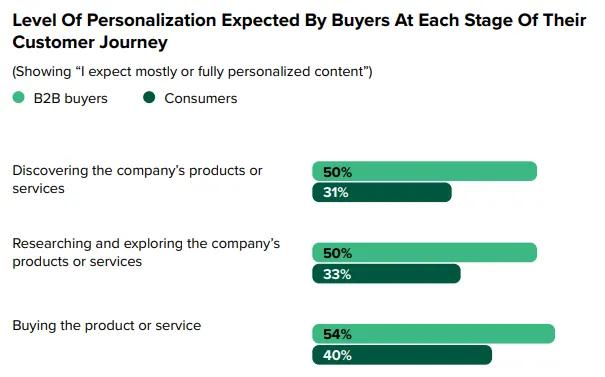
Adobe and Forrester's 2025 research found that 50% of B2B buyers expect mostly or fully personalized content during product discovery, rising to 54% at the purchase stage.
Among consumers, the figures rise from 31% during discovery to 40% at purchase.
So, we suggest asking:
- How familiar are they with your brand or product line?
- Are they aware of the problem your product solves?
- Are they actively comparing options?
- How strong is their purchase intent?
- Where are they likely to encounter the content?
Remember, a first-time viewer scrolling through Instagram Reels has a different level of context than someone who has already visited your product page. That difference should shape how you approach the campaign.
2. Identify the Barrier Delaying Action
Next, figure out what is keeping that customer from moving forward.
It could be price, lack of trust, product confusion, fear of poor results, or reluctance to switch from a familiar brand.
We recommend choosing one primary barrier for each creative concept. We have seen that trying to answer five objections in one short video usually leaves every point underdeveloped.
For example, a shopper may already like your eco-friendly water bottle but wonder whether it keeps drinks cold all day. That concern matters more than repeating every product feature.
3. Define the Decision the Content Should Support
Finally, decide what you want the viewer to do after engaging with the content.
This decision could be:
- Make a first purchase
- Start a free trial
- Book a demo
- Install an app
- Submit a lead form
These actions require different levels of persuasion. A free app download usually needs less commitment than a high-value purchase.
Once you define the decision, the rest of your creative strategy has a much clearer starting point.
Steps to Translate Customer Strategy Into a UGC Creator Brief
Once you know who you want to persuade and what decision you want to influence, the next step is translating that strategy into instructions a creator can act on.
We recommend including the following five elements:
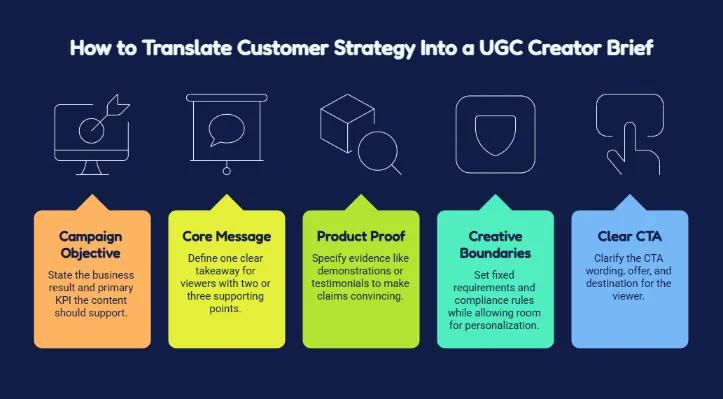
1. State the Campaign Objective and Primary Metric
Start with the business result you want the content to support. Then connect that result to one primary KPI.
For example:
- Conversion campaign: Drive first-time purchases, measured by conversion rate
- Lead generation campaign: Generate qualified leads, measured by cost per lead
- App campaign: Drive installs, measured by cost per install
You can include supporting conversion metrics such as click-through rates or ROAS. However, keep one metric as the priority.
The creator does not need access to your full ad accounts or reporting setup. They should understand what success means for the content they are producing.
2. Define the Message Viewers Should Remember
Next, give the creator one clear takeaway.
For example, if you sell an eco-friendly water bottle, your core message might be:
“This bottle keeps your drink cold throughout the workday without relying on disposable plastic.”
Then add two or three supporting points that strengthen that message. These could cover the material, insulation, or ease of cleaning.
Insider tip: Avoid turning the brief into a product catalog. Too many features compete for attention and make the main message harder to remember.
3. Specify the Proof the Creator Should Show
A product claim becomes more convincing when viewers can see why they should believe it.
Depending on the product and campaign, that proof could include:
- A product demonstration
- A personal experience
- A side-by-side comparison
- Customer testimonials
- A visible result
- Relevant supporting evidence
This kind of proof can influence buying behavior. According to Sprout Social, 64% of consumers say genuine reviews are the type of influencer content most likely to compel them to buy.
So, match the proof to the concern you identified earlier. If customers question durability, show the product being used. If they doubt the outcome, demonstrate the result where possible.
This gives authentic content something concrete to communicate instead of relying on broad claims.
4. Set the Creative and Compliance Boundaries
Your creator should know which parts of the brief are fixed and where they have room to make the content their own.
When our 9AM team works with UGC creators, we clearly define requirements such as:
- Required product mentions
- Approved claims
- Restricted words or claims
- FTC compliance and disclosure
- Brand voice
- Product visibility
- Relevant brand guidelines or visual guidelines
Then identify what the creator can personalize. This might include their wording, filming location, storytelling style, or delivery.
Clear boundaries protect your brand positioning while leaving enough room for the creator’s natural voice.
5. Clarify the Next Action
The customer action you defined earlier now needs to become a clear CTA in the brief.
Specify the CTA wording, offer, and destination. You should also explain when it needs to appear and whether it should be spoken, shown on screen, or both.
The CTA should fit the viewer’s level of intent. Someone discovering your product for the first time may need a softer next step than someone who is already comparing options.
For paid ad campaigns, make sure the spoken CTA also makes sense with the landing page and offer. A clear handoff between the UGC ad creative and destination makes the customer journey easier to follow.
Read Next: Mastering Landing Page Alignment: Speed, Scent, and Social Proof
Adapt the UGC Brief to the Creator and Platform
A strong brief should stay consistent on strategy while giving each creator room to work in the format they already do well.
A testimonial-style creator may be strongest with personal stories. A demonstration-led creator may perform better with product use cases. Comedy, educational, and lifestyle creators will each need a different execution style.
The core message can stay the same, but the delivery should fit the creator.
Platform behavior matters too. TikTok, Instagram, and Facebook do not behave the same way. Pacing, hook clarity, video length, and CTA timing should reflect how people consume content in each setting.
For example, Meta reports that Reels campaigns using 9:16 video with audio and key messages in the safe zone saw a 34.5% lower cost per result than campaigns using image ads on Reels.
Across the campaign, keep the core message, required proof, and main customer concern consistent. Give creators more flexibility with hooks, storytelling, and filming style.
We see this as controlled variation. The strategy stays intact, while the execution gives you enough range to learn what actually performs.
Improve Future UGC Ad Briefs With Performance Data
A UGC brief should get smarter after every campaign. Once your ads are live, performance data can show which creative decisions deserve another round and which ones need to change.
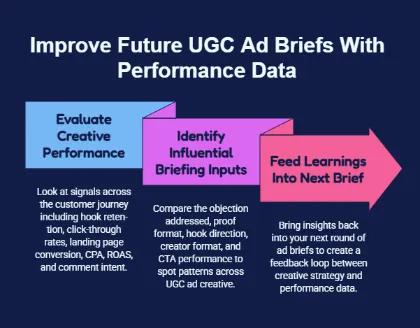
1. Evaluate Creative Performance Beyond Views
Views can tell you whether people watched, but they cannot tell you the full story about business impact.
Look at signals across the customer journey, including:
- Hook retention
- Click-through rates
- Landing page conversion
- CPA
- ROAS
- Comment intent
A user-generated video could earn strong watch time but send very few people to your landing page. Another might attract fewer views while producing more conversions at a lower CPA.
This is why we prefer to judge creative against the campaign goal rather than attention alone.
2. Identify Which Briefing Inputs Influenced Performance
Next, look beyond which creator or video “won.” Ask what was different about the direction behind each asset.
Compare the objection addressed, proof format, hook direction, creator format, and CTA performance. Creative analytics can help you spot patterns across a larger set of UGC ad creative.
Be careful about assigning all success or failure to the creator. A strong creator can receive weak direction, while a clear brief can make execution easier.
The useful question is: Which creative decisions are consistently connected with stronger performance?
3. Feed Campaign Learnings Into the Next Brief
Once patterns start to emerge, bring those insights back into your next round of ad briefs.
You might:
- Update hook guidance based on retention data
- Refine proof requirements based on conversion performance
- Remove talking points that consistently fall flat
- Add recurring customer questions found in comments
- Save winning concepts and visual references in a swipe file
- Maintain brief versions for different audiences, funnel stages, or platforms
Over time, this creates a feedback loop between your creative strategy and performance data.
The brief stops being a document you recreate from scratch for every campaign. It becomes part of a learning system where each round of UGC gives the next one a stronger starting point.
A Conversion-Focused UGC Brief Framework
You can use this framework to turn customer strategy into a creator brief that is clear, focused, and easier to execute.
| Brief Section | What to Include | Why It Matters | Example |
|---|---|---|---|
| Campaign outcome | Desired action and primary metric | Connects the content to a measurable business result | Drive first-time purchases while maintaining an acceptable CPA |
| Audience context | Customer segment, awareness level, and buying situation | Helps the creator address a specific viewer | Adults with acne-prone skin who have tried routines that caused dryness |
| Decision barrier | Main question, concern, or objection delaying action | Gives the content a focused persuasion task | Concern that the product may irritate sensitive skin |
| Core message | One main takeaway and two supporting points | Keeps competing claims from weakening the asset | A simple routine can support clearer skin without harsh steps |
| Required proof | Demonstration, experience, comparison, or evidence | Makes the message more credible | Show texture, application, and how the skin looks after use |
| Creative direction | Recommended content angle, hook direction, and format | Gives the creator a useful starting point | Open with frustration about routines that leave skin feeling tight |
| Creator flexibility | Wording, setting, pacing, storytelling, and filming choices | Protects authenticity and creator fit | Use a personal story and the creator’s usual filming style |
| CTA | Exact next step, offer, and landing destination | Connects viewer interest to campaign action | Shop the routine and choose the set that fits your skin concern |
| Requirements | Claims, disclosures, product shots, usage rights, and restrictions | Protects accuracy, compliance, and brand consistency | Include the paid partnership disclosure and avoid guaranteed claims |
UGC Brief Examples From Our Campaigns
Remember, UGC briefs do not always need to follow the same format. The level of detail can change based on the campaign, creator relationship, and context shared before production.
Here are some examples from campaigns our team has worked on.
Example 1: Chin-Su Creator Brief
This Chin-Su brief keeps the direction visual and easy to scan. It gives the creator a three-part storyboard with an opener, subject, and CTA. It also covers deliverables, reference ads, required hashtags, filming guidance, and clear do’s and don’ts.
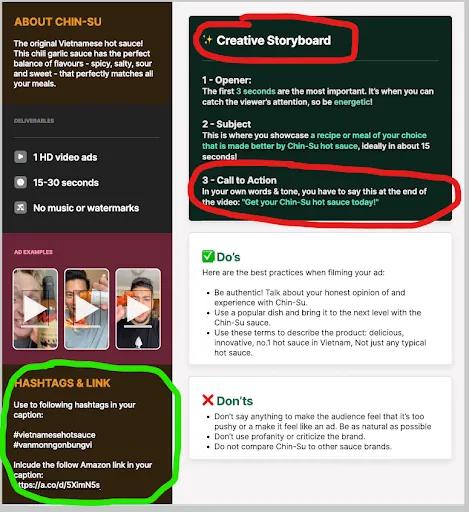
Disclaimer: This was an execution-focused brief. We had already discussed details such as the target audience, campaign objectives, performance targets, and usage terms with the creator. The document could therefore stay focused on what the creator needed for production.
Example 2: Brave Creator Brief
Our Brave brief gives creators more detailed messaging direction while still leaving room for their own delivery.
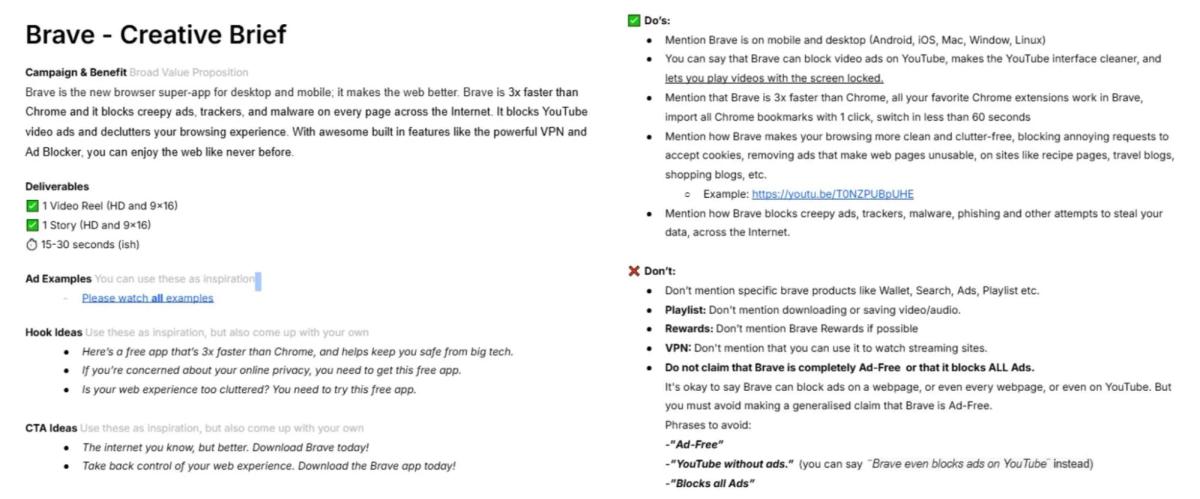
This gives the creator clear direction on the message, hooks, CTA, and claim boundaries without prescribing every word.
Disclaimer: Details such as the target audience, campaign objective, primary KPI, usage rights, and other campaign terms had already been aligned outside this execution brief.
These examples highlight an important point: every campaign detail does not need to live in one document. The creator does, however, need the full strategic, creative, and production context before filming starts. If that context has not been shared elsewhere, the brief should cover it directly.
Complete UGC Creative Brief Example
The two examples above show how real execution briefs can vary depending on the campaign and what has already been agreed with the creator.
To show what a complete standalone brief can look like, we created the sample below for an eco-friendly water bottle campaign.
UGC Creative Brief Example
Eco-Friendly Water Bottle Campaign
A practical creator brief built around one audience, one decision barrier, and one measurable campaign outcome.
Campaign objective
Drive first-time purchases from paid social while maintaining the target CPA.
Target audience
Professionals aged 25 to 40 who carry water throughout the workday and want to reduce their use of disposable plastic.
Audience stage
Problem-aware and comparing reusable bottle options.
Main customer barrier
The viewer likes the sustainability angle but questions whether the bottle can keep drinks cold throughout a full workday.
Core message
This reusable bottle keeps drinks cold throughout the workday while providing a practical alternative to disposable plastic bottles.
Supporting talking points
- Insulated design
- Easy to carry throughout the day
- Simple to clean
Required proof
Fill the bottle with a cold drink in the morning and show it again later in the day. Include close-up shots of the bottle, lid, and drinking experience.
Creative direction
Build the video around a normal workday. Open with a relatable problem, such as a drink becoming warm before lunch or relying on disposable bottles throughout the week.
Hook territory
Use the frustration or curiosity behind the problem rather than starting with a generic product introduction.
“I wanted one water bottle I could fill before work and forget about for the rest of the day.”
Creator flexibility
Use your normal filming style, wording, setting, pacing, and storytelling approach. The video should feel consistent with the content your audience already knows you for.
Required elements
- Show the product clearly
- Mention the key product benefit
- Include the required paid partnership disclosure
- Follow approved product claims
- Avoid guaranteed or unsupported claims
CTA
Encourage viewers to shop the bottle and choose their preferred style.
Landing destination
Product landing page.
Primary metric
Conversion rate.
Supporting metrics
- Click-through rate
- CPA
- Hook retention
- Landing page conversion
Deliverables
- One 30-second vertical video
- 9:16 format
- Clean footage without copyrighted music
- Raw footage where required for agreed usage
- One revision round
Usage rights
Specify the agreed paid social usage period, platforms, content licensing terms, and any creator whitelisting rights before production.
Creator takeaway
The video needs to persuade a customer who already wants a reusable bottle but still questions its everyday performance. The creative should make that performance easy to see and connect it to a clear purchase action.
Create Performance-Driven UGC With 9AM
If you want your UGC ad creative to do more than earn attention, the right strategy needs to start before production.
At 9AM, we help brands develop performance creative, produce UGC at scale, test creative variants, and use performance data to improve each new round of content.
Our team connects strategy, production, and testing so your creator briefs stay focused on the outcomes that matter.
Request a free UGC audit now to see where your current briefs may be limiting performance and what to improve next.
FAQs
How Long Should a UGC Creative Brief Be?
A UGC creative brief should be long enough to give the creator clear strategic and production direction without overwhelming them. In most cases, one to three pages can work well. Prioritize the audience, campaign objective, core message, proof, requirements, and CTA over unnecessary detail.
Should a UGC Brief Include a Complete Script?
Usually, no. A complete script can make user-generated content feel rigid or unnatural. Instead, give creators the core message, required talking points, proof, CTA, and brand guidelines. A full script may still make sense when exact wording is required for compliance or specific claims.
How Many Content Concepts Should You Include in One UGC Brief?
There is no universal number, but keeping each concept focused makes execution easier. If you want to test several hooks, objections, or creative angles, separate them clearly rather than packing everything into one concept. Each variation should have a specific reason for being tested.
Should Paid Ads and Organic UGC Use Separate Briefs?
Yes, in most cases. Paid UGC ad creative usually needs clearer performance targets, hooks, offers, CTAs, and platform-specific requirements. Organic content may leave more room for community engagement and creator storytelling. Separate briefs help you account for the different role each asset plays.
Does 9AM Create UGC for Paid Social Campaigns?
Yes. 9AM develops performance creative with conversion in mind, including UGC at scale. Our team supports creator networks, content production, rights management, and performance optimization as part of its creative strategy services.
Can 9AM Help Test Different UGC Creative Variations?
Yes. 9AM uses systematic creative testing and ad iteration to compare creative variants and identify stronger performers. This includes A/B testing, creative analysis, performance tracking, and rapid iteration. These insights help brands turn campaign learnings into better creative decisions over time.