

When you are responsible for scaling paid acquisition, producing another ad is rarely the hardest part. The real challenge is building a creative testing system that turns every experiment into a reusable decision.
Without that system, your team can launch more creative, increase ad spend, and collect endless performance data. Yet you may still struggle to explain why an idea worked, what caused the improvement, or whether the success can be repeated.
Unfortunately, this measurement gap is widespread. According to Marketing Week’s 2023 survey, 8 in 10 respondents identified creative quality as a key driver of effectiveness. But only 57.3% said they had an analysis in place to measure it.
And not much has changed in the years since, as more recent research from Marketing Week put that number even lower at 46.2%.
This disconnect matters because creative directly influences attention, engagement, conversion, and acquisition costs. It deserves the same level of discipline you already apply to targeting, bidding, and budget allocation.
And that starts with reliable creative testing solutions, coupled with a solid creative strategy. Together, they can turn every result into a better decision for your next test.
How Creative Testing Actually Improves Performance
Creative testing helps you make better decisions before your team commits significant production time and media spend.
A weak testing process simply tells you which ad performed best. A stronger system goes deeper. It shows you which audience insights, messages, formats, and creative choices are most likely to influence customer behavior.
Kantar reports that digital advertisements with high creative quality can generate up to 2.5 times the sales of low-quality creative.
Creative testing improves ad performance in several connected ways:
- It helps you allocate budget toward evidence-backed ideas rather than internal preferences.
- It reveals which messages resonate with different customer groups, strengthening audience segmentation.
- It separates attention problems from persuasion and purchase problems.
- It gives production teams clearer direction about what to preserve, remove, or expand.
- It turns successful ideas into repeatable creative territories instead of one-off advertisements.
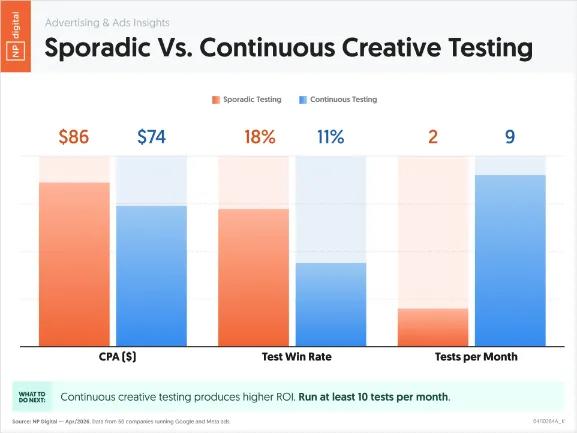
However, you only get the full value when testing happens consistently. Sporadic experiments may produce occasional winners, but they rarely create a reliable body of knowledge.
According to Neil Patel, continuous testing produces a higher return on investment (ROI).
We have seen this in our three-year partnership with Genomelink. We built a multi-format creative production and testing framework focused on conversion and growth. As part of that system, our team consistently produced more than 70 assets each month across 6 formats.
The main purpose was not to find one winning creative. We wanted to learn which angles, elements, and channels consistently led to higher conversions and lower acquisition costs. And through that well-tuned testing system, we reduced CAC costs by 77% over the partnership period.
Why Traditional Creative Testing Falls Short
Many marketers use creative testing to identify a winning ad, but their process does not explain what actually drove the result. That may support a short-term campaign goal, but it gives your team very little knowledge to reuse.
Short-term gains are good for specific campaign goals, but when you’re looking at a multi-million-dollar paid media budget, finding a winning creative for a Meta ad simply won’t cut it.
Let’s look at where and how creative testing fails:
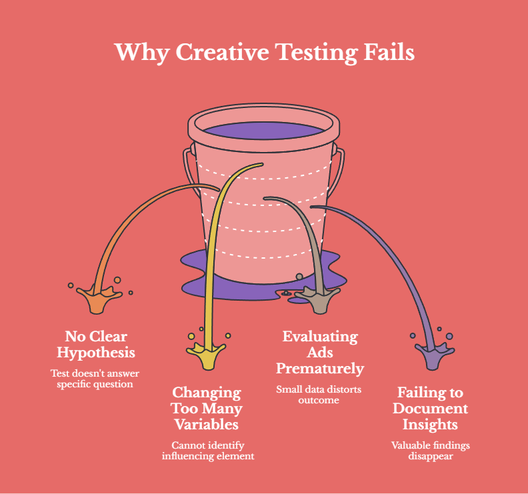
1. Testing Without a Clear Hypothesis
Every test should answer a specific question rather than compare several ads and see what happens.
Even Google’s own guidance for video experiments recommends starting with a clear hypothesis. The hypothesis should define what you expect to learn and influence the creative concepts you produce.
For example, “launch three customer videos” describes an activity, but it does not explain what you expect to learn.
A stronger hypothesis would be:
“Showing the product solving the customer’s main frustration within the first three seconds will increase qualified clicks from problem-aware shoppers.”
The hypothesis should guide the hook, message, format, and audience before the creative brief is finalized. Otherwise, your team may end up testing loosely connected ads and drawing conclusions that the experiment was never designed to support.
2. Changing Too Many Variables at Once
When the opening visual, creator, offer, headline, video length, and call-to-action all change, you cannot identify which element influenced the outcome.
At 9AM, we change only one variable at a time because simultaneous changes make the result difficult to interpret.
Several elements may have contributed to the outcome, or one may have driven most of the impact. The data cannot tell you which.
This doesn’t mean every experiment must be narrowly controlled. In the early stages, you can test very different creative concepts against each other. However, once you identify a promising direction, use A/B testing to isolate individual elements across your ad variations.
3. Evaluating Ads Before Enough Data Is Available
Early results can be misleading because a small number of purchases or high-value orders can distort the outcome.
For some Google Ads experiments, Google recommends running the test for at least 4 to 6 weeks and discarding the first 7 days of data to account for ramp-up.
Our team applies the same principle to paid social creative testing. We wait until the test has enough stable data before deciding which ad performed better.
4. Failing to Document and Reuse Creative Insights
Even valuable findings disappear when they remain inside dashboards, presentation decks, or Slack conversations. Teams then repeat failed experiments, revisit disproven assumptions, and brief new creators without the benefit of previous evidence.
We usually record the findings of each test in a searchable Airtable or Notion database, or in a dedicated creative intelligence platform. For each test, we document the hypothesis, variables, audience, asset links, results, confidence level, observations, and recommended next step.
This is also important for turning creative testing into a repeatable system rather than just scaling the winning ad. Even the latter approach has limits because at some point, the creative fatigue will set in. But if you have well-documented knowledge, you can apply it to the next set of creatives.
How To Build an Effective Creative Testing System
The best creative testing system, particularly for enterprise-level campaigns, starts with establishing goals, developing a solid hypothesis, creating a scalable workflow, and turning findings into repeatable assets that are destined to do well from the get-go.
The following framework can help you build one:
Step 1: Establish Clear Creative Testing Goals
Before your team develops a brief or produces an asset, define the decision the experiment must support. But don’t be vague.
A useful goal identifies the business outcome, funnel stage, test type, audience, and success criterion.
For example, a mobile app team could test whether demonstrating the product within the opening seconds produces more qualified installs among first-time prospects.
We recommend matching the goal to the customer’s position in the funnel:
| Funnel Stage | What You Are Trying to Learn | Useful Metrics |
|---|---|---|
| Awareness | Whether the creative captures attention and strengthens memory | Ad recall Awareness Consideration Purchase intent |
| Consideration | Whether the message encourages people to learn more | Qualified site visits Product exploration Search activity Buying intent |
| Action | Whether the creative drives a measurable business response | Purchases Leads Subscriptions Qualified installs |
| Retention | Whether the creative brings existing customers back | Repeat purchases Upgrades Renewals Reactivation |
Arla Foods provides a useful example of choosing an outcome that matched the campaign’s purpose. The company did not judge its native YouTube Shorts through views alone. They used Brand Lift studies to measure changes in awareness and ad recall
In one experiment, ad-recall lift increased from 3% with its business-as-usual approach to 9% after native Shorts were introduced. Across other tests, recall was two to four times higher than previous benchmarks, and the Shorts approach produced twice the awareness lift of the control setup.
Your objective should also determine the type of experiment you run:
- Exploration tests compare substantially different ideas when you do not yet know which message or creative direction deserves investment.
- Validation tests place a promising idea against a control to confirm that the initial result was repeatable.
- Optimization tests isolate smaller execution choices after the underlying direction has shown potential.
- Scaling tests determine whether the result holds when you increase reach, broaden the audience, or change the delivery conditions.
When you keep these purposes separate, it helps you interpret results more fairly. An ambitious concept may need refinement before it can outperform a heavily optimized control. An early win may also need further validation before you increase spend.
Step 2: Develop Testable Creative Hypotheses
A creative hypothesis turns an audience insight into a statement that can be supported or rejected by evidence. It should define what you are changing, why the change may matter, who you expect to respond, and which outcome will guide the next decision.
Each hypothesis should connect directly to the testing goal you defined in the previous step.
Here’s an example:
For first-time shoppers who worry that the product will not fit properly, showing three customers with different body types using the product within the first five seconds will increase product-page visits and buying intent compared with a lifestyle-only opening, without increasing acquisition cost.
This statement contains four essential components:
- Audience: Identifies whose behavior you expect to change.
- Message: Connects the test to a documented motivation, objection, or desired outcome.
- Treatment: Explains what the customer will see or hear.
- Expected outcome: Defines how you will evaluate the result.
Audience insight should shape the execution. Review how customers interact with current campaigns, where they lose interest, which objections appear repeatedly, and what previous tests have revealed.
This groundwork matters most during concept testing because you are comparing different persuasive ideas. You are not simply changing a color, headline, or opening line.
A footwear brand, for instance, might compare a comfort concept, a durability concept, and a personal-style concept. Once one direction shows promise, the team can create narrower creative variants that isolate the hook, creator, proof point, offer, or visual style.
New Look’s TikTok Catalog Ads experiment shows how a clear hypothesis creates an interpretable result. The retailer tested whether a carousel + video strategy could outperform its video-only control. The test treatment opened with a video and then allowed customers to browse several linked products in a carousel.
TikTok reports that the treatment generated 61% higher ROAS, a 32% higher conversion rate, and a 54% higher click-through rate than the control. The result supported a specific creative-and-commerce treatment; it did not prove that carousels will outperform videos for every retailer, audience, or campaign.
Before launching a hypothesis, we always check it against these five questions:
- Is it grounded in customer, behavioral, or historical evidence?
- Does it identify a meaningful creative difference?
- Can the expected outcome be measured?
- Is there a suitable control or comparison?
- Will either possible result change what the team does next?
That final question is critical. If your team would make the same decision whether the treatment wins or loses, the experiment is not worth consuming production time or budget.
Step 3: Choose the Right Creative Testing Framework
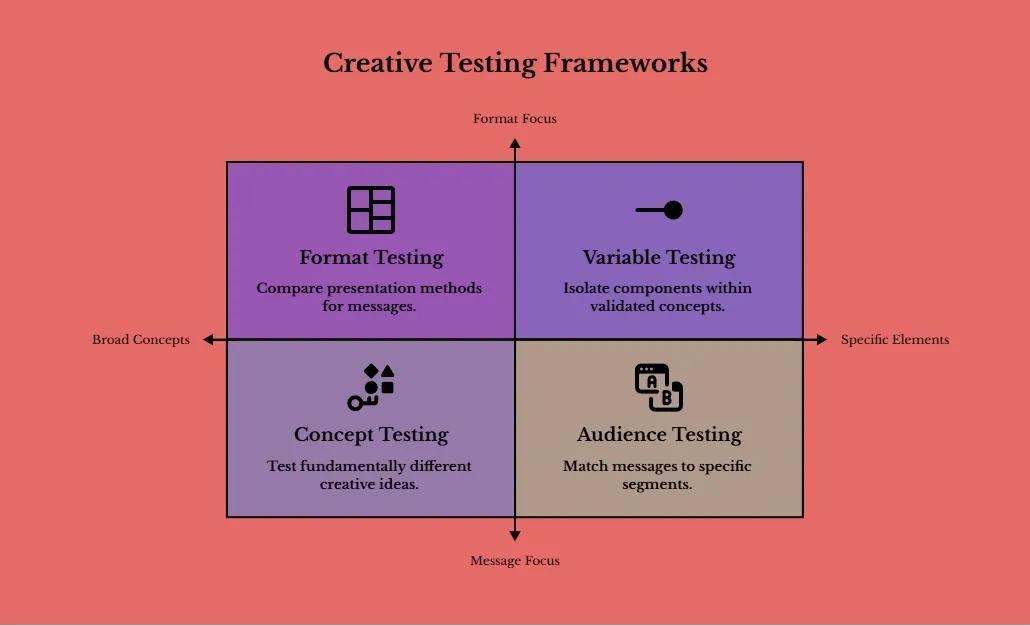
A useful framework matches the type of experiment to the question you need to answer. Without this classification, teams end up comparing fundamentally different ideas, minor execution changes, formats, and audiences in the same test, and then struggle to determine what caused the result.
For most creative strategists and advertisers, the following four types of creative testing provide distinct outcomes:
Concept-Level Testing
Concept-level testing compares fundamentally different creative ideas, messages, emotional angles, or value propositions. It can be suitable when the product or service has various benefits, and you want to find which one sticks the best.
For example, a meal-delivery brand might test convenience, cost savings, healthier eating, and family connection as separate concepts.
The purpose is to identify which broad direction resonates most strongly with the audience before investing in multiple executions. Because several elements may differ between treatments, this type of testing reveals which concept deserves further development. It doesn’t focus on individual elements or details.
Variable-Level Testing
Variable-level testing isolates one component within a promising concept, such as the opening hook, headline, creator, product demonstration, offer, proof point, visual treatment, or call-to-action. The remaining elements should stay as consistent as possible so you can attribute any meaningful change to the variable being tested.
This approach helps refine a validated idea and provides more precise guidance for future advertisements.
Format Testing
Format testing compares how the same central message performs across different creative formats, such as creator-led videos, product demonstrations, testimonials, static images, carousels, animations, and founder-led advertisements.
The audience, value proposition, and offer remain consistent (wherever possible). This allows you to determine whether the method of presentation, not a different message, is influencing attention, engagement, or purchasing behavior.
Audience-Message Testing
Audience-message testing examines which messages resonate with specific audience segments or levels of awareness.
The same product may appeal to different customers for different reasons. When you match distinct messages to documented audience needs, you can identify which combinations improve relevance and avoid relying on one generic ad for every prospect.
This, in turn, helps you target a specific audience with a creative ad that’s most likely to impact them.
Step 4: Build a Scalable Creative Production Workflow
A scalable workflow does not simply produce more advertisements. It produces clearly differentiated experiments on a predictable schedule, while preserving enough consistency for your team to interpret the results.
4.1 Create Structured Creative Briefs
Begin each production cycle with a structured brief. The brief should be short enough to use but specific enough to prevent writers, designers, and creators from interpreting the assignment in entirely different ways.
Include:
- The intended audience and funnel stage
- The customer evidence behind the idea
- The hypothesis being tested
- The test type (concept, variable, format, or audience insight)
- Specifics on what to test (like central message, product claim, offer, CTA, etc.)
- The elements that must remain constant
- The primary result and decision rule
- Mandatory brand, legal, and platform requirements
4.2 Use Modular Creative Production
Modular production lets your team reuse validated components without having to start from an empty timeline. Capture and organize interchangeable elements like opening hooks, customer statements, proof points, voiceovers, product close-ups, and feature explanations.
A single creator video session, for example, could produce five openings, three demonstrations, two proof sections, and two endings.
Those components may support several combinations, but that does not mean your team should assemble every possible version. Each variation should communicate a coherent idea and answer a specific testing question.
For example, suppose a skincare brand wants to test whether clinical proof or customer experience is more persuasive. The team can keep the creator, product demonstration, offer, and closing sequence constant while replacing only the proof module:
- Treatment A uses a dermatologist explanation.
- Treatment B uses before-and-after customer evidence.
- The control uses the existing product-benefit explanation.
After the proof direction is validated, the team can produce additional video edits that test its placement, length, or wording. This sequence generates more useful evidence than releasing 20 loosely related cuts at once.
4.3 Develop a Consistent Production Cadence and Quality Control
Set a recurring creative production schedule instead of requesting new assets only after performance begins to decline.
Your production cycle may run weekly, every two weeks, or monthly. What matters is that research, briefing, production, approval, launch, and analysis work as connected stages rather than separate requests.
Also, leave some capacity for urgent responses, seasonal opportunities, and unexpected declines.
In our creative team, we typically leave 10%-20% of production capacity uncommitted rather than scheduling every designer or editor at full utilization.
Most importantly, don’t let speed and volume hit quality. Every creative asset used in the experiment should meet established quality standards plus any other platform-specific requirements.
Quality control should cover:
- Message accuracy
- Product and pricing accuracy
- Brand consistency
- Audio clarity
- Caption accuracy
- Mobile readability
- Safe zones and aspect ratios
- Destination URL
- Tracking parameters
- Usage rights and expiration dates
- File naming and version status
4.4 Define Team Roles and Responsibilities
Scaling becomes difficult when everyone contributes, but nobody owns the handoff. Therefore, we suggest assigning one accountable owner to each stage:
| Role | Primary Responsibility |
|---|---|
| Creative strategist | Converts research into hypotheses and briefs |
| Media buyer | Defines platform conditions, budget requirements, and launch structure |
| Producer or project manager | Manages scope, schedule, dependencies, and approvals |
| Copywriter | Develops hooks, scripts, claims, and action prompts |
| Designer or editor | Converts the brief into platform-ready executions |
| Analyst | Validates tagging, analyzes outcomes, and documents findings |
| Brand or legal reviewer | Confirms that claims and executions meet required standards |
You can use workflow rules to handle administrative steps like:
- Creating tasks from approved briefs
- Notifying reviewers when a version is ready
- Flagging overdue approvals
- Updating statuses after sign-off
- Sending approved files to the asset library
- Recording the final delivery date
Plus, do not let the system automatically approve claims, determine whether two concepts are meaningfully different, or decide that an asset should be scaled solely because one early indicator improved. Human judgment remains necessary for strategic relevance, brand risk, customer sensitivity, and interpretation.
A completed workflow should produce more than a folder of approved assets. Each experiment package should contain the brief, asset versions, ownership records, approval history, launch details, and repository tags.
This record creates a clear link between the original audience insight, the creative execution, and the final result.
Step 5: Measure Everything for Contextual Understanding
Your primary metric tells you whether the test achieved its intended outcome. And supporting metrics help you understand why it succeeded or failed.
Review performance across the full customer journey rather than judging the creative through one isolated number.
- Attention metrics such as thumb-stop rate, hook rate, video hold rate, and average watch time show whether the advertisement earns and retains attention.
- Engagement and traffic metrics, including click-through rate, cost per click, landing page view rate, and engagement rate, reveal whether that attention translates into qualified interest.
- Conversion metrics like conversion rate, cost per acquisition, ROAS, and revenue per impression indicate whether the creative generates commercial value.
Keep the success metric you selected in Step 1 as the main measure for the experiment. Treat the remaining metrics as diagnostic signals that help explain the outcome.
For example, strong impressions and clicks followed by weak landing-page engagement may indicate a disconnect between the advertisement and the destination, while strong attention but poor conversion can point to weak proof, pricing, or offer communication.
Step 6: Maintain a Creative Learning Repository
To truly make your creative tests into a repeatable system, create a searchable repository that connects each hypothesis with its audience, control, creative variants, performance data, and final decision.
This is particularly beneficial for agencies that can lean back on that knowledge across different campaigns, platforms, and clients.
At 9AM, we document what changed, what remained constant, the primary metric, the result, and the recommended next action.
We also tag assets consistently by concept, message, format, creator, hook, audience segment, and outcome. This makes it much easier for strategists, analysts, media buyers, and product teams to find relevant insights before planning the next campaign.
Plus, our team preserves losing, inconclusive, and invalid experiments because they can expose weak messages, unsuitable formats, tracking problems, or ideas worth refining.
Over time, this repository helps prevent repeated mistakes and turns individual campaign results into reusable creative intelligence.
Creative Testing Solutions and Tools Marketers Prefer
Your first layer of ad creative testing should usually be the experimentation tools already available inside the media platforms where the advertisements will run. They use real delivery and behavioral outcomes, require little additional integration, and help you determine whether a treatment improves results under live auction conditions.
For instance, Google Ads Video Experiments supports a basic two-arm test in which the video creative is the sole variable, while its custom setup allows up to 10 experiment arms.
Depending on the campaign and account, you can evaluate measures such as click-through rate, conversion rate, cost per conversion, view rate, and Brand Lift.
In the paid social space, Meta Ads Manager provides native A/B testing that divides audiences into statistically comparable groups, helping you compare variables without relying on overlapping delivery.
You can use it to test creative, audiences, placements, or campaign approaches, while Meta Conversion Lift is better suited to determining whether advertising caused incremental action.
For high-cost campaigns, early concepts, or questions that native experiments can’t diagnose, consider one of the following dedicated creative testing tools.
1. Behavio
Behavio combines respondent research, randomized control trials, implicit-association methods, and AI-predicted attention heatmaps. It can test ideas, storyboards, text, static designs, audio, and completed videos.
It’s best for behavioral pre-testing before production or launch.
Behavio states that each standard creative test uses a unique representative sample of at least 500 respondents, while its attention model is trained on 20,000 eye-tracking experiments; published delivery options range from approximately three to seven days.
2. Kantar LINK+ and LINK AI
Kantar’s LINK suite is suited to organizations that need established research methods, cross-market norms, and diagnostic brand metrics alongside commercial-impact predictions.
LINK+ supports testing from early ideas and storyboards through finished television, digital, print, outdoor, influencer, and brand-experience work. On the other hand, LINK AI is intended for faster screening of high creative volumes.
LINK+ can return results in as few as six hours, and its marketplace solutions operate in more than 80 countries. This breadth makes it viable for global brands that need comparable standards across markets. However, it may be more research-intensive than a performance team needs for inexpensive weekly iterations.
2. Neurons AI
Neurons is designed for rapid predictive evaluation of advertisements before launch. Its AI capabilities analyze attention, engagement, memory, and the likely distribution of visual focus, producing heatmaps and creative diagnostics within seconds rather than requiring a conventional research field period.
This makes the platform useful when a team must screen many layouts, opening frames, product images, or campaign variants before selecting a smaller group for live testing.
Neurons says its models are powered by a large neuroscience database, but an AI prediction is still an estimate based on learned patterns, not proof that an advertisement will achieve a particular CPA or sales lift in your account.
In-House, Agency, or Hybrid: Which Creative Testing Model Works Best?
Continuous creative testing at scale requires resources, which your marketing or design team may or may not have. Generative AI has made testing relatively simple and faster, but as mentioned earlier, human oversight is absolutely essential for it to become a learning system.
You have three options for creative testing: having your team conduct it independently, outsourcing to an agency, or using a hybrid model in which internal teams and agencies share the work.
In-House Model
An in-house model works best when you have steady testing volume, strong internal expertise, and direct access to customer and campaign data. It offers faster collaboration, greater control, and better retention of creative insights, but it can become expensive or repetitive when specialist skills and outside perspectives are limited.
Agency-Supported Model
An agency-supported model is recommended if you need additional strategy, production capacity, research expertise, or access to specialized creators. It can expand your capabilities quickly.
However, it only works if the external team has access to enough data and insight into previous campaigns, briefs, measurement standards, and any learning repository.
In most cases, it makes sense to partner with a full-service agency that can also handle paid media and analytics, as these are intrinsically connected to creative testing.
Hybrid model
A hybrid agency model for creative testing provides the best balance. Your internal team can own customer research, priorities, measurement, and final decisions, while external partners support complex production, specialist research, or temporary capacity.
How Creative Testing Compounds Over Time
Creative testing compounds when every experiment improves the next decision. Customer research produces stronger hypotheses; controlled tests generate reliable performance data; and documented findings improve future briefs, creative performance, production priorities, and budget allocation.
Over time, this cycle gives you more than a collection of winning ads. You build a searchable understanding of which concepts, messages, formats, and audience combinations work under specific conditions.
Automation can accelerate variations, analysis, and feedback, but the advantage comes from applying what you learn throughout the campaign lifecycle.
This is something we’ve learned over the years here at 9AM.
As a data and testing-obsessed performance marketing agency, we’ve made creative testing a core part of our strategy and paid media apparatus. That’s because our focus is always to deliver the maximum impact at the lowest cost. And that doesn’t happen without experimenting with different creatives and audience segments.
If your marketing team needs expertise or just extra hands for creative testing, 9AM can help. Book a free creative testing strategy call.
FAQs
What are the different types of creative testing in marketing?
Creative testing in marketing measures which ads generate the best business results before scaling spend. The main types include A/B testing, multivariate testing, concept testing, message testing, visual testing, audience testing, placement testing, and offer testing.
What is the best Facebook ads creative testing strategy?
The best Facebook ads creative testing strategy tests one creative variable at a time while keeping audience, budget, placement, and optimization constant. Start with broad concept testing, then test headlines, primary text, images, videos, hooks, and calls to action. Scale only creatives that achieve a statistically meaningful improvement in ROAS, CPA, or conversion rate.
What are the best creative testing solutions?
The best creative testing solutions combine experimentation, automation, and performance measurement. The best starting point is the testing capabilities within ad platforms like Google Ads, Meta Ads, and TikTok Ads. For deeper, predictive analytics into creative performance, tools like Behavio, Kantar, and Neurons AI can be used.
How does 9AM test creative for paid social?
9AM team tests paid social creative through a structured framework that first validates broader concepts and then isolates specific variables before increasing ad spend. We typically begin with several creative angles, then compare hooks, visuals, messages, formats, and calls to action while keeping targeting and campaign settings as consistent as possible.
How to measure ad creative performance?
You can measure ad creative performance by tracking click-through rate (CTR), conversion rate, cost per acquisition (CPA), return on ad spend (ROAS), cost per click (CPC), engagement rate, video watch time, thumb-stop rate, and frequency (depending on format). Compare each creative against the same audience, budget, and attribution settings to identify which ones do better.