
CTR (Click-Through Rate) used to be the metric everyone watched first.
If people clicked, the ad looked like it was working. If they did not, you changed the headline, CTA, landing page, or audience targeting.
But in today’s feed-first world, a CTR you don’t interpret in context can hide the bigger problem.
Your video ad can show up in Meta Ads, TikTok, YouTube Shorts, Reels placements, or LinkedIn video and still get scrolled past before you even get to the point.
This matters because short-form video is now where a lot of marketing attention goes. HubSpot’s 2026 data shows that short-form video is the most used media format by marketers, with 49% ranking it as the top ROI-driving content format.
So, yes, CTR still matters. It shows whether someone cared enough to act on your message.
But hook rate answers the earlier question: Did they stop long enough to see/ understand that message?
This is why measurement needs to go beyond clicks. At 9AM, we help you build stronger marketing measurement frameworks that connect early creative signals with clicks, conversions, attribution, and revenue.
In this blog, we’ll cover:
- What hook rate means and how it differs from the thumb stop ratio
- Why CTR still matters, but cannot explain the full creative performance story
- How hook rate, hold rate, completion rate, conversion rates, and CPA work together
- How to measure hook rates across Meta Ads, TikTok Ads Manager, YouTube Ads, and Reels placements
- How to improve hook rate without creating clickbait
- How to use hook variants, A/B testing, and creative analysis to improve your creative strategy
So, let’s get started.
TL;DR: What You Can Learn From This Article
If you only have a few seconds, below’s the gist of it (though we promise, you can find lots of useful, in-depth information below).
- CTR shows click intent, but hook rate shows whether the creative earned attention first.
- Hook rate is most useful when interpreted in the context of metrics like hold rate, CTR, conversions, CPA, and revenue.
- Meta, TikTok, YouTube, LinkedIn, and other organic social platforms measure early attention differently.
- Strong hooks qualify the right viewer instead of chasing empty attention.
- The first few seconds should make the audience, problem, or outcome clear.
- High hook rate does not always mean strong performance if hold rate or conversions drop.
- Creative testing works best when you change one hook variable at a time.
- The best teams treat hook rate as part of creative analysis, not a standalone success metric.
What Is the Hook Rate?
The hook rate measures the percentage of people who keep watching after the first few seconds of a video ad or creative impression.
In simple terms, it tells you whether your opening actually stopped the scroll.
For Meta Ads, hook rate is mostly calculated using 3-second video views:
So if your video gets 10,000 impressions and 2,500 three-second video views, your hook rate is 25%.
Hook Rate vs Thumbstop Rate
Both metrics point to the same idea: your creative has to win the first few seconds before the rest of the message can do its job.
However, expert marketers understand the nuance between them:
The thumbstop ratio focuses on the behavior. It asks whether someone stopped scrolling. Hook rate, on the other hand, focuses more on the creative mechanism. It asks whether the first frame, opening line, motion, visual contrast, or on-screen prompt earned attention.
The CTR Is No Longer the First Signal That Matters
CTR became the default because it matched how the older web (and traditional marketing) worked.
Users had more control over the path.
- A search ad answered a query.
- An email CTA reached someone who had already subscribed.
- A display banner appeared beside the content someone had chosen to read.
- A website link appeared while someone was already exploring a topic.
So CTR made sense as a first signal. The user had already entered the journey.
That logic becomes weaker inside TikTok, Instagram Reels, YouTube Shorts, LinkedIn video, Meta Ads, and other ad platforms where people move through content quickly.
There, the click is no longer the starting point.
Today’s Marketing Happens Inside Attention Feeds
In social feeds, users are filtering.
And you are competing inside extremely crowded spaces. Facebook reports 200 million companies are on the platform. This means every impression is hard-earned. Over 90% of businesses in general use social media to connect with their followers.
So, your video ad appears between creators, memes, news, friends, product demos, user-generated content, AI video ads, and platform-native posts.
This makes the opening seconds critical. If the first frame, first line, or on-screen prompt does not feel relevant, the viewer moves on before the offer appears.
Remember: A strong CTA or landing page cannot fix a creative that gets skipped before the message starts. But monitoring your hook rates diligently helps you catch this problem early.
The Attention Funnel Comes Before The Conversion Funnel
The old question was: Did they click?
The better question now is: Did the right audience stop long enough to care?
This shift matters because people do not move straight from impression to conversion. The path usually looks more like this:
Impression > stop > watch > understand > research some more > believe > click > convert > retain
Each stage tells you something different.
- If people do not stop, the opening needs work.
- If they stop but leave quickly, the payoff is weak.
- If they watch but do not click, the offer or CTA may need clarity.
- If they click but do not convert, the issue may be audience fit, landing page quality, or offer strength.
So CTR still has a role, but it should not be the first signal you rely on for video-led creative performance.
The Shift From Click Optimization to Attention Optimization
Performance marketing used to be more click-led. You optimized keywords, improved ad copy, increased CTR, lowered CPC, tested landing pages, and scaled what converted.
As we explained above, this still matters. But in feed-first channels, a click comes after a more basic win: attention.
The Old Performance Marketing Model
The older model was built around improving what happened after someone showed intent.
You tracked:
- Keyword performance
- Ad copy quality
- CTR
- CPC
- Landing page conversion
- CPA, CAC payback periods, or ROAS
If CTR dropped, you reviewed the headline or CTA. If conversion rates dropped, you reviewed the landing page or offer.
This process still works for search and high-intent campaigns. But for Meta Ads, TikTok, Reels placements, YouTube Shorts, and other feed-based formats, it can miss the first creative problem: Did the viewer stop long enough for the message to matter?
The New Creative Performance Model
The newer model starts with the opening.
You test hook variants, measure early attention, review hold rate, study completion rate, and check where video viewers drop off. Then you connect that creative analysis to CTR, CPA, CAC, pipeline, or revenue.
This makes your creative analysis more useful.
You can see which hook earned attention, which message kept people watching, which proof created trust, and which CTA moved them forward.
TikTok’s own ad guidance reflects this shift. It recommends introducing the content proposition in the first 3 seconds and prioritizing the hook in the first 6 seconds.
In fact, TikTok has also reported that 90% of ad recall impact is captured within the first 6 seconds.
Why This Shift Matters Now
Feeds move fast, and creative fatigue can show up quickly.
This means your creative strategy needs regular A/B testing, fresh hook variants, and smart creative revisions. The same opening may work for a few days, then lose strength as audience engagement drops.
Ad platforms are also more automated. Meta says Advantage+ sales campaigns use AI to optimize creative, targeting, placements, and budget.
So your creative now carries more of the targeting work.
A broad ad set or lookalike audience can help distribution, but the hook tells the platform and the viewer who the message is for. If the opening is too broad, you may attract the wrong attention. And if it is too vague, the right buyers may scroll before they understand the offer.
This is why attention optimization now comes before click optimization.
Hook Rate vs CTR: The Practical Difference
Hook rate and CTR answer different questions.
Hook rate tells you whether the opening made someone pause. And CTR tells you whether the message made someone act.
So, you should not interpret either metric without proper context. A strong video ad needs to get noticed first, hold attention long enough for the message to land, and give the right viewer a clear reason to click.
Here’s the practical difference between the most important marketing metrics:
Creative Performance Metrics: What Each Signal Really Means
| Metric | What It Measures | Best Used For | Limitation |
|---|---|---|---|
| Hook rate | First few seconds of attention | Diagnosing creative openings | Can reward clickbait if read alone |
| Hold rate | Continued attention after the hook | Measuring message relevance and pacing | Does not prove buying intent |
| CTR | Click behavior | Measuring action intent | Misses people who watched but did not click |
| CVR | Post-click conversion | Judging landing page and offer effectiveness | Ignores what happened before the click |
| CPA/CAC | Acquisition efficiency | Measuring business performance | Comes too late for early creative diagnosis |
| ROAS/LTV | Revenue impact | Making scaling decisions | Requires enough clean data to read properly |
How to Measure Hook Rate Across Channels
Hook rate is not measured the same way everywhere.
Meta Ads Manager, TikTok Ads Manager, YouTube Ads, Reels placements, LinkedIn, and websites all give you different signals. So instead of forcing one universal benchmark across every channel, we recommend comparing each channel against its own behavior.
Start with the platform definition, then compare your results by format, placement, audience, and campaign objective.
Meta ads
For Meta Ads, hook rate is usually calculated with 3-second video plays and impressions.
Meta defines 3-second video plays as the number of times your video played for at least three seconds, or nearly its full length if the video is shorter than three seconds.
Meta Ads Manager does not always show hook rate as a default column, so you may need to create it as a custom metric. Meta’s own setup path is simple: go to Ads Manager, select Columns, choose Customize columns, then select Create custom metric.
Once you have the metric, do not read it alone. Compare the hook rate with the metrics we mentioned above.
You should also segment it by placement. A video ad in Instagram feed may behave differently from the same creative in Reels placements, Facebook feed, or Audience Network. One ad set can also hide useful differences if the placements are mixed together.
Use benchmarks only as a starting point. Published hook rate ranges usually treat 25% to 30% as solid, 30% to 40% as good, and 40%+ as very strong on Meta. But your own account history is usually more useful because it reflects your audience, offer, format, and creative style.
Meta Hook Rate Benchmarks
| Meta Hook Rate | What It Usually Suggests |
|---|---|
| Below 15% | The opening frame or first second is not stopping the scroll. |
| 15% to 24% | The hook likely needs work before you judge deeper funnel metrics. |
| 25% to 30% | A workable baseline for many accounts. |
| 30% to 39% | Strong early interest. The ad is getting enough time for the message to land. |
| 40%+ | Excellent early interest. Still validate with hold rate, CTR, CPA, and ROAS. |
Insider tip: Do not scale or kill a Meta campaign based on hook rate alone. A high hook rate can still fail if the hold rate drops, CTR is weak, or conversions do not follow.
TikTok ads
TikTok hook rate needs a slightly different read because TikTok Ads Manager gives you several early-view signals.
Start with 2-second video views for a quick hook check. TikTok defines this as the number of times your video starts playing for at least 2 seconds in an impression session.
For deeper creative analysis, also review 6-second video views, focused views, average play time, and video views at 100%.
Pro tip: In our daily practice, we have noticed that 2-second views are useful for testing the opening, but they do not tell the full story. To understand whether the message held attention, compare them with 6-second views, average play time, and completion metrics.
Also, watch TikTok trends carefully. A trend can help your video feel native to the feed, but it should not replace message clarity. If the trend attracts the wrong viewers, the hook rate may look good while CTR, conversion rates, or CPA still struggle.
TikTok Hook Rate Benchmarks
| TikTok Hook Rate | What It Usually Suggests |
|---|---|
| Less than 20% | The opening visual, audio, or movement may be too generic. |
| 20% to 29% | The hook is getting some attention, but the opening likely needs sharper movement, audio, or audience relevance. |
| 30% to 35% | Solid early interest for many accounts. |
| 35% to 40% | Strong hook performance. |
| 40%+ | Excellent, but still needs validation through CTR and conversions. |
Note: Use this table as a directional guide. Your best benchmark is still your own TikTok Ads Manager history across audience, format, offer, and creative style.
Read Next: TikTok Ads vs Meta Ads: How to Brief Differently for Each Platform
YouTube, LinkedIn, and Organic Social
YouTube, LinkedIn, and organic social do not always give you a clean hook rate metric, the way Meta Ads Manager or TikTok Ads Manager might.
So here, you need to read early attention through behavior.
Look at:
- Retention
- Average watch duration
- Replays
- Drop-off points
- Video views
- Comments
- Saves
- Profile visits
- Engagement quality
- Assisted pipeline signals
Review the first 1 to 3 seconds separately. This is where you can see whether the opening frame, first line, text overlay, or visual movement gave people a reason to keep watching.
From what we have seen, B2B content typically creates value before it creates a click. Someone may watch, save, comment, visit your profile, search your brand later, or bring it up in a sales conversation before they ever click.
Therefore, hook rate should be read in the context of audience quality, rather than raw volume alone.
So:
- Look for patterns in videos with a stronger completion rate, saves, comments, or replays. If an organic post keeps the right people watching, treat it as an input for paid creative testing.
- Pull the winning hook, format, angle, or first-frame idea into your next Meta Ads, TikTok, or YouTube Ads test.
How to Improve Hook Rate Without Creating Clickbait
Remember: a better hook does not have to be louder. It has to be more relevant.
Your goal is to make the right person pause, understand why the message matters, and keep watching long enough to reach the offer.
Below, we have shared a few ways to do that without turning your creative into clickbait:
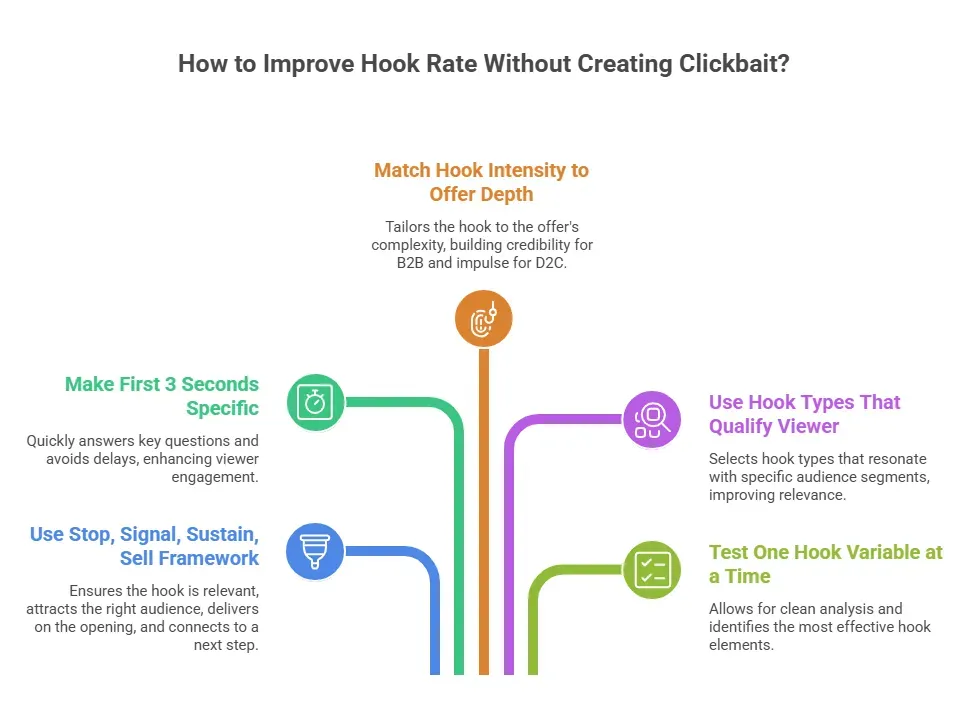
1. Use the Stop, Signal, Sustain, Sell Framework
Use this simple framework when reviewing hook variants:
- Stop: Create the pause with a strong first frame, motion, contrast, pain-point recognition, or a direct audience callout.
- Signal: Show who the video is for so you attract the right viewers instead of broad, low-quality attention.
- Sustain: Deliver on the opening with proof, examples, contrast, or a clear story.
- Sell: Connect the idea to a next step and make the CTA specific.
For example, a weak hook might say:
“Want better ad performance?”
A stronger version would be:
“Your Meta Ads may not have a targeting problem. They may have a first-three-seconds problem.”
This hook works harder because it creates a pause, signals the audience, introduces a clear problem, and sets up the rest of the video to explain what to fix.
If your hook stops people but does not signal the right audience, you may get attention that never turns into CTR, conversion rates, or revenue. A strong hook should pull in the right people and set up the rest of the video ad to do its job.
2. Make The First 3 Seconds Specific
Once the hook idea is clear, tighten the execution.
Cut anything that delays the point. Avoid any kind of long setup, logo-first intro, slow product reveal, or generic opening line.
Your first 3 seconds should answer one of these quickly:
- Who is this for?
- What problem are we talking about?
- What outcome should the viewer expect?
- Why should they keep watching?
Pro tip: We suggest using on-screen prompts when the spoken line needs support. For example, if the creator says, “This is why your ads are getting clicks but no sales,” the text overlay can say:
High CTR, low conversions? Check the hook.
This gives the viewer context even with the sound off and makes the opening easier to understand.
Read Next: The Rise of Micro-Moments: Capturing Intent in a 3-Second World
3. Match Hook Intensity to Offer Depth
Not every offer needs the same kind of hook.
High-intensity hooks can work well for impulse products, where the buyer needs a quick reason to care. But B2B and high-consideration offers need credibility much faster.
For complex offers, curiosity alone is not enough. Your hook should signal expertise, context, or a sharp problem the buyer already recognizes.
Someone may respond to urgency as part of a DTC messaging ladder:
“This serum sold out twice for a reason.”
A B2B buyer usually needs a more specific reason to trust you:
“Your paid social problem may not be targeting. It may be creative fatigue showing up before CTR drops.”
This matters even more in B2B. LinkedIn’s 95-5 rule says 95% of potential buyers are not ready to buy today. So your hook needs to build memory and trust before it drives an immediate click.
The deeper the offer, the more your hook needs to prove that the rest of the message is worth their time.
4. Use Hook Types That Qualify the Right Viewer
A strong hook should help the right viewer recognize themselves fast. Different hook types do that in different ways.
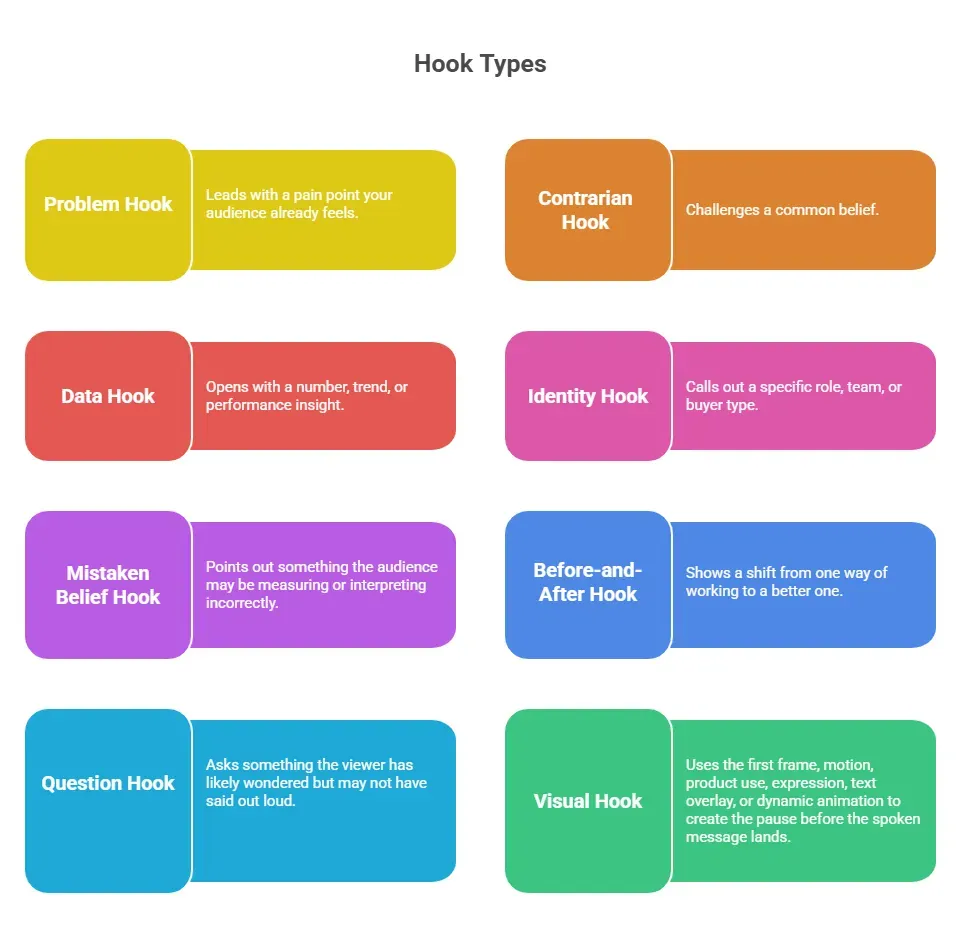
- Problem hook: Leads with a pain point your audience already feels. This works well when the buyer knows something is wrong but may not know the cause.
For example, for National Debt Relief, we used a problem hook built around debt stress instead of leading with the offer. The opening shows someone overwhelmed by bills, with the line “she hasn’t slept in weeks because of debt stress.” It works because the pain is clear before the solution appears.
- Contrarian hook: Challenges a common belief. Use this when you want to interrupt familiar thinking and make the viewer reconsider.
- Data hook: Opens with a number, trend, or performance insight. This works when your audience responds to proof or wants a sharper reason to pay attention.
- Identity hook: Calls out a specific role, team, or buyer type. This helps filter broad audiences and attract the people the message is actually for.
- Mistaken belief hook: Points out something the audience may be measuring or interpreting incorrectly. This works well for educational or thought-leadership content.
- Before-and-after hook: Shows a shift from one way of working to a better one. Use this when you want to make a change feel clear and practical.
Here’s a perfect example of an ad our team created for HiSmile using a similar before-and-after pattern.
- Question hook: Asks something the viewer has likely wondered but may not have said out loud. This works when the question creates instant relevance.
- Visual hook: Uses the first frame, motion, product use, expression, text overlay, or dynamic animation to create the pause before the spoken message lands.
The best hook type depends on the viewer’s awareness level. Cold audiences typically need a clear problem or identity signal. Whereas warmer audiences may respond better to proof, contrast, or a sharper point of view.
5. Test One Hook Variable at a Time
In our daily practice, we test one hook variable at a time because it keeps creative analysis clean. This means changing the first line, first frame, visual format, speaker, problem angle, audience callout, proof point, or CTA placement while keeping the offer and audience stable.
If you change everything at once, you will not know what actually improved the hook rate.
Rotate hook variants one at a time, whether you are testing user-generated content, AI video ads, product footage, or dynamic animation. This makes creative revisions easier and gives your team a cleaner creative testing framework.
A Better Way to Diagnose Creative Performance
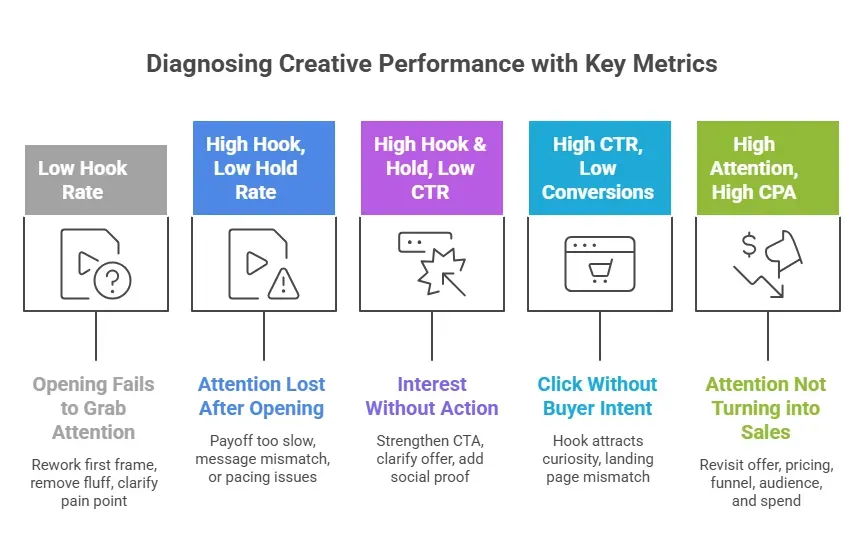
Metrics are only useful when they tell you what to fix next. Based on our experience working with different clients, we have learned that the cleanest read comes from looking at hook rate, hold rate, CTR, conversions, and CPA together.
If the Hook Rate is Low
Your opening is not creating a pause. Rework the first frame, remove intro fluff, make the pain point clearer, test a stronger audience callout, use sharper contrast or motion, and bring the outcome earlier.
If the Hook Rate is High, But the Hold Rate is Low
This means the opening got attention, but the content did not hold it. The payoff may be too slow, the message may not match the hook, or the video may need tighter pacing.
If Hook and Hold are High, But CTR is Low
People are interested, but they may not see a clear next step. This is a signal to strengthen your CTA, clarify the offer, and bring social proof or product proof earlier.
If CTR is High, But Conversions are Low
The click is happening, but buyer intent may be weak. Check whether your hook is attracting curiosity instead of buyers, and make sure your landing page matches the ad promise.
If CPA is High Despite Strong Attention Metrics
This signals that attention is not turning into commercial intent. In this case, we recommend revisiting the offer, pricing, funnel, audience quality, and where your ad spend is going before scaling the video ad.
The Future: From CTR-First Marketing to Attention-Led Growth
As ad platforms automate more targeting decisions, creative has to carry clearer signals. Broad audiences need hooks that tell both the viewer and the platform who the message is for. Vague hooks create vague signals. Strong hooks help the right people self-select before you spend more budget trying to find them.
The best marketing teams will think like editors and performance analysts at the same time.
This is why hook libraries, first-frame testing, opening-line analysis, creative scorecards, attention benchmarks, creative fatigue monitoring, and post-click quality checks will become part of normal creative operations.
The old question was, “Which ad got the most clicks?” The better question is, “Which idea earned the right attention and moved the right people forward?”
Turn Hook Rate into Revenue Clarity with 9AM
If you want a clearer way to read creative performance, our team at 9AM can help you turn early attention signals into decisions your team can actually use. We connect creative analysis, attribution, and revenue data so you can see which ads deserve more budget and which need another round of testing.
Ready to see where your creative is winning or leaking performance? Book your strategy call!
FAQs
Is the hook rate better than CTR?
Not always. Hook rate is better for diagnosing whether your opening stopped the scroll. CTR is better for measuring whether the message, offer, and CTA created click intent. You can use the hook rate to fix the first few seconds and CTR to judge whether the ad gave people a reason to act.
What is a good hook rate?
A good hook rate depends on the platform, format, audience, placement, and campaign objective. For Meta Ads, 25% to 30% is often a workable baseline, 30% to 39% is strong, and 40%+ is excellent. For TikTok, 30% to 35% is usually solid, while 40%+ is strong, but TikTok hook rates can look higher because the platform uses a shorter 2-second view metric.
But remember, your most important benchmark is still your own account history by ad set, creative type, audience, and offer.
What are the 7 types of hooks?
The 7 common hook types are:
- Problem hook: Leads with a pain point
- Contrarian hook: Challenges a common belief
- Data hook: Opens with a number or insight
- Identity hook: Calls out a specific audience
- Mistaken belief hook: Corrects a wrong assumption
- Before-and-after hook: Shows a clear shift
- Question hook: Asks something the viewer already cares about
A visual hook can support any of these through the first frame, motion, product use, expression, or text overlay.
What are the hook rate and hold rate?
Hook rate shows how many people stayed through the first few seconds of a video. Hold rate, on the other hand, shows how many of those early viewers kept watching after the hook. A high hook rate with a low hold rate usually means the opening worked, but the payoff, pacing, or message did not hold attention.
How to calculate hook rate and hold rate?
For Meta Ads, hook rate is commonly calculated as:
Hook rate = 3-second video views ÷ impressions × 100
Example: 2,500 three-second video views ÷ 10,000 impressions × 100 = 25%
Hold rate can be calculated as:
Hold rate = 15-second video views ÷ 3-second video views × 100
Example: 1,000 fifteen-second views ÷ 2,500 three-second views × 100 = 40%
How does 9AM help brands use hook rate?
At 9AM, we help you connect the hook rate with hold rate, CTR, conversion rates, CPA, ROAS, and revenue. This makes it easier for you to see whether the creative problem is happening in the opening, the message, the CTA, or the post-click funnel.
Can 9AM build dashboards for the hook rate and creative performance?
Yes. At 9AM, we build custom dashboards that track early attention, creative performance, attribution, and revenue in one place. This is useful when your team is running Meta Ads, TikTok ads, YouTube Ads, or cross-channel campaigns.
Appendix
- https://newmediaservices.com.au/how-many-businesses-use-social-media
- https://ai.meta.com/ai-for-good/datasets/small-business-surveys/
- https://www.hubspot.com/marketing-statistics
- https://ads.tiktok.com/help/article/creative-best-practices
- https://ads.tiktok.com/business/en/blog/creative-best-practices-top-performing-ads
- https://www.facebook.com/business/ads/meta-advantage-plus/sales-campaigns
- https://www.facebook.com/business/help/743427195703387
- https://www.facebook.com/business/help/698045821051774
- https://ads.tiktok.com/help/article/video-play
- https://business.linkedin.com/advertise/resources/b2b-institute/b2b-research/trends/95-5-rule