

Direct-to-consumer (DTC) brands compete in an environment where attention disappears in seconds. A shopper may discover a product through a social ad, click through to a landing page, skim the page, and leave before a brand ever has the chance to communicate real value.
This lack of attention translates directly into lost revenue. Nearly 70% of shoppers leave their cart without completing a purchase.
For DTC brands, this challenge is even greater. Unlike brands that sell to retailers, DTC companies engage with customers directly and only receive revenue when customers actually buy.
Sure, the DTC model can offer higher margins and stronger customer relationships. But those benefits only appear when brands successfully guide shoppers from initial interest to purchase.
That’s where messaging ladders come in.
A structured DTC messaging strategy helps turn brief attention into meaningful engagement and, ultimately, conversions. In this guide, we’ll explain how messaging ladders work and how brands can use them to move shoppers from skim to buy.
We’ll cover:
- Why a structured messaging strategy is essential for DTC brands
- Understanding the ecommerce journey from quick skim to purchase
- Five messaging approaches that drive higher conversions in DTC
- How effective messaging adapts across different marketing channels
P.S. Are shoppers clicking your ads but leaving before they buy? 9AM helps DTC brands build high-converting messaging and performance campaigns that turn attention into revenue. Book a free strategy call now.
Why DTC Brands Need Strategic Messaging
For many modern DTC brands, growth doesn’t fail because of weak products or a lack of traffic. Instead, it fails because the brand messaging across ads, product pages, and landing pages doesn’t guide customers to a clear decision.
If messaging is unclear or inconsistent, even strong DTC brands lose potential revenue before a shopper ever reaches checkout. Here’s why you need a detailed brand and campaign messaging strategy.
Shoppers Move Quickly Across Product Pages and Ads
E-commerce browsing behavior is built around speed. A shopper might see a product recommendation from influencers on Instagram or TikTok, click to go to a website, look at more pictures, and decide within seconds that they don’t want it.
In our experience working with DTC teams, this is where many brands lose potential customers. The first few lines of conversion copy must communicate value instantly. Without a strong creative strategy, traffic from paid growth campaigns, marketplaces, or content marketing can disappear quickly.
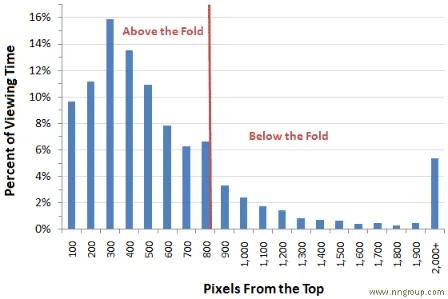
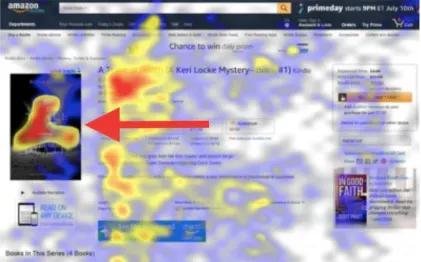
The chart below shows how most users focus their attention on the top part of a page. Engagement drops significantly as visitors scroll below the fold.
Decision-Making Happens in Layers
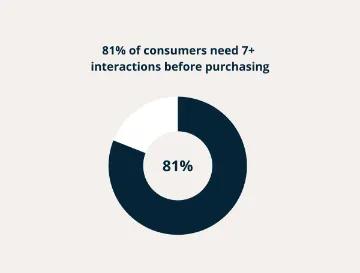
Buying decisions rarely happen in a single moment. Instead, shoppers build confidence through multiple layers of messaging during the customer journey.
This layered process explains why audience segmentation and customer data play a critical role in DTC marketing. If you understand your target market, you can deliver more relevant messaging at each stage of the funnel.
Messaging Ladders Reduce Cognitive Load and Increase Clarity
One of the biggest mistakes conversion copywriters see in e-commerce is message overload. A page tries to communicate everything at once: product features, discounts, brand story, social proof, guarantees, and delivery promises.
When this happens, shoppers experience cognitive friction.
Messaging ladders solve this problem. They organize information into a clear sequence that matches how people process information online. The next sections explain how this structure works and how DTC brands apply it. (We’ll cover all this in next sections)
The “Skim to Buy” Journey in DTC E-commerce
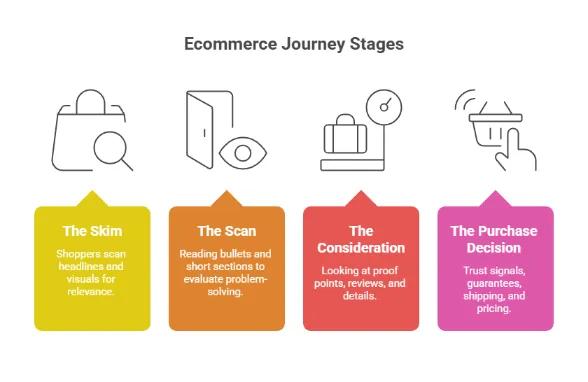
The key to successful DTC marketing, particularly messaging, is understanding how shoppers actually read and process information online. Most visitors do not land on a page and read everything carefully. Instead, they move through a predictable behavioral pattern.
This pattern shapes how brand messaging, website copy, and content should be structured on product pages, landing pages, and broader marketing funnels.
Below is the four-stage “Skim to Buy” journey that most ecommerce shoppers follow.
Stage 1 - The Skim
The first interaction a customer has with a brand may last only a few seconds. They may encounter the product through search ads, influencer recommendations on social media, or content marketing.
At this stage, the shopper is not evaluating details. They are asking a simple question:
“Is this relevant to me?”
At this stage, you have to capture attention and, ideally, hold it to move them to the next stage. This depends on the creatives you’re using, the message or value you’re offering, and, to some extent, how they’ve come upon that message (a user actively searching for a similar product would obviously be more interested).
Stage 2 - The Scan
Once the shopper clicks through to a landing page or product page, they begin scanning the layout.
Instead of reading paragraphs, they look for visual anchors such as:
- Headlines and subheads
- Product images
- Bullet points summarizing benefits
- Price and shipping information
- Trust badges or reviews
This scanning behavior explains why conversion copywriting must focus on clarity and hierarchy.
Based on our experience, tools such as Hotjar, Microsoft Clarity, and Crazy Egg can help you visualize where users actually scan and click. Heatmaps mostly show that users focus heavily on benefit sections and social proof instead of long descriptions.
Stage 3 - The Consideration
If the messaging remains clear, the shopper begins a deeper evaluation. At this stage, they want answers to questions such as:
- Does this product actually solve my problem?
- Can I trust this brand?
- Are other customers satisfied?
This is where storytelling, reviews, and data-driven messaging become important.
Data shows how fragile this decision phase can be. According to Baymard Institute, the average e-commerce cart abandonment rate is around 70.19%.
Even when interest exists, unclear messaging or missing reassurance can interrupt the purchase process.
Stage 4 - The Purchase Decision
The final stage is when the shopper is nearly convinced but still evaluating risk. At this point, the messaging should address common friction points: delivery speed, return policies, guarantees, and payment flexibility.
This is where you highlight faster delivery promises, satisfaction guarantees, easy returns, and loyalty programs.
When these reassurance elements are clearly presented, shoppers are far more likely to move from consideration to purchase.
DTC Messaging Strategy: 5 Types of High-Converting Messaging
Now that you understand the consumer pattern in e-commerce, the next step is structuring your brand messaging to match that behavior. This is where messaging ladders become operational.
Below, we have shared the five types of messaging that consistently drive conversions for DTC brands.
1. Pattern Interrupt (Stop the Scroll)
The first job of messaging is simply to capture attention. In most digital advertising environments, your message competes with hundreds of other posts, ads, and recommendations.
This is why creative direction and messaging must work together. A strong pattern interrupt disrupts scrolling behavior and signals relevance to the target market.
Effective pattern interrupts can include:
- Unexpected statistics
- Bold claims
- Visual contrast
- Problem-focused headlines
- Strong audience identification
For example, the cookware DTC brand Our Place used messaging like:
“The Always Pan replaces 8 pieces of cookware.”
This single line quickly communicates a clear value proposition while creating curiosity.
2. Core Benefit
After capturing attention, your messaging must immediately communicate the primary benefit of the product.
Many e-commerce pages fail here by focusing on features instead of outcomes. However, shoppers are typically interested in results rather than specifications (at least not this early in the consideration stage).
For example:
Feature-focused messaging: “Contains vitamin C and hyaluronic acid.”
vs.
Benefit-focused messaging: “Brighter skin in 2 weeks with dermatologist-backed ingredients.”
The second message communicates a clear outcome, which makes it more compelling during the early stages of evaluation.
Also, successful DTC brands present benefits clearly because they know shoppers are scanning quickly. Research from the Nielsen Norman Group shows that users read web pages in an F-shaped scanning pattern. This research is old but still very much relevant. Consumers prioritize headlines and short summaries rather than long blocks of text.
From what we have seen across ecommerce product pages, clear benefit framing improves engagement quickly.
High-performing product pages usually include:
- A strong benefit-focused headline
- Three to five scannable value points
- Short supporting descriptions that explain the outcome
3. Problem-Solution Framing
Once the shopper understands the benefit, the messaging should clarify why the product matters.
This is where storytelling and problem framing become powerful. Instead of simply describing a product, the message positions the product as a clear solution to a specific pain point.
For example:
A sustainable apparel brand might frame the problem like this:
“Most athletic wear is made from synthetic materials that shed microplastics into the ocean.”
The solution then follows:
“Our performance fabrics are made from recycled, eco-friendly materials designed to reduce environmental impact.”
This type of narrative helps strengthen brand positioning and differentiate the product in a crowded market.
DTC brands in North America, a highly competitive market, also reinforce this message through content marketing, blog posts, and educational resources.
Our client, Hurom, a cold-press juicer brand, established itself as the solution for easily incorporating fresh produce into busy schedules through juicing. It did so through well-researched, problem-focused content on its blog and social media accounts.
This ad from our Hurom campaign shows how problem-focused messaging connects product value with a clear everyday benefit.

4. Proof and Credibility
Even if a product sounds promising, most shoppers still want evidence before buying.
Trust signals are a critical layer in the messaging ladder. These signals show that other customers have already experienced positive outcomes.
BrightLocal’s consumer review survey found that 97% of consumers read online reviews. The company’s CEO, Myles Anderson, explains it well:
“Reviews are stable, sticky, and more important than ever.”
Common proof elements used by DTC brands include:
- Verified customer reviews
- Before-and-after images
- Influencer testimonials
- Press mentions in media outlets
- Certifications or clinical data
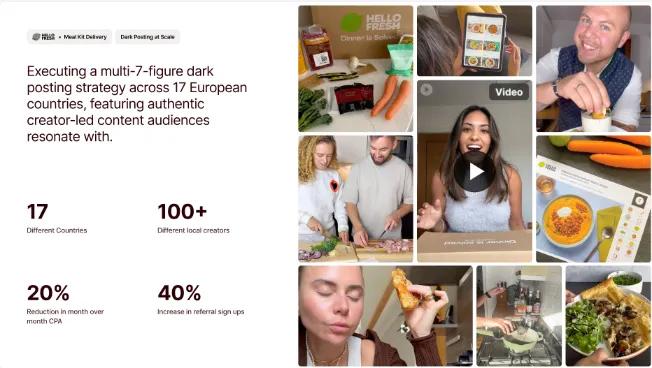
Our personal favorite is influencer and UGC-based testimonials. These work super well at resonating with audiences, particularly UGC. At 9AM, we’ve incorporated these into the broader marketing strategy for DTC brands like HelloFresh.
5. Risk Reversal
The final layer of the messaging ladder addresses the biggest remaining barrier: purchase anxiety.
Even when shoppers believe the product might work, they may hesitate due to uncertainty about product quality, shipping reliability, return policies, and price justification.
Risk reversal messaging reduces this friction by reassuring the buyer. Common examples include:
- 30-100 day money-back guarantees
- Free returns or exchanges
- Faster delivery promises
- Secure checkout messaging
- Subscription flexibility (cancel anytime)
How DTC Messaging Works Across Different Channels
DTC messaging doesn’t live in one place. That’s why you need to use multiple channels to meet your customers where they are and walk them through the funnel.
That said, brand messaging must remain consistent across every touchpoint in the customer journey.
This is where integrated messaging and a well-defined digital marketing strategy become essential. When the same core message flows across social ads, organic content, websites, and email campaigns, the shopper moves more smoothly through the marketing funnel.
So let’s talk about the most important ones for DTC brands:
Paid Ads (Search, Social + Programmatic)
Paid ads are the entry point for many DTC brands. These can include Google Search and Shopping, Meta ads (Instagram and Facebook), TikTok advertising, and programmatic display networks.
At this stage, the message must capture attention quickly while communicating the core benefit.
Effective ad messaging usually follows a three-step structure:
- Hook: A pattern interrupt that stops scrolling.
- Benefit: A clear outcome that the customer wants.
- Curiosity trigger: A reason to click and learn more.
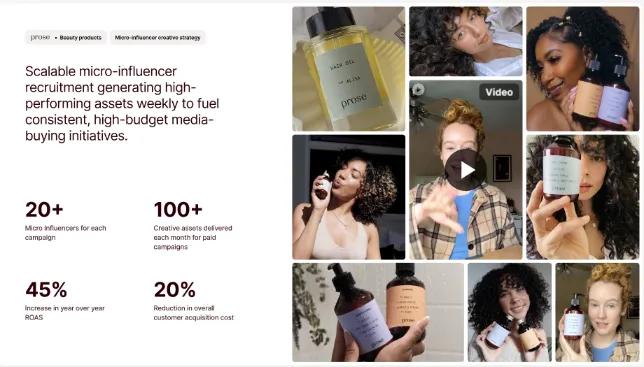
For example, in a campaign for Prose, we ran paid social ads using UGC from micro influencers. The content opened with a strong hook and quickly introduced the benefits of the personalized haircare products. This structure helped increase campaign ROAS by 45%.
Landing Pages
When a shopper clicks an ad, blog, or affiliate link, the landing page must immediately continue the same narrative.
A common mistake in DTC marketing is sending paid traffic to generic pages that don’t match the original ad message. When the messaging changes abruptly, visitors bounce.
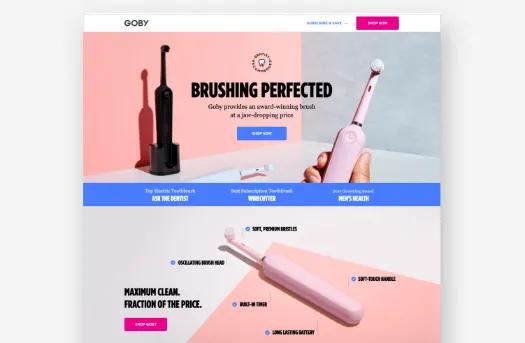
Instead, effective landing pages mirror the structure of messaging ladders:
- Hook: Reinforce the promise made in the ad (in a header)
- Benefit: Clearly explain what the product does.
- Problem framing: Show why the product matters.
- Proof and credibility: Reviews, testimonials, influencer endorsements.
- Call to action (CTA): Guide the visitor toward purchase.
Product Pages
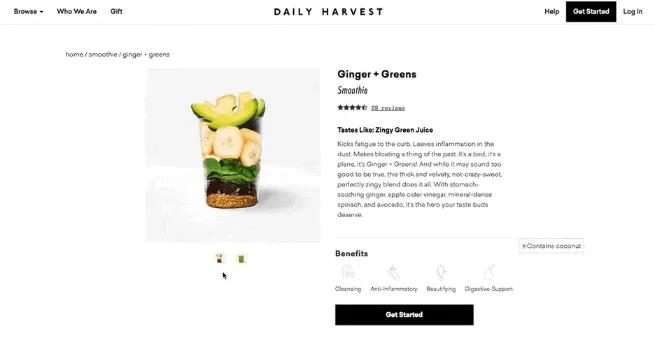
For most e-commerce stores, product pages are where the purchase decision actually happens. They need to be optimized and built upon the message delivered in ads, social media posts, or emails without overloading.
High-performing product pages typically follow a messaging ladder like this:
- Headline: Communicate the core value proposition.
- Key benefits: Present three to five scannable advantages.
- Product details: Explain features, materials, or specifications.
- Proof: Reviews, ratings, UGC.
- Reassurance: Shipping speed, guarantees, and easy returns.
It’s important to present all this information in a way that’s easy to read and skim through. Use bold text, symbols, and images to convey information more readily.
Email Marketing
Email remains one of the best-performing channels in DTC marketing. It can deliver an average return of $36 for every $1 spent.
In the DTC messaging strategy, email plays a unique role: it nurtures interest after the initial visit.
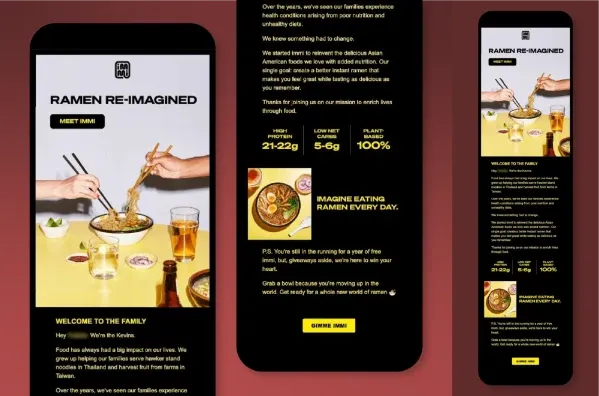
In our experience working with DTC brands, email flows often follow a simple structure:
- Curiosity-driven subject line: Encourages the recipient to open the message.
- Benefit reminder: Reinforces why the product matters.
- Storytelling or social proof: Customer testimonials, influencer experiences, or brand narrative.
- CTA: Direct link back to the product page or offer.
In addition to promoting the product or service, email marketing can also be great for retargeting and retention. You can use automated email flows for welcome sequences, abandoned cart reminders, post-purchase follow-ups, and loyalty programs.
Win DTC Marketing with 9AM
For DTC brands, clear and structured brand messaging can make a big difference. Messaging ladders help guide the customer journey from quick skimming to confident purchasing by presenting the right information at the right moment.
We have noticed that many brands struggle with this step across DTC campaigns. Ads capture attention, but the message loses clarity across landing pages, product pages, and follow-up channels.
This is where our team at 9AM helps. We work with DTC brands to align creative strategy, UGC, and performance media so the message stays clear across the entire customer journey.
If you want messaging that turns attention into real revenue, book a free strategy call and let’s review your current campaigns together.
FAQs
What is a DTC strategy?
A direct-to-consumer (DTC) strategy is when a brand sells its products directly to customers without relying on traditional retail intermediaries. This approach allows companies to control brand messaging, pricing, and the entire customer journey across channels like landing pages, ecommerce stores, and social media.
What are some marketing strategies for DTC brands?
Common DTC marketing strategies include digital advertising, content marketing, influencer collaborations, and email-driven retention campaigns. Many DTC brands also rely on strong conversion copywriting, optimized product pages, and data-driven audience segmentation to improve conversions.
What is the best marketing channel for a DTC brand?
DTC brands see strong performance from social media advertising, search ads, email marketing, and influencer marketing, particularly when messaging remains consistent across channels. The most effective approach is to test channels within a structured paid growth strategy and scale the ones that generate the highest conversions.
How important is storytelling for DTC marketing?
Storytelling plays a major role in helping a brand differentiate in a crowded market and communicate its positioning clearly. When messaging connects a product to a real problem or customer experience, shoppers are more likely to trust the brand and continue through the customer journey.
How does 9AM help DTC companies?
9AM helps you develop integrated growth strategies that connect branding, messaging, and performance marketing. We support companies through digital strategy, creative development, paid growth campaigns, and data-driven optimization
Does 9AM offer brand strategy?
Yes, 9AM can create a full brand strategy, including positioning, messaging frameworks, and go-to-market planning. We can define the target audience, clarify the brand narrative, and create consistent messaging across digital advertising, content, and media relations.