


Scaling marketing spend without compromising efficiency is the single hardest challenge for modern growth leaders.
The pressure to capture market share is intense, yet aggressive scaling often triggers a silent killer: a massive spike in customer acquisition cost (CAC) across all your marketing channels.
In fact, industry data shows that customer acquisition costs rose by approximately 60% over the five years leading up to 2024. This surge punishes brands that prioritize volume over unit economics. That said, you cannot afford to treat efficiency and volume as opposing forces.
The tension between aggressive growth and gross margin protection is manageable, but only if you implement guardrail metrics.
These benchmarks act as an early warning system, alerting teams the moment acquisition efficiency starts to erode. When used correctly, guardrails help you scale revenue without scaling losses.
P.S.: Need support scaling paid media without letting CAC spiral? 9AM helps you build guardrail-led paid media systems that protect efficiency while budgets scale. From channel strategy to creative testing, we focus on sustainable, profitable growth. Book a free strategy call with us now!
TL;DR
- Unchecked marketing spend often destroys unit economics before you can secure early wins.
- Growth hacking tactics that work at the seed stage often fail at scale. Strategically framing safe fail limits is the only way to protect your margins.
- Customer acquisition costs have increased by 60% over the past 5 years. This makes strict decision rules non-negotiable for survival.
- Real scaling requires disciplined execution to avoid bleeding cash.
What Are Guardrail Metrics in Paid Media?
Like strict budget thresholds, guardrails are secondary metrics. These protect business health while you chase growth. Unlike North Star metrics, they prevent vanity victories where volume spikes cost per acquisition.
Think of guardrails as enforced boundaries. They signal when incremental spend starts degrading unit economics, even if top-line results look strong. This allows you to scale with discipline rather than reacting after profitability has already eroded.
You can use modern analytics platforms, tools like Amplitude, to safeguard lifetime value during conversion rate optimization. Just connect conversion metrics to long-term behavioural metrics like retention and LTV. This ensures your brand awareness efforts don’t compromise long-term customer retention and value.
To learn about how best to go about scaling paid media, watch this video:
Why Do You Need Guardrail Metrics When Scaling Paid Media?
Scaling paid ads without guardrails is dangerous. Research shows that 37% of budgets are wasted on blind spots. Without clear boundaries, campaigns can look successful on the surface while quietly eroding profitability.
Guardrail metrics exist to prevent this. To ensure solvency, you need a 3:1 lifetime value to CAC ratio. Without this discipline, incremental spend typically attracts lower-quality customers, which weakens margins and extends payback periods.
We see that optimizing for single metrics usually cannibalizes funnel fixes. Plus, without decision rules, customer acquisition costs spike as you increase marketing spend. This destroys gross margin.
Why CAC Spikes When You Scale Paid Media Spend (and How to Avoid It)
Scaling paid media budgets almost always introduces new efficiency challenges. From what we’ve seen across multiple accounts, customer acquisition costs rise not because campaigns suddenly break, but because scaling pushes spend into less efficient parts of the auction.
Here is exactly why customer acquisition cost increases and how to stop it.
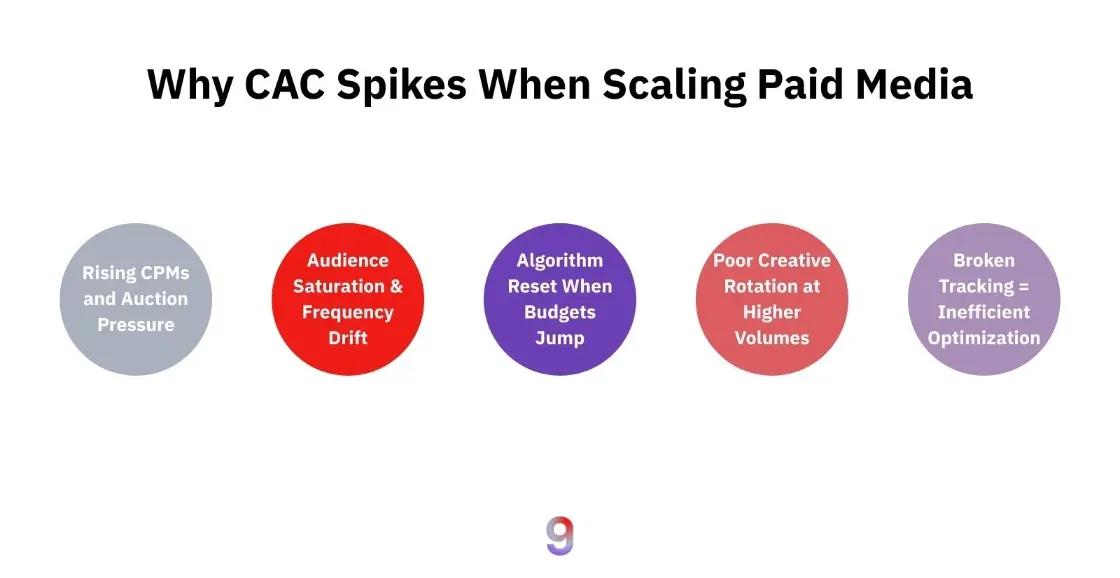
1. Rising CPMs and Auction Pressure
As you increase marketing spend, you naturally exhaust "easy" inventory and enter highly competitive auctions due to diminishing marginal returns.
During peak periods like Q4, paid ads (e.g., Facebook Ads) CPMs frequently spike due to increased advertiser demand competing for limited ad inventory.
In our day-to-day work, we’ve observed that many teams lose control of CAC here. Algorithms optimize for delivery, instead of profitability, and as spend rises, they will happily pay higher prices to maintain volume.
Insider tip: When scaling, switch from auto-bidding to bid or cost caps. This forces efficiency. A strict cost cap prevents the algorithm from wasting budget on expensive, low-intent auctions
Avoid this by segmenting budgets to avoid dumping all capital into a single high-pressure bid pool. You can navigate these dynamics by diversifying your bid strategies to maintain market share without overpaying.
2. Audience Saturation & Frequency Drift
Your efficiency metrics will collapse if you repeatedly hit the same users. This is audience saturation, and it can be considered a silent tax on your marketing spend.
Insider tip: Consider using automated rules to pause an ad set when your frequency is too high. This forces a cycle of creative testing to refresh the feed before fatigue destroys your campaign's profitability.
Once your ad frequency crosses a certain point, say four, the cost per acquisition skyrockets because your users just tune out.
Data from AdEspresso paints a similar picture. When the frequency hits nine, CPC increases by over 160%.
To protect your acquisition channels, we suggest using strict frequency caps. Because without them, you are paying premium rates to effectively annoy your bottom-funnel demand.
3. Algorithm Reset When Budgets Jump
Scaling paid media requires patience. We have noticed that aggressive budget jumps are one of the fastest ways to destabilize performance. If you double your marketing spend overnight, you’ll just shock the algorithm.
On platforms like Meta ads, large budget increases can reset the learning phase. When that happens, the system effectively loses its recent optimization signals and has to relearn how to find high-intent users. The result is almost always a short-term spike in customer acquisition cost.
In practice, budget increases larger than 20% are the most common trigger for this reset
Remember that paid ads respond best to stability rather than volatility. That’s why you need smart budget thresholds built into your decision rules.
Stick to a stair-step method: here, only bump spending by, say, 10–15% every few days. This keeps your acquisition channels steady and efficient while you grow volume.
4. Poor Creative Rotation at Higher Volumes
As you increase marketing spend, ad frequency rises and results decay. While you double down on old winners, you also need aggressive testing.
Otherwise, customer acquisition costs spike. In fact, CPA can increase by over 20% once ad fatigue sets in.
To combat this, monitor your creative cycles. If new creative permutations aren't hitting your win-rate goals, pause scaling immediately. You need fresh wins to keep your paid ads efficient.
5. Broken Tracking = Inefficient Optimization
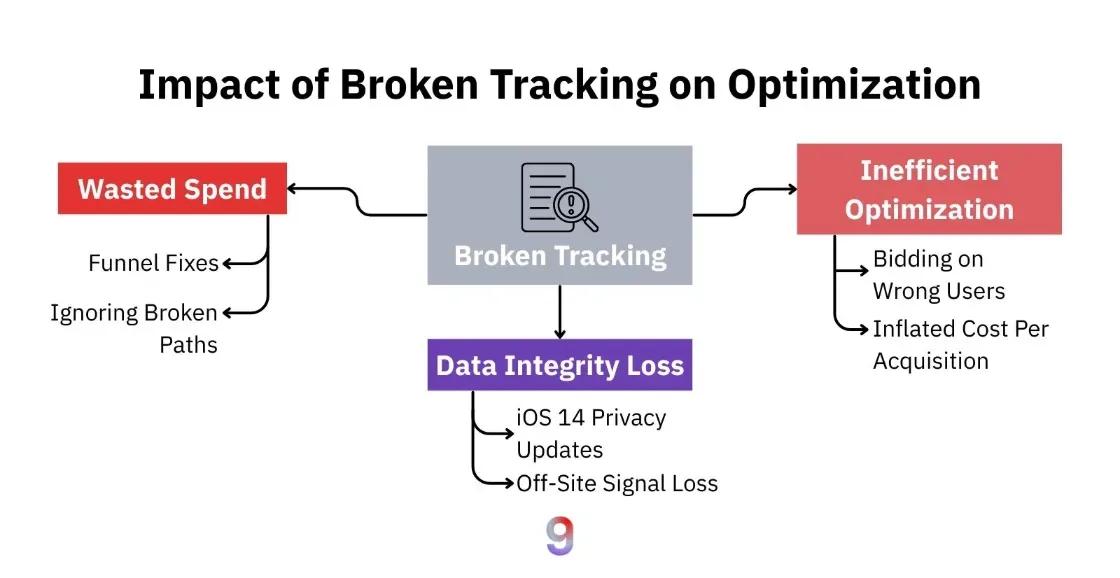
You cannot optimize what you cannot see. And when data integrity breaks, you end up bidding on the wrong users, which artificially inflates your cost per acquisition.
Signal loss, accelerated by privacy updates like iOS 14, has created significant blind spots for advertisers. Ad platforms usually end up optimizing for clicks instead of revenue.
In fact, research published in Marketing Science found that losing off-site signal data increased the median cost per incremental customer by 31%.
This inaccurate data can lead to wasted spend on funnel fixes that aren't actually broken, or even worse: ignoring broken paths that are bleeding revenue.
Leading global market research company, Forrester, estimates that 21% of marketing budgets are wasted entirely due to poor data quality.
If you have advanced teams, it’s worth considering moving raw data into a central data warehouse. Alternatively, you can look at second-party data partnerships where you share data with a trusted partner to enrich your audiences and regain signal loss.
That’s not all. To protect your conversion rate optimization efforts, we recommend auditing your pixel and server-side tracking regularly (say, weekly) to maintain data integrity between your ad platform and CRM.
Attribution Problems That Inflate CAC During Paid Media Scaling
Relying on last-click attribution when scaling paid media won’t work because platforms like Meta and Google often over-claim credit, while signal loss from privacy updates creates false negatives when tracking conversions.
These make your customer acquisition appear more expensive than it actually is.
From what we’ve seen across different teams, the biggest mistake is treating any single attribution view as the source of truth. Last-click models obscure the contribution of upper- and mid-funnel activity, which can lead teams to pull spend from channels that are quietly driving incremental demand.
To counter this, we use a triangulated approach that combines three perspectives:
- Multi-Touch Attribution (MTA) for user journeys,
- Marketing Mix Modeling (MMM) for holistic channel impact, and
- Blended metrics like MER (Marketing Efficiency Ratio).
If you don’t cross-reference these, you risk cutting high-performing acquisition channels simply because they don’t claim the last click.
How to Choose Guardrail Metrics Based on Funnel Stage
You must align your metrics with the user journey to avoid optimizing for the wrong outcome. This will help you scale effectively.
| Funnel Stage | Guardrail | Description |
|---|---|---|
| TOFU | CPM CTR Scroll depth | Protect brand awareness integrity by monitoring CPM and scroll depth via tools like Hotjar and Microsoft Clarity. |
| MOFU | CPC Cost per engaged visitor | Validate interest by tracking cost per engaged visitor before users ever enter your onboarding sequences. |
| BOFU | CAC ROAS | Enforce strict customer acquisition cost caps to profitably capture your bottom-funnel demand. |
| N/A | LTV Churn rate | Watch both of these to ensure you are not filling leaks. |
3 Essential Guardrail Metrics for Protecting CAC
Now let’s explore the specific metrics you must monitor to ensure your growth remains efficient.
1. User Engagement & Traffic Quality
To be honest, high traffic volume with low engagement signals wasted spend. You must track your bounce rate and average session duration to ensure traffic quality matches your marketing spend.
Insider tip: When diagnosing engagement issues, don’t just look at your landing page. Ensure you check your checkout optimization flow drop-off points. If you see users bounce after the cart, it’s either a pricing or user experience issue. Traffic quality is not the problem in this case.
For B2B sites, the average bounce rate ranges between 25% to 65%. If you find your scaling efforts push this above 70%, you are likely buying irrelevant clicks.
That’s why we recommend segmenting engagement by traffic source in Google Analytics 4 to isolate underperforming traffic sources immediately.
2. Retention & Lifetime Value (LTV)
Acquisition only works if customers stick around. In our experience, early churn, typically within the first 30 days, is one of the clearest indicators that scaling efforts are attracting the wrong users. If new customers drop off quickly, early CAC “wins” rarely translate into sustainable growth.
This risk is even higher today. With customer acquisition costs having surged 60% in the last five years, you can’t afford to churn and burn. We’ve learned that long-term profitability almost always comes from retaining fewer, higher-quality customers rather than endlessly acquiring new ones.
Insider tip: Compare the lifetime value of new cohorts against historical benchmarks to monitor performance for early intervention.
3. Ad Performance & Creative Fatigue
Lastly, you’ve got to strictly monitor your frequency caps because if you allow creative ad fatigue to set in, it will drag down your ROAS.
We recommend treating frequency as a potential leading indicator of rising costs. For instance, if your frequency on brand keywords or prospecting audiences is excessive, your costs will rise.
That’s why implementing strict limits ensures your creative cycles remain efficient (and fresh). Knowing these metrics is the first step. And implementing them, the second.
Creative Volume Requirements for Safe Paid Media Scaling
To sustain high marketing spend, you need a relentless pipeline of creative testing.
Specific rules and benchmarks for your creative pipeline will vary based on your campaign goals, audience size, and platform.
That said, we recommend producing new creative permutations weekly for every set amount of money for sustained performance.
Pro tip: Static image variations typically outperform video for rapid testing (because they’re more cost-effective, can be created quickly, and instantly deliver messages). Based on this, we recommend avoiding overproducing concepts and instead making simple tweaks to stabilize performance.
Cross-Channel Guardrail Coordination
The truth is: your acquisition channels do not exist in a vacuum. For instance, increasing your marketing spend on Meta, in addition to concurrent marketing campaigns, can drive a measurable lift in your brand keywords on Google.
So if you judge top-of-funnel channels like YouTube solely by direct cost per acquisition, you risk cutting the brand awareness fuel that could lower costs elsewhere.
To prevent this, we suggest monitoring your blended CAC alongside platform-specific metrics using marketing attribution software like Northbeam or Triple Whale.
Key Steps to Follow When Scaling Paid Media With Guardrail Metrics
You need a disciplined workflow when implementing these guardrails. Follow these top five steps to build a safety net for your scaling efforts.
Step 1: Define Your Primary Scaling Goal & Potential Risks
While you need a singular North Star metric, usually revenue or ROAS, you also need to map your worst-case scenario.
It’s vital to explicitly define what failure looks like to you (e.g., seeing CAC doubling) before increasing marketing spend.
Shockingly, only 39.2% of marketers actually track whether their work drives real business outcomes. Without clear guardrails, you’re just guessing. And you risk becoming part of this grim statistic.

Step 2: Select Your Guardrail Metrics & Set Thresholds
Here, you need to use a paired metric strategy. For every volume metric (e.g., leads), pair it with an efficiency metric (e.g., cost per lead). And set strict decision rules such as, “If CPM rises by 20%, we’ll pause scaling.”
Pick a max of 2–3 budget thresholds to avoid analysis paralysis. You can rely on context transfer from historical data to help you set realistic baselines. This ensures you don’t kill campaigns that are having a slow day, for example.
Next, you’re going to establish how to track these numbers in real-time.
Step 3: Establish Real-Time Monitoring & Reporting
Weekly reporting is too slow for scaling paid media aggressively. Without the ability to spot potential issues or jump on opportunities, you risk bleeding your budget.
The solution is setting up automated Slack or email alerts for breached thresholds. You can use tools like Supermetrics to push data directly into Slack channels.
Set rules to tag the specific media buyer responsible so they can be notified and react promptly.
Step 4: Integrate with Your Experimentation Framework
You need to be able to shut down any test when necessary. So before launching any A/B testing, your team must clearly define its criteria for success and failure.
Insider tip: Similar to a shared experimentation roadmap, your team should log every failed test in a central database. Knowing what doesn’t work can help you avoid spending your marketing resources on the same mistakes.
To achieve this, consider maintaining a shared experimentation roadmap where every test serves a specific learning goal. If a test breaches its guardrail, don’t be afraid to hit the kill switch.
Step 5: Leverage Dashboards for Holistic Views
Next, build a central dashboard. Tools like Looker or Tableau can be used to visualize cross-channel data. It can serve as your team’s source of truth for aligning your stakeholder map.
Seeing your guardrails and data in real-time turns raw marketing data into a competitive advantage. Plus, it ensures that everyone from the C-suite to the junior buyer sees the same picture.
Need to see a dashboard in action? This video by AdRoll shows how to achieve similar holistic views on their advertising platform.
How to Adapt Your Strategy When Scaling Paid Media
When your guardrail metrics flash red, it’s time to act. Passively observing during a scaling print will burn through your marketing spend and destroy your gross margin.
Here’s what to do when this happens.
1. Interpret Warning Signals: Pause, Pivot, or Persevere
You can use a "Pause, Pivot, or Persevere" decision matrix to take feelings out of the chaos of scaling.
- Pause: If unit economics (e.g., LTV:CAC) break the hard floor, stop spending immediately.
- Pivot: If engagement drops but costs remain stable, consider rotating your creative(s) or audience segments.
- Persevere: If costs rise slightly but remain within the budget thresholds you set in Step 2, hold the line. It could just be volatility.
2. Diagnose Root Cause of Issues
Once you pause or pivot, you must isolate the variable causing the failure. Ask yourself: Is it a creative, technical, or audience issue?
- Technical: Always check the site speed first. According to Instant, a mere 1-second delay in page load time can cause a 7% reduction in conversions.
- Creative: Check if your frequency has crossed a certain threshold. If it has, it may signal ad fatigue.
- Audience: Look for overlap between ad sets that might be driving up your internal competition.
Insider tip: It can be easy to blame the algorithm when the root cause is actually a specific area. In this situation, we recommend checking a report that shows you a breakdown by region. You’ll be able to identify if a state or country has an excessive CPA compared to the rest. Then, you can exclude that region and resume scaling.
3. Make Strategic Adjustments to Optimize Campaigns
Once you identify the leak, it’s time to apply specific funnel fixes.
If brand awareness is high but conversion is low, for instance, your offer may be stale. That’s a sign to refresh it.
But if your creative cycles are burning out too fast, you need to expand your lookalike audiences to lower the frequency.
Making changes can deliver massive returns. Take our client, Hurom, for example. By optimizing targeting and creative through full-funnel paid media architecture, we achieved a 70% reduction in CPA for them. Plus, they scaled revenue 4X times.
Here’s what our client had to say.

Advanced Paid Media Optimization Strategies to Scale Without Spiking CAC
Scaling paid media is not something you set up and forget. To maintain market share without bleeding cash, you must be proactive.
Let’s explore how:
1. Predict CAC Risk Early with Proactive Analytics
Marketing teams reacting only after a metric breaks is a common pitfall. You need to avoid this. To do so, be proactive and consider what could break and why. This can help you forecast cost per acquisition spikes before they happen.
If you have access to historical data, we recommend using regression models in Excel or Google Sheets to forecast seasonal CPM spikes. This allows you to adjust budget thresholds in advance.
For instance, instead of waiting for the fourth quarter to wreck your efficiency, build a predictive model based on historical data.
Also consider using AI-driven predictive analytics. Research shows that firms using this improve their ROI by 30% compared to those using traditional methods.
2. Segment Performance to Uncover Hidden CAC Inefficiencies
Averages can give you an idea of what’s going on. But you need granular data for truthful insights. For example, a stable aggregate customer acquisition cost can hide issues in a specific segment.
You must analyze performance by device, OS, and time of day to see things clearly. Early wins on mobile, for instance, can evaporate at scale. This is because mobile conversion rates typically lag behind desktop.
To mitigate this, we recommend strategically framing your reports. Avoid just presenting CPA at face value; break it down by device for a clearer picture.
Next, consider automation.
3. Automate Bids with Dynamic Thresholds
Manual optimization is too slow for modern auctions. So you should use custom scripts to automatically adjust bids based on your decision rules.
Look for automated rules in Meta or Google Ads (depending on the platform you’re using). Then, set it to cut ad spend if a guardrail is breached.
In this instance, automation is about controlling costs. It can reduce marketing overhead by 12.2%. This frees up your budget for more creative experiments (if you choose to do so).
But what are the best automated rules in Google Ads? You may find this video quite helpful.
4. Use Guardrails to Inform Strategy
Remember that every failed test can help you refine future guardrails; that’s if you use them well. To achieve this, conduct post-mortems on every guardrail breach.
That experimentation roadmap mentioned earlier? You’ll update it with your learnings.
Was the threshold too tight? Was the context transfer from previous campaigns mislead the team? These are questions worth asking.
Companies that achieve this level of data maturity are significantly more likely to report robust revenue growth. According to SAP, mature data organizations are almost twice as likely to see revenue growth from data-driven insights.
The ROI of Guardrails: How They Reduce CAC and Protect Profit at Scale
When you stop bleeding cash on inefficient ad spend, you effectively lower your blended customer acquisition cost. This frees up capital to reinvest in winning strategies.
Quantify How Guardrails Prevent Wasted Ad Spend
Marketers estimate they waste 26% of their budgets on ineffective channels and strategies. This eats into your gross margin.
Assume your scale-up spending is $10k/month. That’s $120,000/year. And $31.2k incinerated annually.
To mitigate this, calculate the cost of not checking your ad spend. If a two-week unchecked marketing spend spike increases your CPA by $50 across 1,000 conversions, you have lost $50k.
By using decision rules to catch that spike in 24 hours, you save $47k.
This strategic framing shifts the conversation from slowing down to protecting profit. Which finance professional would disagree with that?
Improve LTV and Retention Through Quality Acquisition
Acquiring customers who are a good fit is important for protecting lifetime value. Unfortunately, aggressive scaling mostly brings in low-intent users who churn quickly.
In our daily practice, we avoid this by linking your acquisition channels to long-term retention data. Tracking how customers from each channel behave over time makes it easier to confirm whether growth is genuinely compounding value or simply inflating short-term volume.
Research from Bain & Company supports this. Their Prescription for Cutting Costs report shows that a 5% increase in customer retention can increase profits by 25% to 95%.
You can validate this by tagging every new customer with their acquisition source in your CRM. Notice a specific ad channel bringing in users churning faster than the average? Investigate (and consider cutting it).

Use Guardrails to Scale Aggressively Without Margin Risk
Pursuing sustainable growth beats growing at all costs. And when you frame guardrails as something that gives you a competitive advantage, it enables you to bid aggressively (and without fear).
This confidence allows you to capture market share while your competitors hesitate.
Also, advanced analytics are a key differentiator. According to Bain & Company, companies with advanced analytics are two times more likely to have top-quartile performance.
So incorporate them to help you perform better with precise targeting and real-time performance management when scaling paid media.
Scale Paid Media Profitably with 9AM
Scaling aggressively shouldn't mean scaling blindly. To win in competitive online shopping and B2B markets, you need a media buyer who’s also a strategic partner. You need someone who acts as your fractional CMO.
At 9AM, we help teams make smarter decisions around marketing spend, acquisition channels, and scaling thresholds.
Our role goes beyond execution. We operate as an extension of your leadership team, bringing a fractional CMO mindset to paid media strategy.
Contact 9AM today to scale your paid media without any stress.
Frequently Asked Questions
1. What are guardrail metrics in paid media scaling?
Guardrail metrics are safety limits (like specific budget thresholds) set to protect profitability while you scale volume. Unlike North Star metrics, which measure growth, guardrails prevent negative side effects. This ensures you don't waste marketing spend acquiring low-quality leads.
2. How are guardrail metrics different from counter metrics?
Counter metrics specifically measure what you don't want to happen (e.g., increased unsubscribes from aggressive email marketing). Guardrails are broader operational limits (e.g., "Pause if CPA > $50"). While similar, guardrails are proactive triggers, whereas counter metrics are often reactive checks.
3. How do you set effective guardrail metrics?
Start by analyzing historical marketing data to find your break-even point. Then, use context transfer from previous successful campaigns to set realistic baselines. If your profitable CPA is $40, for instance, set a guardrail at $45 to allow for testing volatility without risking deep losses.
4. What are the best guardrail metrics for B2B?
For B2B, focus on lead quality guardrails. Track referral programs and organic sources separately, and set limits on cost per sales qualified opportunity in addition to leads. If lead volume rises but the volume for cost per sales qualified opportunity stays flat, your guardrail should trigger a strategy review.
5. Which guardrail metrics work best for Meta Ads?
The best guardrail metrics for Meta Ads are those that protect against unintended negative consequences (increasing CAC, reducing ROAS, etc) while optimizing for your primary goal.
6. How does 9AM help brands scale paid media without increasing CAC?
At 9AM, we use guardrail metrics, predictive thresholds, and disciplined budget controls to ensure paid media scales profitably. Instead of chasing volume, we optimize campaigns around unit economics, retention signals, and long-term value.
7. What makes 9AM’s paid media approach different from traditional agencies?
Unlike execution-only agencies, 9AM operates with a fractional CMO mindset. Strategy, guardrails, and decision rules are built into every campaign so growth remains controlled as spend increases.