

Customer acquisition costs (CAC) have increased by up to 60% over the past five years, and your media budget feels it every quarter.
At the same time, trust in traditional ads is eroding. Nearly 70% of consumers say they find recommendations from influencers they follow more credible than traditional advertising.
So, the fact is, you’re paying more for channels people trust less.
User-generated content continues to outperform brand-produced creative with a 28% higher engagement rate across social platforms. Yet many brands still treat influencer marketing like a side quest.
But let’s be clear: likes don’t pay the bills. Conversion does.
This is where most teams get it wrong. They treat creators as awareness partners instead of performance assets.
So if you’re ready to deliver 10X higher conversion rates with performance influencer marketing, keep reading. We’re about to break down how to build a creator system that drives cost-per-acquisition (CPA) down and revenue up.
In this blog, we’ll cover:
- What performance influencer marketing actually means and why traditional campaigns fall short
- How to find creators who drive real acquisition results
- How to run creators like paid media with testing, whitelisting, and UGC funnels
- How to measure, optimize, and scale creator performance sustainably
P. S.: Is your influencer budget driving impressions but not lowering your CPA? At 9AM, we turn creator content into structured performance assets built for testing, paid amplification, and measurable revenue impact. Book your strategy call and see how your current influencer setup can work harder for growth
TL;DR
- Influencer marketing is no longer a PR experiment. It’s a scalable paid media channel.
- Combining a flat fee with performance-based incentives is the best structure to ensure timely deliverables, reduced CPA, and increased ROAS.
- Whitelisting, Spark Ads, and dark posting unlock true paid scalability.
- Rigorous attribution beyond vanity metrics is non-negotiable for executive-level budget decisions.
What Is Performance Influencer Marketing?
Performance influencer marketing is a model where creators produce conversion-focused content that is tested, amplified, and optimized like paid media to drive measurable revenue outcomes such as lower CPA and higher ROAS.
Traditional influencer marketing was about borrowing attention. You sponsored a personality, crossed your fingers, and hoped their audience would vibe with your brand.
Performance influencer marketing flips that model entirely.
Instead of renting reach, you’re acquiring high-performing creative assets designed for paid amplification. The creator becomes a production partner. And their deliverable is conversion-ready media built for structured testing.
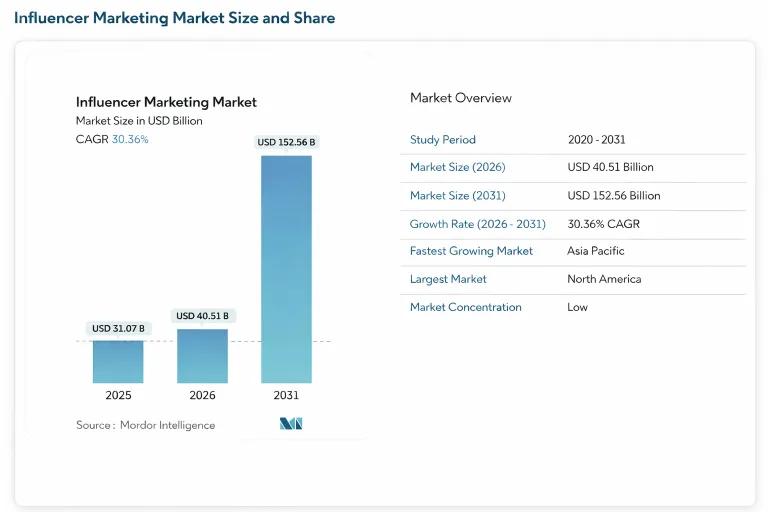
The influencer marketing industry exceeded $32 billion in 2025 and is expected to reach $152 billion by 2026. Yet most of that spend still sits in awareness budgets instead of performance media allocations.
This is where most teams fall behind.
Creators should be integrated into your strategies with the same standards you apply to paid media. This means clear briefs, defined KPIs, revenue targets, and structured testing plans.
From what we have seen working across performance teams, the brands that win build structured creator partnerships. They use shared dashboards, transparent ROAS reporting, feedback cycles, and compensation tied directly to outcomes.
They use shared dashboards, transparent ROAS reporting, feedback cycles, and compensation tied directly to outcomes.
Why Does Traditional Influencer Marketing Fall Short?
Most traditional influencer campaigns optimize for reach and engagement. Teams report impressions, likes, and comments. Meanwhile, the revenue impact mostly remains unclear.
Performance-driven campaigns focus on outcomes such as sales, qualified leads, and incremental lift tied directly to media spend.
Here’s where things break down: traditional influencer marketing typically relies on organic distribution. And organic reach is unstable.
The average Instagram business account reaches roughly 3.5% of its followers organically. On Facebook, it’s just 1.65%.
This means the vast majority of your audience is unlikely to see your content without paid amplification. And a single algorithm change could worsen those prospects even further.
Another common issue is the “spray and pray” gifting model that traditional influencer marketing is famous for. This tactic involves sending large volumes of products to multiple creators without adequate vetting or research.
With influencer marketing fraud draining an estimated $1.3 billion from businesses worldwide, sending 100 products and hoping one post “goes viral” isn’t a strategy.
It’s a costly gamble that’s unlikely to pay off.
From what we have seen, the problem is not creator marketing itself. The problem is the lack of a performance structure.
If you want influencer marketing to drive acquisition, you need defined targeting, controlled distribution, and measurable CPA benchmarks instead of hoping organic traction converts into revenue.
Benefits of Performance Influencer Marketing
When you treat creators like paid media assets, you gain measurable advantages that improve acquisition efficiency over time.
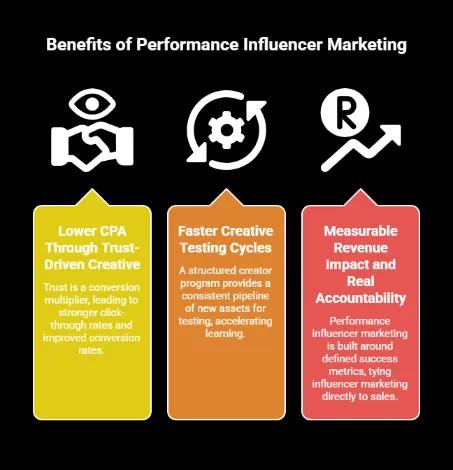
Here are three major benefits that matter at the executive level:
1. Lower CPA Through Trust-Driven Creative
Trust is a conversion multiplier. 84% of consumers trust peer recommendations more than traditional ads. When you combine that built-in credibility with paid targeting, you mostly see stronger click-through rates (CTRs) and improved conversion rates compared to brand-led creative.
The result is lower CPA without increasing spend.
In our experience, this becomes even more powerful at scale. We collaborated with HelloFresh on a multi-seven-figure dark posting strategy across 17 European countries.
By activating more than 100 local creators and structuring campaigns around performance benchmarks, month-over-month CPA decreased by 20% while referral sign-ups increased by 40%.

When creator content is treated as performance media instead of one-off posts, acquisition efficiency improves measurably.
2. Faster Creative Testing Cycles
Creative fatigue quietly erodes performance over time. As audiences see the same assets repeatedly, click-through rates drop, and conversion efficiency weakens. In many paid media accounts, even small improvements in creative freshness can lift conversion rates by 8%.
A structured creator program gives you a consistent pipeline of new assets designed for testing. Instead of relying on one hero video, you rotate multiple variations across hooks, formats, and angles.
From what we have seen in performance accounts, faster creative iteration shortens testing cycles and accelerates learning. You identify winning messages sooner and pause underperforming assets before they inflate your CPA.
When creators operate inside a testing framework, optimization becomes continuous instead of reactive.
3. Measurable Revenue Impact and Real Accountability
Unlike awareness campaigns, performance influencer marketing is built around defined success metrics from day one. In fact, 68% of marketers now tie influencer marketing directly to sales.
Each creative asset is deployed with a specific acquisition objective and a target CPA or ROAS benchmark.
With proper tracking infrastructure, including UTMs, unique codes, platform attribution, and post-purchase surveys, creator performance becomes measurable against revenue, instead of surface-level reach metrics.
This clarity changes behavior. When success is clearly defined, accountability follows.
How to Identify Performance-Ready Influencers
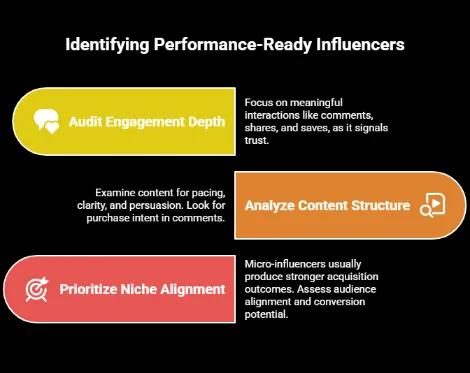
Remember that not all creators are built for conversion. Performance-ready creators are identified through audience quality, engagement depth, and conversion signals.
Let’s see how to spot the right ones.
1. Audit Engagement Depth, Not Follower Volume
Big audiences may look impressive, but they don’t guarantee revenue.
As follower counts increase, engagement rates consistently decline. A million followers who casually scroll past your content are less valuable than 40,000 followers who comment, ask questions, and actually buy.
Focus on meaningful interactions such as comments, shares, and saves, as it signals trust. And trust is what moves people from scrolling to spending.
2. Analyze Content Structure and Visible Purchase Signals
Start with the content itself.
- Does the creator naturally tell stories that drive action?
- Do they explain products clearly?
- Do they hook viewers in the first three seconds?
Performance creative requires pacing, clarity, and persuasion.
Now move to the comments. Are followers tagging friends? Asking about pricing? Saying, “I need this”?
That’s purchase intent in plain sight.
Next, audit audience alignment. Do demographics match your ideal customer profile (ICP)? Use native platform insights and third-party verification tools to assess authenticity and detect inflated engagement.
Pay attention to saves and shares. Across platforms, these behaviors signal deeper interest than passive likes.
At the executive level, this isn’t about creative preference; it’s risk mitigation. You’re investing in a distribution and growth partner. That means audience quality, engagement integrity, and ICP alignment must be measurable, not assumed.
3. Prioritize Niche Alignment and Conversion Potential Over Scale
In performance influencer marketing, smaller and more focused audiences usually produce stronger acquisition outcomes.
Micro-influencers (creators with 10,000–100,000 followers) pull in 47% more engagement than those with larger audiences. Their audience is mostly defined and more invested in specific topics.
When evaluating these creators, look beyond engagement rate alone. Assess how closely their audience aligns with your ideal customer profile and whether past brand collaborations show measurable response signals such as comments about purchasing, saved posts, or repeated promotions.
Data show that micro-influencers’ highly aligned niche audiences typically convert at 20% higher rates. That’s a win-win approach for you.
As Kelly Ehlers, Forbes Councils Member, explains:
“A common concern with micro-influencers is that their follower count is smaller, reducing the number of eyes viewing sponsored content. However, the engagement and conversion of a micro-influencer’s followers are typically higher because users trust the individual, are more likely to comment and engage, and, most critically, click the “purchase” button.”
Performance Influencer Marketing Strategies: Activate Creators Like Ad Channels
Creators should operate inside your paid acquisition framework. This means structured creative, controlled amplification, and clear conversion pathways. Here’s how.
1. Optimize Creator Content for Direct Response
Creator ads don’t convert by chance. They have to be engineered to stop scrolling and convince engaged audiences to buy.
Polished studio ads scream “advertisement.” However, creator content feels more personal.
When it comes to connecting with your audience, the first three seconds matter most.
Fast cuts, bold on-screen text, and immediate value statements help anchor attention. The problem you solve should be immediately identifiable and relatable. Use platform-native fonts, and keep it vertical.
For the technical aspects, Meta reports that Reels ad sets using vertical, sound-on creative delivered 4.8% lower cost per action, 5.1% higher CTR, and 2.9% higher conversion rates compared to other video types.
To improve performance, we recommend focusing on:
- Uploading or whitelisting 9:16 vertical assets
- Enabling reels placement explicitly
- Activating Advantage+ Creative optimizations
- Layering in music or voiceover (Reels ads with both show a +15-point higher positive response score)
In our daily practice, we treat these elements as performance levers. Creative structure directly influences CPA and ROAS outcomes.
2. Use The Power of Whitelisting, Spark Ads, and Partnership Ads
It’s one thing to collaborate with creators, but amplifying them through paid media creates scale, control, and measurable efficiency.
Spark Ads on TikTok allow you to increase organic creator posts as paid ads. Branded Content Ads on Meta work in much the same way to formalize and scale creator partnerships.
Both tools allow brands to promote a creator’s organic content as a paid advertisement while maintaining the creator’s handle, name, and credibility. The same principle applies to whitelisting on Meta, where ads appear as organic posts from the influencer rather than the brand.
TikTok reports that Spark Ads drive 134% higher video completion rates and 157% higher 6-second view-through rates compared to standard In-Feed ads.
And creator-linked ads deliver 13% higher CTR and 19% lower CPA compared with traditional placements.
From what we have seen in paid acquisition accounts, whitelisting bridges the gap between trust and precision. You preserve creator credibility while applying the same bidding, audience segmentation, and scaling discipline used in performance media.
This combination improves efficiency in a measurable way.
The post below shows an example of this influencer whitelisting structure executed for our client Miro.
3. Build UGC Conversion Funnels
As we have mentioned earlier, not all creator content serves the same purpose. When you treat every asset like it’s meant to close the sale, performance suffers.
- Top of Funnel (TOFU) creator content should stop the scroll. (Think: Humor. Relatable pain points. Bold hooks.) The goal here isn’t immediate purchase. It’s driving traffic and building an audience.
- Middle of Funnel (MOFU) content educates. This can include product demos, ingredient breakdowns, and comparison videos. This is the stage where objections must be overcome.
- Bottom of Funnel (BOFU) content converts using testimonials, unboxings, “Why I switched” stories, and reinforcing CTAs.
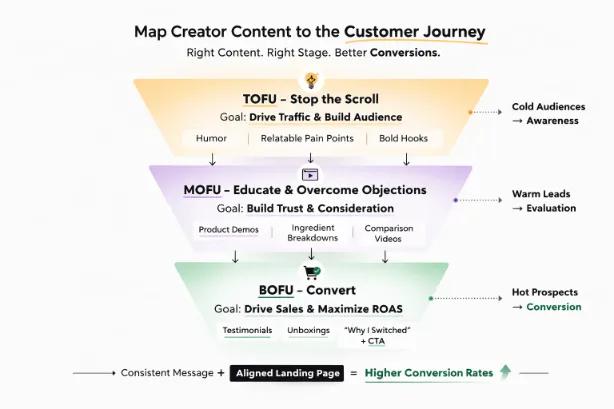
When you map creator assets to these stages, your retargeting becomes intentional. When you don’t, you waste budget pushing cold audiences to buy before they trust you.
Once traffic moves down the funnel, landing page alignment becomes critical. If the ad feels native and authentic, the landing experience should reflect that same tone and visual language.
In our experience, consistency between creative and destination reduces friction and improves conversion efficiency.
What Performance Influencer Marketing Actually Looks Like
Let’s move from theory to execution. A surprising number of brands still send creators a product and say, “We love your style. Just be authentic.” This approach lacks structure and rarely produces consistent acquisition results.
High-performing teams brief creators like what they are: production partners inside a paid media system.
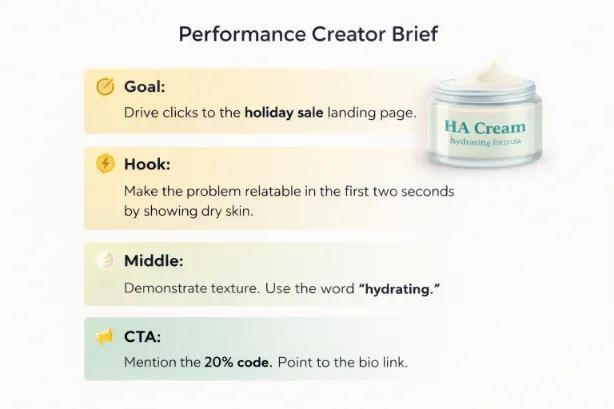
Every brief should outline:
- The goal: Clearly define the business objective. Is it clicks, purchases, app installs, or email signups? The creator needs to know what success looks like so they can optimize their storytelling around the outcome.
- Hook (First 2–3 Seconds): This is the scroll-stopper. It should immediately surface the problem or desire. On short-form platforms, attention is the bottleneck. If the hook fails, nothing else matters.
- Middle (Proof + Demonstration): This is where credibility is built. Show the product in action. Highlight texture, features, and results. Specify key phrases or benefitsto reinforce positioning and message consistency.
- CTA (Call to Action): Be explicit. What should the viewer do next? Mention discount codes and create urgency. Point to the bio link. Ambiguity kills conversion.
Now the creator isn’t guessing at what matters. Instead of a pretty lifestyle post, you get a structured, conversion-focused creative asset built to lower CPA and improve ROAS.
How to Measure and Track Performance Influencer Marketing Success
If you can’t measure it against revenue, it isn’t performance. Here’s how to track what actually matters.
1. Define Performance-Driven KPIs for Creator Campaigns
Before a single post goes live, success has to be defined in financial terms.
Start with CPA, what does it cost to generate a sale or install? Then measure ROAS, how much revenue is generated per dollar invested. Finally, zoom out to MER (Marketing Efficiency Ratio), total revenue divided by total marketing spend.
These metrics differ from “brand sentiment,” reach, or engagement. Those indicators may signal awareness, but they don’t tell you if your unit economics are improving.
For executive teams, clarity at this stage prevents subjective debates later.
| Category | What to Measure | Why It Matters | How to Track |
|---|---|---|---|
| Acquisition efficiency | CPA | Shows cost to generate a customer or install | Platform reporting + blended backend revenue |
| Revenue return | ROAS | Revenue generated per dollar spent | Ad platform + backend revenue reconciliation |
| Blended efficiency | MER | Total revenue divided by total marketing spend | Finance dashboard |
| Engagement quality | CTR, saves, shares | Signals creative resonance and purchase intent | Platform analytics |
| Conversion influence | Assisted conversions | Measures upper-funnel impact | Google Analytics 4 |
Once KPIs are defined, accuracy becomes the priority. How do you ensure those numbers reflect reality?
2. Use Advanced Attribution Models
Platform dashboards are directional. So, relying solely on reporting inside Meta or TikTok can inflate or misattribute performance. Instead, layer your attribution.
- Use UTM parameters for campaign-level tracking.
- Assign unique discount codes to each creator.
- Implement post-purchase surveys asking, “How did you hear about us?”
Most importantly, use Google Analytics 4 to analyze Assisted Conversions. Creator content often influences purchase before the final click. GA4 helps quantify that upper-funnel impact.
When multiple data sources align, confidence increases. And when confidence increases, budget decisions become easier.
3. Iterate and Optimize: The Performance Marketing Feedback Loop
Performance influencer marketing isn’t “set and forget.” It’s test, learn, scale, repeat.
Review audience retention curves. If drop-off spikes at 15 seconds, adjust the pacing. If CTR is strong but conversion lags, refine the landing page.
Give creators specific, data-backed feedback that will improve the next iteration or asset: “The hook worked. Viewers stayed for eight seconds. But engagement dropped before the CTA.” A/B test new thumbnails, swap headlines, and adjust opening frames.
We have noticed that in performance accounts, small creative refinements usually produce meaningful shifts in CPA when tested systematically.
How AI and Automation are Reshaping Performance Influencer Marketing
AI is changing how performance teams source, test, and scale creators. Today’s tools analyze audience overlap, engagement integrity, and historical conversion signals before a campaign even launches.
Editing platforms now automatically resize, caption, and adapt creator assets across TikTok, Reels, Shorts, and paid placements, increasing creative output without increasing production timelines.
AI has now become a force multiplier. It helps you:
- Identify creators with high conversion probability
- Repurpose assets faster across formats
- Forecast performance before scaling budgets
Virtual influencers such as Lil Miquela show how brands can maintain full creative control and eliminate scheduling or reputation risk. However, control does not equal conversion. Human creators still drive stronger trust signals, which directly influence purchase behavior.
Privacy changes have also reshaped measurement. Apple’s App Tracking Transparency reduced cross-app tracking, making first-party data and intent-driven creative more valuable.
This means contracts must clearly secure:
- Paid usage rights
- Whitelisting permissions
- Cross-platform distribution authority
But note that AI can strengthen performance systems; it can’t replace human credibility. The brands that win combine automation with authentic creator storytelling.
Scale Performance Influencer Marketing with 9AM
CAC is rising, and organic reach continues to decline. Nowadays, posting content and hoping it converts is no longer a viable acquisition strategy. If your creator program is not tied to CPA, ROAS, and paid amplification, you are investing in content without building predictable growth.
Engagement may look strong in reports, but revenue is what moves the business.
At 9AM, we structure creator partnerships inside performance media systems. From disciplined testing frameworks to paid amplification and revenue-backed attribution, every creator asset is built to improve acquisition efficiency.
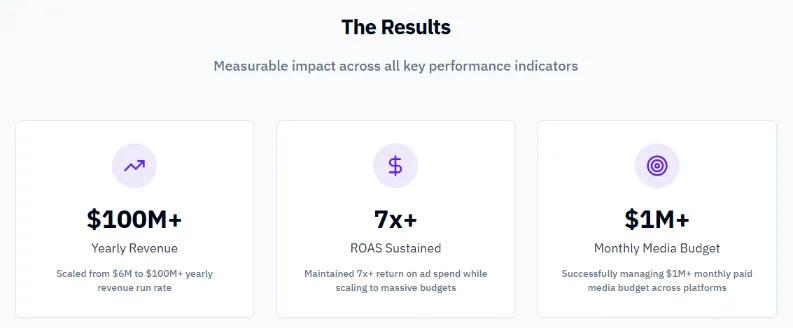
We have helped multiple brands, such as EVRY Jewels sustain 7X ROAS across multiple platforms through high-volume creator testing and controlled scaling.
If you are ready to treat creators as performance channels instead of awareness plays, book a strategy call with 9AM and audit your current influencer framework.
Frequently Asked Questions
How can influencer marketing be optimized to deliver ad-like results?
To optimize influencer marketing for ad-like results, you can use whitelisting or TikTok Spark Ads to run creator content through paid media platforms. Plus, make sure to structure briefs for conversion, and continuously A/B test hooks, creatives, and CTAs. Most importantly, measure success using CPA and ROAS instead of engagement metrics.
How can we track and analyze influencer content to ensure it performs like an ad?
You can track influencer marketing performance by running creator content through Meta or TikTok Ads Manager using whitelisting. Apply UTM parameters, unique discount codes, and post-purchase surveys. Monitor CPA, ROAS, and conversion rate to compare creator ads against traditional paid media benchmarks.
Why is it important to make creators work like ads in performance marketing?
Making creators work like ads ensures influencer marketing drives measurable revenue. When creator content is amplified through paid media and optimized for CPA and ROAS, it becomes scalable and accountable. This transforms your influencer marketing from a branding tactic into a performance acquisition channel.
How does 9AM build a performance influencer marketing strategy?
We build performance influencer marketing systems by combining creator partnerships, paid media amplification, and advanced attribution. Our team whitelists, tests, and optimizes creator assets against clear CPA and ROAS targets to ensure measurable revenue impact.
How does 9AM scale creator campaigns efficiently?
We scale creator campaigns through always-on ecosystems, rapid creative testing, and disciplined budget reallocation toward top-performing assets. When content proves it can convert efficiently, our team amplifies it through paid media to maximize performance and control acquisition costs.
Can 9AM integrate influencer marketing with existing paid media campaigns?
Yes. We integrate influencer marketing directly into your existing paid media infrastructure across Meta and TikTok. Our campaigns align with defined performance KPIs, operate under unified attribution models, and are optimized to improve the overall marketing efficiency ratio (MER).
Appendix