

Retail media was an instant hit when it first became a digital advertising tool back in 2012, and for good reason.
A high-margin advertising channel filled with high-intent shoppers sounded like a dream come true to anybody in charge of getting customers.
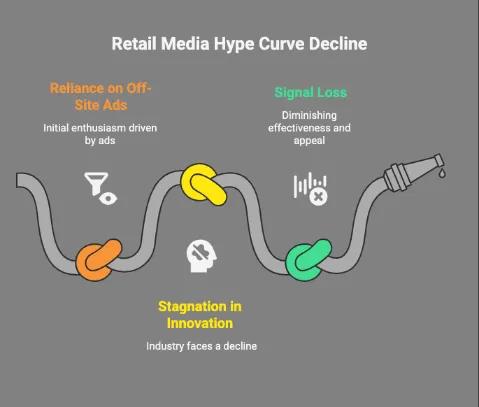
But what businesses and marketers slowly found out was that while sales seemed to quadruple initially, there would always be a silent drop over time.
This wasn’t by chance but because of a fundamental flaw everyone in retail media was missing: treating media channels like traditional ad networks.
Now, even though retail media accounts for about 20% of global ad budgets, it’s stuck in an unhealthy loop that can only be broken by changing how marketers think about media networks.
We’ll thoroughly analyze how this confusion affects brand building in this guide and discuss ways teams can overcome it.
P.S. Are your retail campaigns driving clicks but not translating into real store traffic or sustained sales? 9AM helps you connect digital marketing with in-store performance through a true omnichannel strategy. Book a free strategy call now.
TL;DR
- Retail media often prioritizes ROAS and last-click metrics while overlooking brand-building signals.
- Many marketers mistakenly treat retail media networks like ad networks instead of media environments.
- Retail media networks operate as walled gardens, which makes cross-platform attribution difficult.
- Overreliance on bottom-of-funnel targeting limits discovery and long-term brand growth.
- Static product ads weaken brand distinctiveness and creative engagement.
- Brands should align retail media with full customer journey planning.
- Unified measurement helps teams track cross-channel impact and reduce siloed reporting.
- Incrementality testing reveals the real value of retail media campaigns.
- Combining upper-funnel storytelling with performance placements improves long-term demand.
- First-party and zero-party data enable stronger personalization and audience understanding.
What Retail Media Is (And What It Isn’t)
Retail media is any practice in which marketers and brands place ads within a retailer’s ecosystem. The retailer is usually a widely popular business that has access to first-party shopper data.
By advertising on a retailer’s app, website, or in-store screen, brands tap into environments already filled with high-intent customers. Making it easy to influence customer decisions at the point of sale.
This is where the lines start to blur for many people. Teams begin treating a retail media network solely as an ad network instead of recognizing it as a broader media environment.
Retail media certainly includes ad placements and sponsored listings. However, its deeper role is to shape the buying experience and influence how shoppers discover products.
Many teams approach retail media with a narrow performance mindset that focuses only on reach and immediate conversions.
Short-term results may look promising. However, your brand does not stay top of mind for shoppers. Early campaigns can produce encouraging conversions, yet the long-term impact on revenue often becomes difficult to measure.
From what we have seen working with different teams, stronger outcomes appear when brands partner with retail media networks that build real digital destinations for shoppers. Your creative assets must then reflect what customers genuinely care about so your brand stands out.
How Do Retail Media Networks Work?
A retail media network (RMN) is an advertising platform owned and operated by big retailers like Target or Amazon.
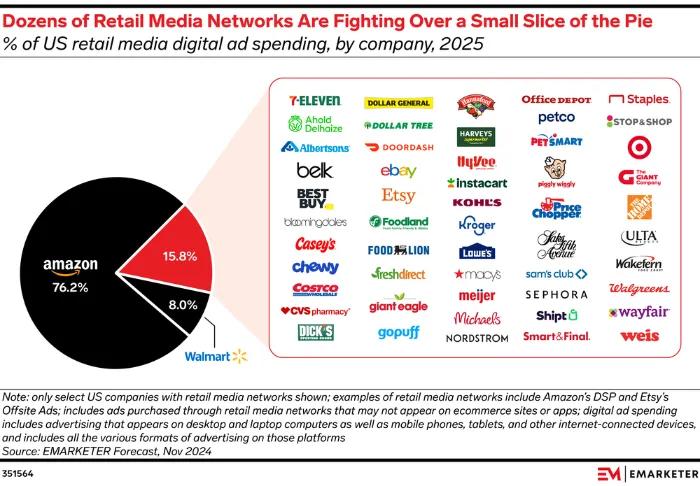
Because of the nature of their operations, they have access to first-party buyer data. As a result, they can afford to let third-party businesses place adverts across their digital and physical channels (in-store or online).
Most brands expect that using retail media in this way will immediately increase conversions while also winning over shoppers as loyal customers for themselves. And they’re not far off.
Studies have shown that 58% of shoppers who see a retail media ad on the front screens of retailer entrances will immediately buy the advertised product.
But here’s where the reality starts getting different. Since RMNs specialize in highly targeted ads, they prioritize conversions and bottom-of-funnel metrics. This means the metrics that marketers are tracking here are one-sided.
The metrics RMNs are obsessed with right now are;
- Return-on-ad-spend (ROAS),
- Average sales sizes, and
- Last-click attribution stats.
These measurements focus strongly on short-term transactions. They rarely capture brand awareness or long-term brand influence.
Some retail media networks also just sell off-site display ads on YouTube and Meta with their shoppers’ data. This dilutes your ads by clinging to sites that overclaim attribution, and as a result, you use the wrong analytics.
So you end up targeting a broader audience than necessary or even a completely unrelated demographic to your business’s services.
The Disconnect Between Retail Media and Branding
Retail media as it is today doesn’t align with true branding goals for many reasons. These include:
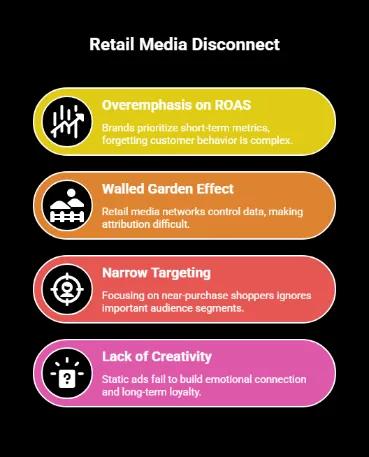
1. Overemphasis on ROAS and other short-term metrics
Return on ad spend (ROAS) is an important metric for any brand trying to maintain profitability. At the end of the day, the company bank account is what lets you know you’re doing well as a business.
But what we’ve noticed is that brands usually forget that clicks and conversions work more like a web than a straight line. Real customer behavior doesn’t go directly from discovering a product to just buying it.
A shopper may first encounter a product through a retail media ad. Then they may search for reviews on Google or watch product content on YouTube before making a purchase.
In many cases, the final purchase happens through a different retailer than the network that originally delivered the advertisement. Tracking this process has become even harder in a cookieless environment.
That’s why you should prioritize factors like lifetime value of customers, mental availability, and brand prominence, as those give better insight into how customers are moving. They are the hallmarks of a business that’s built to last.
From our experience, these signals reveal how customers truly move through the buying journey. They are also strong indicators of a brand that can sustain growth over time.
Industry research reinforces this shift toward balancing performance and brand development.
“Advertisers place equal emphasis on retail media networks for performance marketing and brand building.”— McKinsey & Company
2. The Walled Garden Effect of RMNs
Retail media networks are usually owned by competing hypermarkets and retailers in the same line of business. Because of this, their performance data remains tightly controlled and rarely shared across different retail media networks.
This situation creates what marketers call the walled garden effect. It becomes difficult to see where your advertising actually influences the customer journey. So you can’t properly attribute where a sale comes from.
And here’s the kicker: each network also has its own unique statement formats and KPIs. So even if these juggernauts played nice together, it’d still be a nightmare to unify the data and measure where incrementality comes from.
3. Narrow Targeting of Customers Who Already Want to Buy
We know that retail media networks, including Target Roundel, offer highly precise targeting, but this accuracy comes at a cost. By focusing solely on near-purchase shoppers, they can overlook other audience segments that are just as important.
Brand building with confidence means calling out your audience rather than focusing solely on in-market consumers. After that, you can continue to nurture them with engaging messaging and storytelling that makes them feel seen.
We’ve found that when brands treat retail media strictly as a narrow ad-targeting service, their upper-funnels suffer from poor activation. This stifles brand growth, so businesses end up being big fish in still, shallow ponds.
4. Lack of Brand Distinctiveness and Creativity
Another gap between retail media and brand building comes from how many marketers approach the channel.
Retail media initially stood out because it placed advertising directly next to purchase decisions. For many teams, this felt like a breakthrough compared with traditional banner advertising or basic display campaigns.
However, advertising behavior has evolved, and customer expectations now extend far beyond simple product information. Customers now enjoy:
- Immersive storytelling,
- Short-form discovery, and
- Creator-led community building.
These formats build emotional connection and familiarity with a brand. Static retail media ads rarely deliver the same level of engagement.
From what we have seen working with different teams, brands usually rely too heavily on basic product placements and sponsored listings. This limits the creative expression needed for strong brand recognition.
Some campaigns also extend retail media data into external display platforms. When this happens, your ads often become transactional messages rather than brand experiences.
Over time, you attract shoppers who buy once and disappear. Your campaign may generate sales, yet your brand fails to build recognition or long-term loyalty.
How to Bridge The Gap Between Retail Media and Brand Building Goals
To close the gap between retail media and brand building, you need to connect retail campaigns with your broader brand strategy instead of treating them as isolated performance channels.
First, align your retail media planning with your full customer journey. Retail ads should reinforce the same brand signals that appear in your other marketing channels.
Second, ensure your creative assets carry distinctive brand elements across every retail media placement. This helps shoppers recognize your brand even inside crowded retail environments.
From what we have seen working with different teams, brands that integrate retail media with brand storytelling achieve stronger long-term demand while maintaining strong conversion performance.
What an Effective Retail Media Strategy Looks Like
A successful retail media strategy creates engagement loops that propel discovery, connect with an audience, and convert within the same environment.
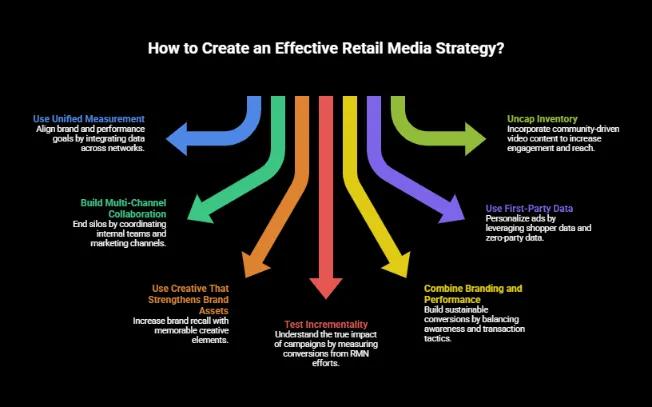
1. Use Unified Measurement to Align Brand & Performance Goals
Retail media dashboards often remain fragmented because each network controls its own reporting systems. However, you do not have to let disconnected data limit your understanding of performance.
Because unclear ownership between sales, brand, and media teams means your brand doesn’t own anything, not even your own process
We suggest moving beyond manual tracking and integrating tools into your process to aggregate performance data, such as audience numbers, campaign metrics, and brand-lift studies, into a single platform.
When your measurement framework is unified, you can compare cross-channel performance more consistently. This helps you identify which tactics support long-term brand growth and which ones only deliver short-term transactions.
Stronger measurement also helps you control your own signals in a market where attribution is becoming increasingly difficult.
In our experience, centralized reporting systems create transparency across teams. They also reduce overlapping budgets and prevent conflicting KPIs from slowing down your strategy.
2. Build Multi-Channel Collaboration Across Teams to End Silos
Retail media networks mostly operate as isolated ecosystems. Each platform controls its own data, which makes cross-network collaboration difficult.
You cannot fully remove this structure, but you can reduce its impact by improving coordination across your internal teams and marketing channels.
Shared reporting systems help you maintain consistent messaging and planning across channels.
This approach brings several moving parts into one coordinated space:
- Brand partnerships,
- Creator collabs, and
- Your creative performance teams.
When these functions operate together, you gain clearer visibility into campaign impact. You can identify which activities contribute to additional sales lift and strengthen your relationship with your audience.
This brings you stronger brand coherence, reduced duplication of performance data, and a better handle on your resources.
3. Use Creative That Strengthens Distinctive Brand Assets
Most RMN ad formats focus on showcasing products you want to sell immediately. As a result, little attention is given to creative elements that strengthen brand recognition.
Even simple, but memorable creative assets like your logo, a well-thought-out tagline, and brand colors can significantly increase brand recall. So prioritize formatting that lets you add those things.
This includes visual storytelling in the form of scrollable videos and other content-rich, video-first environments, like Connected TV and premium publisher sites. These should be built into your preferred RMN, so you know they don’t center on off-site ads
In our experience, shoppers increasingly respond to always-available, shoppable experiences powered by user-generated content, creator partnerships, and brand-safe AI tools.
When you align these formats with your distinctive brand assets, your campaigns build stronger mental availability across both search and browsing moments.
4. Test Incrementality, Don’t Just Attribute to the Last Click
Last click attribution often assigns the full conversion to the final ad interaction, even when earlier touchpoints influenced the purchase decision. This can create a misleading picture of how retail media actually contributes to sales.
Many brands struggle to understand the true incremental value of their retail media campaigns. According to research from Skai, 36% of organizations say difficulty proving incremental impact is the primary reason they may reduce future retail media investment.
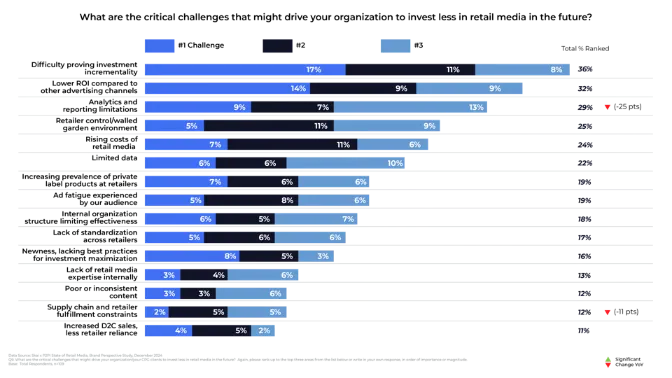
Incremental testing measures the incremental impact of your specific retail media strategy by calculating the conversions generated solely from your RMN campaign efforts.
We recommend using geo-lift tests with controlled experiments in different regions to easily identify the influence of your media campaign.
This lets you know what RMN placements you need to cut, so you don’t overestimate your ad budget.
5. Combine Upper-Funnel Branding With Lower-Funnel Performance Tactics
Retail media was never made to be a bottom-of-funnel tactic alone. Even in the early days, the idea was that brands just needed to get in front of customers, and discovery followed suit.
This might have worked at the time, but customer behavior has completely turned on its head in the last 10 years. Audiences want to know who you are and how you’re similar to them, beyond what you’re selling to them.
You should pair video awareness units with your sponsored placements, so you can alternate between the two.
This synergy builds more sustainable conversions thanks to better brand resonance in the long-run, and even boasts of higher CTRs than what ad-centered retail media promises.
6. Use First-Party Data for Personalization
Retail media may fall short in some areas of brand building, but one advantage remains clear. Retailers hold direct access to large volumes of first-party shopper data.
This data helps you understand how customers browse, search, and purchase products. However, many RMNs could go further by evolving beyond transactional signals and capturing what is often called zero-party data.
With how popular short-form content and influencer marketing have become, customers now want to share what ticks their boxes. People actively ask for recommendations on platforms like TikTok. In fact, 74% of consumers want ads to match the content they’re watching.
This is where you should deliver contextual recommendations based on real user behaviour. Instead of relying only on last-click signals, align your personalization with what audiences are engaging with in the moment.
From our experience, personalized placements work best when they support broader brand engagement. We recommend combining them with brand awareness initiatives that encourage feedback loops through community-driven conversations and creator collaborations.
7. Uncap Your Inventory
Move beyond relying only on native digital placements and banner ads in your retail media strategy. You should also incorporate continuous feeds of community-driven video content.
These videos combine product discovery with engaging storytelling. Shoppers stay longer, explore more products, and often move naturally toward purchase.
And even if they don’t convert immediately, they’re now in your ecosystem. That won’t show up in your ROAS report, so we suggest tracking metrics like unique reach and engagement rates as well.
What A Great Retail Media Strategy Does For You
After you’ve successfully implemented your new and improved retail media strategy, you should feel a weight lifting off your shoulders figuratively and literally.
The clunky reports you try to gather are all gone, and in their place is an intuitive dashboard with figures and metrics that are self-explanatory.
As an advertiser or brand, you now know what has been responsible for incremental causality all along, and have enough control of your own channels to imprint your brand distinctiveness all across the customer journey.
And customers gain a lot too. They gain:
- Useful products they actually asked for,
- Deep brand loyalty, and
- Community and interactive spaces.
On top of discovering helpful recommendations of things they actually need from you, they also get digital third spaces. Here they’re in fun and familiar territory with micro-influencers they know and a brand like yours that they relate to.
Media owners aren’t left out, since modern media strategies open up pathways to brand new revenue streams for them too.
Create a Full Funnel Retail Media Strategy With 9AM
Many marketers still evaluate retail media mainly through short-term performance metrics. This approach often overlooks the role brand building plays in sustained growth.
Stronger results come from balancing upper, mid, and lower funnel signals so you can understand how discovery, engagement, and conversion work together.
With 9AM, you can unify your measurement framework and evaluate retail media performance more clearly. Our approach helps you test incrementality, understand cross-channel impact, and see how your creative performs across different customer touchpoints.
Book a strategy session today to review your current RMN mix and identify where last-click reporting may be masking wasted ad spend.
FAQs
What are the types of retail media strategy?
Retail media strategies typically include sponsored product placements, display advertising on retailer websites or apps, off-site advertising using retailer data, and in-store digital placements. More advanced strategies also combine video discovery, creator content, and cross-channel campaigns to support both brand awareness and direct conversion.
How can brand loyalty become a problem for retailers?
Strong brand loyalty can reduce exposure to competing products. When shoppers repeatedly buy the same brand, retailers struggle to promote new or alternative items. This limits product discovery, reduces category competition, and can make retail media campaigns less effective for emerging brands trying to reach loyal customers.
How does social media affect retail?
Social media shapes product discovery and purchasing decisions. Platforms such as TikTok and Instagram influence what shoppers search for and buy. Creator recommendations, short-form videos, and community discussions usually guide customers toward specific products before they even enter a retailer’s platform.
What metrics should brands use to measure retail media success?
Brands should measure retail media success using a mix of performance and brand metrics. These include return on ad spend, incremental sales lift, unique reach, engagement rates, customer lifetime value, and brand recall indicators. When you combine these signals, they give a clearer view of both short-term conversions and long-term brand growth.
How can retail media support both brand and performance goals?
Retail media supports both goals when brands combine discovery-focused formats with conversion placements. Video content, creator partnerships, and storytelling build awareness, while sponsored listings capture demand. When these tactics run together, brands strengthen recognition while still driving measurable sales.
How can 9AM help brands improve their retail media strategy?
At 9AM, we help you plan, execute, and measure retail media campaigns using a full-funnel approach. We align brand strategy with performance tactics, unify reporting across RMNs, and run incrementality tests. This allows you to identify wasted spend, improve creative effectiveness, and build campaigns that drive both brand growth and measurable sales.
Can 9AM help us understand whether we are overspending on retail media?
Yes. 9AM consolidates campaign data across retail media networks and applies incrementality testing to reveal which placements generate real value. This helps you identify wasted spend hidden by last-click attribution and reallocate budget toward tactics that deliver measurable impact.
Appendix
- https://marketingltb.com/blog/statistics/retail-media-networks-statistics
- https://www.vistarmedia.com/news/mfour-retail-media-study
- https://www.investopedia.com/terms/h/hypermarket.asp
- https://newsroom.transunion.com/seven-in-ten-companies-plan-to-increase-retail-media-budgets-but-scale-and-measurement-remain-key-barriers/
- https://skai.io/reports-and-whitepapers/2025-state-of-retail-media-report/
- https://www.mediapost.com/publications/article/383059/subterranean-context-shoppers-prefer-ads-related.html