

Facebook Ads can still drive serious revenue, but putting most of your acquisition budget into one platform has become harder to defend.
Performance teams now have more places to invest. Google Search can capture existing demand, while TikTok and YouTube can reach buyers earlier.
Brands are also putting more money into creator partnerships, affiliate marketing, and owned channels to reduce their reliance on paid social.
In fact, Gartner found that 69% of digital marketing spend went to paid online channels in 2025, with paid search taking 13.9% and social advertising 12.2%.
We still see a clear place for Meta Ads in a profitable media mix.
But the bigger question is where else your next marketing dollar can deliver value.
This guide breaks down the leading Facebook Ads alternatives, where they fit, and how to reallocate budget without abandoning a profitable Meta channel.
TL;DR
- Facebook Ads can still be profitable, but relying on one platform puts too much of your acquisition strategy in one place.
- Google Ads works best when you want to capture existing demand from people already searching for a solution.
- TikTok, YouTube, LinkedIn, and Snapchat each serve different audiences and stages of the buying journey.
- Choose new advertising platforms based on customer intent, audience fit, creative demands, and campaign economics.
- Creator-led UGC and whitelisting can give paid social teams more creative angles to test and scale.
- SEO, email, SMS, and affiliate marketing can add acquisition and retention paths beyond platform advertising.
- Compare channels using the metrics that match their role instead of applying the same KPIs across your entire media mix.
- Keep Meta Ads where they remain profitable, then test complementary channels with controlled budgets before reallocating more spend.
Why Performance Marketers Are Looking Beyond Facebook Ads
Facebook still gives you massive reach and strong targeting. The problem starts when too much of your acquisition plan depends on keeping one channel efficient.
Several pressures are making that dependence harder for performance teams to justify.
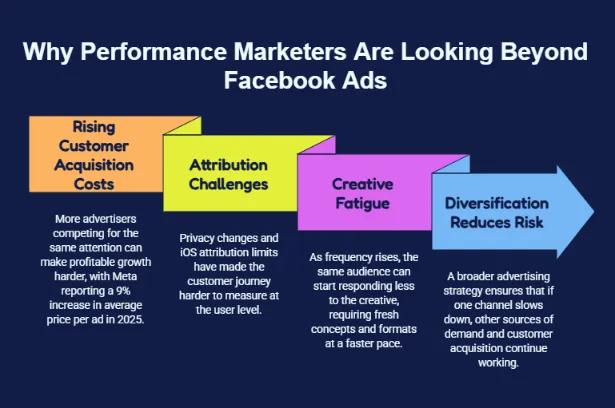
Rising Customer Acquisition Costs
More advertisers competing for the same attention can make profitable growth harder.
Meta reported that the average price per ad increased by 9% in 2025, while ad impressions increased by 12%.
Higher ad prices do not automatically mean higher CAC, but they put more pressure on campaign economics.
Our team looks at customer acquisition costs alongside contribution margin before pushing more spend into a campaign. If that math starts to weaken, testing other channels becomes a practical next move.
Attribution Has Become More Challenging
A conversion can involve several touchpoints before the sale. Someone might discover you on Instagram, search for you on Google, return through email, and then buy.
Privacy changes and iOS attribution limits have made that journey harder to measure at the user level.
That makes platform-reported ROAS less useful on its own. First-party data, incrementality, and broader performance data can give you a more complete view of what actually influenced the sale.
Read next: The Cookie-Less Future: How to Win in a Privacy-First World
Creative Fatigue Makes Scaling Harder
A winning Facebook ad has a shelf life. As frequency rises, the same audience can start responding less to the creative.
This makes creative production part of the scaling equation. More spend can mean you need fresh concepts, hooks, ad formats, and vertical video at a faster pace.
Diversification Reduces Platform Risk
Heavy dependence on the Meta platform leaves more of your revenue exposed to changes you cannot control.
An algorithm update, campaign rejection, account restriction, CPM spike, or tracking change can affect performance quickly.
We've found that a more diversified advertising strategy gives performance teams more room to respond when one channel becomes less efficient.
Quick Comparison of Facebook Ads Alternatives
There is no universal replacement for Facebook Ads. The better choice depends on what you need your next budget allocation to accomplish.
| Channel | Best For | Time to Signal | Funnel Stage | Creative Demand |
|---|---|---|---|---|
| Google Ads | Capturing high-intent search demand | Fast | Mid to bottom funnel | Low to medium |
| TikTok Ads | Product discovery, e-commerce, and apps | Fast to medium | Top to mid funnel | High |
| YouTube Ads | Education and higher-consideration purchases | Medium | Full funnel | High |
| LinkedIn Ads | B2B leads and specific decision-makers | Medium to slow | Mid to bottom funnel | Medium |
| Snapchat Ads | Reaching younger mobile-first audiences | Fast to medium | Top to mid funnel | High |
Now let’s look at where each channel fits, what it does well, and the trade-offs to consider before moving budget.
Where Performance Marketers Are Reallocating Paid Media Budget
Facebook Ads alternatives work best when you choose them for a specific job rather than looking for a like-for-like Meta replacement.
The right fit depends on the demand you want to capture, the audience you need to reach, and what your budget can support.
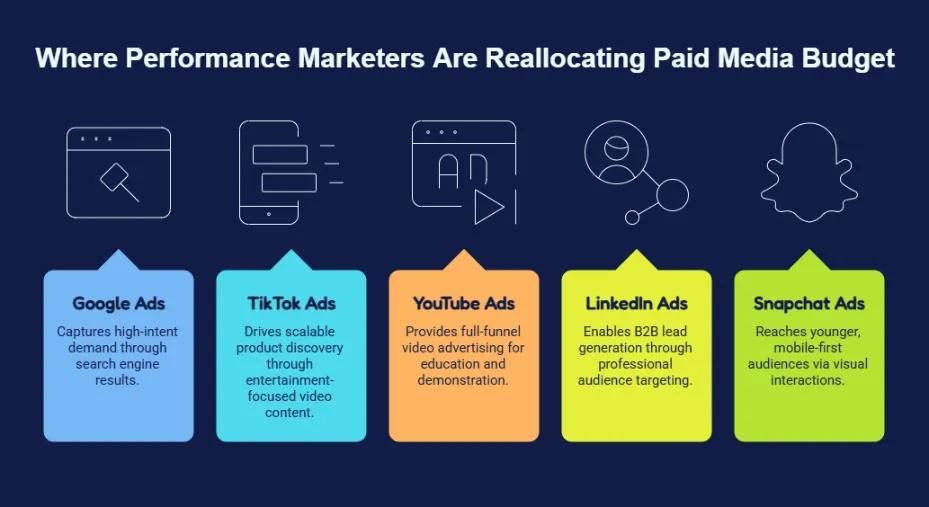
1. Google Ads for Capturing High-Intent Demand
Google Ads changes the starting point of the conversation. Instead of interrupting someone in a social feed, you can meet them through the search engine when they have already expressed intent.
This intent comes with a huge scale. Google said in 2025 that it processed more than 5 trillion searches a year, while commercial search queries were still growing.
- Best for: Ecommerce, local services, SaaS, and categories with existing search demand.
- Strengths: Google Search reaches people who are actively looking for a product or solution. Google Shopping can also connect e-commerce shoppers with relevant product pages directly from search results.
- Limitations: Search engine ads capture existing demand, so scale depends partly on search volume. Competition can also make clicks expensive in valuable categories.
- Budget considerations: Look at conversion value and contribution margin alongside CPC. An expensive keyword can still make sense when the traffic converts profitably.
- Our take: Google Ads deserves more budget when search intent translates into profitable conversions for your business.
2. TikTok Ads for Scalable Product Discovery
TikTok puts your creative into an entertainment feed where people may have had no intention of shopping. But strong content can turn that passive scrolling into product discovery.
In fact, TikTok Shop research published in 2026 found that two-thirds of U.S. users discovered a new brand on the platform, and more than 57% bought from that brand within days.
- Best for: Ecommerce, consumer brands, mobile apps, and products that translate well to short-form video.
- Strengths: TikTok Ads support native vertical video, which works well for demonstrations, testimonials, problem-solution concepts, and creator-led ad formats.
- Limitations: Creative can lose momentum quickly. You need a steady supply of new concepts, hooks, and executions to keep testing.
- Budget considerations: Plan for creative production alongside media spend. More budget creates little room to scale if you cannot produce enough variations to support your paid social campaigns.
- Our take: TikTok earns budget when your product can create interest quickly through strong visual creative.
3. YouTube Ads for Full-Funnel Video Advertising
Some buying decisions need more than a quick interruption in a social feed. YouTube gives people more time and context to evaluate what you sell.
In 2026, Kantar research cited by YouTube ranked it the #1 platform viewers turn to when they want to research, vet, or make a decision about a brand or product, ahead of other social platforms.
- Best for: Higher-consideration products, SaaS, education-led offers, and brands with a longer path to purchase.
- Strengths: YouTube supports multiple video ad formats across different stages of the funnel. Its connection to Google's advertising ecosystem also gives you several audience and campaign options.
- Limitations: Your creative still has to earn attention quickly. Production becomes more demanding when you need demonstrations, storytelling, and multiple video variations.
- Budget considerations: Include production and testing costs in the media plan. Heavy distribution spend becomes harder to justify when you only have one or two videos available.
- Our take: YouTube deserves a closer look when buyers need more information before they are ready to act.
4. LinkedIn Ads for B2B Lead Generation
B2B media buying has a different problem from mass-market advertising. Reaching fewer people can be perfectly fine when those people are the ones involved in the buying decision.
This helps explain why more B2B budget is moving toward the platform. Dreamdata research highlighted by LinkedIn in 2026 found that LinkedIn's share of B2B advertising budgets increased from 39% to 41%.
- Best for: B2B SaaS, enterprise products, professional services, and account-based marketing.
- Strengths: LinkedIn Ads lets you build audiences around professional signals such as job title, company, industry, and seniority. This precision can help you reach specific buying committees and decision-makers.
- Limitations: Clicks and leads can be expensive compared with many other advertising platforms. Low-cost reach is rarely the right benchmark.
- Budget considerations: Evaluate spend against qualified pipeline and revenue rather than lead volume alone. A higher customer acquisition cost can still work when deal values and contribution margin support it.
- Our take: LinkedIn makes sense when audience quality matters more to your economics than audience size.
5. Snapchat Ads for Reaching Younger Mobile-First Audiences
Snapchat offers a different audience opportunity from Facebook and Instagram, particularly when younger and mobile-first consumers matter to your growth.
The platform reaches 75% of people aged 13 to 34 across more than 25 countries, which makes that audience a key reason for advertisers to consider it.
- Best for: Consumer brands, mobile apps, entertainment, and products aimed at younger social media users.
- Strengths: Snapchat Ads support vertical video and several ad units, including Single Image or Video Ads, Collection Ads, Story Ads, and AR experiences.
- Limitations: The platform becomes less compelling when your target customers skew older, or your offer requires a long explanation before conversion.
- Budget considerations: Start with a controlled test and compare customer quality and acquisition costs with your other paid advertising channels before increasing spend.
- Our take: Snapchat is most useful when its audience closely matches the customers you want to acquire.
Marketing Strategies Receiving More Performance Budget
Reallocating the budget can go further than switching advertising platforms. Some of that spend can support strategies that create demand, produce better creative, or get more value from customers you already acquired.
At 9AM, we look at these investments as part of the wider performance mix rather than separate marketing projects.
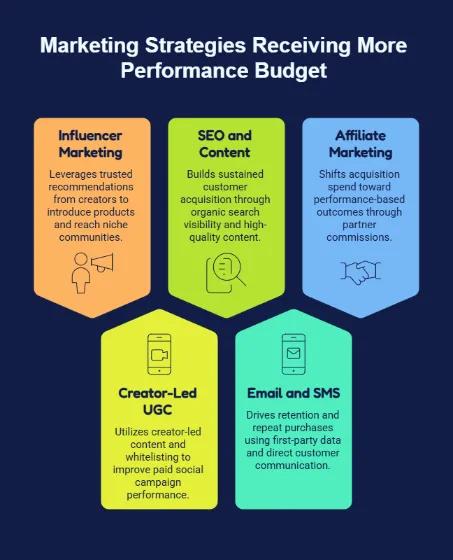
1. Creator-Led UGC and Whitelisting for Stronger Campaign Performance
Your media budget can only work as hard as the creative behind it. Creator-led UGC gives paid social teams more concepts, hooks, demonstrations, and testimonials to test.
And whitelisting takes that content further by running ads through a creator's account rather than the brand account.
We use this approach across many campaigns because it connects creator production directly with media buying. Performance data can then show which messages deserve more spend.
For example, our team used this model in a campaign for Miro with product leadership creator David Pereira.
Instead of stopping at a sponsored post, we ran his content as a paid ad from his handle. This gave us control over targeting and spend while keeping the message native to his audience.
2. Influencer Marketing for Trusted Recommendations
Influencer marketing gives your product a recommendation from someone your audience already chooses to follow. This makes it useful for introducing unfamiliar products and reaching niche communities through a more personal format.
Creator partnerships can also give you access to content and audience insights that inform future campaigns.
However, the key is choosing creators for audience fit and commercial relevance rather than follower count alone.
3. SEO and Content Marketing for Sustained Customer Acquisition
Paid media can drive demand fast, but it also keeps charging you for every visit. SEO gives you a different kind of return.
We recommend treating strong content as an acquisition asset rather than a one-off campaign.
And even as AI changes how people search, organic visibility still matters. BrightEdge research covering January through August 2025 found that AI search accounted for less than 1% of referral traffic, while organic search remained the primary referral driver and delivered the majority of conversions in its dataset.
This makes the job clear: find topics with real search demand, answer the buyer's question well, and give that traffic a clear path toward conversion.
It takes longer to build momentum than paid advertising, but it can make your acquisition mix less dependent on constant media spend.
4. Email and SMS Marketing for Retention and Repeat Purchases
Acquisition gets expensive when every sale depends on finding a new customer. Email marketing and SMS give you another lever: getting more value from the audience you have already paid to acquire.
These channels can bring customers back through abandoned-cart messages, replenishment reminders, product launches, and loyalty programs.
They also give you a direct line to your audience using first-party data, with less dependence on paid media for every repeat purchase.
5. Affiliate Marketing for Performance-Based Acquisition
Affiliate marketing shifts part of your acquisition spend toward outcomes. Publishers, creators, and other partners promote your offer and receive a commission when they generate an agreed action, such as a sale.
This model can make costs easier to tie to revenue, but partner quality still matters.
We would rather build a smaller affiliate program with relevant partners than chase a large network that sends low-value traffic.
For performance teams, the appeal is simple: affiliate marketing can add another acquisition source with economics that are closely tied to measurable results.
5 Common Mistakes to Avoid When Moving Away From Facebook Ads
A broader media mix can help, but a rushed shift creates a different set of problems. We suggest watching for these common mistakes:
- Chasing lower CPMs: Cheap reach means little if CAC, conversion quality, or contribution margin gets worse.
- Moving too much budget too quickly: A new channel needs enough controlled spend to prove itself before it earns a larger share.
- Forcing Meta creative onto other platforms: Search, TikTok, YouTube, and LinkedIn each demand a different message and format.
- Judging channels too early: Early performance can be noisy. Give campaigns enough time and data before you make a call.
- Optimizing to the wrong success metric: Brand discovery, search capture, B2B pipeline, and retention should not all be judged by the same KPI.
Should I Replace Facebook Ads or Diversify Your Marketing Mix?
You should usually diversify your marketing mix rather than replace Facebook Ads completely. Keep Meta Ads where they remain profitable, reduce overdependence by adding channels that serve different roles, and test each addition with controlled budgets before shifting more spend.
Build a More Profitable Channel Mix With 9AM
If you want to reduce your reliance on Facebook Ads without giving up a channel that still works, 9AM can help you decide where your next marketing dollar should go.
Our performance marketing services cover media buying, creative strategy, influencer marketing, growth strategy, and analytics to help you find the right mix for your goals and scale what performs.
Book a free strategy call to find the right channel mix for your growth goals.
FAQs
What Are the Best Alternatives to Facebook Ads for Ecommerce Brands?
Google Ads and TikTok Ads are the strongest starting points for many e-commerce brands. Google captures shoppers already searching for products, while TikTok can create demand through product discovery. YouTube Ads can support products that need more explanation before purchase.
Which Facebook Ads Alternatives Work Best When Meta CPMs Keep Rising?
Do not switch platforms based on CPM alone. Test Google Ads if you have strong search demand, TikTok Ads for discovery-led products, or YouTube Ads when buyers need more education. Compare CAC and contribution margin before reallocating the budget.
What Are the Best Facebook Ads Alternatives for Mobile App Growth?
Google Ads is strongest for intent-led app discovery, while TikTok Ads and Snapchat Ads work better for visual, entertainment-led apps that can sell the experience quickly. YouTube Ads fit apps that need more explanation before install. Judge each channel on activation, retention, and revenue after install.
Influencer marketing vs Facebook Ads: Which is better for brand awareness?
Facebook Ads are better when you want controlled reach, targeting, and predictable distribution. Influencer marketing, on the other hand, can be stronger when brand awareness depends on creator credibility and audience trust. The better choice depends on how you want people to discover your brand.
Can 9AM Manage Multiple Paid Media Channels Under One Strategy?
Yes. 9AM manages paid social, search and shopping, programmatic, CTV, and retail media under one performance strategy. The team coordinates channel roles, creative, budget allocation, and optimization around shared growth goals.
How Does 9AM Measure Performance Across Different Advertising Platforms?
9AM connects platform data with broader business metrics such as CAC, LTV, revenue, and contribution margin. Our team also uses attribution modeling and custom dashboards to compare channel performance without forcing every platform into the same KPI.