

Consumer brands rarely have a single-channel growth problem.
An expensive first order may be a media issue, an offer issue, or a measurement issue; weak repeat purchase calls for a different team altogether. The right agency depends on which decisions you need it to own, where your customers buy, and how it will judge profit when spend increases.
This shortlist compares nine agencies with public consumer-brand work.
It distinguishes growth strategy from hands-on channel delivery and DTC revenue from retail or marketplace demand. Case results are reported by the agencies themselves and describe individual engagements.
Which growth marketing agency fits your bottleneck?
| Agency | Strongest fit | Scope to confirm in the pitch |
|---|---|---|
| 9AM | Paid media, creative, CRO, and revenue measurement | Whether retention execution is needed beyond strategy |
| Common Thread Collective | Forecasting and contribution-margin decisions for DTC | Finance and inventory inputs the model needs |
| Tinuiti | DTC, retail, marketplace, and streaming media | How online and in-store impact will be joined |
| Power Digital | Cross-channel planning and incrementality | Which channels and tests the team will directly run |
| Darkroom | Retention, paid media, and marketplace growth | The first workstream and ownership of the whole account |
| Pilothouse | Building a DTC acquisition and retention engine | Website, creative, and lifecycle production scope |
| Sweat Pants Agency | CPG acquisition and repeat-purchase growth | Whether to begin with one service or a shared plan |
| NoGood | Consumer launches and rapid experimentation | Experiment cadence and post-launch ownership |
| Hawke Media | Flexible growth leadership with paid and email | Senior strategist involvement and specialist staffing |
How we selected them: Each agency has an active official site, a documented consumer-brand engagement, and a distinguishable growth capability. We compared strategy, media, creative, CRO, analytics, retention, and channel fit; a service menu alone did not establish case proof. The profiles are numbered for navigation and ordered by buyer use case. 9AM publishes this article and appears on the list. Its inclusion follows the same criteria. Our ranking methodology explains the broader editorial policy.
The best growth marketing agencies for consumer brands
1. 9AM: Paid growth tied to creative and measurement
9AM's growth strategy team combines channel audits, landing page and funnel work, attribution modeling, and retention planning with media buying and creative strategy. The clearest fit is a consumer brand whose acquisition budget is growing but whose creative, post-click experience, and reporting are being managed as separate projects.
For EVRY Jewels, 9AM describes high-volume creator testing, performance-led partnerships, and a production system that supports paid media across channels. Its Booksy case shows a TikTok-first acquisition program using beauty professionals as creators; Booksy is B2B SaaS, so that example demonstrates the testing approach.
- Ask: Who owns the operating dashboard, and how creative and media decisions change when blended acquisition costs diverge from platform ROAS. Confirm the precise email and SMS execution scope in the proposal.
- Best for: Consumer brands that need paid media, creator-led creative, CRO, and measurement to work from one acquisition plan.
- Not a fit for: A retail-media-only brief with no need for creative, post-click, or cross-channel growth work.
2. Common Thread Collective: DTC growth governed by contribution margin
Common Thread Collective is most relevant when the debate is how much a brand can afford to spend, not whether an ad account can produce a stronger screenshot. Its profit-focused operating model links demand forecasts, media allocation, creative output, and the costs behind each order.
The agency's Urban Armor Gear discussion includes the brand's ecommerce leader and describes roughly 40% year-over-year DTC revenue growth and 43% contribution-margin growth during the period discussed. He explains how shared profitability modeling changed conversations between marketing and finance. The case is especially useful for a brand with several product lines, inventory constraints, or a CFO asking where extra media spend stops paying.
- Ask: To see a forecast built from your own gross margin, first-order economics, and repeat-purchase data before accepting a spend target.
- Best for: DTC teams that need media budgets and forecasts tied to contribution margin, inventory, and repeat purchase.
- Not a fit for: A brand that cannot share the financial and customer data needed to build that operating model.
3. Tinuiti: Growth across DTC, retail, and marketplaces
Tinuiti belongs on an omnichannel shortlist when paid search and social, Amazon, retail media, and streaming all affect the same consumer sale. Its role in an expanded Honest Company partnership spans paid search, shoppable media, paid social, affiliate, marketplaces, and analytics, with stated attention to Target and Honest.com. A 2026 Allies of Skin appointment covers streaming, search, social, and commerce media.
There is more concrete measurement detail in Tinuiti's Poppi case study: the agency used Amazon Marketing Cloud to connect Amazon media exposure with attributed Whole Foods purchases during a 2022 campaign.
- Ask: A brand selling through retail should ask how the agency will distinguish incremental store demand from sales simply attributed to media exposure. Also clarify which channels sit within one account team and which require separate specialists.
- Best for: Brands selling through DTC, Amazon, and physical retail that need coordinated media and measurement.
- Not a fit for: A narrow single-platform test when the main need is fast, low-complexity execution.
4. Power Digital: Cross-channel allocation and incrementality
Power Digital is a fit for a consumer brand that has substantial spending spread across paid, organic, affiliate, and lifecycle programs and needs one allocation view. Its work covers strategy and execution; the fashion case below describes its nova Intelligence incrementality modeling, validated with matched-market testing.
In an anonymous fashion-brand case, the agency says matched-market validation informed a shift away from overinvestment in branded search toward Meta, TikTok, and nonbrand demand. It reports 36% lower new-customer acquisition cost, a 9% higher average order value, and 21% year-over-year revenue growth with less ad spend. Because the client is unnamed and the figures are agency-reported, treat this as an example of the method, then request a relevant named reference during procurement.
- Ask: Which tests will change budget allocation and how the team will reconcile acquisition with margin.
- Best for: Established brands whose channel budgets need incrementality testing and a shared allocation plan.
- Not a fit for: A new advertiser without enough channel history or volume to inform cross-channel tests.
5. Darkroom: Retention-first growth for CPG and beauty
Darkroom can take on retention, paid media, creative, Amazon, TikTok Shop, and commerce experience. Its breadth matters most when a brand already acquires customers but cannot turn that customer base into reliable repeat revenue.
For Public Goods, a home and personal-care brand, Darkroom began with email and SMS infrastructure, including product-timed replenishment and cross-sell flows. The agency reports 36.85% quarter-over-quarter growth in retention-attributed revenue in the first full quarter; the engagement later expanded to media and creative. This is an agency-reported result attributed to retention, not proof of incremental profit.
- Ask: Whether your first phase should repair lifecycle, acquisition, or marketplace merchandising, and who owns the shared forecast when those workstreams expand.
- Best for: CPG and beauty brands that need repeat-purchase programs connected to media, creative, and marketplaces.
- Not a fit for: An isolated paid-search audit with no lifecycle or commerce work in scope.
6. Pilothouse: Build the DTC engine around the product
Pilothouse works across media strategy, creative, Meta and other acquisition channels, email and SMS, and CRO. It is particularly relevant to a consumer brand moving from wholesale or founder-led sales into a direct customer relationship.
The Cane Brew case shows that operating scope clearly: Pilothouse built the DTC site, Meta account, launch creative, first-purchase offers, Klaviyo flows, and tested landing and product pages for the sweet tea brand. It reports 315% year-over-year revenue growth after more than two years together, alongside higher spend. The number is self-reported and cannot isolate any single tactic.
- Ask: What the team will build in the first 90 days, who will produce new creative and site experiments, and which retention metrics will be reviewed alongside paid acquisition.
- Best for: Consumer products building or rebuilding a DTC acquisition and retention system.
- Not a fit for: A retail-media-only assignment that does not involve an owned customer experience.
7. Sweat Pants Agency: CPG growth from first trial to repeat order
Sweat Pants Agency explicitly serves DTC and ecommerce CPG brands across paid media, email and SMS, performance creative, and offers. Its stated model allows a brand to start with one workstream or hire a shared growth team. That flexibility is useful if the bottleneck is clear but the brand is not ready to outsource the whole function.
In its Schoolyard Snacks case, the agency describes creative testing, daily budget decisions, search-intent landing pages, and subscription development. It reports roughly 7.5x annual revenue growth over two and a half years, while noting the founder's major role.
- Ask: Check the expected split between acquisition work and repeat-purchase work for your product's buying cycle.
- Best for: DTC CPG brands that need product trial, offer testing, and repeat order economics in one plan.
- Not a fit for: B2B lead generation or an assignment unrelated to consumer product sales.
8. NoGood: Rapid experimentation for launches and new audiences
NoGood offers growth strategy, paid media, performance branding, CRO, lifecycle, and analytics. Its consumer work is especially relevant when a brand is launching or trying to find the right message and channel mix quickly.
The JVN Hair launch case documents experiments across audiences, value propositions, creative, and channels for a new beauty brand. A separate Postable holiday case gives a clearer sales context: NoGood reports its client's largest fourth quarter while supporting the stationery brand's paid social and search, with creative testing around its peak season.
- Ask: How many hypotheses the team can test at once, what counts as a winning test, and which learning survives beyond the launch window.
- Best for: Launches and new audience bets that need a fast test cadence across message, creative, and channel.
- Not a fit for: A brief limited to routine campaign maintenance with no room for experiments.
9. Hawke Media: Flexible leadership alongside channel specialists
Hawke Media is worth considering when a consumer brand needs strategic leadership as well as specialist execution in paid search, paid social, email, and ecommerce. Its outsourced CMO model can help a founder coordinate merchandising, campaign calendars, and channel priorities without hiring a full senior team immediately.
In the Frasier Sterling case, Hawke describes strategy, Facebook ads, search, Google Shopping, website work, and email for a jewelry brand entering ecommerce. It reports more than 2,000% email list growth over 14 months and says the welcome series generated 13% of site revenue. The case is older, so use it as proof of operating scope.
- Ask: Exactly which strategist will lead your account, how specialists coordinate weekly, and whether the engagement can change as your internal team grows.
- Best for: Founders who need senior growth direction and specialists they can add as priorities change.
- Not a fit for: A mature in-house strategy team seeking only a tightly defined execution task.
What should a growth marketing agency own for a consumer brand?
The phrase “full funnel” is too broad to assign accountability. Write the work into the proposal by decision and deliverable:
- Acquisition: Who allocates spend across search, social, creators, Amazon, and retail media? Who can stop a channel when new-customer economics deteriorate?
- Creative and conversion: Who writes the test brief, produces new assets, changes landing or product pages, and reads the result? A creative testing system only helps when the next production cycle uses what the previous one learned.
- Retention: Who owns welcome, replenishment, win-back, and cohort reporting after the first order? Retention planning for acquisition teams is useful when repeat revenue changes the allowable cost to acquire a customer.
- Measurement: Who reconciles platform reports with first-party orders, margin, and store or marketplace sales? Agree on a shared definition of a new customer and the reporting lag before launch.
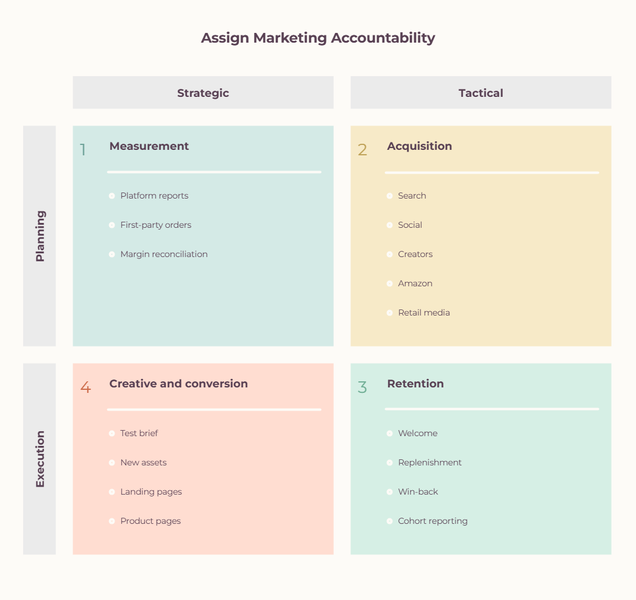
If a capability stays in-house, name the counterpart and handoff. An agency can still be a strong fit with a narrower remit; the contract should make that boundary visible.
How should you measure a growth agency beyond platform ROAS?
Ask for a scorecard that separates business outcomes from channel diagnostics.
For DTC, that usually means new-customer revenue, blended CAC, contribution margin after variable costs, and repeat purchase by acquisition cohort. Platform ROAS, click-through rate, and attributed orders help diagnose campaigns, but they should not be summed across platforms to claim total incremental revenue.
For a brand with Amazon or retail distribution, add channel-specific sell-through and new-to-brand measures where available, and document what the data cannot observe.
Ask how the team will validate a budget shift: a geo or matched-market test, a holdout, or a pre-agreed read of blended sales with seasonality accounted for. Set spending guardrails before scaling; 9AM's paid media scaling guide shows how that decision can be structured.
The best answer in a pitch is a sample weekly report with thresholds: what would trigger a creative change, a landing page change, a budget pause, or a channel reallocation? Each threshold should have an owner and a date for review.
Specialist or full-service growth agency: which should you hire?
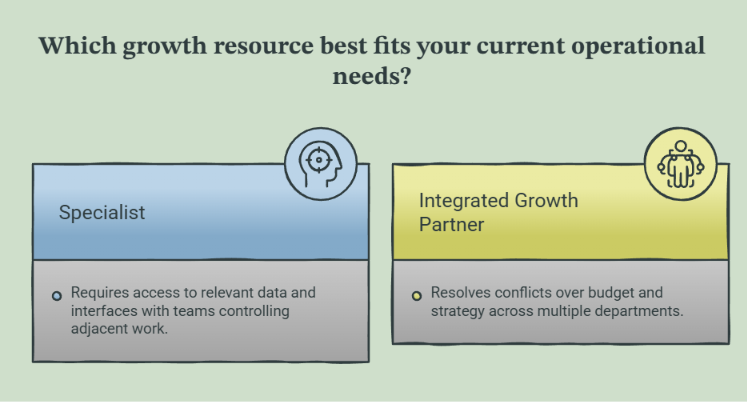
Hire a specialist when you already have an internal growth owner and the bottleneck is bounded: one paid channel, a defined CRO backlog, a retention rebuild, or a retail-media setup. Give that partner a single outcome, access to the relevant data, and an interface with the teams that control the adjacent work.
Choose an integrated growth partner when paid acquisition, creative volume, product-page conversion, and lifecycle performance are coupled and no one inside the brand can prioritize the trade-offs. The value is a shared decision process, not the number of services on a menu. Ask who leads the account, which specialists actually deliver each workstream, and how conflicts over budget are resolved.
If your brand sells both DTC and through retailers, decide whether one agency can own cross-channel planning while specialists execute particular channels. Require one measurement owner so the same sale is not counted as a separate win in every channel report.
How to compare proposals from growth agencies
Ask the same questions in every pitch. A useful answer contains the data request, a decision rule, and the person accountable for making the change.
- What is the growth constraint? Ask the agency to separate traffic quality, first-order conversion, contribution margin, and repeat purchase using your actual numbers. A proposal that prescribes a channel before this diagnosis has not established the bottleneck.
- What governs media spend? Request a simple scenario showing expected new customers, first-order margin, payback, and the point at which additional spend no longer supports the target. Our attribution model audit explains why platform credit alone can mislead that decision.
- Who owns the work between ad click and second order? Name the team responsible for creative, product and landing pages, email or SMS, and site experiments. “Full funnel” is meaningful only when the contract assigns delivery, testing, and reporting.
- How will DTC, Amazon, and retail be read together? Ask for a sample report that shows what can be observed, what is modeled, and what remains unknown. Retail exposure and online conversions should not be added as if they were independent sales.
- What happens in the first 90 days? Expect an audit, a prioritized test queue, owners, a reporting cadence, and explicit stop or scale rules. Request one comparable client example with the same buying cycle and distribution model.
What should your growth marketing agency shortlist include?
Invite three agencies with meaningfully different strengths: one for the current bottleneck, one for the next stage of growth, and one that challenges your preferred plan.
Give each the same margin, channel, customer, and repeat-purchase data. The best pitch will show which decision changes first and what evidence could prove the agency wrong.
Choose a growth marketing agency that can name the first decision
Start with the constraint you can verify: costly first orders, weak repeat purchase, fragmented retail reporting, or a launch that has not found its message. Then compare agencies on the work they will own and the evidence they will use to change course. The cases above establish relevant experience, but your own margin, customer, and channel data should determine the shortlist.
If paid media, creative testing, and revenue measurement are pulling in different directions, 9AM can audit the system and define a test plan.
Book a strategy call to discuss the accountable team, deliverables, and measurement rules before signing.
FAQ
What is the difference between a growth marketing agency and a performance marketing agency?
A performance marketing agency typically manages measurable acquisition channels such as paid search and social. A growth marketing agency may also take responsibility for creative testing, conversion, retention, and the economics connecting them. Labels vary, so compare the actual scope, named owners, and success metrics in each proposal.
How much does a growth marketing agency cost?
Pricing depends on channel scope, creative production, analytics work, and staffing. Ask each agency to separate its management fee, media spend, production costs, tools, and setup work. Compare the cost of the complete operating plan against the decisions and deliverables included, rather than a headline percentage of ad spend.
Should a consumer brand hire a specialist or a full-service agency?
Choose a specialist when an internal leader can coordinate the rest of the funnel and the task is narrow. Choose a broader partner when acquisition, creative, site conversion, and retention decisions must be made together. A hybrid can work if one owner reconciles priorities and reporting across teams.
What KPIs should a DTC growth agency report?
Ask for new-customer revenue, blended CAC, contribution margin, repeat purchase by cohort, and channel diagnostics with clear definitions. Retail and marketplace brands need additional sell-through or new-to-brand measures where available. The agency should explain what is observed, what is modeled, and what a test would validate.
How long should you give a new growth agency to show results?
Set a first-90-day plan with an audit, baseline, test queue, owners, and decision dates. Some changes can be read quickly, while retention and retail effects require longer windows. Judge whether the team identifies the real constraint and changes decisions with evidence before expecting a stable long-term revenue trend.