

Most of the controls a media buyer used to own now sit inside the platforms. Google sets bids auction by auction, and Meta's Advantage+ suite automates budget allocation, audience targeting, and bid adjustments.
What's left to manage is the input the algorithms can't produce on their own: creative worth delivering.
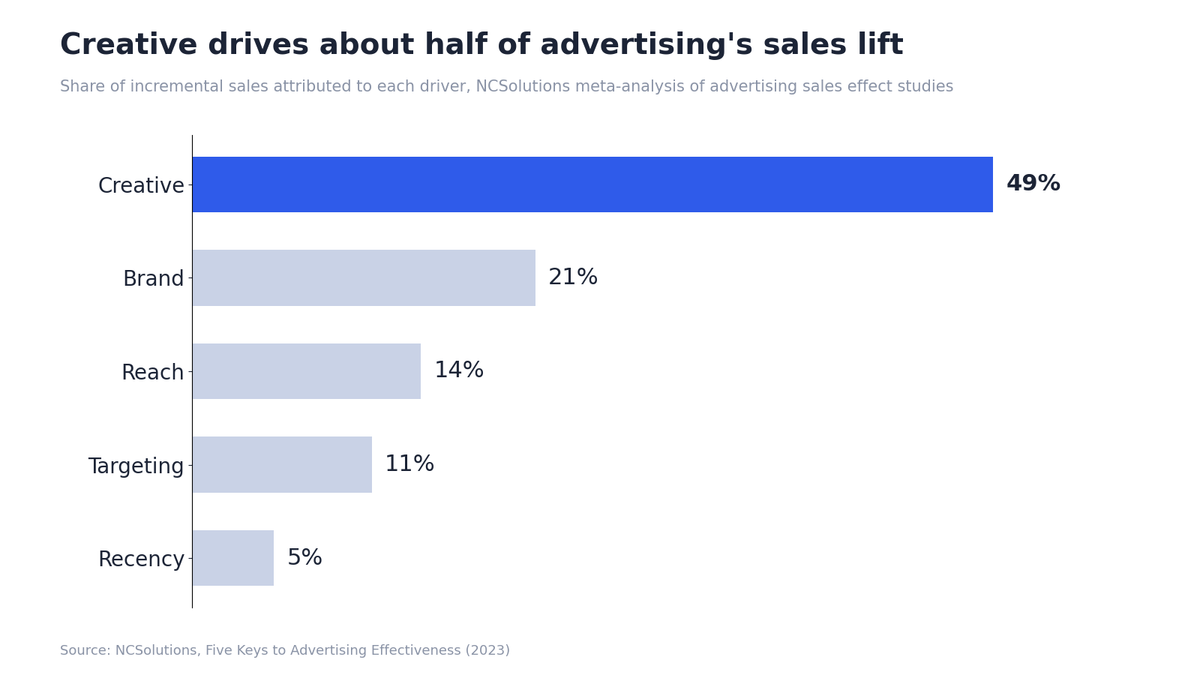
And creative carries more weight than most teams assume, driving 49% of the incremental sales lift from advertising in NCSolutions' analysis.
This guide covers what creative testing and ad refresh deliver, how to tell whether an agency does them, and how to measure, scale, and use AI in the process.
P.S. If you want a second opinion on your current creative pipeline, our creative strategy team audits accounts and builds testing systems alongside media buying.
TL;DR
- Creative drives the biggest share of results. It accounts for about half of advertising's sales lift, more than four times the share of targeting.
- Bidding is automated. Smart Bidding, Performance Max, and Advantage+ handle bids and budgets, so the agency's leverage moves to creative.
- Ad fatigue is measurable. Meta flags an ad once its cost per result climbs past your previous ads, and calls it fatigued at double.
- Winners come from volume. About 5% of Meta creatives become winners, so the number of real tests decides how many you find.
- AI multiplies variations, not ideas. It cuts production time, while concepts, claims, and brand judgment still need people.
Our view before the details: the creative is now the targeting. When the platform chooses the audience, the person on screen, the problem they name, and the format they appear in decide who sees the ad and who responds. That makes paid media a laboratory for creative ideas, where every dollar should either scale a proven concept or teach you something about the next one. An agency that only manages bids is tuning the part of the system the platform already runs, and leaving the larger lever to whoever happens to send over new assets.
What Are the Benefits of Creative Testing and Ad Refresh?
Creative testing and ad refresh raise sales lift, lower cost per result, and produce more winning ads. They also help automated platforms deliver better, improve search ads, and reveal who your buyers are. Each benefit has published platform or industry evidence behind it, summarized at the end of this section.
Creative drives the largest share of sales lift
Creative is the single biggest driver of advertising's sales effect.
NCSolutions' 2023 Five Keys study, built on hundreds of sales effect studies, attributes 49% of incremental sales to creative, 21% to brand, 14% to reach, 11% to targeting, and 5% to recency.
Marketers consistently underestimate this. Across five years of Advertiser Perceptions surveys, marketers have put creative's share at only 19% to 21%. Budgets and agency scopes built on that estimate spend most of their attention on the smaller levers.
Automated platforms deliver better when they get more creative
Automated campaigns perform better with more, and more varied, creative to work with. Meta reports that advertisers who switched on Advantage+ creative saw a 22% increase in ROAS, and businesses using its image generation saw about 7% more conversions.
Meta has also been direct about where the lever sits now.
In 2025 it told advertisers that the focus has moved from niche targeting to creative diversification as the best way to reach the right audiences. Its Andromeda retrieval system picks which ads compete for each person, so a library of genuinely different concepts gives it more distinct options to match.
Regular refresh keeps cost per result from climbing through ad fatigue
Ad fatigue is the point where an audience has seen the same creative so often that response drops and cost per result rises. Meta defines it precisely.
Ads Manager shows "Creative limited" when cost per result is above your past ads but less than double, and "Creative fatigue" once it reaches double or more.
Two details in Meta's definition matter for refresh planning.
- It counts recent exposures of the same image or video across all campaigns from your Page, so duplicating a winning ad into a new campaign doesn't reset fatigue.
- Its first recommendation is a new ad that is materially different from the original, which a color swap or new headline usually isn't.
The warning signs show up before the status changes, and catching them early is how to avoid ad fatigue before it costs money:
| Signal | What it looks like | Where to check | What to do |
|---|---|---|---|
| Rising frequency | The same people see the ad more often each week | Ads Manager frequency column, by ad | Brief a new concept for the same audience |
| Falling click-through rate | CTR drops against the ad's own first weeks | Ad-level trend over 7 to 14 days | Test a new hook on the same angle |
| Climbing cost per result | CPA rises with no change in bids or budget | Ad-level cost per result compared with account history | Launch replacements and keep the original live |
| Delivery status change | "Creative limited" or "Creative fatigue" appears | Ads Manager delivery column | Move the replacement brief to the front of the queue |
| Spend shifting away | The platform stops spending on a former winner | Spend share by ad over time | Read it as fatigue first, before changing bids |
More tests produce more winning ads
Winning creative is rare, so the number of real tests decides how many winners you find.
Motion's 2026 Creative Benchmarks, covering $1.29 billion in Meta spend and 578,750 creatives, found that about 5% of creatives become winners, defined as ads that earn at least ten times the account's median spend.
At a 5% hit rate, an account that tests 10 concepts a month should expect one winner every other month. An account that tests 40 can expect two a month.
The difference shows up in how long a brand can scale before performance stalls.
Search ads improve with creative testing too
Creative testing pays off in search along with paid social. Google reports that advertisers who improve responsive search ads and sitelinks from "Poor" to "Excellent" ad strength see 15% more conversions on average. Adding a second responsive search ad to an ad group brings about 6.6% more conversions at a similar cost, and a third adds another 3.7%.
Those gains come from headline and description variety, which is copy testing by another name. An agency that treats search as a bidding exercise leaves them on the table.
Creative tests tell you who your buyers are
Every creative test is also a small piece of market research. When a concept built around one persona or objection outperforms the others, it tells you which customer the platform found and what they responded to.
That insight travels.
It can sharpen landing page messaging, inform which offers to lead with, and guide where to expand, including the channels performance teams are adding as they diversify beyond Facebook ads.
| Benefit | Evidence | What changes in your account |
|---|---|---|
| Higher sales lift | Creative drives 49% of incremental sales | Creative gets a planned share of time and budget |
| Better automated delivery | Advantage+ creative users saw 22% higher ROAS | More distinct concepts per campaign |
| Lower cost per result | Meta flags fatigue at double past cost per result | Replacements are briefed before fatigue sets in |
| More winners | About 5% of creatives become winners | Testing volume becomes a tracked target |
| Stronger search ads | Excellent ad strength brings 15% more conversions | Headlines and descriptions get tested on a schedule |
| Buyer insight | Persona and angle results show who responds | Landing pages and offers follow creative learnings |
Why Bid Management Alone No Longer Moves Performance
Bid management alone no longer moves performance because the platforms took over most of it. Google says more than 80% of its advertisers use automated bidding, a figure from 2021 that has only grown since, and Performance Max runs exclusively on Smart Bidding.
On Meta, Advantage+ handles budgets, audiences, and bid adjustments.
Manual bid work still exists at the edges: setting targets, choosing conversion events, managing seasonality. But the daily tuning that used to fill a performance marketing manager's week now happens at auction time, inside the platform, on more signals than any person can process.
| Lever | Who controls it now | What the agency still owns |
|---|---|---|
| Bids | Platform, at auction time | Bid strategy choice, CPA or ROAS targets |
| Budget pacing | Platform, within campaign budgets | Budget split across campaigns and channels |
| Audience selection | Platform, with broad targeting | Exclusions, signals, and the persona inside the creative |
| Placements | Platform, with automatic placements | Format choices so every placement has a fitting asset |
| Creative | Advertiser and agency | Concepts, hooks, formats, testing, and refresh |
| Measurement | Shared | Conversion setup, tracking quality, incrementality tests |
The last two rows are where a media agency earns its fee now. An agency that reports on bid changes and budget pacing is reporting on work the platform already does.
What Creative Testing and Ad Refresh Mean for a Media Agency
Creative testing is the structured practice of launching distinct ad concepts, hooks, and formats to learn which ones drive results, with enough budget and time for each to give a readable answer. Ad refresh is the planned replacement or rotation of creative before fatigue raises costs, based on each ad's performance history.
Creative diversification, Meta's term, is the result both produce: a set of ads different enough that the platform can match each one to a different kind of person.
For a media agency, these are ongoing responsibilities that sit inside the media plan, with their own cadence and budget. The full mechanics of building a testing system, from hypotheses to tools, live in our guide to creative testing systems that compound over time. This piece covers what that work should look like inside an agency relationship.
How to Tell If Your Media Agency Handles Creative or Only Bids
The quickest way to tell is to ask about volume, ownership, and speed. These six questions surface whether creative testing is part of the agency's work or something it waits for you to supply.
1. Ask how many new concepts they launched last month and how many became winners
"How many genuinely new concepts did you launch in our account last month, and how many earned scaled spend?"
A strong answer gives two numbers and separates new concepts from small variations. Compare the volume to your spend level using the benchmarks in the volume section below.
2. Ask who briefs the replacement when an ad fatigues, and how fast it ships
"When an ad hits fatigue, who writes the next brief, and how many days until a replacement is live?"
Look for a named owner and a turnaround measured in days. If the answer is "we let you know and you send new assets," the agency manages delivery while you carry creative.
3. Ask how creative strategists and media buyers work together
"Do the people who buy the media and the people who make the ads work on the same team, with the same data?"
Strong agencies run creative and media from one account team and one performance view. Handoffs between separate departments slow refresh and lose the learnings that should shape the next brief.
4. Ask how they test creative in search campaigns
"How do you test headlines and descriptions in search, and how often do you rewrite them?"
A strong answer names the asset-level report they review and how often they replace low performers. Silence here suggests search is treated as bids and keywords only.
5. Ask how they source enough variety without exhausting the brand
"Where will the next 30 concepts come from, and how will they stay on brand?"
Creator programs are one answer. For NIQ, we built a network of more than 100 unique creators a month across 17+ countries, and for Unroll.me, we worked with eight different creators each month inside a volume testing framework. A strong agency can explain its sourcing and the brand guardrails around it.
6. Ask how creative production is scoped and priced
"What creative volume is included in the fee, and what does each extra concept cost?"
A strong answer ties volume to spend and spells out usage rights for creator content. Vague answers often mean creative is billed as a surprise once fatigue arrives.
| Question | Strong answer | Red flag |
|---|---|---|
| New concepts and winners | Two numbers, concepts separated from variations | "We refresh regularly" |
| Replacement ownership | Named owner, turnaround in days | "Send us new assets when you have them" |
| Creative and media teams | One account team, shared data | Separate departments with handoffs |
| Search creative | Multiple RSAs, asset reporting, rewrite schedule | Search managed as bids and keywords |
| Creative sourcing | Creator network or production system with guardrails | No plan beyond your in-house designers |
| Scope and pricing | Volume tied to spend, usage rights defined | Creative billed ad hoc |
How to Measure Creative Testing Results
Measure creative on a ladder, from early attention signals up to incremental conversions, and make decisions on the deepest rung your data supports. Early metrics tell you whether an ad gets watched. Only the later rungs tell you whether it makes money.
| Metric | What it tells you | When it misleads |
|---|---|---|
| Hook rate (3-second views ÷ impressions) | Whether the opening stops the scroll | A strong hook can attract people who never buy |
| Hold rate or average watch time | Whether the story keeps attention | Long watch time on a weak offer still won't convert |
| Click-through rate | Whether the message earns a visit | Curiosity clicks inflate CTR without sales |
| Cost per acquisition and ROAS | Whether the ad drives conversions at a profit | Platform attribution can credit sales that would have happened anyway |
| Incremental conversions | Whether the ad caused sales that wouldn't have happened | Needs enough volume and a clean holdout to read |
Incrementality is the hardest rung and the most honest one.
Meta's lift studies split people into a test group that can see your ads and a control group that can't, then report the difference. Use them to check whether the creative approach your platform data favors is actually driving new sales.
Every rung depends on clean conversion data. If events are missing or duplicated, creative tests read noise, which is why tracking quality belongs in the creative conversation. Our guide to server-side tracking for paid media teams covers the setup.
How Much Creative Volume a Media Plan Needs
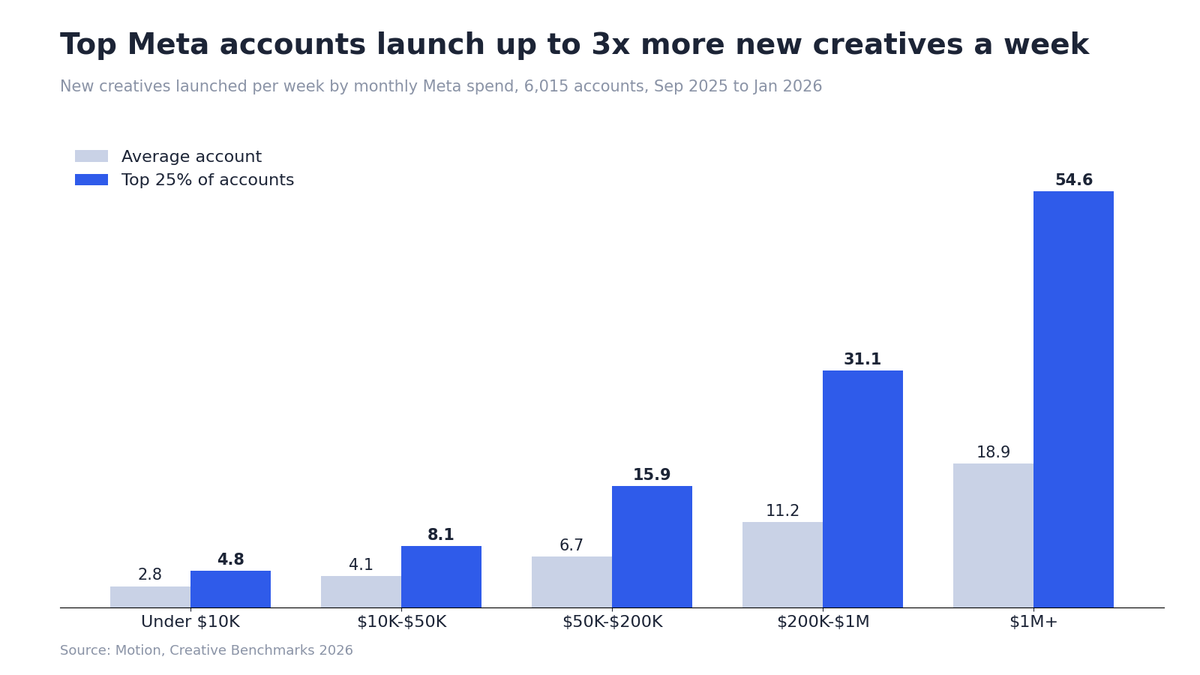
Creative volume should scale with spend, and the best-performing accounts ship roughly two to three times the average at most budget levels.
Motion's 2026 data shows average weekly creative launches by spend tier, from 2.80 new creatives a week for accounts spending under $10,000 a month to 18.85 for accounts above $1 million. The top quarter of accounts at each tier ship far more: 15.95 a week at the medium tier and 54.64 at the top.
Customer acquisition at scale needs that kind of throughput.
For our clients, we can produce 50+ unique assets a month across multiple creative types, which keeps the account supplied with fresh concepts over multi-year partnerships.
Use your spend tier as a starting target, then adjust to what your account's own fatigue rate shows. If you'd like a plan sized to your budget, our media buying team builds creative volume into every media plan.
How a Creative Testing and Refresh Cycle Runs Inside a Media Agency
A working cycle runs on a weekly or biweekly rhythm, with media and creative teams reading the same data and agreeing on the next brief together. These five steps keep it moving:
- Set fatigue thresholds from each account's own baseline. Agree in advance what rise in cost per result or drop in CTR triggers a replacement brief, using each ad's own history.
- Brief new concepts from performance data. Start from what the last round taught: which persona, objection, or format won. Our guide to high-converting UGC briefs covers how to write them.
- Launch tests in a ring-fenced budget slice. Keep a fixed share of spend for new concepts so tests get enough delivery to read, without putting the main campaigns at risk.
- Read results on the business metric. Judge concepts on cost per acquisition or ROAS, and confirm big shifts with incrementality where volume allows.
- Log the learning for the next brief. Record what each test showed, so the next round starts from evidence and the account keeps getting smarter.
How to Scale Winning Creative
Scale a winner by extending the concept, protecting its delivery, and adapting it for new placements and channels. These four moves work in parallel.
Build iterations on the winning concept
Keep the angle that won and test new hooks, lengths, formats, and on-screen talent around it. Iterations usually hit faster than brand-new concepts because the core idea is already proven.
Move winners into scaling campaigns without resetting delivery
Add winners to your main campaigns and leave the original running. Meta notes that keeping the original ad active alongside new ones may maximize results, because pausing a proven ad throws away the delivery data behind it.
Extend winners through creators and whitelisting
A winning script can be re-shot by several creators and run from their handles as whitelisted ads, which adds variety and borrowed trust at once.
Our roundup of Spark Ads and whitelisting agencies covers how teams run this on TikTok. Give each creator room to retell the script in their own words, since a word-for-word reshoot tends to read as the same ad to the platform and to viewers.
Adapt winners across placements and channels
Reformat the concept for Reels, Stories, YouTube, and display, and test it in other marketing channels.
A concept that wins in one feed usually carries, but the format has to be native to each placement: vertical and sound-on for Reels, a clear first frame for Stories, and a stronger opening five seconds for skippable video.
Pro tip: YouTube in particular rewards longer cuts of a winning idea, which is why we track the YouTube ads agencies doing this well.
How AI Changes Creative Testing and Refresh
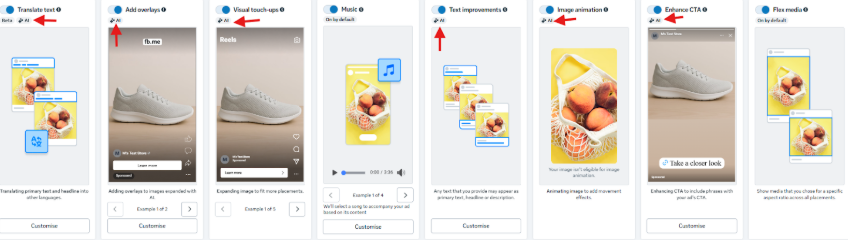
AI lowers the cost of producing variations and speeds up refresh, while concepts, claims, and brand perception still need human judgment. Adoption is already broad: Meta said in July 2026 that more than 9 million small businesses use at least one of its AI creative tools, and that its Advantage+ suite had passed a $75 billion annual revenue run rate.
AI is useful in four places:
- Variations: new backgrounds, crops, text versions, and cut-downs of a winning ad.
- Resizing: one concept adapted to every placement and aspect ratio.
- Localization: translation and voiceovers for new markets.
- Search copy: Google's text customization generates headlines that count toward ad strength.
AI is weaker at the work that decides results: choosing the persona, the problem, and the proof. It also has a quiet failure mode. When every variation comes from the same source asset, the ads look alike, and a retrieval system that groups similar creative can treat them as one. Use AI to multiply a good idea, and keep people responsible for the ideas themselves.
Build a Creative Testing Engine with 9AM
The agencies that keep growing accounts treat creative as part of the media plan, with its own volume targets, budget, and cadence.
That's how we run accounts at 9AM: creative strategists and media buyers on the same team, briefs built from performance data, fatigue thresholds set per account, and every test read on cost per acquisition or ROAS. Learnings from one round go straight into the next brief, so the account compounds what it knows.
If your current agency reports mostly on bids and budgets, bring the scorecard above to your next review and ask for last month's concept count alongside the usual spend report.
Or book a strategy call and we'll audit your creative pipeline, fatigue patterns, and testing volume against your spend.
FAQs
Does Advantage+ creative replace a refresh process?
No. Advantage+ creative generates variations of the assets you give it, so it extends the life of a concept without supplying new ones. Once the underlying idea fatigues, its variations fatigue with it.
How long should a creative test run before you call it?
Run it until each concept has enough conversions to compare, which usually means at least a week to cover day-of-week swings. Calling tests on a day or two of data tends to reward early clicks over buyers.
How do you test creative when conversion volume is low?
Read a higher-volume proxy that correlates with purchases in your account, such as add-to-cart or qualified lead, and test fewer, bigger concept differences. Small variations need far more volume to separate than distinct ideas do.
Do search campaigns need a refresh cadence like paid social?
Search fatigues more slowly, because people see your ad only when they search. Review asset-level performance monthly, replace the weakest headlines and descriptions, and keep at least two responsive search ads per ad group.