


A national retail launch rarely reaches every shelf at once. Product availability, retailer approvals, store openings, and promotional calendars vary by market, even when the advertising has one launch date.
The agency's job is to make those moving parts work together.
That starts with shared messages and a purchase path shoppers can actually use. It also requires a plan for changing campaign coverage when the retail footprint changes.
This guide explains what evidence to request from an agency, how to compare proposals, and how to measure and expand a rollout after launch.
Our view: creative, media, and retail execution should inform each other throughout the campaign. A local stock problem should change the media decision. A recurring shopper objection should change the creative brief. Sales evidence should shape the next expansion. Integration earns its value through those decisions, with named people responsible for making them.
If those connections need a closer review, 9AM's retail marketing services can support the strategy for digital demand and store performance.
What Does Integrated Marketing Communications Mean for a National Retail Rollout?
Integrated marketing communications coordinates the message, timing, and purpose of each customer touchpoint around a shared commercial objective.
For a retail rollout, that might connect a national awareness campaign with local creator content, retailer search ads, PR, store signage, and a product page showing where to buy. Each channel has a specific job, and shoppers should recognize the same product benefits as they move between them.
Omnichannel retail adds a related layer: the shopping experience across stores, ecommerce, pickup, and customer service. Retail media supplies advertising placements and retailer data. An integrated communications strategy decides how those capabilities support the launch, alongside channels outside the retailer's environment.
The practical starting point is the purchase barrier.
A new food product may need taste education and trial; a durable product may need demonstrations and price justification. New stores need local discovery and accurate opening information. Our guide to CPG digital marketing explores how those demand and purchase pathways connect.
Pro tip: Ask an agency to map the journey from first exposure to the actual shelf, product page, or store visit. The map should identify the message, destination, and owner at each transition.
What to Look for in an Integrated Marketing Agency for a Retail Rollout
Look for evidence that the agency can coordinate a launch under the conditions your business actually faces. Relevant deliverables, assigned people, and clearly qualified results make that evidence easier to assess.Here’s a breakdown of what all that entails:
Retail Readiness Should Determine the Agency's Rollout Plan
A credible rollout plan begins with where shoppers can buy and when that availability can be verified. Request a readiness register covering the retailer, market, product assortment, expected shelf date, purchase destination, and person responsible for confirming each condition.
A purchase order or delivery to a distribution center does not establish that a product is on shelf. The agency should explain which retailer or field inputs it needs and how uncertainty affects geographic coverage. Where inventory data is delayed, the plan needs a documented way to verify availability before promising it in ads.
Use a simple register to connect readiness with campaign decisions:
| Readiness check | Evidence to request | Campaign decision |
|---|---|---|
| Product or store is available | Confirmed locations, assortment, or opening status | Activate the relevant market |
| Purchase destination works | Tested product page, locator, or pickup path | Approve the destination and call to action |
| Retailer requirements are cleared | Approved creative, offer conditions, and placement dates | Release the applicable assets |
| Replenishment can support demand | Agreed stock updates and escalation contact | Adjust spend or coverage when conditions change |
For owned stores, Google's local inventory tools can connect nearby shoppers with product and store information. A CPG supplier selling through third-party retailers must establish what the retailer controls, what data is accessible, and which advertising arrangements are available. Access should be demonstrated during planning.
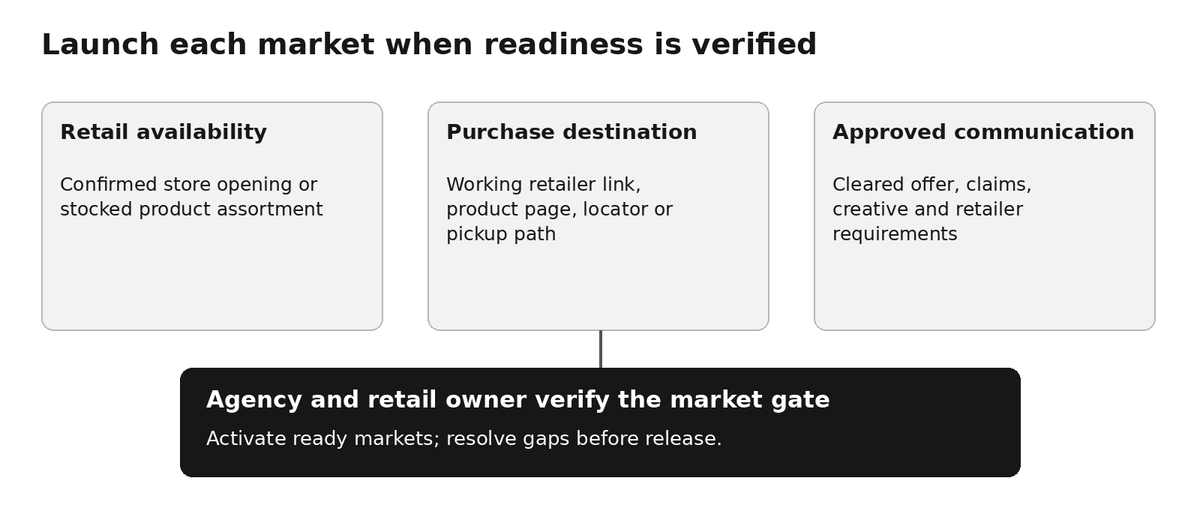
Ask the agency to walk through a shelf-set delay in one region. A useful answer identifies who verifies the delay, which assets change, and how affected spend is handled while ready markets continue.
National Brand Messaging Needs a Defined Local Adaptation System
National consistency starts with a clear message architecture:
- Product benefits
- Recognition cues
- Approved claims
- Offer conditions
- The evidence behind them
Local adaptation then makes that message relevant to a particular retailer, audience, or purchase occasion.
Request examples showing how one campaign idea becomes a creator brief, paid social ad, retailer product message, and shelf asset. The formats should reflect their environments. A short shelf message has different space and attention constraints from a demonstration video.
Our approach to creative testing systems provides useful context for asking how those variations are tested and refreshed. Ask what the agency learns from each variation and how that learning changes the next brief.
Define the adaptation rules before production begins:
| Message element | National rule | Permitted local change |
|---|---|---|
| Product benefit | Approved benefit and supporting evidence | Relevant use occasion or shopper objection |
| Brand recognition | Agreed packaging, identity, and product cues | Format-specific composition |
| Availability | Verified retailers and locations | Local destination and store reference |
| Offer | Approved eligibility and terms | Retailer-specific offer where authorized |
Creator programs also need clear disclosure instructions.
The FTC's influencer guidance explains how material relationships should be disclosed with endorsements. The agency should build that requirement into briefing and review.
For a bounded example, 9AM's Mogu Mogu campaign used 65+ local micro-influencers to introduce an unfamiliar coconut jelly drink through reaction videos and taste tests. The published case reports 30M+ accounts reached.
Side note: Those figures, of course, demonstrate the program's reported creator scale and reach; they do not establish store sales lift.
The question for a prospective agency is specific: how will it preserve the product's core promise while adapting the messenger, context, and purchase destination?
The Assigned Team Must Coordinate National and Store-Level Execution
The team selling the work may differ from the team delivering it. A national rollout can use an agency's own specialists, partner firms, or client teams.
- Meet the assigned account lead, creative lead, media lead, and measurement lead.
- If physical activations are included, establish who owns staffing, retailer authorization, training, and field reporting. The arrangement needs a clear integrator with authority to resolve dependencies.
- Ask how partners are selected, what is subcontracted, and who remains accountable when a handoff fails.
- Request a sample launch schedule showing asset deadlines, retailer approvals, media activation, field activity, and reporting.
- Then ask for the escalation process behind it. A shared calendar is useful only when people know which conditions authorize the next action.
The physical layer has its own demands.
Walmart Canada's sampling case study describes targeted two-day activations across five grocery-brand campaigns. Scheduling, product availability, shopper-facing instructions, and reporting all need coordination. It is a useful reminder to examine field capability whenever sampling appears in the scope.
Pro tip to make this better: Give the agency a realistic scenario.
- The retailer rejects an offer asset after production, while one market experiences a stock shortage.
- Request the decision sequence, responsible people, and revised deliverables. The response should show how the team protects accurate messaging and keeps ready locations moving.
Also verify capacity during overlapping launch waves. A regional network alone says little about current staff availability or supervision. References from clients with comparable retailer and production complexity help establish whether the delivery model works in practice.
Retail Measurement Must Separate Attributed Sales from Incremental Growth
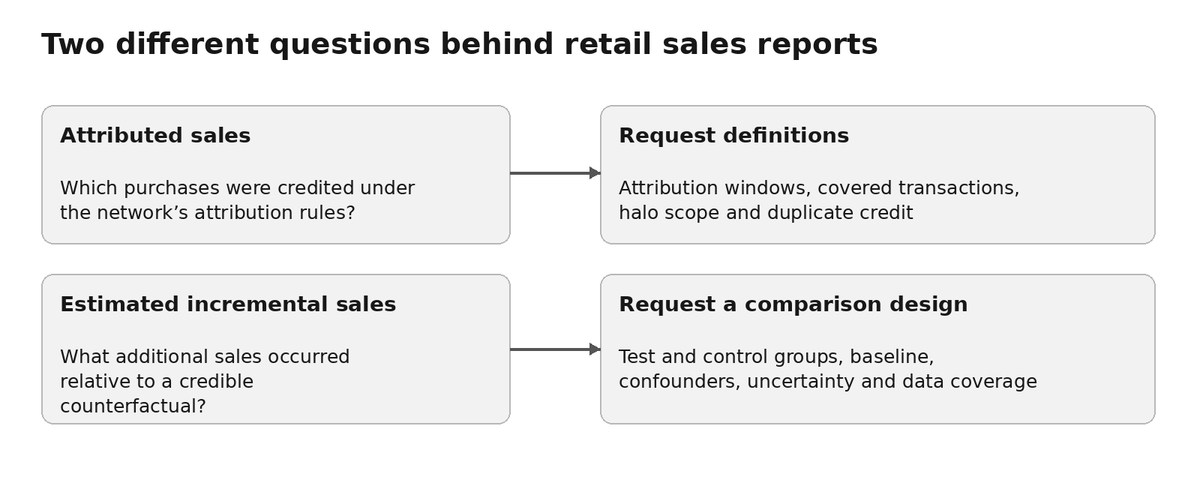
Ask for a measurement plan before reviewing performance claims. It should identify accessible data, the baseline, reporting coverage, attribution definitions, and the method used to estimate any incremental effect.
- Attributed sales are purchases credited to advertising under a network's rules.
- Incremental sales are the additional purchases estimated to result from the activity.
The distinction matters when shoppers encounter multiple channels or would have bought without the campaign.
The IAB/MRC retail media measurement guidelines provide a reference for examining measurement definitions, but request the agency's actual specification:
- Click and view windows
- Online and offline coverage
- New-to-brand lookback
- Halo products
- Returns
- Potential duplication between networks
For a concrete case, Vestcom reports 8.7% incremental sales lift for Amy's Kitchen during a 16-week shelf-media campaign promoting seven new SKUs. The published method compares exposed stores with matched unexposed stores, using 1:1 matching across multiple variables.
That disclosed design makes the result more assessable, although matching cannot guarantee that every relevant difference was removed.
Our discussion of retail media and brand building adds context for evaluating how short-term advertising results relate to the wider brand objective.
Ask what the agency would do when randomized testing is unavailable. Suitable alternatives may include carefully matched markets or stores, with explicit assumptions. Promotions, stockouts, seasonality, and shopper movement can complicate comparisons. Data coverage and statistical power should determine what can be concluded.
Source: 9AM
An agency that qualifies its evidence gives the buyer a stronger basis for decisions. A dashboard alone cannot resolve missing data, incompatible definitions, or an unsupported causal claim.
Agency Proposals Need Comparable Costs and Explicit Scope
Compare proposals against the same retailer footprint, product assortment, asset volumes, launch waves, and reporting requirements. A lower headline fee can reflect fewer deliverables, different assumptions, or costs billed elsewhere.
The WFA/VoxComm agency-selection guide recommends clarity on objectives, budgets, engagement models, and selection criteria. It also cautions against relying solely on hourly-rate comparisons. Use a common scope so each proposal can be assessed as a complete engagement.
| Cost category | Compare across proposals | Clarify before signing |
|---|---|---|
| Strategy and management | Deliverables, assigned team, launch waves | Included coordination and revision work |
| Creative and localization | Formats, asset quantities, adaptations | Refreshes, approval rounds, source files |
| Media and creator activity | Management charges, spend, usage rights | Minimums, markups, license duration |
| Physical execution | Staffing, printing, freight, storage | Cancellation charges and subcontractors |
| Data and measurement | Access, implementation, reporting, tests | External fees, limitations, maintenance |
Choose the operating model deliberately.
- A lead integrated agency can own coordination across specialists.
- A client-led roster requires internal capacity to manage dependencies.
- A hybrid arrangement can retain existing partners while assigning one team responsibility for the launch plan.
Separate launch production from ongoing optimization.
Document what happens when a retailer adds locations, an approval requires new assets, or a product range changes. Identify who approves additional costs and how contingency funds are controlled.
Finally, establish account access, creative ownership, creator licenses, reporting exports, and handover support. Those terms affect whether the business can continue the program smoothly after the initial rollout or a change of partner.
Relevant Case Studies Need Verifiable Scope and Outcomes
Ask for cases that resemble the rollout's commercial conditions: category, retailers, geographic footprint, purchase barriers, and coordination requirements. A famous client name provides limited information about the work an agency performed.
For each case, request:
- The agency's specific responsibilities and delivery partners.
- The campaign period, baseline, and relevant budget context.
- The outcome definition and data source.
- The role of promotions, distribution changes, and stock availability.
- A reference who can discuss the assigned team's work.
Treat performance examples according to their disclosed scope.
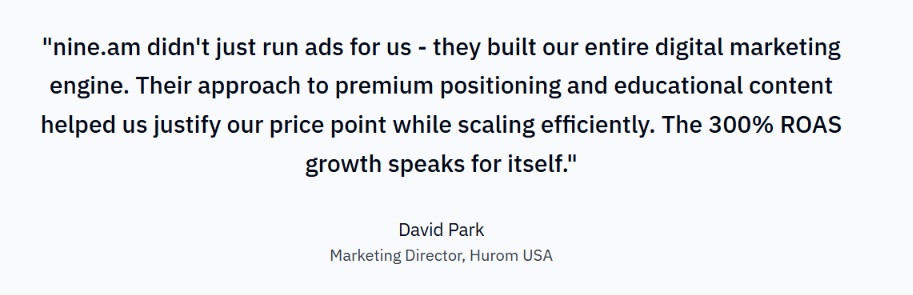
9AM's Hurom case study reports 4x revenue growth and a 70% CPA reduction through creative, educational content, and paid media. That is relevant to a performance capability discussion. The published case does not establish national store rollout execution, so a buyer should assess that requirement separately.
Ask the reference how the agency handled a missed deadline or changed retail conditions.
Clarify which team members managed the response and whether reporting arrived in time to support a decision. The same discipline applies to any shortlisted agency. A media result does not establish merchandising capability, and a completed activation does not establish incremental sales. Ask the provider to connect the evidence to the responsibility being awarded.
For CPG teams preparing that coordination, 9AM's CPG marketing services can support a discussion of demand generation, retail media, creative, and measurement around the launch plan.
How to Measure an Integrated Retail Launch
Measure operational readiness from launch and review outcomes as usable data arrives. Waiting for a single retrospective report can leave avoidable execution problems unresolved.
Unfortunately, NIQ reports that over two-thirds of global innovators do not measure launches until at least week 12. If you are doing the same thing, you are likely missing a lot of useful information.
Use the metric dictionary agreed before activation:
| Metric | What it tells you | Where it comes from |
|---|---|---|
| Verified availability | Whether advertised stores or products are ready | Retailer updates, inventory feeds, field checks |
| Units per store per week | Sales velocity within a defined store group | Retailer POS or syndicated sales data, where accessible |
| Attributed sales and ROAS | Purchases credited under stated advertising rules | Retail media network reports |
| New-to-brand purchasers | Buyers classified as new within a stated lookback | Retailer transaction or loyalty reporting |
| Estimated incremental lift | Additional sales estimated against a counterfactual | An appropriately designed experiment or comparison |
| Repeat purchase | Whether identified trial buyers buy again | Accessible panel, loyalty, or consented customer cohorts |
As a practical operating cadence:
- Review availability, working destinations, delivery, and spend weekly.
- Review velocity and margin when refreshed sales data permits.
- Agree broader outcome checkpoints before launch, accounting for retailer reporting delays and the product's purchase cycle.
For owned web journeys, server-side tracking can support governed event collection and validation. It does not automatically expose third-party store purchases, eliminate identity gaps, or prove that advertising caused a sale. Keep web events, retailer transactions, and experimental results clearly identified in the report.
Every review should end with a decision, an owner, and a follow-up date.
Correct inaccurate availability immediately; investigate weak velocity alongside pricing, promotion, and stock conditions; scale only when the evidence supports the agreed commercial objective.
How to Scale After the First Retailer Wins
Scale from a repeatable commercial result: demand that holds beyond the initial promotion, replenishment that can support it, and contribution economics that justify further investment.
A useful default sequence is to add retailers selectively, expand regions, then widen the product assortment. Existing buyer commitments or supply constraints may require a different order. Change one major source of complexity at a time where possible.
- Add retailers with a clear purchase and reporting plan. Confirm shopper fit, assortment, fees, launch support, and accessible performance data. Prepare each retailer's creative and media requirements. The Walmart Connect guide explores why retail readiness matters alongside campaign setup.
- Expand regions from verified availability. Prioritize locations with replenishment capacity and a viable purchase path. Carry forward the core message, then test local objections and destinations. Give each region an explicit launch gate and review owner.
- Add products after demand and operations support the next assortment. Assess whether a new SKU reaches another purchase occasion, improves the offer, or creates avoidable fragmentation. Establish its margin, shelf requirements, and production implications before increasing promotion.
Then examine the demand left after launch activity slows.
- For frequently purchased products, repeat buying can reveal whether trial becomes an ongoing habit.
- For durable goods, retention may involve accessories, referrals, or service relationships. A retailer's new-to-brand classification does not establish repeat purchase by itself.
Our retention marketing guide explores how lifecycle communication supports that relationship. At retail, apply those tactics only where customer access and consent allow them. Continue retailer partnerships and shopper education where direct communication is unavailable.
Use the next rollout wave to test a defined expansion hypothesis. Record what changed, what stayed consistent, and which evidence will justify another commitment.
How to Evaluate Agency Finalists Before a National Retail Rollout
Evaluate finalists against one consistent brief and require evidence for the responsibilities each agency would own. This creates a practical comparison across different operating models.
Use the following sequence:
- Issue a shared brief. Include markets, retailers, assortment, launch constraints, commercial objectives, budget assumptions, and known data access.
- Request comparable submissions. Ask for a readiness plan, adapted creative, named delivery leads, measurement specification, and itemized costs.
- Meet the assigned team. Discuss dependencies with the people who would manage them and confirm their availability.
- Run a common disruption exercise. Use a delayed shelf set or rejected offer asset. Compare the proposed decision process and response.
- Verify references and close gaps. Check actual scope and delivery quality, then record unresolved risks before appointment.
| Evaluation area | Evidence worth requesting | Warning sign |
|---|---|---|
| Retail and category fit | Comparable scope and client references | Logos without a clear account of the work |
| Launch readiness | Store-level gates and escalation process | Coverage based only on planned distribution |
| Message coordination | Actual adaptations and approval rules | Unclear ownership of claims or local changes |
| Delivery capacity | Assigned leads and partner responsibilities | Unnamed team or undocumented subcontracting |
| Measurement | Definitions, access, baseline, test assumptions | Guaranteed lift or unexplained attribution |
| Commercial clarity | Comparable scope and full cost assumptions | Important costs left outside the proposal |
Set weights around the business's main execution risks.
A launch with heavy sampling requirements needs different emphasis from a retailer ecommerce expansion. A score can organize judgment, but an unresolved critical dependency still needs a named solution before the contract is awarded.
Plan Your National Retail Marketing Rollout with 9AM
A strong agency relationship gives the rollout a shared message, a workable purchase path, accountable delivery, and evidence the business can act on. The selection process should establish how those elements will connect before production and media commitments grow.
9AM's published services cover creative strategy, media buying, influencer marketing, growth strategy, and analytics. A rollout discussion can identify how that work should connect with the client's retail team and any retailer, PR, merchandising, or field partners required by the scope.
Book a strategy call to review launch objectives, priority markets, readiness dependencies, and measurement feasibility. Start with the decisions the next rollout needs to resolve, then define the capabilities and ownership required to deliver them.
FAQ
Can a performance marketing agency lead an integrated retail rollout?
A performance marketing agency can lead when its agreed scope and delivery model cover the rollout's coordination requirements. Verify responsibility for creative, media, retailer approvals, physical execution, and measurement. Specialist partners or client teams may own some workstreams; one lead should integrate their decisions.
Does a national retail launch need every marketing channel?
A national retail launch needs the channels that address its purchase barriers and reach shoppers where the product is available. Select formats around the objective, budget, retailer support, and measurement capacity. Require a reason for each channel and a clear purchase destination.
How far before a retail launch should an agency be appointed?
Appoint the agency early enough to complete the launch's research, production, approvals, data setup, and partner onboarding. Work backward from retailer dates and the longest dependency. A universal lead time would overlook differences between store openings, new products, and existing-range expansion.
What can an agency measure without store-level sales data?
Without store-level sales data, an agency can report delivery, engagement, locator use, available retailer attribution, and other qualified indicators. These can guide improvements but may not establish total sales impact. State the coverage gap and investigate panel, retailer, or experimental options where feasible.
How should brands adapt the agency brief for store openings?
For store openings, emphasize actual opening readiness, catchment geography, accurate listings, local awareness, event logistics, and store-visit evidence. Product rollout briefs need additional attention to SKU distribution, shelf availability, sales velocity, and replenishment. Both require a verified destination and clear launch ownership.