


Paid media budgets are holding flat while expectations keep rising. Marketing budgets sat at 7.8% of company revenue in 2026, and paid media's share hit a five-year high of 31.4%. More money is moving through fewer, more automated channels, with more people touching it.
That makes ownership a performance issue. This guide gives you a paid media RACI template, the reasoning behind each row, and a way to audit ownership on a live account.
P.S. If you want a partner that runs media buying inside a clear ownership model from day one, 9AM sets this up during onboarding.
What is a paid media RACI matrix?
A paid media RACI matrix is a table that names who is Responsible, Accountable, Consulted, and Informed for every recurring paid media decision and task. It's a responsibility assignment matrix applied to budget, creative, tracking, and performance calls.
| Our view: most paid media problems that look like performance problems start as ownership problems. A reallocation waits a week for sign-off. Nobody owns the conversion event. Creative sits in review while the winning ad fatigues. The fix is boring and it works: one accountable owner per decision, written down, with thresholds that let the people closest to the data act fast. |
Responsible, accountable, consulted, and informed in paid media
Each letter maps to a specific kind of involvement:
- Responsible: the person who does the work, such as the media buyer who moves budget between ad sets.
- Accountable: the one person who owns the outcome and signs off. Every row gets exactly one.
- Consulted: people whose input is required before the work ships, such as legal on a health claim.
- Informed: people who need to know after the fact, such as finance after an in-month reallocation.
Why paid media needs a dedicated RACI matrix
Paid media needs its own matrix because money moves daily, several companies share the work, and the platforms automate decisions that used to be manual. A general marketing RACI covers campaigns at the brief level. It rarely says who can shift $40,000 between channels on a Tuesday, who owns the Conversions API, or who decides an ad is fatigued.
Decision speed is the real cost.
In a McKinsey Global Survey, only 20% of respondents said their organizations excel at decision making, and 61% said most of their decision-making time is used ineffectively. Paid media feels that inefficiency faster than most functions, because spend keeps running while a decision waits.
Who belongs in a paid media RACI matrix?
Seven to nine roles cover most paid media setups: client-side leaders who own budget and brand risk, agency-side operators who run the accounts, and specialists who supply creative and data. List roles as columns and never use individual names, so the matrix survives a hire or a departure.
Client-side roles
- Growth or marketing lead: owns the business targets and the total budget. Usually the accountable owner for anything that changes spend levels or KPIs.
- Finance: sets budget guardrails, approves payment methods, and reconciles spend.
- Data or engineering: implements tags, server-side events, and CRM connections inside the client's stack.
- Brand and legal: reviews claims, disclosures, and creator usage terms. The subject matter expert on risk.
Agency-side roles
- Agency lead: owns the plan, the recommendation, and the client relationship.
- Media buyer: builds campaigns, paces spend, and executes optimizations.
- Analyst: specifies tracking, QAs data, and builds reporting.
Creative partners, creators, and measurement vendors
Creative can sit with the agency, an in-house studio, or a separate creative agency. Creators, measurement vendors, and platform reps usually belong in the matrix as Consulted or Informed. Give them a column only when they own a deliverable with a deadline.
Paid media RACI template
The template below assigns R, A, C, and I across 25 recurring paid media decisions for a brand working with a media buying agency. Copy it, then adjust the columns to match your team. A dash means the role isn't involved.
| Want the editable version? Copy the free paid media RACI template as a Google Sheet. It includes dropdowns for every role, a check that flags rows without exactly one accountable owner, a threshold calculator for budget reallocations, and a monthly ownership audit. |
Column key: Growth = client growth lead, Fin = finance, Data = client data/engineering, Legal = brand and legal, Lead = agency lead, Buyer = media buyer, Analyst = agency analyst, Creative = creative team.
Budget rows
Budget rows separate setting the budget from pacing and moving it, because those need different approvers.
| Budget decision | Growth | Fin | Data | Legal | Lead | Buyer | Analyst | Creative |
|---|---|---|---|---|---|---|---|---|
| Annual and quarterly paid media budget | A | C | - | - | R | C | C | I |
| Channel mix within the approved budget | A | I | - | - | R | C | C | I |
| Monthly budget pacing | I | I | - | - | A | R | C | - |
| Reallocation inside the agreed threshold | I | - | - | - | A | R | C | - |
| Reallocation above threshold or budget increase | A | C | - | - | R | C | C | I |
| Billing and payment method | C | A/R | - | - | I | - | - | - |
Creative rows
Creative rows split strategy, production, and approval so brand review can't stall testing.
| Creative decision | Growth | Fin | Data | Legal | Lead | Buyer | Analyst | Creative |
|---|---|---|---|---|---|---|---|---|
| Creative testing roadmap | C | - | - | I | A | C | C | R |
| Creative briefs | C | - | - | C | I | C | I | A/R |
| Brand and legal review | I | - | - | A | I | - | - | R |
| Launch approval for new concepts | A | - | - | C | I | R | - | C |
| Fatigue and refresh calls | I | - | - | - | A | R | C | C |
| Creator usage rights and whitelisting | A | C | - | C | I | I | - | R |
Tracking and measurement rows
Tracking rows give the client ownership of the stack and the agency ownership of the specification.
| Tracking decision | Growth | Fin | Data | Legal | Lead | Buyer | Analyst | Creative |
|---|---|---|---|---|---|---|---|---|
| Tracking specification and QA | I | - | C | - | I | C | A/R | - |
| Pixel, Conversions API, and server-side tagging | I | - | A/R | C | I | I | C | - |
| Conversion event definitions and values | A | C | C | - | C | C | R | - |
| Attribution settings and reporting source of truth | A | C | C | - | C | I | R | - |
| Incrementality and lift tests | A | I | C | - | C | C | R | - |
| Consent and privacy compliance | I | - | R | A | I | - | C | - |
Performance decision rows
Performance rows push day-to-day calls to the agency and keep target-setting with the brand.
| Performance decision | Growth | Fin | Data | Legal | Lead | Buyer | Analyst | Creative |
|---|---|---|---|---|---|---|---|---|
| Campaign launch and pause | I | - | - | - | A | R | C | I |
| Scale or cut inside guardrails | I | - | - | - | A | R | C | I |
| New channel tests | A | C | - | - | R | C | C | C |
| KPI targets for CAC, ROAS, and MER | A | C | - | - | C | I | R | - |
Access, reporting, and governance rows
Governance rows protect the brand's assets and keep the matrix itself current.
| Governance decision | Growth | Fin | Data | Legal | Lead | Buyer | Analyst | Creative |
|---|---|---|---|---|---|---|---|---|
| Ad account and asset ownership | A | I | R | - | I | - | - | - |
| User access and offboarding | A | - | R | - | C | I | I | - |
| Weekly performance report | I | I | - | - | A | C | R | I |
| Updating the RACI matrix | A | I | I | I | R | I | I | I |
Who owns the paid media budget?
The client's growth lead owns the size of the paid media budget, and the agency owns how it moves day to day inside limits the growth lead sets. Splitting it this way keeps finance in control of the total without making finance a bottleneck on every optimization.
Annual and quarterly budget setting
The agency lead recommends the annual and quarterly budget, the growth lead approves it, and finance is consulted on cash and margin. The recommendation should arrive as a forecast finance can check.
A finance-ready paid media revenue forecast shows spend, expected CAC, and revenue by month, so the approval is a decision about numbers.
Monthly budget pacing
The media buyer paces spend and the agency lead is accountable for landing the month within an agreed range, such as plus or minus 5%. The client is informed weekly. If pacing needs a manual review every few days, the pacing process itself needs fixing before more people get involved.
In-flight budget reallocation and approval thresholds
Set a written threshold that lets the agency move budget without asking, and require the growth lead's approval above it. A common starting point:
- Inside the threshold: shifts up to 15% of a channel's monthly budget, within the approved total. The buyer acts, the agency lead is accountable, the growth lead is informed within 24 hours.
- Above the threshold: larger shifts, new channels, or any increase to the total. The agency lead recommends, the growth lead decides within two business days, finance is consulted.
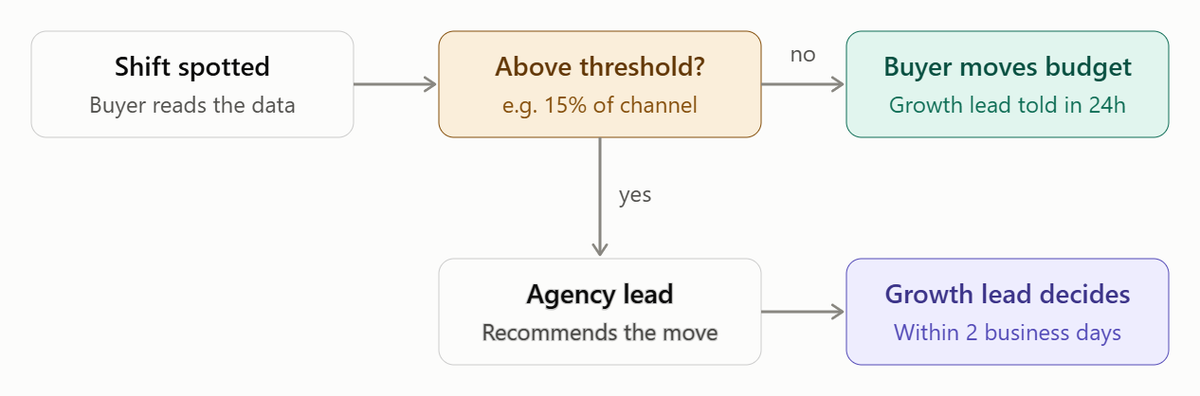
Scale the threshold to the budget. At EVRY Jewels, 9AM manages a $1M+ monthly media budget across platforms, so a 15% move can mean six figures. At that size, a dollar cap alongside the percentage keeps both sides comfortable.
Pro tip: put a response deadline on the approval path. An above-threshold request with no reply after two business days should default to the agency's recommendation or to no change, decided in advance. Either default is fine. Having no default is what stalls accounts.
Billing and the payment method on the ad account
Finance owns billing and the payment method, and the card or invoice line should sit in the brand's name. When an agency pays the platforms and rebills, the brand loses direct visibility of spend and can lose the account if the relationship ends.
Google Ads, for example, separates billing access from standard and admin access, which lets finance hold payment control without touching campaigns.
Who owns paid media creative?
The creative team owns making the ads, the agency lead owns which ads get tested and when, and the growth lead owns launch approval for new concepts. Brand and legal own a narrow approval for claims and compliance. Keeping these separate is what keeps testing fast.
Creative deserves this much structure because it does most of the work. An NCSolutions and Nielsen analysis of roughly 500 campaigns found creative drove 47% of sales contribution while targeting drove 9%.
The ownership model for creative usually decides how many good ideas reach the auction and how fast tired ads get refreshed.
Creative strategy and the testing roadmap
The agency lead is accountable for the testing roadmap, and the creative team writes it with input from the media buyer and analyst. The roadmap lists which concepts, hooks, and formats get tested in what order, with a budget and a read date for each. The growth lead is consulted on priorities, not on every variant.
Creative briefs and production
The creative team owns briefs and production end to end. The media buyer is consulted on placements and specs, and brand is consulted on messaging. A brief built for performance names the audience, the objection the ad answers, and the action it asks for, the same structure 9AM uses in its UGC briefs.
Creative approval, brand review, and legal review
Give brand and legal an accountable role only on the parts they actually govern: claims, disclosures, regulated language, and brand guidelines. Everything else stays with the creative team and the growth lead.
Bain's RAPID research makes the same point about veto rights: one company it studied gave its regulatory team an approval role only on the text of a brochure to keep it compliant, and decisions sped up.
Volume makes this non-negotiable.
For Genomelink, 9AM produced 70 unique assets a month across 6 creative formats. A weekly committee review can't keep up with that cadence. Pre-approved claim libraries and a 48-hour legal turnaround can.
Creative refresh and fatigue calls
The media buyer calls creative fatigue and the agency lead is accountable for having a replacement ready. Agree on the signals in advance:
- Rising frequency
- Falling click-through rate
- A CPA that drifts above target for several days
The refresh pipeline should already be running before an ad fails.
Creator content and whitelisting permissions
The growth lead is accountable for creator usage rights because they're a contract, and the creative team is responsible for securing them. Legal is consulted on usage terms, and the media buyer is informed once whitelisting access is live. Write the usage window and paid media rights into each creator agreement before the ad ships, using the setup in our creator whitelisting guide.
Who owns conversion tracking and measurement?
The client owns the tracking infrastructure and conversion definitions, and the agency analyst owns the specification and QA. The growth lead also names the source of truth for reporting. Tracking breaks most often when everyone assumes someone else is watching it.
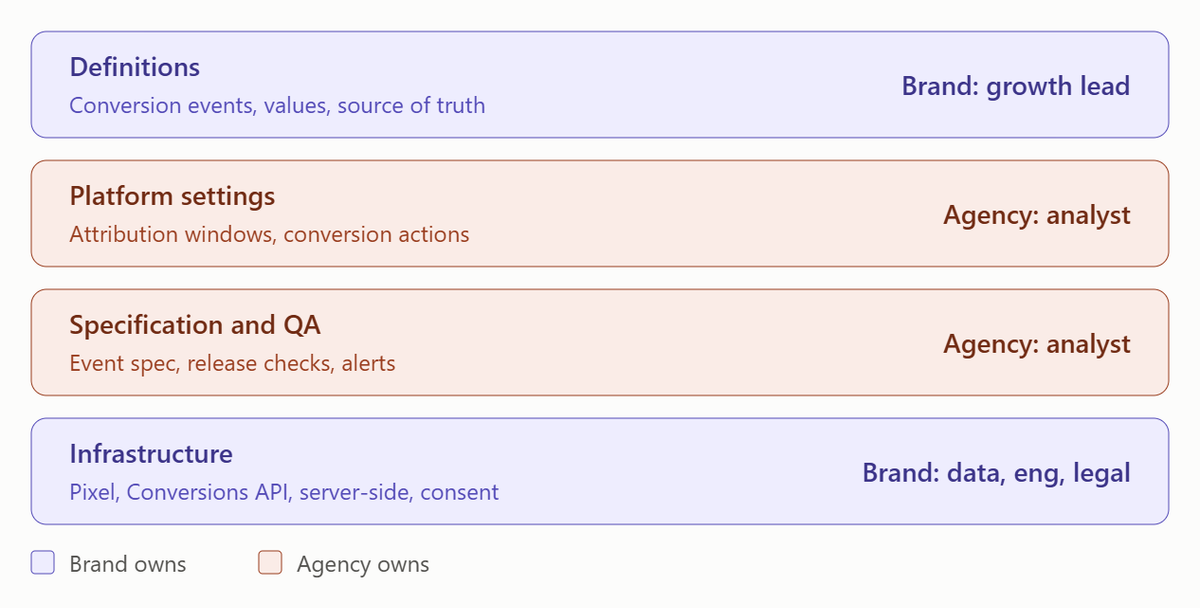
The layered view matters because each layer fails differently:
- A broken tag is an engineering problem.
- A conversion event that counts newsletter signups as purchases is a definition problem.
- A dashboard that disagrees with Shopify is a source-of-truth problem.
Pixel, Conversions API, and server-side tagging
The client's data or engineering team is accountable for implementing pixels, the Conversions API, and server-side tagging, because the code runs on the client's site and servers.
The agency analyst writes the event specification and QAs every event after release. Our server-side tracking guide covers what that specification should include.
Conversion event definitions and values
The growth lead decides which actions count as conversions and what each is worth, with finance consulted on values. The analyst drafts the definitions. A purchase, a qualified lead, and a trial start send very different signals to bidding algorithms, so this choice belongs with the person who owns the business target.
Attribution settings and the reporting source of truth
The growth lead is accountable for naming one source of truth, such as Shopify revenue, the CRM, or a blended dashboard, and the analyst is responsible for keeping attribution settings consistent with it. Platform-reported numbers will always disagree with each other. An attribution model audit is the analyst's tool for finding where the gaps come from.
Incrementality and lift testing
The analyst designs and reads lift tests, and the growth lead is accountable for acting on the result. The media buyer is consulted on holdout design so the test doesn't break live campaigns. Geo-lift testing is the most common method for brands that can't run platform-native lift studies.
Consent, data access, and privacy compliance
Brand and legal are accountable for consent and privacy, and data or engineering is responsible for implementing it. This row has teeth. To keep using measurement, ad personalization, and remarketing for users in the EEA, Google requires advertisers to collect consent and pass consent signals. An agency can flag gaps, but it can't own a brand's legal basis for processing data.
Insider tip: the analytics row most often left blank is "Tracking specification and QA" after a site migration. Add a re-QA trigger to the matrix so every relaunch, checkout change, or new subdomain gets checked before spend resumes.
Who makes paid media performance decisions?
The agency lead is the decision maker for day-to-day launch, pause, scale, and cut calls inside agreed guardrails. The growth lead decides targets, new channels, and anything outside those guardrails. The split works because the agency sees the data hourly and the brand sees the whole business.
Campaign launch and pause decisions
The media buyer launches and pauses campaigns, and the agency lead is accountable. The growth lead is informed through the weekly report, plus same-day notice for anything brand-sensitive, such as pausing a product launch campaign.
Scale and cut decisions on campaigns and ads
The agency decides when to scale a winner or cut a loser, as long as spend stays inside the approved total and the reallocation threshold. The analyst is consulted on whether a result is real or noise. Write minimum sample rules, such as a set spend or conversion count before a cut, into the matrix's notes column.
Channel mix and new channel tests
The growth lead is accountable for adding a channel, because a new channel brings new creative needs, new tracking, and new learning costs. The agency lead recommends tests with a budget, a success metric, and a read date. Finance and creative are consulted.
KPI targets for CAC, ROAS, and MER
The growth lead sets KPI targets with finance consulted, and the analyst builds the model behind them. Decide up front which CAC the targets use, because blended CAC and paid CAC can point in opposite directions. Many brands pair a paid CAC target with a marketing efficiency ratio target for the business as a whole.
Escalation path for a stalled decision
Every row needs a named escalation path with a deadline. When a Consulted party blocks a decision past the agreed turnaround, it goes to the row's Accountable owner within two business days, then to a named senior sponsor on each side within five. Bain found decisions stall most often at a few predictable points, including the line between inside and outside partners, which is exactly where a brand and its agency meet.

Log the outcome in the matrix's notes column so the same row doesn't stall twice.
Who should own the ad accounts, pixels, and audience data?
The brand should own every ad account, pixel, dataset, catalog, and audience, and grant the agency partner access to them. That keeps conversion history, audiences, and algorithm learning with the brand if the agency relationship ends.
On Meta, the brand adds the agency in Business Settings under Partners and assigns specific assets to the agency's business portfolio. On Google Ads, the brand keeps at least two admin users and links the agency's manager account.
Google warns that an account with only one administrator can lose access to its tags if that person becomes unavailable.
Write an offboarding clause into the contract: the agency exports reports, naming conventions, and creative learnings, then the brand removes partner access. Done this way, switching agencies takes an afternoon.
Paid media RACI examples by team structure
The accountable owner shifts with the team structure, but the brand keeps budget size, targets, assets, and compliance in every model. Hybrid setups are now the norm: 82% of ANA members have an in-house agency, and 54% of those in-house agencies handle some media planning or buying. That's why the choice between in-house and agency paid media usually ends with a split matrix.
| Decision area | In-house team with a media buying agency | Full-service performance agency | Separate media and creative agencies | In-house team with no agency |
|---|---|---|---|---|
| In-month reallocation | Agency lead (A) | Agency lead (A) | Media agency lead (A) | Internal paid media lead (A) |
| Creative testing roadmap | Shared: agency lead (A), in-house creative (R) | Agency lead (A) | Media agency lead (A), creative agency (R) | Internal paid media lead (A) |
| Creative production | In-house creative (A) | Agency creative (A) | Creative agency (A) | In-house creative (A) |
| Tracking specification and QA | Agency analyst (A) | Agency analyst (A) | Media agency analyst (A) | Internal analyst (A) |
| Budget size and KPI targets | Growth lead (A) | Growth lead (A) | Growth lead (A) | Growth lead (A) |
In-house team with a media buying agency
This is the template above. The agency runs buying, pacing, and testing decisions, while the brand's in-house team produces some or all creative. The handoff to watch is creative: the agency owns the roadmap, the in-house team owns production, and both need a shared turnaround time.
Full-service performance agency
A full-service agency holds most R and A roles for execution, including creative. The brand still owns budget size, targets, assets, and compliance. This model is simplest to run and depends most on a strong weekly report.
Separate media agency and creative agency
Two agencies need a written tiebreaker. Make the media agency accountable for the testing roadmap and the creative agency accountable for production and turnaround. Without that split, each agency can point at the other when performance slips.
In-house team with no agency
A fully in-house team still needs the matrix, usually more than an agency setup does, because roles blur when everyone sits in the same channel. Name an internal paid media lead as accountable for in-month calls so the growth lead isn't approving every bid change.
How to build a paid media RACI matrix
A paid media RACI matrix takes about two working sessions to build. Use this RACI framework, in order:
- List the decisions before the tasks. Start with the calls that move money or risk, such as reallocation, launch approval, and conversion definitions. Tasks follow from decisions.
- Map every person and partner involved. Use roles as columns, including third parties that own a deliverable.
- Assign one accountable owner per row. If two people both believe they're accountable, escalate that row to the sponsor now, while nothing is at stake.
- Set approval thresholds and turnaround times. Add a dollar or percentage threshold to every budget row and a response time to every Consulted role.
- Review the draft with client and agency together. Walk through three recent decisions and check whether the matrix would have sped them up.
- Attach the matrix to the SOW and the weekly review. Link it in the contract and revisit it in the weekly marketing cadence whenever a row causes friction.
Revisit the full matrix every quarter and after any trigger event: a new channel, a new agency, a team change, or a tracking migration.
How to audit paid media ownership on a live account
Audit paid media ownership by matching recurring symptoms to the ownership gap behind them. If two or more symptoms below show up in the same month, the matrix needs work before the media plan does.
| Symptom | Likely ownership gap | Fix |
|---|---|---|
| Reallocations wait more than three days for approval | No written threshold | Add a percentage and dollar threshold to the reallocation rows |
| Winning ads fatigue before replacements are ready | Fatigue calls owned, refresh pipeline unowned | Make the agency lead accountable for a standing refresh queue |
| Platform and backend revenue disagree every week | No reporting source of truth | Growth lead names one source; analyst aligns attribution settings |
| Conversions dropped after a site update | Tracking QA has no owner after releases | Add a re-QA trigger to the tracking specification row |
| Creative waits on legal for every variant | Legal holds approval beyond claims | Narrow legal's accountable role to claims and disclosures |
| Nobody can grant a new buyer access quickly | Single admin or agency-owned assets | Move assets to the brand portfolio with two admins |
Mismatched revenue numbers are the most common symptom, and they usually trace back to the last-click attribution problem more than to anyone's mistake. Fix the rows in the order they cost money: approval delays and tracking gaps first, access and admin issues second.
Build a paid media operating model with 9AM
A paid media RACI matrix turns budget, creative, tracking, and decisions into rows with one owner each. Built well, it lets the agency act inside clear guardrails and keeps the brand in control of money, assets, and risk.
9AM builds this ownership model into every account it runs, alongside the media plan, the testing roadmap, and the tracking specification. A paid media operating audit maps who owns what on your account today and returns a filled-in RACI matrix with the media audit.
Book a strategy call to walk through your current setup, the decisions that stall most often, and where clearer ownership would speed up spend.
Frequently asked questions
Can an agency be accountable for paid media results?
An agency can be accountable for results it controls, such as pacing, testing velocity, and platform efficiency inside agreed guardrails. Business outcomes like blended CAC depend on pricing, landing pages, and inventory too. Most brands make the growth lead accountable for business KPIs and the agency accountable for the media metrics underneath them.
Can one person be both responsible and accountable?
Yes. One person can hold both roles on a row, marked A/R, which is common for finance on billing or the creative team on briefs. The rule is one accountable owner per row, not one role per person.
How does the matrix change if the agency is paid on performance?
A performance-based fee gives the agency a direct stake in the KPI, so the KPI definition and the reporting source of truth need an owner outside the agency. Keep the growth lead accountable for both, with finance consulted, and write them into the contract. The agency can still own day-to-day optimization inside the guardrails.
Who owns the decision when Advantage+ or Performance Max makes the call?
The platform makes the in-auction choices, but people still own the inputs: budget caps, conversion goals, brand exclusions, and the creative fed in. Keep each input as a row, with the agency lead accountable for campaign settings and the growth lead accountable for conversion goals and exclusions. Automation moves decisions into setup, so the setup rows matter more.
What is the golden rule of RACI?
The golden rule of RACI is exactly one Accountable owner per row. Several people can be Responsible, Consulted, or Informed, but shared accountability means the decision has no clear owner.
Is RACI outdated for marketing teams?
RACI isn't outdated, but it's often applied at the wrong level. It works for recurring paid media decisions with clear owners. For one-off strategic calls with many stakeholders, a decision-rights tool like RAPID fits better.
What is the difference between RACI, RASCI, and DACI?
The RACI model assigns four roles. RASCI adds Supportive for people who help the Responsible party. DACI swaps in Driver, Approver, Contributors, and Informed, and fits project decisions better than recurring operations.
How often should a paid media RACI matrix be updated?
Review a paid media RACI matrix quarterly and after any trigger event, such as a new channel, agency, team member, or tracking migration. Rows that cause friction in a weekly review should be fixed that week.
Should the RACI matrix live in the SOW or a separate document?
Put a summary in the SOW and keep the working matrix in a shared doc both sides can edit. The SOW should fix the rows with financial or legal weight: budget thresholds, asset ownership, and offboarding. Everything else changes too often to need a contract amendment.