


Turning on a new country in Meta or Google Ads takes about ten seconds. Making that country profitable takes months, because every market runs its own auction and its own margin math once duties and shipping land.
That gap is why so many international expansion strategies stall in the first wave. Language alone filters out a large share of demand: 40% of online shoppers say they never buy from websites in other languages.
Beyond language, this guide gives you a seven-factor market scorecard, a formula for sizing each market test, and the rules we use to decide whether a market scales, holds, or exits.
P.S. If you'd like a second set of eyes on your shortlist, our growth strategy team builds these scorecards with brands before the first dollar goes abroad.
TL;DR
- Check readiness first. Expand paid media abroad only once the home market has positive contribution margin and a known CAC payback.
- Score markets on seven paid-media factors: first-party demand, auction cost against order value, landed-cost margin, localization load, payment fit, channel availability, and measurement feasibility.
- Size each test from your target CPA. On Meta, plan roughly target CPA × 50 per ad set per week so the ad set can exit learning.
- Test one wave of one or two markets for six to eight weeks before adding more.
- Judge each market on its own contribution margin and incrementality, never on a blended global ROAS.
One conviction shapes everything below. We treat paid media as the cheapest market research a brand can buy: a few weeks of controlled spend in a country tells you more about real demand than any TAM spreadsheet, as long as the creative speaks to that market's buyer and the numbers are read per country. Media buying is where an expansion thesis meets the auction. Contribution margin is the scoreboard. And the creative, made with local creators in the local language, carries much of the targeting that country-level settings can't.
What Is a Market Prioritization Framework for International Paid Media?
A market prioritization framework for international paid media is a ranked shortlist of countries, plus the order each one launches in and the test budget it gets. It turns "where should we go next?" into a scored comparison you can defend to finance.
It sits one level below a full market entry strategy.
Decisions about legal entities, distributors, or local warehouses are business-level choices that usually come later, typically once paid media has shown a market is worth that investment.
This article covers the paid media layer: which markets earn test budget, in what order, and what proof unlocks the next one.
The thinking behind it is older than digital ads.
In Harvard Business Review, Pankaj Ghemawat argued that companies routinely overestimate the attractiveness of foreign markets because they rank them on size and wealth while ignoring cultural, administrative, geographic, and economic distance.
In his worked example, adjusting for distance moved Mexico to the second most attractive market, far ahead of Germany and Japan. The scorecard below applies the same correction with paid-media data.
Signs a Brand Is Ready for International Paid Media
A brand is ready to expand paid media internationally when its home market is profitable at current spend and its CAC payback is known and stable. Without that baseline, you can't tell whether a weak foreign market is weak or whether the whole acquisition engine is.
Run through this checklist before scoring a single country:
- Confirm the core market is profitable. Contribution margin after ad spend is positive, and product market fit shows up in repeat purchase or retention data as well as first orders.
- Know your payback window. You should be able to state your CAC payback period by channel, because every foreign market will be measured against it.
- Check creative capacity. Each new language adds a full creative pipeline. If the team struggles to refresh ads at home every few weeks, a second market will run on fatigued creative.
- Confirm you can ship and take returns abroad. Know your carrier rates, delivery times, and returns process for each candidate country.
- Confirm you can charge in local currency with the payment methods buyers expect there.
- Confirm you can track by country. Orders, revenue, and refunds need a country field you can join to ad spend.
If two or more of these fail, fix them first. Expansion multiplies whatever is already broken.
The Seven Factors That Decide Which Market Comes First
Seven factors decide which market should get paid media budget first: existing demand, auction cost against order value, contribution margin after landed cost, localization load, payment fit, channel availability, and measurement feasibility. Each one can be scored from data you can pull this week.
Existing Demand Signals in First-Party Data
The strongest first market is usually one already sending you unpaid demand. Start your market research in your own systems before buying any third-party report:
- GA4: sessions, add-to-carts, and purchases by country over the last 12 months, filtered to organic and direct traffic.
- Search Console: impressions and clicks by country for branded and category queries.
- Store data: abandoned checkouts or orders blocked because you don't ship there.
- Owned lists: waitlist or newsletter sign-ups by country, and inbound wholesale requests.
Score a market higher when signals agree across two or more sources. A country with steady organic sessions, branded search impressions, and blocked checkouts is showing demand you haven't paid for yet.
Auction Cost Relative to Order Value
Auction cost only matters in relation to what a customer is worth in that market. Lebesgue's 2026 e-commerce data puts Meta CPMs at roughly $16 in the US, $12 in the UK, and $1.40 in India, a spread of more than ten times between the most and least expensive of those three.
A cheap CPM doesn't guarantee a cheap customer. Estimate it with a quick projection:
- Projected CAC = CPM ÷ 1,000 ÷ CTR ÷ conversion rate. Use your home-market CTR and conversion rate as a starting assumption, then discount the conversion rate for an unfamiliar brand.
- Compare projected CAC with local average order value, after converting currency. A market where projected CAC exceeds first-order margin needs strong repeat purchase to work.
Pro tip: Sanity-check the result against paid media benchmarks by spend tier so your assumptions aren't wildly optimistic.
Contribution Margin After Landed Cost
Landed cost is usually what separates a good-looking market from a profitable one. Price, duties, import VAT, shipping, payment fees, currency conversion, and return rates all come out of the same order before ad spend.
Rules change, so check them each time you refresh the scorecard.
Since July 1, 2026, the EU has applied a flat €3 customs duty per item category on parcels under €150 shipped to consumers from outside the bloc. For a brand shipping low-priced items from the US, that charge can erase the margin on a single-item order.
Build a per-market margin line before launch:
- Local price (after any rounding or price localization)
- Minus landed cost per order
- Minus expected returns and refunds
- Equals contribution margin before marketing, which sets your maximum CAC
Our guide to contribution margin marketing walks through the calculation for ad accounts.
Localization Load for Creative and Landing Pages
Localization load is the amount of creative, copy, and site work a market requires before ads can perform. Buyers notice when it's skipped: in CSA Research's survey of 8,709 consumers across 29 countries, 76% preferred buying products with information in their own language.
The study dates from 2020, but it remains one of the largest datasets on the question.
Translation is the starting point. Cultural differences shape which benefits lead, which objections need answering, and who should appear on screen. Score each market on:
- Number of languages required (Switzerland and Belgium need more than one)
- Supply of local creators who match your buyer persona
- Product pages, reviews, and support content that need adapting
- Claims or packaging that may need legal review
This is where volume matters. For NIQ, we built a system of 100+ creators a month across 17+ countries, producing content in 20+ languages, so every market's panel recruitment ran on culturally relevant creative.
Checkout and Payment Fit
Payment fit measures whether shoppers in a market can pay the way they usually pay. If the dominant local method is missing at checkout, ads will drive clicks that die on the payment page.
Local methods can dominate fast.
Worldpay's 2025 Global Payments Report found that account-to-account e-commerce spend in Brazil grew from $3.6 billion in 2020 to $35.3 billion in 2024 after the launch of Pix. In the Netherlands, iDEAL bank transfers play the same role.
Score a market by checking three things on your current stack:
- Whether the leading local methods are supported
- Whether prices display and settle in local currency
- Whether buy now, pay later options common in that market are available
Channel Availability by Country
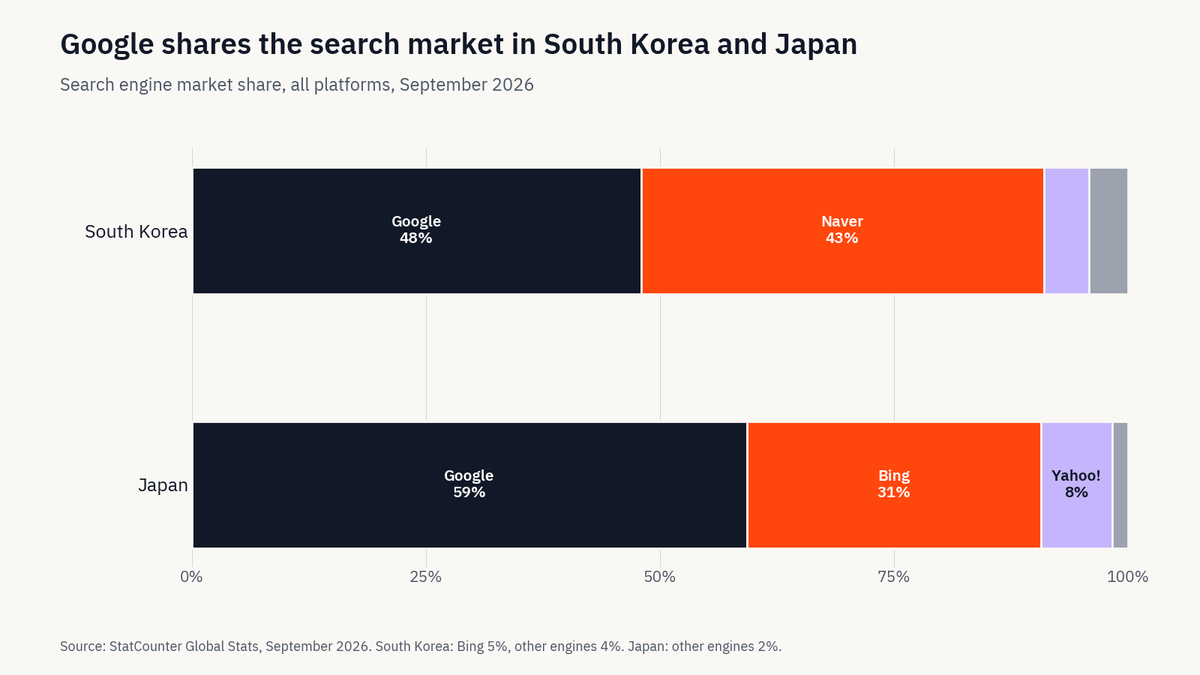
Channel availability asks whether the platforms you know how to run reach this market's buyers at scale. Google and Meta cover most markets, but search share is far from uniform.
In StatCounter's September 2026 data, Naver held 43% of search share in South Korea, close behind Google at 48%. In Japan, Bing held 31% and Yahoo! 8% of search share across platforms, so Microsoft Advertising deserves a line in any Japanese search plan.
Also check format availability. TikTok Shop, Meta's Shops features, and retail media networks launch country by country, so a market where your best-performing format isn't live should score lower.
Measurement and Privacy Feasibility
Measurement feasibility is whether you can read a market test accurately enough to make a decision. If a market can't be measured, it can't be prioritized, however attractive the demand looks.
Privacy rules and local laws shape this most. Google's EU user consent policy requires advertisers to obtain valid consent from users in the European Economic Area, the UK, and Switzerland for cookies and ad personalization, and Google can limit product use for advertisers who don't comply.
Consent rates in those markets will shrink observed conversions, so plan for modeled data and first-party tracking.
Score each market on:
- Whether a consent banner and consent mode are already set up for it
- Whether your server-side tracking passes country and order value cleanly
- Whether the market has regions large enough to run a geographic holdout test
- Whether finance can report contribution margin by country within a week of month end
How to Score and Rank Markets with a Weighted Scorecard
A weighted scorecard ranks markets by multiplying each factor's score by its importance to your business and adding the results. It makes resource allocation explicit, so the debate moves from "I like Germany" to "Germany scores lower on margin and localization."
- Shortlist six to ten countries from your demand signals, plus any markets leadership has already named.
- Set weights for the seven factors that add up to 100. Weight margin and demand highest unless you have a reason not to.
- Score each market from 1 to 5 on every factor, using the definitions below.
- Multiply and add, then divide the total by 5 to get a score out of 100.
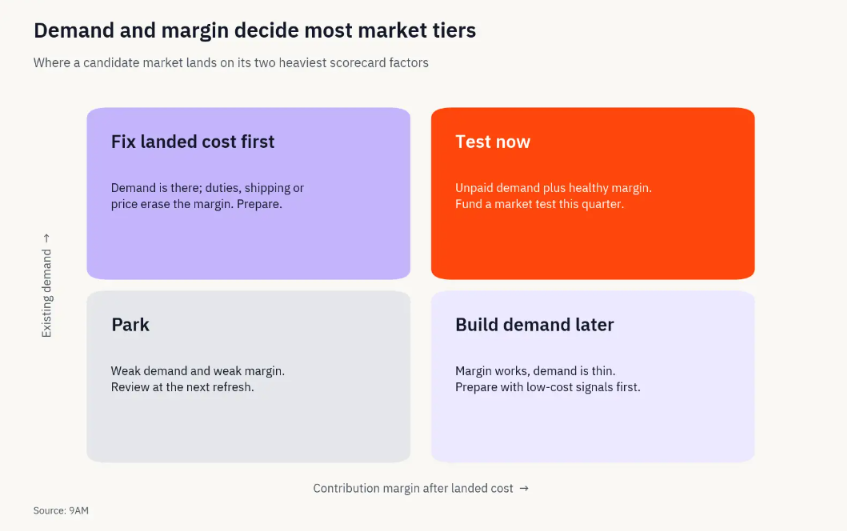
- Assign a tier: 70 or above is a test-now market, 55 to 69 is a prepare market, and below 55 is parked until something changes.
- Record the data source next to every score, so the next refresh takes an hour.
| Factor | Suggested weight | What a 1 looks like | What a 5 looks like | Data source |
|---|---|---|---|---|
| Existing demand | 25 | No organic sessions or orders from the country | Steady organic sales and blocked checkouts | GA4, Search Console, store data |
| Auction cost against order value | 15 | Projected CAC above first-order margin | Projected CAC under half of first-order margin | Platform CPMs, home CTR and CVR |
| Contribution margin after landed cost | 20 | Negative margin on a typical order | Margin close to the home market | Carrier quotes, duty rules, returns data |
| Localization load | 10 | New language, scarce creators, legal review | Same language and similar buyer | Creator search, site audit |
| Payment fit | 10 | Leading local method unsupported | All common local methods live | Payment provider coverage |
| Channel availability | 5 | Core platforms or formats unavailable | Every format you rely on is live | Platform availability lists |
| Measurement feasibility | 15 | No consent setup, no country reporting | Clean tracking and holdout-ready regions | Analytics and finance audit |
Here is an illustrative example for a US skincare brand looking at three markets. The scores are invented to show the math and don't come from client data.
- United Kingdom: demand 4, auction cost 3, margin 3, localization 5, payment 5, channels 5, measurement 3. Weighted score: 75, a test-now market.
- Australia: demand 3, auction cost 3, margin 2, localization 5, payment 5, channels 5, measurement 4. Weighted score: 69, a prepare market held back by shipping costs.
- Germany: demand 3, auction cost 3, margin 3, localization 2, payment 3, channels 5, measurement 3. Weighted score: 60, a prepare market until German creative and local payments are ready.
The tier tells you what to do next.
A test-now market gets budget this quarter. A prepare market gets a fix list tied to its weakest factor, and Australia's would be negotiating carrier rates. A parked market gets reviewed at the next refresh.
Keep the scorecard in the same file as your media plan; a cross-channel media planning template works well for holding both.
How to Size the Test Budget for Each Priority Market
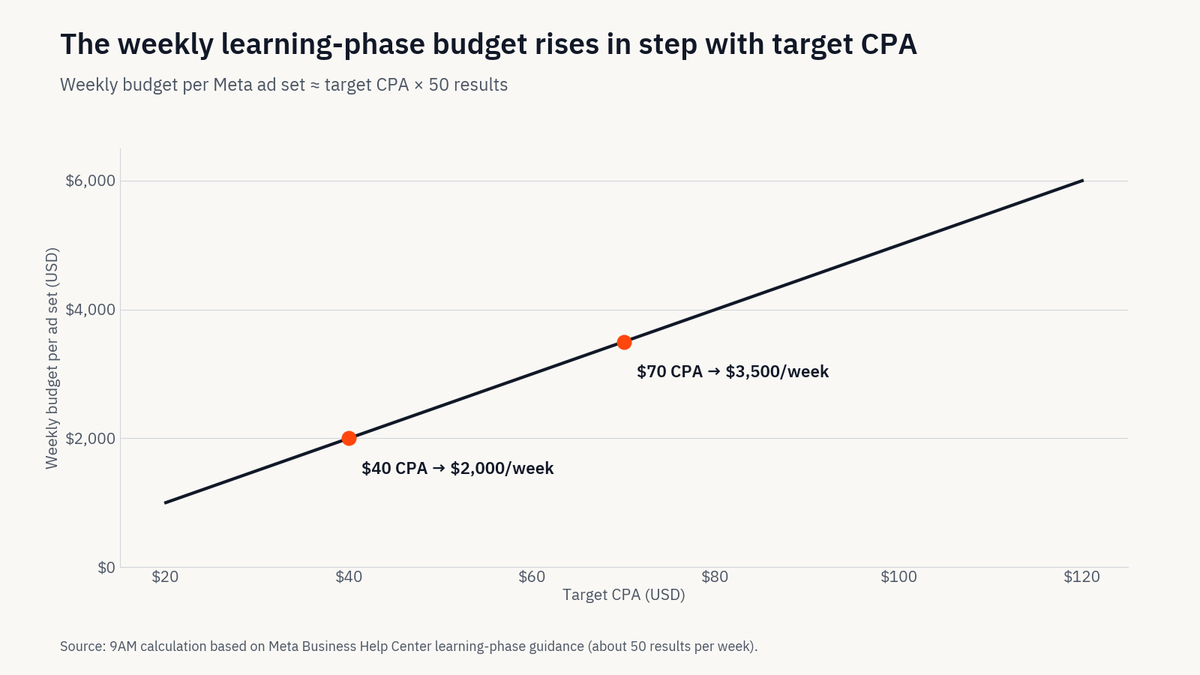
Size a market test from your target CPA: on Meta, budget roughly target CPA × 50 per ad set per week. Meta says ad sets usually exit the learning phase after about 50 results in the week after the last significant edit, and an ad set that can't afford those results stays unstable for the whole test.
Work it out per market, because target CPA differs by country:
- Set a target CPA per market from its contribution margin line. If first-order margin in the UK is $70 and you accept breaking even on the first order, the UK target CPA is $70.
- Multiply by 50 for the weekly budget each ad set needs. At a $70 target, that's $3,500 per week.
- Decide the number of ad sets. Start with one or two per market; every extra ad set needs its own 50 results.
- Multiply by the test length. Six to eight weeks gives the algorithm time to stabilize and gives you two to four weeks of usable data, provided a budget pacing plan keeps spend even across the window.
At $3,500 per week for one ad set over eight weeks, a UK test needs about $28,000. A market with a $40 target CPA needs $2,000 a week, or $16,000 over the same window. If the number looks too high, optimize for a more frequent event, such as add to cart or initiate checkout, during the test, then move to purchase once volume allows.
Run one wave of one or two markets at a time. Testing five countries at once splits a fixed budget into ad sets that never exit learning, and you end up with five inconclusive reads. Spread the wave's budget evenly across the window so the final weeks aren't starved.
Pro tip: hold back 15% to 20% of the test budget for a creative refresh in weeks four to six. Small new markets fatigue faster than the home market because the reachable audience is smaller.
If you want this math run against your own margin data, our media buying team sizes market tests as part of every expansion plan.
How to Structure Campaigns for a Market Test
Structure each market test as its own country-level campaign, so budget, bids, and reporting stay separate. The structure you pick decides whether you can read the result.
| Structure | When it fits | Trade-off |
|---|---|---|
| One campaign per country | Testing a single market or markets with different prices | Cleanest read; each campaign needs its own learning budget |
| One campaign per language | Markets sharing a language and similar prices (Germany and Austria) | Pools conversions; country results must be split in reporting |
| One regional campaign | Mature markets at scale, low budget per country | Most data per campaign; hides per-country margin |
For tests, choose one campaign per country and graduate to language or regional groupings only after each market has proved itself.
Three setup choices protect the read:
- Use "Presence" location targeting in Google Ads for tests. Google's default, "Presence or Interest," also reaches people who have shown interest in your targeted locations, which can pull in home-market shoppers researching the destination and blur the result.
- Match the landing experience to the ad. Currency, language, shipping promise, and payment badges on the landing page should match the market the ad ran in, following the same rules as landing page alignment at home.
- Brief creative to local consumer behavior. Lead with the benefit and objection that matter in that market, and cast creators who match the local buyer. A batch of 10 to 20 native-language assets from local creators gives the test enough variety to find a winner.
Insider tip: launch the home market's best-performing concept first, remade by local creators, alongside one market-specific concept. If the remake wins, your positioning travels. If the local concept wins, budget more for market-specific creative in wave two.
How to Decide Whether to Scale, Hold, or Exit a Market
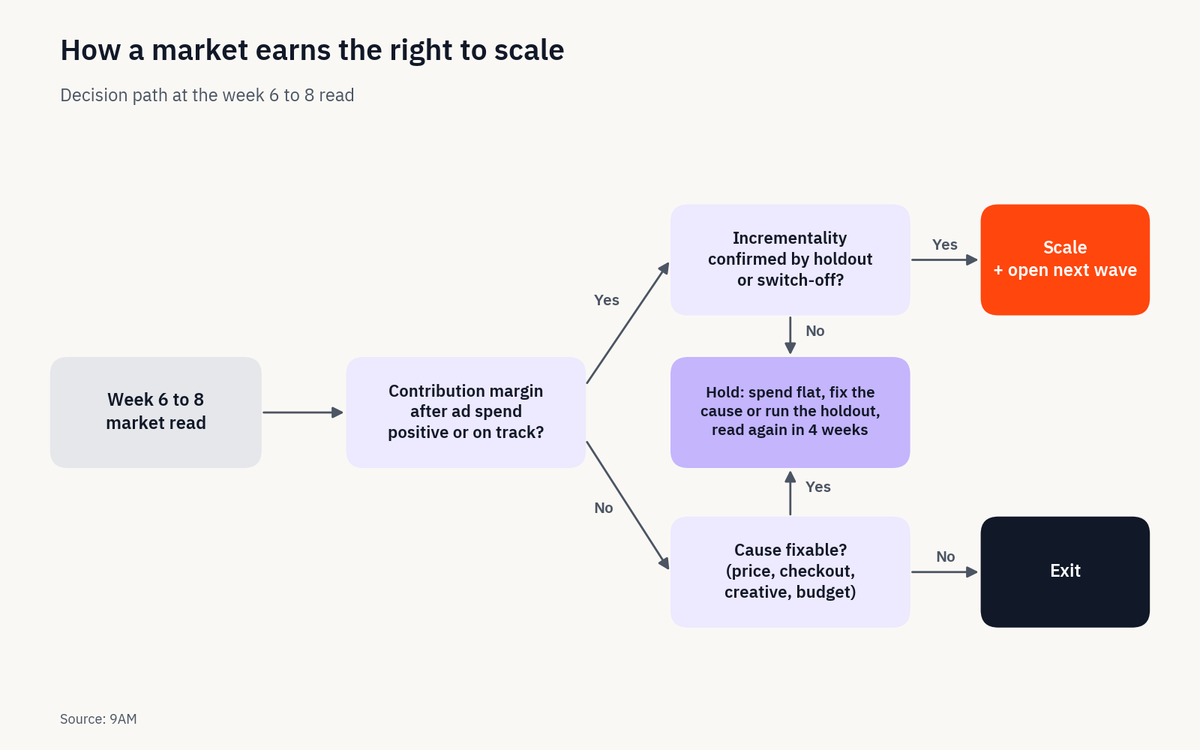
Decide on each market at week six to eight, using its contribution margin after ad spend and evidence that the ads drove sales that wouldn't have happened anyway. Platform-reported ROAS alone isn't enough, because a new market usually harvests demand your brand already had there.
Apply three rules:
- Scale when contribution margin after ad spend is positive or on track to meet your payback window, and an incrementality read confirms the lift.
- Hold when margin is close to break-even and the diagnostic below points to a fixable cause. Fix it, keep spend flat, and read again in four weeks.
- Exit when margin is negative and the cause is structural, such as landed cost or a price ceiling you can't move.
For incrementality, a geo-lift test works well in larger markets: run ads in some regions, hold others out, and compare sales. In smaller markets, a switch-off test of two to three weeks is a practical fallback.
When results are mixed, use this diagnostic before deciding:
| What you see | What it likely means | What to check next |
|---|---|---|
| CPA near target but margin negative | Landed cost or price is wrong for the market | Duties, shipping subsidy, local price points |
| High CTR, low conversion rate | Checkout or landing page friction | Payment methods, currency display, page language |
| Strong platform ROAS, weak holdout lift | Ads are capturing existing demand | Organic baseline by country, branded search share |
| Ad sets stuck in Learning Limited | Budget below the 50-result threshold | Consolidate ad sets or optimize to a higher-funnel event |
| Strong first two weeks, then rising CPA | Creative fatigue in a small audience | Frequency, creative refresh with a new creator batch |
Track marketing efficiency ratio per country alongside platform data. Total revenue in a market divided by total marketing spend there is hard to distort with attribution settings, so it's a useful cross-check on what the platforms report.
A market that scales becomes your gate to the next wave. Refresh the scorecard with what you learned, especially real CAC and landed cost, then fund the next one or two markets.
What NOT to Do When Prioritizing International Markets
Most failed expansions into foreign markets trace back to the order markets were chosen in. These five sequencing mistakes show up most often:
- Ranking by GDP or population. Size says little about whether buyers will choose your brand; the demand and margin factors carry more weight for a reason.
- Following the cheapest CPM. Low auction costs frequently come with lower order values and conversion rates. Run the projected CAC math first.
- Launching too many markets at once. A fixed budget spread across many countries leaves each test underfunded and inconclusive.
- Reporting one blended global number. A blended figure hides a losing market behind a winning one. Report paid CAC by country alongside the total.
- Never refreshing the scorecard. Duty rules, platform availability, and your own costs change. Rescore the shortlist after every wave and at least twice a year.
Plan Your International Paid Media Expansion with 9AM
International growth works best as a sequence: prove readiness at home, score markets on paid-media evidence, fund one wave properly, and let each market's contribution margin decide what comes next.
That's how we approach expansion at 9AM.
Our media buyers, creative strategists, and analysts plan and run market tests together, so the creative is briefed for each country, the budget is sized to clear learning, and results are read per market. For NIQ, that approach supported more than $20M in managed media across 17+ countries and five-plus channels.
If you're weighing your next market, book a strategy call. We'll review your shortlist, pressure-test the margin math for each country, and outline a first-wave test plan.
FAQs
Should a brand prioritize a same-language market even when its CPMs are higher?
In many cases, yes. A same-language market like the UK for a US brand needs little new creative and converts on your existing site, so a higher CPM can still produce a lower CAC than a cheaper market that needs full localization. Run the projected CAC math for both before deciding.
How many markets can one paid media budget test at the same time?
Divide the test budget by the weekly learning threshold (target CPA × 50) and the test length. If the result supports only one or two ad sets, test one market. In practice that usually means one or two markets per wave, and a paid media revenue forecast helps plan when the next wave becomes affordable.
When does it make sense to test a market with English creative before localizing?
It makes sense when the goal is a quick demand signal in a market with high English proficiency, such as the Nordics or the Netherlands. Treat the result as a floor. Localized creative and pages usually improve conversion, so a market that's close to break-even in English may be worth a localized second test.
How does the scorecard change for Amazon or retail media expansion?
Marketplace expansion shifts weight toward marketplace demand and fulfilment costs and away from checkout and payment fit, which the marketplace handles. Replace the payment factor with marketplace fees and fulfilment options, and score demand from marketplace search volume in that country.
How should a B2B or app brand adapt the seven factors?
B2B brands should score demand from inbound leads and pipeline by country, and swap landed cost for sales coverage and time zone support. App brands should replace payment fit with app store pricing tiers and local payment support inside the stores, and weight measurement higher, since app attribution varies by platform and country.