

Most paid teams have room for one clean test per cycle. The ad and the landing page compete for that slot, and picking the wrong one costs a month of budget and a result nobody can act on.
The usual instinct is to fix the page. The data points the other way.
Marketers estimate that creative drives about 21% of advertising's sales effect, while measured studies put it at 49%. That gap shapes where test budgets go.
This guide gives you a four-number diagnostic, the cost math behind each test, and a sequence you can run this month.
P.S. If you'd rather hand the sequencing to a team that runs it weekly, our media buying team plans ad and page tests as one roadmap with one budget.
TL;DR
- Run the ad test first in most paid social and paid search accounts.
- Run the landing page test first when post-click metrics are clearly the leak.
- Run neither while tracking, the offer, or traffic volume is broken.
- A CTR test can show a lift for a few hundred dollars per variant. A page test measured on purchases can need over $20,000. The catch: cheaper clicks don't prove cheaper customers.
- Carry the winning ad angle into the page test, so the page is built on proof.
We treat paid media as the lab where every idea gets priced. A test that produces a clear learning is cheap, even when the variant loses; a test that can't reach a verdict is the expensive one. The ad also does work most teams credit to targeting: the person on screen, the problem they name, and the promise they make decide who clicks. So the ad sets up everything the page can do. Sequence your tests the way you'd sequence spend: put the cheapest readable signal first, then build on what it proves.
Should You Test Your Landing Page or Your Ad First?
Test the ad first, unless your post-click numbers are clearly the weak point. That rule holds for most paid social and paid search accounts, and it has three outcomes.
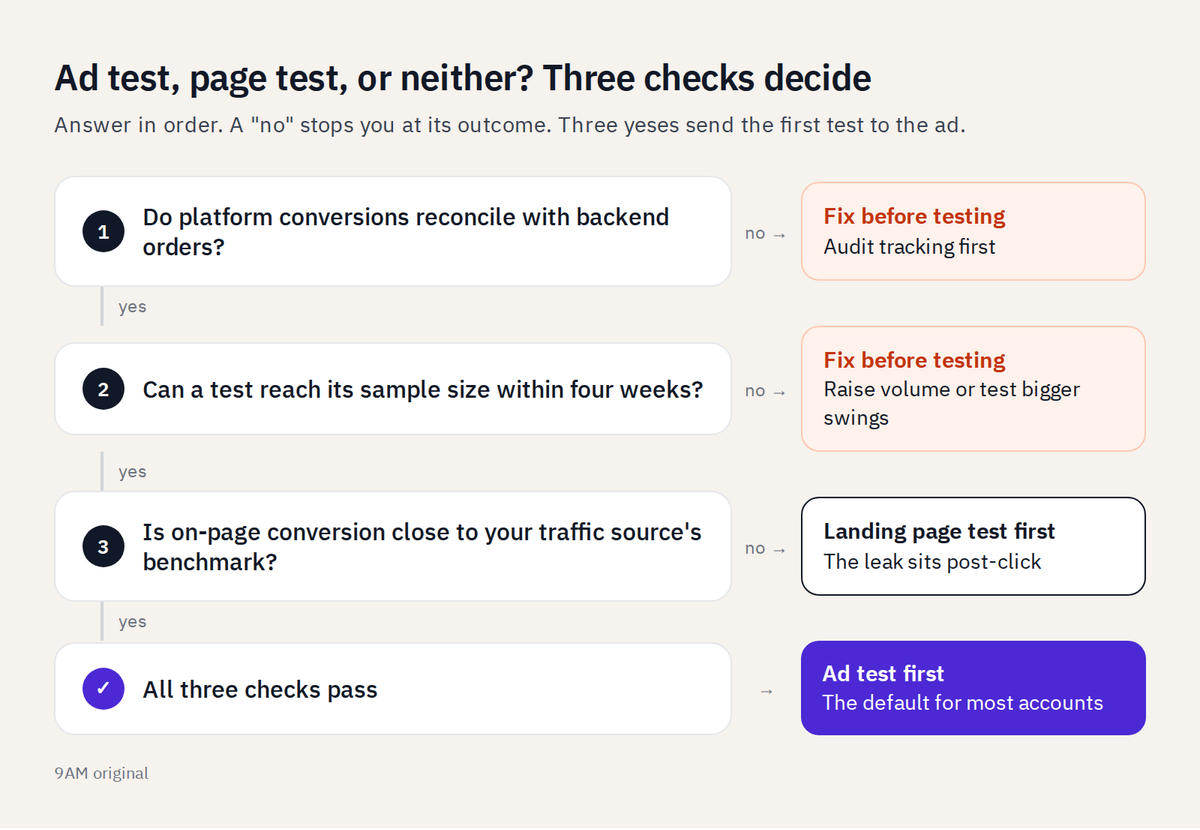
- Ad first (the default). Your click-through and attention metrics have room to move, and the page converts close to the norm for your traffic source. The ad test is faster, cheaper, and its winner tells you what the page should say.
- Page first (the exception). People click at healthy rates and then stall on the page. Five specific conditions point here, and each gets its own section below.
- Neither (the hold). Tracking is unreliable, volume is too thin to read a result, or the offer itself is unproven. Testing on top of any of these produces results that won't repeat.
The reason the default favors ads comes down to three things: speed of signal, share of impact, and sequencing. A winning ad pre-qualifies the target audience the page receives, so a page test run after it measures the page against the people you actually plan to buy.
How to Tell Whether the Ad or the Landing Page Is the Bottleneck
Read four numbers in order before you choose a test: attention (hook rate or CTR), landing page view rate, on-page conversion rate against your traffic source's benchmark, and CPA. The first number that falls clearly short of your account's norm names the side to test.
Start with attention.
Hook rate tells you whether the first seconds of a video stop the scroll; CTR tells you whether the promise earns the click. Weak numbers here point at the ad.
Next, check landing page view rate: landing page views divided by link clicks. It's the hand-off metric most dashboards bury. A low rate usually means the page loads too slowly for impatient mobile traffic, or the pixel fires late, so check speed and tracking before you touch the copy. A high bounce rate right after a clean hand-off points to a mismatch between what the ad promised and what the page shows first.
Then compare on-page conversion rate to the benchmark for your traffic source.
Paid social and paid search convert at very different baselines, so a single site-wide target hides the real gap.
Google already splits the problem for search advertisers. Its Quality Score rates expected CTR and ad relevance (the ad) separately from landing page experience (the page). Whichever component reads "Below average" is your first test.
| What you see | What it likely means | Test first | What to check before testing |
|---|---|---|---|
| Low hook rate or CTR, normal on-page conversion | The ad isn't earning attention or clicks | Ad | Frequency and fatigue on current winners |
| Strong CTR, conversion far under source benchmark | The page loses people the ad qualified | Landing page | Message match between ad promise and headline |
| Low landing page view rate | Slow load or broken tracking | Neither yet | Mobile load time and pixel firing order |
| Strong CTR and conversion, rising CPA | Auction pressure or audience saturation | Ad (new angles) | CPM trend and frequency |
| Every metric weak at once | Offer or audience problem | Neither yet | Offer, price, and product fit |
Why Ad Tests Usually Come First
Ad tests come first because they reach a verdict faster, they move the variable with the most impact on results, and their winner hands the page a proven message. Each reason holds on its own.
Ad Tests Reach a Readable Result Faster and Cheaper
An ad test decides on impressions and clicks you're already buying. A landing page test decides on conversions, and conversions are scarce.
Here's the math, using a standard two-proportion sample size calculator at 95% confidence and 80% power. These are illustrative inputs, so swap in your own CPC and CPM.
| Factor | Ad test | Landing page test |
|---|---|---|
| Decision metric | CTR or hook rate (diagnostic), CPA (final) | On-page conversion rate |
| Baseline in this example | 1% CTR | 3% conversion rate |
| Sample per variant to detect a 20% lift | About 42,700 impressions | About 13,900 visitors |
| Illustrative cost per variant | About $512 at a $12 CPM | About $20,900 at a $1.50 CPC |
| What a win can prove | Which angle earns attention and clicks | Which page converts the same traffic better |
| Main confound | Platform delivery favoring one ad | Mixed traffic sources hitting the page |
The gap narrows once you judge ads on CPA, because purchase-level ad tests need conversions too. Even then, an ad test usually reads first, since a strong angle changes click volume and conversion together.
Creative Drives the Largest Share of Paid Results
Creative is the biggest single driver of what advertising sells. NCSolutions' analysis of nearly 450 campaigns found the creative accounts for 49% of incremental sales from advertising, well ahead of reach, targeting, and recency.
That makes the ad the higher-impact place to spend your first test. A creative testing system that ships new concepts every cycle compounds faster than a page that changes quarterly.
A Winning Ad Tells the Landing Page What to Say
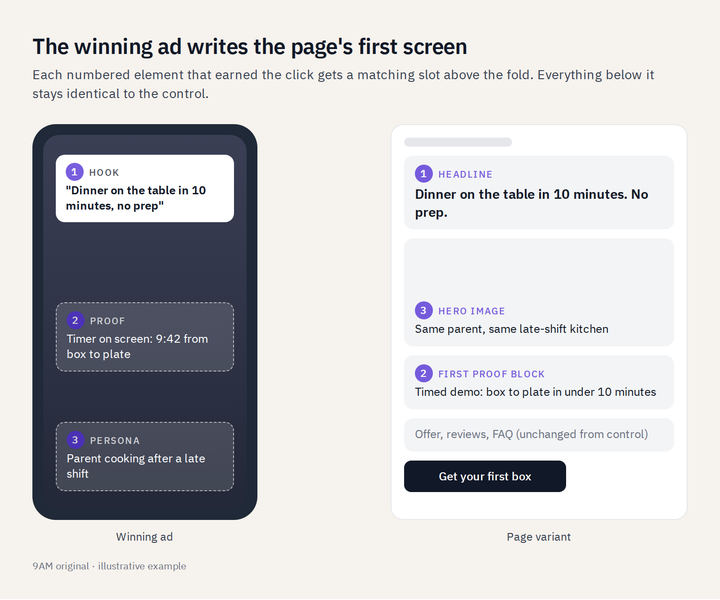
A winning ad hands the page its headline hypothesis. The angle, the proof point, and the persona that earned the click are now measured.
Copy the winning hook's promise into the page's above-the-fold headline before you write any page variant. When a "no prep, ready in 10 minutes" angle beats a "chef quality" angle in the feed, the page should open on prep time.
When to Run the Landing Page Test First
Run the page test first when people click at healthy rates and then stall after they land. Five conditions signal that the leak sits post-click.
Post-Click Metrics Sit Far Below Benchmark
CTR holds at or above your account norm, and on-page conversion trails your traffic source's benchmark by a wide margin. Test the page layout and the order of the offer first: what the visitor sees above the fold, where proof appears, and how many steps sit between landing and buying.
The Ad Promise and the Page Don't Match
A visitor who clicked on a specific promise and lands on a generic homepage leaves. Fix message match by rebuilding the headline and hero around the ad's exact promise, then test that page against the current one.
High-Intent Search Traffic Arrives at Steady Volume
Search clicks arrive pre-qualified by the query, so a page change reads cleaner there than on cold social traffic. If a branded or high-intent non-brand campaign sends steady daily volume, run the page test on that traffic first.
Every Ad Winner Stalls at the Same Funnel Step
When three or more winning ads all lose people at the same step, the step is the problem. Look at the form, the pricing block, or the checkout entry, and test that element on its own.
The Offer or Price Is the Open Question
Price, guarantee, and bundle tests belong on the page, where the visitor sees the full offer. An ad can tease a discount; only the page can show whether the full offer closes.
One of the cheapest first page tests is plain language. Unbounce found pages written at a fifth-to-seventh-grade reading level convert at an 11.1% median, against 5.3% for college-level copy. Rewrite your hero and first section in shorter words and sentences, and test that against the current version.
When Neither Test Should Run Yet
Hold both tests when the measurement or the business underneath can't support a clean read. Any result you get in these conditions will look like an answer and fail to repeat.
- Conversion tracking is broken or double-counting. If platform conversions and backend orders disagree by a wide margin, fix measurement first; server-side tracking closes most of the gap browser-only pixels leave open.
- Volume is too low to read a result within four weeks. Tests that run longer pick up seasonality, promotions, and creative fatigue, so the result describes the calendar more than the change.
- The offer or product fit is unproven. If nobody converts at any price or angle, neither the ad nor the page is the problem.
- Creative fatigue is masking the signal. When frequency on your best ads keeps climbing, refresh the ad set before you judge anything downstream.
Before you book a test budget, run a seven-day tracking audit that reconciles platform conversions with backend orders, and confirm the offer converts on at least one channel.
How to Run an Ad Test Before a Landing Page Test
Run the sequence in seven steps: test the ad against a frozen page, confirm the winner, then split-test the page using that winning ad.
- Write one hypothesis per test. Name the angle or persona you're testing and the result you expect, such as "a time-saving angle lowers cost per purchase against the current quality angle." A clear creative brief keeps every variant on that one idea.
- Freeze the landing page as the control. Lock the page for the full test window, including copy, layout, and offer. A page edit mid-test changes both arms at once.
- Split traffic with the platform's experiment tool. Meta's A/B tests in Experiments remove audience overlap so the result isolates one variable. In Google Ads, use a campaign experiment with a 50/50 split.
- Pick the decision metric before launch. Use cost per purchase or cost per qualified lead as the deciding number. Treat CTR and hook rate as diagnostics that explain the result.
- Set the sample size and the stop date in advance. Checking results daily and stopping at the first significant read inflates false winners: a test reported at 5% significance can carry a 26.1% real false-positive rate when it's checked after every new data point.
- Rebuild the page around the winning angle. Change the headline, hero visual, and first proof point to match the winning ad. Keep the rest of the page identical to the control.
- Split page traffic using the same winning ad. In Google Ads, ad variations can change only the final URL and split users by cookie, which gives you a clean landing page split test. On Meta, duplicate the winning ad with the second URL inside one A/B test.
This sequence is how a testing system compounds.
Pro tip: The bottleneck in step 1 is almost never the testing tool.
It's having enough distinct angles to test, each tied to a real buyer objection and briefed tightly enough to isolate one idea. Teams that keep the queue full test every cycle; teams that brief ad hoc test when there's time, which is rarely.
Keep the queue at least one test ahead of the live one, so a finished test never leaves the account without a challenger waiting.
If that supply is your constraint, our creative strategy team builds the angle backlog and briefs behind each test.
How to Run an Ad Test and a Page Test in Six Weeks
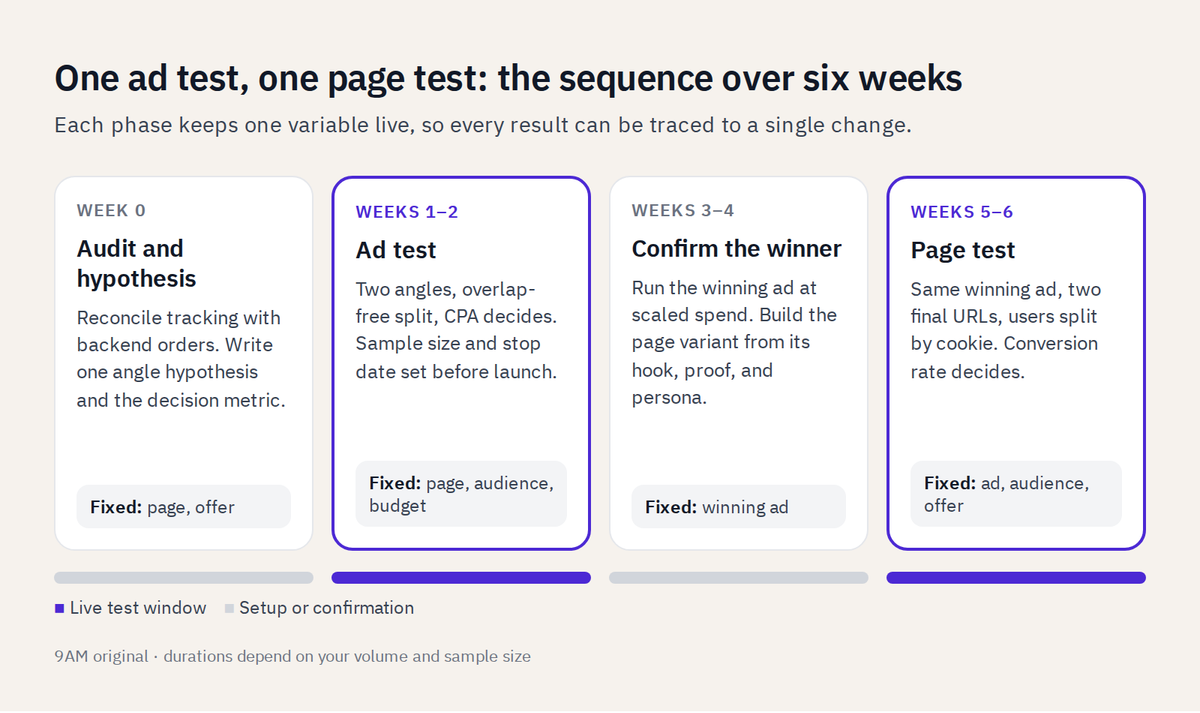
Run the ad test first and the page test second. After a week-0 audit, you test two ad angles (weeks 1-2), confirm the winner at scaled spend (weeks 3-4), then test two landing page versions with that same ad (weeks 5-6). Only one variable is live in each phase, so every result traces back to a single change.
Week 0: Audit and hypothesis
Before launching anything, check that your numbers are trustworthy. Reconcile your tracking with backend orders so the conversions your ad platform reports match the orders you actually received. Then write down one angle hypothesis and the metric that will decide the test. The page and the offer stay fixed.
Weeks 1-2: Ad test
Test two ad angles against each other. Use an overlap-free split, so no one sees both variants and the results stay clean. CPA (cost per acquisition) decides the winner. Set your sample size and stop date before launch, so you aren't tempted to call the test early. The page, audience and budget stay fixed.
Weeks 3-4: Confirm the winner
Run the winning ad at scaled spend to check that the result holds at higher volume. While it runs, build the page variant from the winning ad's hook, proof and persona, so the new page continues the message the ad started. The winning ad stays fixed.
Weeks 5-6: Page test
Send the same winning ad to two final URLs and split users by cookie, so each visitor keeps seeing the same version. Conversion rate decides the winner. The ad, audience and offer stay fixed.
How to Test Ads and Landing Pages Together
You can test both at once only with a design that keeps each change readable. Pick the setup that matches your traffic and the question you need answered.
| Setup | When it fits | What it can tell you | Main risk |
|---|---|---|---|
| Sequential (ad, then page) | Most accounts with steady volume | Which angle wins, then which page converts it | Slower, two test windows |
| Angle-matched pages | Two or more strong angles already proven | Whether each angle performs best on its own page | Needs traffic for every pair |
| Fixed holdout page | High volume, many creative tests | Ad effects with the page held constant | Holdout page ages over time |
| Multivariate testing with dynamic creative | Very high volume, mature tracking | Which combinations of elements tend to work | Platform delivery skews spend, hard to isolate causes |
The trap in combined tests is the interaction effect.
A page can win with one angle and lose with another, because the page continues one specific promise. Judge angle-matched pairs as pairs, and build each page from the angle's place in your messaging ladder, so the page answers the next question that angle raises.
Common Mistakes When Choosing What to Test First
Most testing waste comes from four habits, and each one is easy to fix. Each one makes a test look finished before it has answered the question it was built for.
Polishing Page Details Before the Offer Is Proven
CTA button color and microcopy tests rarely move results while the offer and the angle are still open. Test the offer and the headline promise first, then refine details on a page that already converts.
Calling Winners on CTR Alone
A high-CTR ad can attract curious clickers who never buy. Decide winners on paid CAC or cost per qualified lead, and use CTR to explain why a winner won.
Editing the Page During a Live Ad Test
Any page change during an ad test hits both arms and breaks the comparison. Keep a written freeze on the page until the test's stop date.
Expecting Most Tests to Win
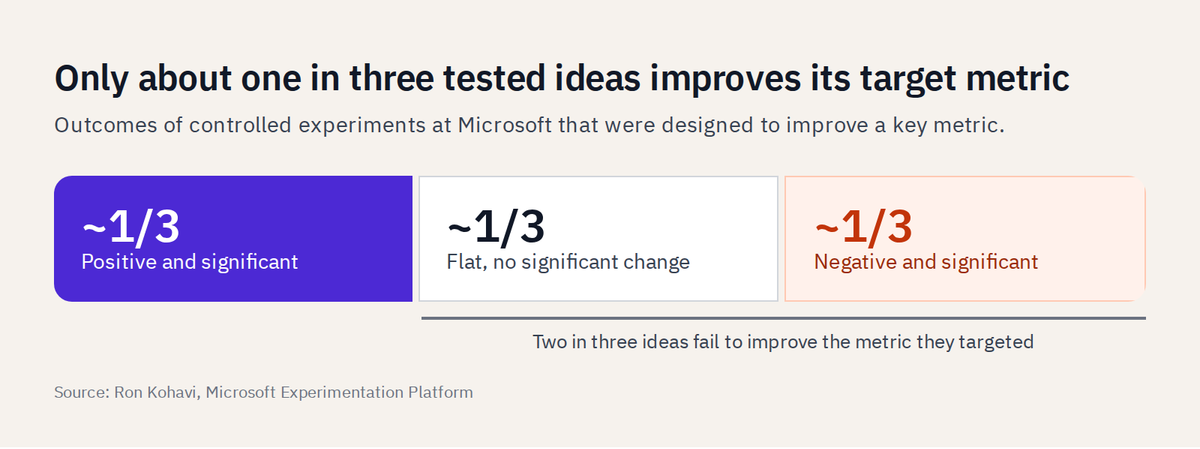
Most tests won't win, and a roadmap should plan for that. In Microsoft's experimentation program, about one-third of tested ideas improved their target metric, one-third were flat, and one-third made it worse. Budget for three tests to find one winner, and log the flat and losing results so nobody reruns them.
Build a Testing Roadmap with 9AM
The right first test depends on where your funnel leaks, and the four-number diagnostic tells you that in an afternoon. From there, the order is consistent: run the cheapest readable test first, confirm the winner, then build the page test from what the ad proved.
9AM runs that sequence as one plan.
Our measurement setup work makes sure the numbers behind each verdict reconcile with your backend, and our creative and media teams build the queue of angles and run the tests in the same weekly cadence.
Each cycle feeds the next brief, so a losing test still narrows what to try. Over a quarter, that adds up to a page built on proven angles and an ad account that keeps finding new ones. A typical first month covers the tracking audit, one ad test against a frozen page, and the brief for the matched page, so your team sees the full loop once before it runs at scale.
Book a strategy call and we'll review your funnel numbers together and leave you with a first test plan.
FAQs
Does Advantage+ creative remove the need for a separate landing page test?
No. Automated creative tools vary the ad, while the destination stays a fixed variable. Hold one page constant while Advantage+ creative runs, then test pages using the combination that performed best.
How do you test a landing page with under 1,000 paid visitors a month?
Test bigger swings, such as a new offer or a new page structure, that can produce differences of 30% or more. Use an earlier conversion event, like add-to-cart or form start, as the decision metric. If you still can't reach a sample, run before-and-after periods and treat the result as directional.
Should B2B lead generation test the form before the ad?
Only when the drop-off from form start to submission is clearly the leak. Otherwise test the ad first, because the angle decides who fills in the form, and lead quality matters more than form completion rate.
How long should a winning ad run before you build its matched page?
Give it one to two weeks of stable CPA at scaled spend after the test ends. That confirms the win holds beyond the test window, so the page is built on a durable angle and not a short novelty spike.