Amazon Share of Voice for Food Brands: When It Pays to Spend More
Amazon share of voice for food brands: how to calculate it, where to find the data and when extra visibility is worth the spend, with a 6-step target plan.

· 14 min read
A while back a client asked me to "own page one" for a high search volume keyword on Amazon.
I checked their search rankings and ad costs.
They already ranked first organically for their brand name, and the category term was the most expensive keyword in their account by a wide margin.
That request comes up a lot, and it rests on a fair instinct. Visibility on Amazon matters. The question I ask is whether another placement will bring in a sale the brand would otherwise miss.
I’ll show you how to calculate Amazon share of voice and where I get the data. Then I’ll explain how I decide whether the extra placements are worth paying for.
P.S. If you want Amazon budgets set by where extra visibility adds sales, the 9AM Amazon advertising team for food brands I work with uses those sales to plan spend every month.
What Is Amazon Share of Voice?
Amazon share of voice is the percentage of search placements your brand holds for a keyword or set of keywords. I split it into paid share of voice from sponsored placements and organic share of voice from unpaid rankings.
In this guide, I count product placements on page one.
I track it because Amazon search works like a shelf.
If a shopper never gets past the first rows, a product lower down never enters the decision.
For a food brand, visibility on terms like “protein bars” or “gluten free crackers” is the closest thing Amazon has to shelf space at eye level.
If you’re more of a visual learner, here’s a good explanation:
My view: share of voice is a diagnostic first. I track it on every account, and I only pay to raise it where a test shows the extra visibility brings sales I wasn't getting already.
How to Calculate Amazon Share of Voice
To calculate Amazon share of voice, divide your brand’s page-one placements for each keyword by all the placements on that page. If you want one number for the keyword group, average those percentages so each term counts equally.
Share of voice (%) = (your brand’s page-one placements ÷ all page-one placements) × 100
A position-weighted version gives higher slots more weight and divides your brand’s weighted score by the total weighted score on the page.
I use it for category terms where I care about the front of the shelf, and I keep the same weights each time I measure.
In this purely imagined example, page one for “granola” has 48 placements and your brand holds six, two sponsored and four organic.
That’s 12.5% total share of voice.
Using all 48 slots as the denominator for both, sponsored placements contribute 4.2 points and organic placements contribute 8.3 points.
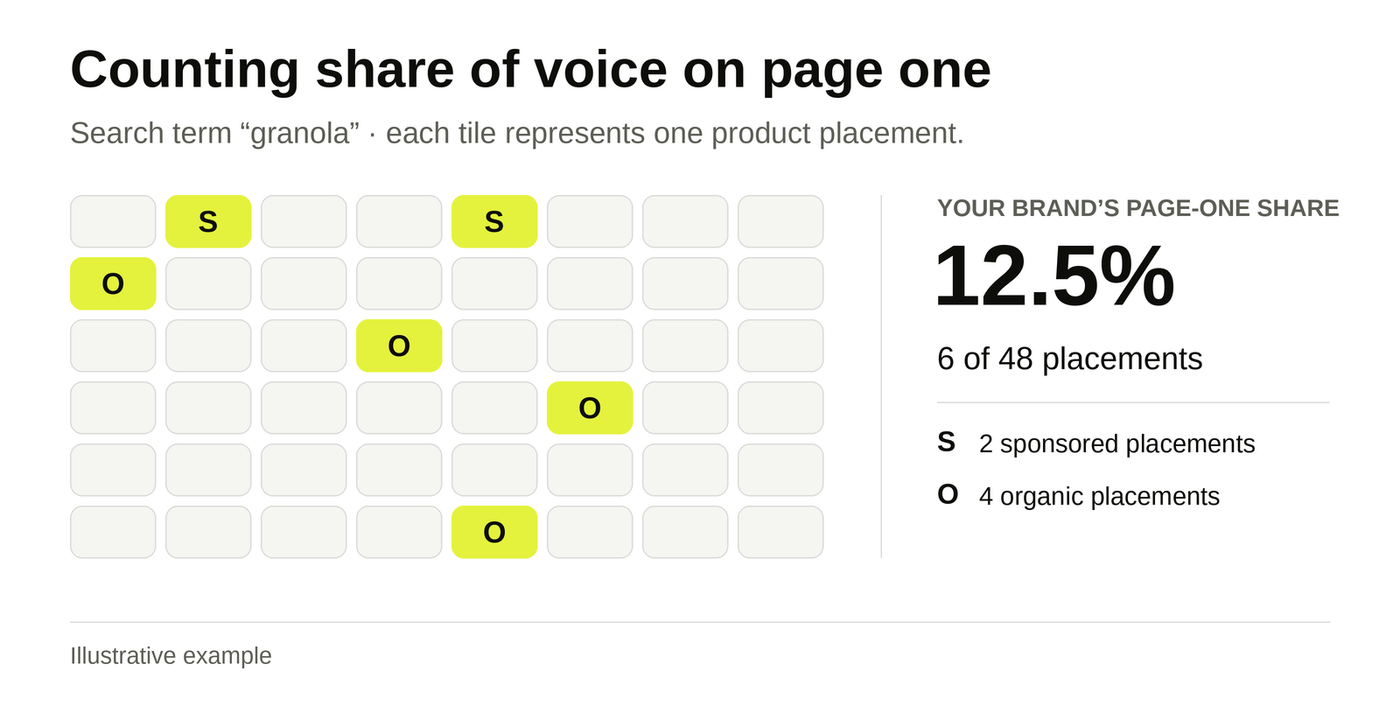
Six brand placements out of 48 give a 12.5% share of voice on page one.
Pro tip: I track share of voice per keyword and per keyword group.
One blended number across 200 keywords can hide the fact that you own your brand terms and barely appear on the category terms that bring new buyers.
I also keep the marketplace, location and device consistent so I can compare results from one check to the next.
Where to Find Amazon Share of Voice Data
I use Amazon Ads impression share and the Brand Impression Share report to see where I have room to buy visibility. Search Query Performance tells me what shoppers do after seeing a listing, and third-party rank trackers show which slots the brand and its competitors occupy.
Impression Share in Amazon Ads Reports
Amazon’s unified reporting includes impression share metrics, but the denominator depends on the report.
Search term impression share shows the portion of Sponsored Products ad impressions an advertiser won for that query.
Top-of-search impression share shows the portion of eligible top-of-search ad impressions the campaign won, so I keep both metrics separate from my page-one slot count.
Brand Impression Share Report and Lost Top-of-Search Sales
In Amazon Ads Agent, I check the Brand Impression Share report for branded top-of-search visibility and the Lost Top-of-Search Sales metric.
I use it to spot where I might be missing sales when I’m absent from the top slot, then test whether winning more of that slot adds sales.
Search Query Performance in Brand Analytics
Eligible brand representatives in Amazon Brand Registry can open Search Query Performance in Seller Central.
It shows a brand’s share of impressions, clicks, cart adds and purchases against the total for each query.
I use it to spot terms where the brand’s share of purchases is much smaller than its share of impressions.
Third-Party Rank Trackers
Jungle Scout offers paid and organic share of voice by keyword. Helium 10 and DataHawk report organic and sponsored positions, which I can use to track how visibility changes.
I compare trends within the same tool because each can sample a different set of results.
Source | Paid or organic | Best use |
|---|---|---|
Impression share in ad reports | Paid | Ad impression coverage by search term or placement |
Brand Impression Share report | Paid, branded terms | Lost top-of-search sales on brand terms |
Search Query Performance | Query-wide brand share | Share of impressions vs clicks and purchases |
Third-party rank trackers | Both, by position | Organic trend and competitor positions |
When Is More Amazon Share of Voice Worth the Spend?
I pay for more Amazon share of voice when the extra visibility could win sales I’d otherwise lose. That can be a branded term a competitor is bidding on, a category term that already converts, or a launch week with more shoppers in the aisle.
The first question I ask is who gets the sale if my ad disappears.
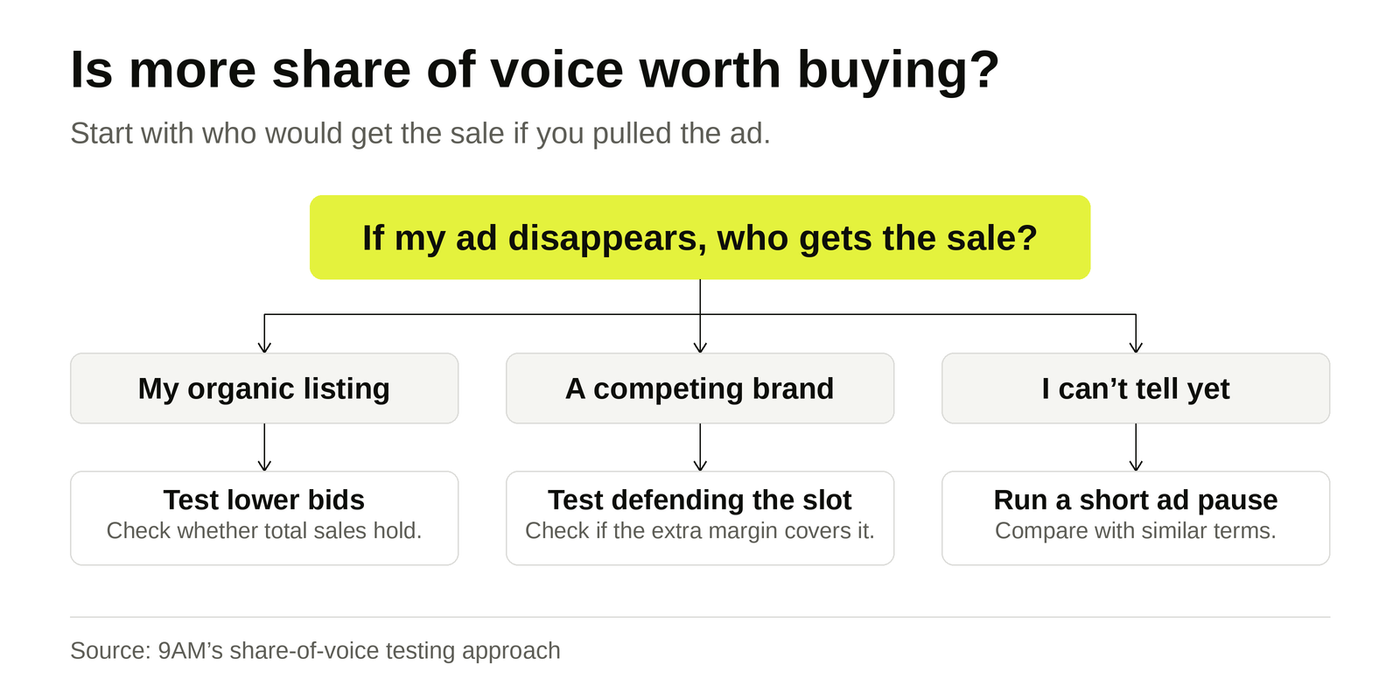
Check who could get the sale, then test what happens to total sales.
I check the search results first, then use a short test to see whether total sales change.
That helps me tell whether the ad brings in sales my organic listing would otherwise miss.
Branded Search Defense
When competitors bid on your brand name, a shopper who searched for you can end up buying from them. Holding the top sponsored placement can help you win that sale.
If I rank first organically and see few rival ads, I test whether organic sales increase when I lower bids.
This is where I see the biggest gap between instinct and evidence.
I check who else is in the auction and what happens to total sales when I reduce bids.
Our guide to brand tax in paid scaling explains what it costs to bid on your own brand.
Category Search Terms That Convert Well
Category terms like “keto snacks” or “sparkling water” can reach shoppers who haven’t picked a brand.
I compare how my listing converts on the term with the query-wide result where I have the data.
If conversion is far below the benchmark, more visibility usually means more paid clicks that don’t buy.
Product Launches and Seasonal Peaks
A new product often starts with little organic visibility, so paid placements can show it on page one while the listing builds a track record.
Around Prime Day, back-to-school or holiday baking, I can buy that visibility for the weeks shoppers are looking.
I check inventory first so the campaign has enough stock to sell through the peak.
Competitor Brand Search Terms
Bidding on a competitor’s name can win sales when your product is a clear alternative at a similar price, especially if theirs is out of stock.
I don’t use it as a standing strategy all that much because a shopper typing someone else’s brand is already looking for a specific product.
Keyword situation | Worth more share? | What I check first |
|---|---|---|
Branded, competitors bidding | Usually yes | Lost top-of-search sales |
Branded, no competitors, top organic rank | Usually no | Sales during a short pause |
Category term, conversion near leaders | Yes, up to margin | Brand conversion vs query benchmark |
Category term, conversion far below | No, fix the listing first | Product page and reviews |
Launch or seasonal peak | Yes, for the period | In-stock depth |
Competitor name | Selectively | Competitor stock and price |
How to Set an Amazon Share of Voice Target Step by Step
I group keywords by role, measure current share and estimate what one more point would cost. Then I test whether that extra visibility adds sales and set a target each group’s margin can support. Here are the six steps I use.
1. Group Keywords by Role: Branded, Category and Competitor
Sort every keyword into branded, category or competitor. Each group gets its own target because a shopper searching your name is much closer to choosing you than someone searching for “granola.”
2. Measure Current Paid and Organic Share of Voice
Record paid and organic share per keyword for at least two weeks. I use weekly averages because a single day of light traffic or a competitor’s promo can skew the daily share for a low-volume term.
3. Estimate the Cost of Each Extra Point of Share of Voice
Raise bids in steps on a small set of keywords and record the extra spend and share at each step. Divide the extra spend by the percentage points gained to get the cost of the next point.
When the remaining placements are harder to win, that cost can rise quickly, the same pattern I look for on a paid media saturation curve.
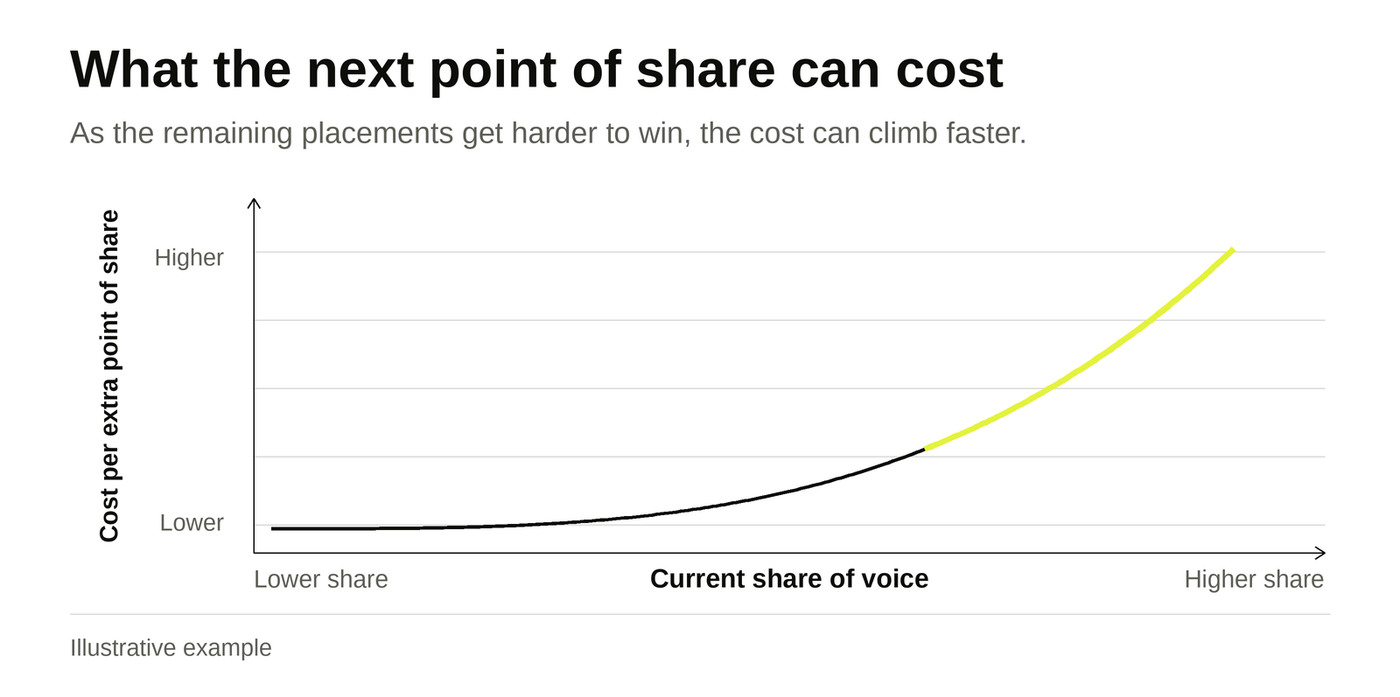
Track the cost of each new point of share as you raise bids.
4. Test the Incremental Sales From Extra Visibility
On branded terms, I pause ads on a small set and compare total brand purchases on those queries with similar terms I leave running.
Search Query Performance gives me that query-level read where the data’s available.
For category terms, I raise bids on one set and keep a comparable set steady, watching stock, price and promotions on both.
The first time I ran a branded pause test, total sales on those terms barely changed, and organic listings received almost all the clicks. On the next account, a competitor took the top slot within days.
The same test can give opposite answers, which is the whole point of running it.
5. Set Share of Voice Targets by Keyword Group and Margin
I set a target where the test showed extra sales and stop when the next point costs more than those sales contribute in margin. Where extra share hasn’t added sales, I keep a visibility floor and stop there.
6. Review Share of Voice Weekly Against Rank and Sales
I check paid share, organic rank and total sales together each week.
If organic rank climbs, I test lower bids and watch whether total sales hold.
If share and sales both fall, I check rival ads, stock and price before changing the target.
Is Sponsored Brands Reserve Share of Voice Worth It?
I consider Sponsored Brands reserve share of voice when a food brand has enough branded searches to defend and a peak that makes the timing matter.
Amazon lets you reserve Sponsored Brands top-of-search visibility for eligible branded keywords at a fixed upfront price.
Amazon’s setup guide specifies who can reserve inventory and which terms qualify.
I use those rules to check whether a campaign is eligible before I compare the quote with the margin I expect it to add.
Eligibility. You need Amazon Brand Registry, active Sponsored Brands campaigns and at least five eligible branded keywords. The U.S. minimum is $6,000 per campaign.
Keywords. Only exact-match branded terms qualify. Amazon excludes generic terms, misspellings and competitor brands.
Pricing. Amazon quotes a fixed CPM and gives 14 to 90 days as an example of a campaign flight.
Formats. Amazon supports Sponsored Brands video, store spotlight and collections.
Amazon’s U.S. beta compared performance on the same branded queries for 15+ advertisers from May to August 2025.
Sponsored Brands top-of-search impression share rose from 62.7% to 99.3%, and Lost Top-of-Search Sales dropped from 10.3% to 0.3%.
I treat those results as the upper end of what I’d expect and test against my own margin.
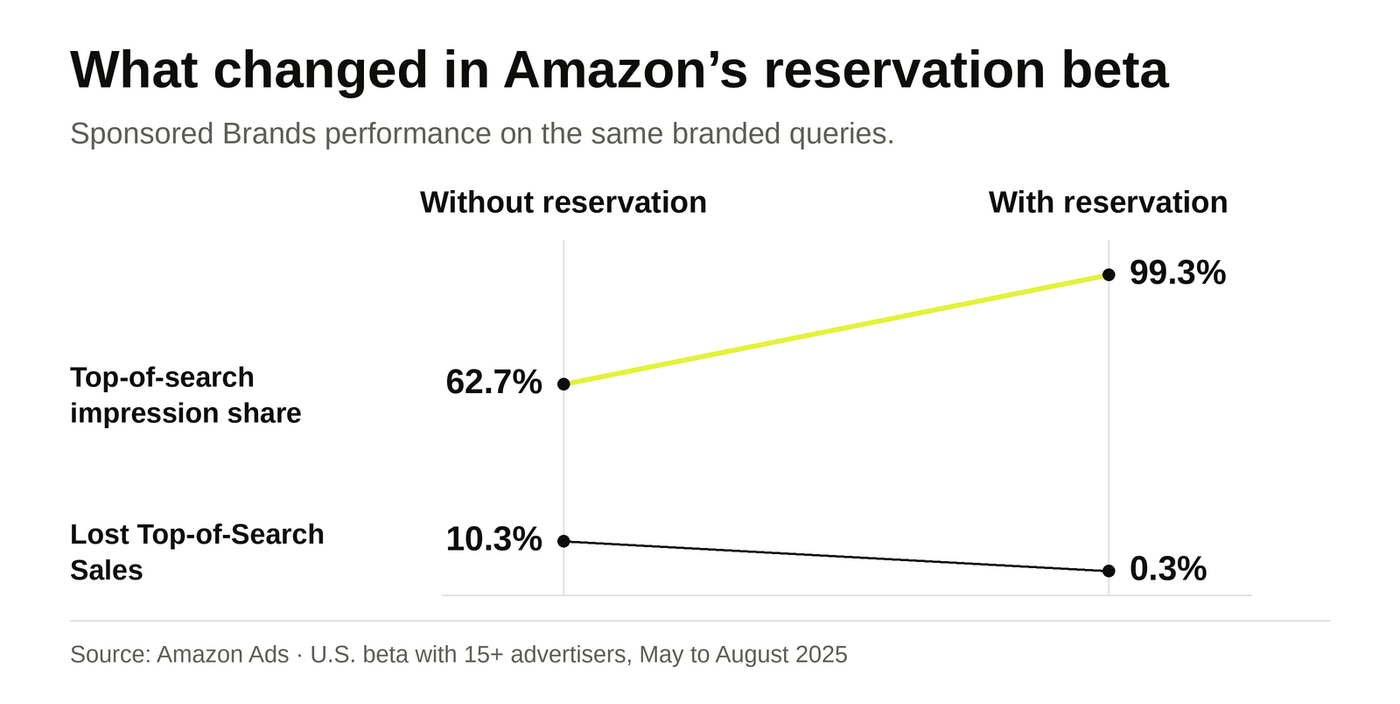
Amazon measured these changes on the same branded queries in its U.S. beta.
A client asked me recently whether reserving their brand terms all year would be "safer".
My answer was to look at lost top-of-search sales first.
If that number is already near zero, a reservation buys certainty you don't need. If it's high in specific weeks, reserve those weeks.
How to Improve Amazon Share of Voice
I start with the listing, reviews, price and stock before adding more ad formats.
These are the first things I check because shoppers can see you and still leave if the pack looks unclear, costs too much or can’t be delivered.
Early in my career I raised bids on a category term for a month to win higher ad placements, and organic rank didn't follow. The product page had a handful of reviews and a blurry main image.
Since then, I check the listing before I change a bid.
Product Titles, Images and A+ Content
Use relevant search terms in the title, show the real pack and flavor clearly in the main image, and use A+ content to explain ingredients and serving ideas.
A clear title helps shoppers find the listing, and the image and A+ content help them decide what to buy.
Reviews and Ratings
I check reviews and ratings because shoppers use them to decide if a pack is worth trying. Eligible new food products can use Amazon Vine to get early reviews.
On established listings, I look for repeat complaints about flavor, packaging or damage and send those back to the product team.
In-Stock Rate and Price
When a product sells out, Amazon pauses its Sponsored Products ads. Price matters too, because shoppers can compare the value of your pack with nearby results before they buy.
Sponsored Products, Sponsored Brands and Video Ads
Sponsored Products promotes individual products, while Sponsored Brands can use collections or video in placements such as top of search and within results.
I test another format where it gives the brand a different way to show the range, then track the extra placements and what they cost.
How to Track Share of Voice on Walmart and Instacart
On Walmart and Instacart, I divide the brand’s placements by all the placements in the results I’m tracking. I set the search scope first because the retailer, market and page layout change what’s available to count.
Pacvue tracks paid and organic share of voice across supported retailers, including Walmart and Instacart.
Where I don’t have a tracker, I check a short list of priority terms by hand each week and record the positions in a sheet.
Three differences I keep in mind:
Walmart. Store and fulfillment choices can change which items are available for pickup or delivery. I keep those settings fixed when I compare searches, and our Walmart Connect guide explains how to advertise on Walmart.
Instacart. I track results by retailer and area, because a store’s catalog and availability shape what a shopper can see and order.
Both. I compare trends within one retailer, since page layouts and the number of sponsored slots can vary.
Buy Amazon Visibility Where It Adds Sales
I track Amazon share of voice on every account and pay for more only where a test shows it adds sales. For most food brands, that means defending contested brand terms, building share on category terms that convert and spending harder around launches and peaks.
It reminds me of a farmers market on a Saturday.
The stall people buy from has the right product at the front and enough of it, whatever the length of its table.
The brands I see make profitable use of extra visibility set share targets per keyword group, test before they raise them and review them every week. Over a few quarters, that turns Amazon ad spend from a fight for page one into a plan built on where visibility pays.
If you'd like share of voice, rank and sales reviewed together every week, book a strategy call. My team builds that into how it runs your Amazon account long term.
Frequently Asked Questions
What is a good share of voice on Amazon?
There’s no single good number. On a contested brand term, I aim for strong top-of-search coverage and use a pause test to see how much protection I need. On category terms, I stop at the highest share where the next point still adds enough margin to pay for itself.
Does paid share of voice improve organic rank on Amazon?
It can help indirectly by getting more shoppers to see and buy the product. I judge any change in organic rank separately and check whether the ranking holds when I lower bids. A listing with relevant keywords, clear images and a price shoppers accept is more likely to sustain sales.
How is share of voice different from market share and share of shelf?
Share of voice measures visibility in search results, and market share measures sales against the category. Share of shelf usually measures how much of the physical or digital shelf a brand occupies. On Amazon, I’d check whether the shelf count includes paid placements before treating it as organic share of voice.
How often should food brands track share of voice?
I track priority keywords weekly and check daily during launches, Prime Day or a competitor’s big promotion. Weekly averages reduce the effect of any single day, and the extra checks during a peak show if I need to act sooner.
About Corentin Grisoni
Corentin Grisoni helps DTC and wellness brands turn paid media into a connected growth system. As Retail Media Lead at inBeat Agency, he works across Amazon, Meta, TikTok, and Google to build omnichannel campaigns that are measurable, scalable, and tied to business outcomes.
His work brings together retail media strategy, paid social and search, attribution modeling, UGC, and performance creative. He focuses on helping retail, technology, and wellness brands understand where their media budget is working and create a system that compounds what performs.
More from Corentin Grisoni