Amazon DSP for Food Brands: What to Check Before You Expand
Amazon DSP is now DVA in Amazon Ads Agent. What changed, what it costs and the 8 checks food brands should run before adding it to sponsored ads.

· 17 min read
Every few months a food brand founder tells me the same thing: "Search is maxed out, so it's time for DSP." Most of the time, when I open the account with them, search isn't maxed out at all. A best seller is out of stock in some regions, or the category terms convert far below the brand terms.
Amazon DSP can reach shoppers before they search for your food brand. Paying for that reach changes what you’re measuring, because an ad view can get credit for a purchase days later. That’s why I run the checks below before I reallocate any ad spend.
I’ll cover what Amazon DSP is called now, how it differs from sponsored ads and what it costs. Then I’ll explain the eight checks I make before adding it to a food brand’s plan.
P.S. If you want Amazon DSP planned around your margin and stock, the 9AM programmatic team for food brands I work with runs it alongside your sponsored ads.
My view: DSP is the second step on Amazon. A food brand should add it once sponsored ads cover search demand, it has enough stock for the campaign and the margin can pay for buyers who need more than one ad to convert.
What Is Amazon DSP and How Does It Work?
Amazon DSP is Amazon’s demand-side platform, the software behind its programmatic display, video, streaming TV and audio buying.
In Amazon Ads Agent, you buy those placements through Display, Video, and Audio campaigns.
I use them to reach shoppers on Amazon properties and across third-party sites and apps, including people who haven’t searched for the product yet.
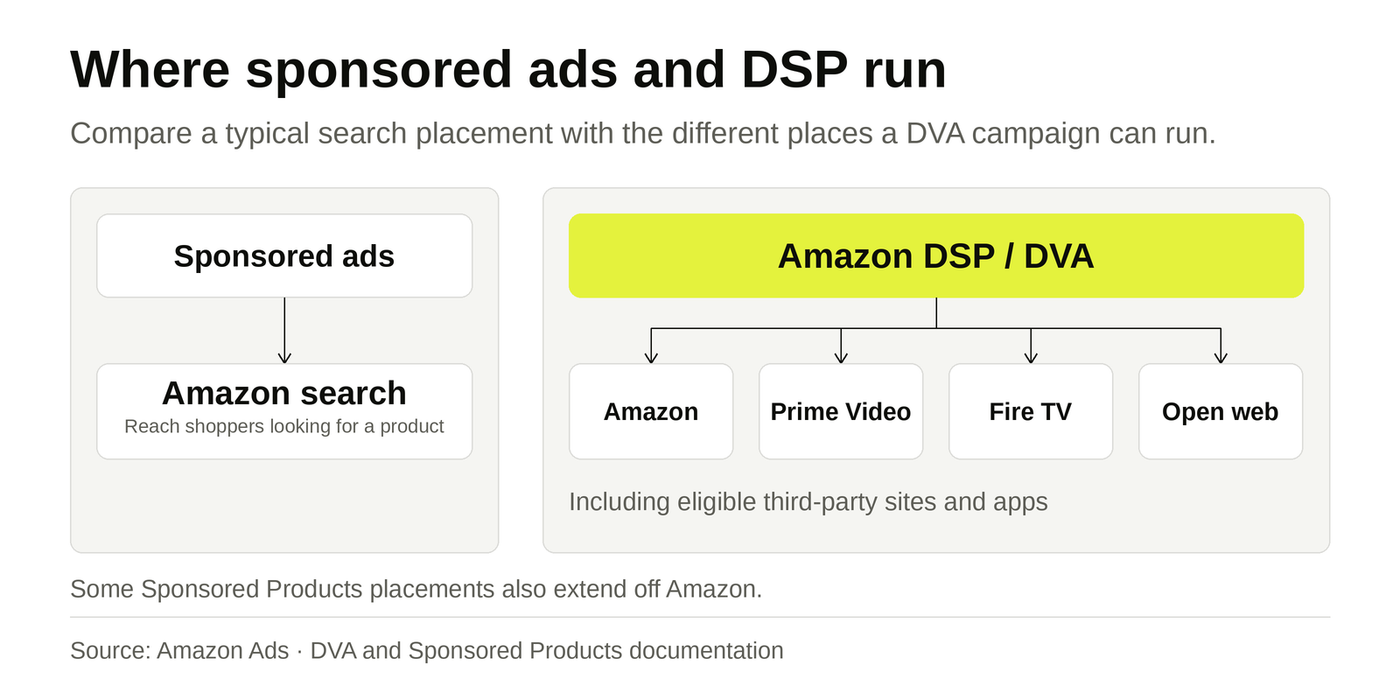
I use sponsored search to reach shoppers who are already searching and DVA to reach shoppers across more placements.
I check four things when I set up a campaign. They tell me who can see the ad, where it can run, what I’ll pay and what Amazon can count.
Audiences. Amazon segments use shopping and streaming signals, and I can add eligible first-party audiences. I pick the audience based on what I want a shopper to do next.
Inventory. Eligible placements include Amazon, Prime Video, Fire TV, Twitch and third-party publishers. The formats I select determine which of those placements I can buy.
Bidding. I usually price media by cost per thousand impressions (CPM). Auction prices can vary, and some deals use a fixed CPM.
Measurement. Amazon can attribute product page visits and purchases on Amazon to ad views or clicks. For your own site, it can use events tracked through Amazon Ad Tag or the Events API.
What Changed with Amazon DSP in 2026
On September 29, 2026, Amazon announced Amazon Ads Agent as the unified platform for its former Ads Console and Amazon DSP. Amazon now offers programmatic buying through Display, Video, and Audio (DVA), with DVA+ as the simplified workflow and advanced settings for more manual control.
I still use the same buying checks after the rename.
The difference I care about is how much control I get over audiences, inventory and bidding, which Amazon lays out in its DVA+ launch page.
Before | Now | What it means for you |
|---|---|---|
Amazon DSP | Display, Video, and Audio campaigns (DVA) | DVA+ simplifies setup. Advanced settings retain manual controls. |
Ads console plus Amazon DSP | Amazon Ads Agent | Sponsored ads and DVA in one platform |
Sponsored Display and Sponsored TV | DVA+ | Display and streaming TV in one buying workflow |
Separate campaign setups | Full-Funnel Campaigns | Amazon allocates budget across sponsored ads and DVA formats |
Sponsored Products and Sponsored Brands | Unchanged | Standard search campaigns still offer CPC pricing |
I check access and budget before choosing a campaign setup. The limits below tell me which options I can test now.
Amazon announced a U.S. beta for DVA+ and targeted general availability across 35 markets in Q1 2027. It also targets general API availability in Q1 2027, so I’d confirm access in your market before booking a flight.
PPC Land reports that Amazon’s automated DVA+ campaign builder accepts up to 20 products. If you want to promote more than 20 flavors or pack sizes, choose which products to test first or split the catalog across campaigns.
Full-Funnel Campaigns have a $100 daily minimum. Amazon allocates the budget across formats and handles targeting, so I use this route when I’m comfortable handing it those decisions.
In this guide I still say "Amazon DSP", because that's the name brands and most search results use.
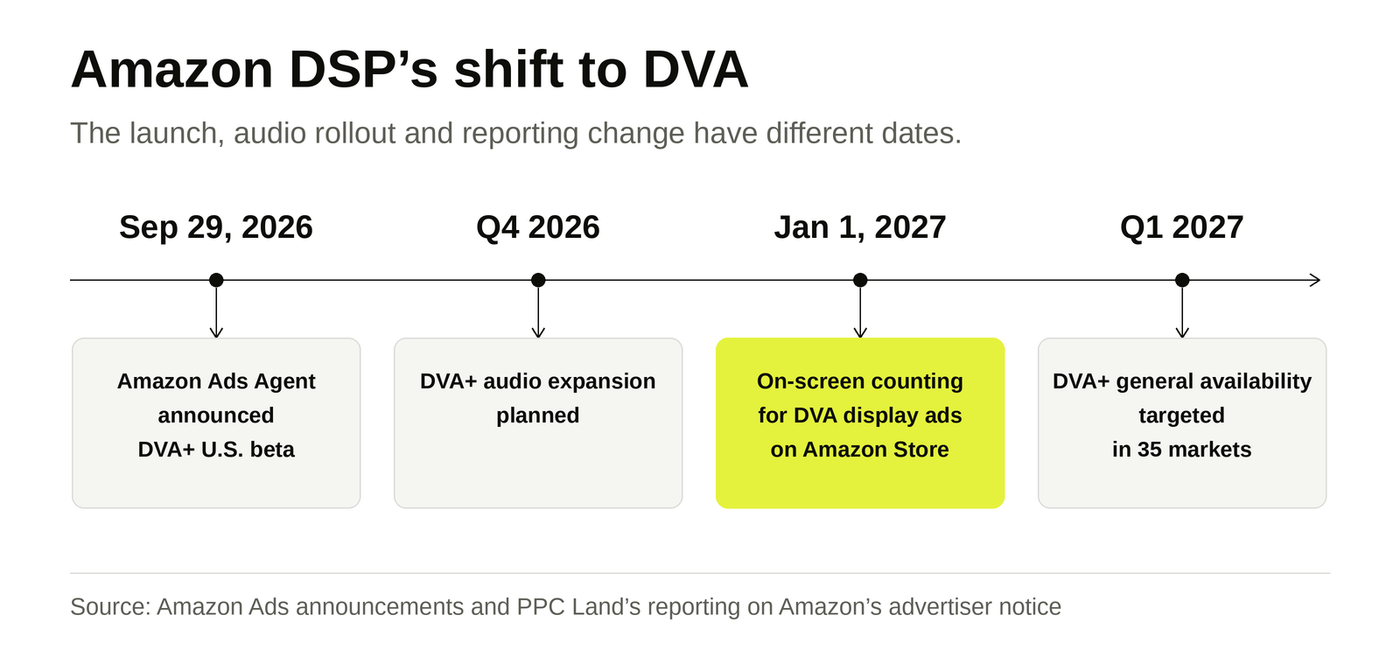
The January counting change applies to DVA display impressions on the Amazon Store.
How Is Amazon DSP Different From Sponsored Ads?
I use Sponsored Products and Sponsored Brands first to reach shoppers already searching on Amazon.
Some sponsored placements can also reach shoppers off Amazon, while DVA lets me plan audience-led display, video and streaming campaigns across Amazon properties and the open web.
I keep the jobs separate when I judge performance, because someone searching for “protein snacks” is closer to buying than someone watching a show.
Sponsored ads | Amazon DSP (DVA) | |
|---|---|---|
Who you reach | Amazon search and shopping pages, plus eligible off-Amazon placements | Audiences on Amazon, Prime Video, Fire TV and the open web |
Targeting | Keyword and product targeting, depending on campaign type | Shopping, streaming and first-party audiences |
Pricing | Typically CPC for standard search campaigns | Typically CPM, with fixed-price deals also available |
Minimum spend | No minimum spend for standard sponsored ads | Depends on access route |
Who can use it | Depends on format and advertiser eligibility | Brands on Amazon and brands that sell elsewhere |
Typical job | Capture existing demand | Create demand and bring buyers back |
Sponsored Display and Sponsored TV are now part of the DVA buying workflow.
Amazon says existing Sponsored Display campaigns can still be accessed there, so I check the campaign I already have before creating a new one.
Amazon DSP Ad Formats for Each Funnel Stage
The main DVA formats are display, online video, streaming TV and audio.
Amazon also offers digital signage where it’s available. I match the format to the job, from showing a new product in use to reminding someone to reorder.
Format | Funnel stage | Typical food brand use |
|---|---|---|
Display | Consideration and conversion | Remarketing to detail page viewers |
Online video | Awareness and consideration | Showing a product in use, such as a recipe |
Prime Video and streaming TV | Awareness | Launching a new product line |
Audio | Awareness | Reaching shoppers on Alexa and Amazon Music |
Digital signage where available | Awareness at point of purchase | Supporting a retail launch |
Display Ads
Display can run on Amazon and third-party sites. Responsive eCommerce creatives can use product details from your Amazon listing, which is useful when I want to remind a shopper about a product they already viewed.
Online Video Ads
Online video can run on Amazon properties, eligible Amazon device placements and third-party sites and apps.
For food brands, I’d try a short recipe or taste demo because it shows how someone could use the product for a meal or snack.
Prime Video and Streaming TV Ads
Streaming TV ads can run on Prime Video, Fire TV and eligible third-party streaming apps, with access to Amazon audiences.
This is the reason I’d use DSP for a food brand that wants TV-style reach but still wants to measure what viewers do afterward.
Our page on CTV advertising explains how to plan streaming and linear TV together.
Audio Ads
Audio ads can run on ad-supported Amazon Music, eligible Alexa devices and podcast inventory.
Amazon planned to expand audio availability in DVA+ in Q4 2026, so I check which audio placements the account can buy before I plan around it.
Out-of-Home Ads and Amazon Fresh Screens
Amazon sells programmatic digital signage where inventory is available.
It announced the closure of its U.S. Amazon Fresh and Amazon Go physical stores in January 2026, while Amazon Fresh online continues in available areas.
Pro tip: I ask which screens are actually bookable before I put them in a retail launch plan.
Amazon DSP Targeting Options for Food Brands
I start with past buyers and in-market shoppers for most food brands, then add other targeting if the campaign needs it. Amazon’s targeting options depend on the workflow, so I check what’s available before building the plan around a specific segment.
Past and Lapsed Buyers of Your Products
I build this audience around past buyers whose usual reorder window has passed, where the account has the right signals.
A repeat buyer already knows the flavor and pack, which is why I start here.
I set the window around the product’s reorder cycle, such as 30 days for coffee pods or 60 for a pantry staple.
In-Market Shoppers for Your Category
I use in-market audiences to reach people whose recent behavior suggests interest in a category, such as protein snacks.
They already know the category, so the ad can get straight to why they might choose this product on their next shopping trip.
Competitor Product Targeting by ASIN
Amazon’s product targeting can use signals such as views and searches of relevant products.
If I can select a competing ASIN in the account, I test it when my product is a close swap at a similar price.
Contextual Targeting
Contextual targeting lets me buy placements based on the surrounding content, such as a recipe page or fitness video.
It gives me a way to reach a relevant audience even when my own shopper list is too small.
Lookalike Audiences
Lookalike audiences help me reach shoppers with behaviors similar to a starting group, such as existing buyers.
Amazon lists lookalikes and retargeting among the controls in DVA+ advanced settings, so I check access before building them into the plan.
Your Own Customer Lists
I can use eligible first-party data, such as a hashed customer list, to create a custom audience. I use it to reach existing customers or exclude them from prospecting when I want a clean read on new buyers.
Should Amazon DSP Ads Send Shoppers to Amazon or Your Own Site?
Use link-in when the advertised product sells on Amazon and the Amazon listing or Brand Store shows the product in stock and available to buy. Use link-out when you want shoppers to buy on your site or find a nearby store.
I pick the conversion event before launch so a site purchase and a store-locator visit don’t get treated as the same outcome.
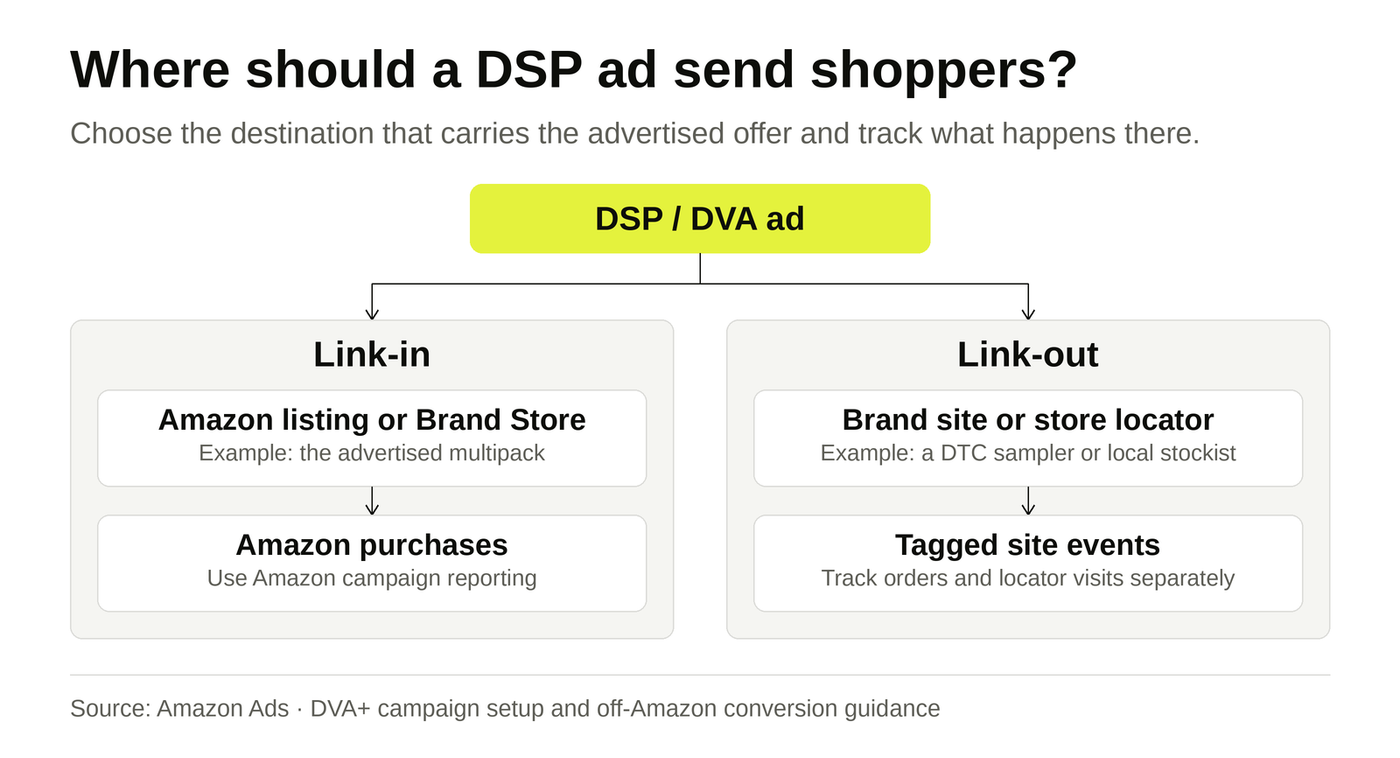
Match the landing page to the offer and set the conversion event for that destination.
A food brand might sell a multipack on Amazon, a sampler on its own store and single packs in grocery.
I send each ad to the destination that carries the offer it shows.
Our guide to food ecommerce ads compares those three buying paths.
The automated DVA+ setup offers location targeting for off-Amazon objectives, according to PPC Land’s coverage of Amazon’s setup guide. For a regional grocery launch, I can use that route to send people in stocked areas to a store locator and measure locator visits separately.
How Much Does Amazon DSP Cost?
Amazon describes self-service DVA with a budget you set and typically lists a $50,000 U.S. minimum for managed service. Full-Funnel Campaigns start at $100 a day.
I check the quote for what’s included, because platform, data, measurement or agency fees can change the cost of a test.
Access route | Minimum | Who runs it | Fees |
|---|---|---|---|
Self-service (DVA+ and advanced settings) | Advertiser-set budget | You or your agency | Platform and eligible add-on fees |
Managed service by Amazon | Typically $50,000 in the U.S. | Amazon's team | Managed-service fee, plus applicable charges |
Full Funnel Campaigns | $100 a day | Amazon automates buying and optimization | CPC or CPM by format |
Through an agency | Set by the agency | Agency | Agency fee and applicable platform fees |
I also compare CPMs within the same format and inventory, because a streaming TV impression and a display impression buy different things.
Amazon lists both auction and fixed-price CPM options, so I price the test using the deal and fees I’ll actually pay.
What to Check Before Adding Amazon DSP to Sponsored Ads Step by Step
Before adding Amazon DSP, I check search coverage, stock and delivery, listing conversion, margin and audience size. I fix any problems with those five before I buy ads. Once they pass, I choose how to buy, set up measurement and start small.
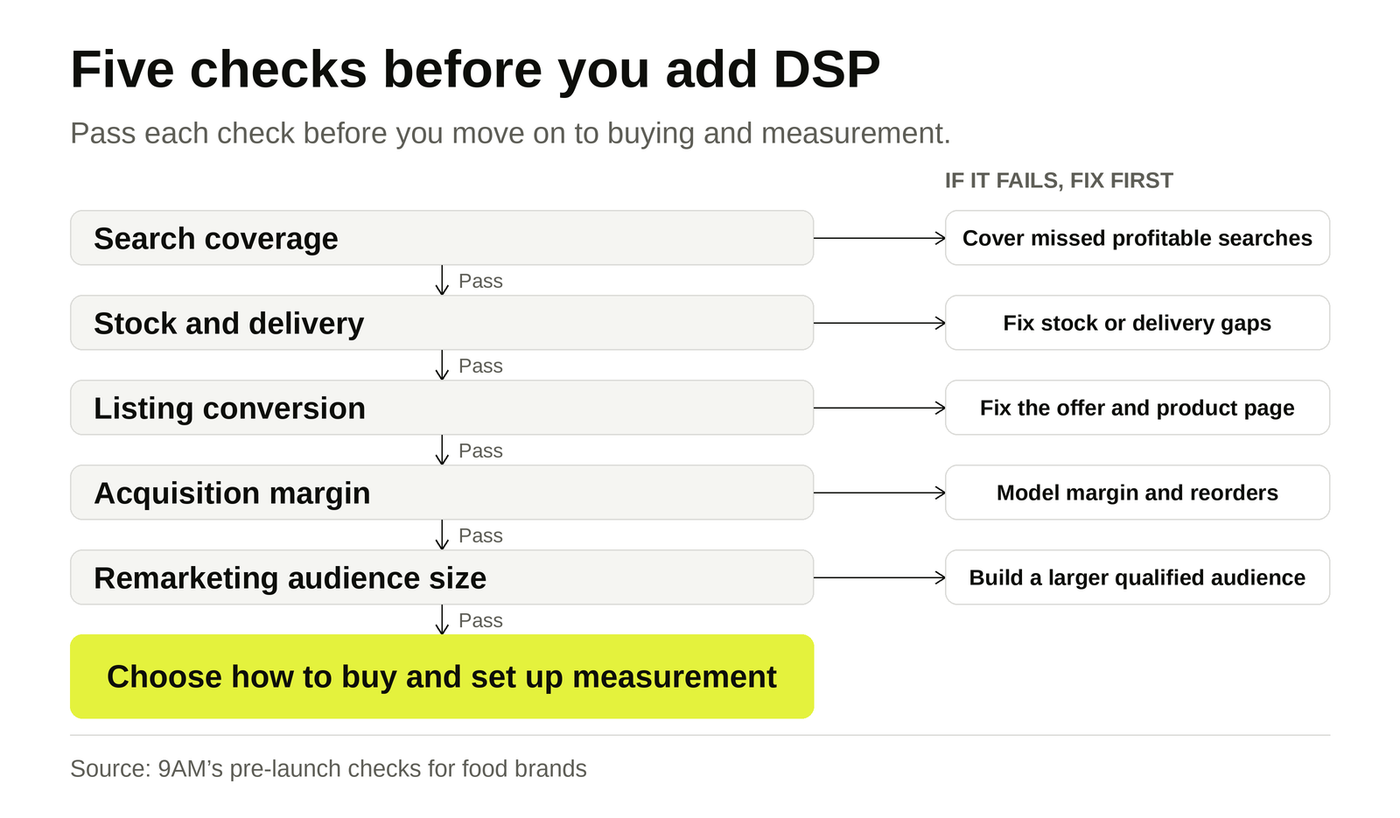
Fix the first failed check before you commit budget to DSP.
1. Confirm Sponsored Ads Already Cover Branded and Category Searches
I check branded impression share, Lost Top-of-Search Sales where it’s available, and conversion on my main category terms.
If I’m missing profitable searches for products I already sell, I put budget there first.
Those shoppers are already looking for the product, so I can test the sale without paying to build interest from scratch.
2. Check In-Stock Rates and Delivery Coverage for Every Advertised Product
I check whether the advertised pack can stay in stock throughout the campaign and where shoppers can get it delivered.
That matters for chilled and fresh products because coverage can vary by area. In this guide to Fresh and Amazon.com ads, I cover what to check for each offer.
I learned this one the hard way.
My team launched a streaming TV flight for a snack launch, and the hero flavor sold out on Amazon in the second week. The ads kept sending shoppers to a page with no buy button.
Now I check stock depth against the campaign length before launch.
3. Check That Detail Pages and Reviews Convert New Traffic
I check the main image, flavor, pack size and reviews before sending new shoppers to a detail page.
Someone who sees the product for the first time needs to know what they’ll get.
A page that struggles to convert search traffic gives me a reason to fix the listing before I buy more visits.
4. Check That Margin Can Carry New-to-Brand Acquisition
A product with a 25% contribution margin before ads needs a 4.0 ROAS to break even on the first order.
If I expect prospecting to fall short on the first purchase, I model how many repeat orders it would take to recover the ad spend. Our article on contribution margin marketing shows how to calculate those numbers, but use this formula to start:
Break-even ROAS = 1 ÷ contribution margin before ads
5. Check That Remarketing Audiences Are Large Enough to Buy
I check whether recent detail page viewers and lapsed buyers give me enough people to reach without showing them the same ad too often.
If the pool is thin, I lower the test budget or build more qualified traffic before I buy remarketing.
I also check frequency controls before I launch.
6. Choose Self-Service, Managed Service, DVA+ or Full Funnel Campaigns
I choose a buying option based on the budget and how much control I need for the first test.
Under about $3,000 a month. I usually wait and put the money into sponsored ads.
Testing with a few thousand a month. I consider DVA+ if I have access, or Full-Funnel Campaigns if I can cover the daily minimum and set aside a holdout group.
Steady spend with a team or agency. I use DVA+ advanced settings when I need more control over audiences and frequency.
This Amazon Ads demo shows how to set up a Full-Funnel Campaign and use one budget across ad formats.
7. Set Measurement and a Holdout Before Launch
I pick the metric before launch and exclude a comparable group or region from the campaign. I watch stock, price and promotions on both sides of the test so a grocery promo or a sold-out pack doesn’t get counted as ad lift.
Amazon’s attributed sales show which products Amazon counted.
8. Start with Remarketing Before Prospecting
I start with detail page viewers and lapsed buyers when the audience is large enough. A repeat-purchase product gives me a reason to test that group before I spend on people who don’t know the brand.
If you use Subscribe & Save, I’d also check when customers tend to reorder so the campaign dates match when people tend to buy again.
If a brand fails any of the first five checks, I fix that first and revisit DSP once I’ve seen whether the fix holds. In most accounts I check again the following month.
How to Measure Amazon DSP Results
I track detail page view rate, new-to-brand purchases, promoted and halo sales, branded searches and incremental lift. I check lift with a holdout and use Amazon Marketing Cloud to inspect the paths that led to purchase.
Note: ROAS by itself can undersell prospecting and oversell remarketing because those shoppers start with different reasons to buy.
In fact, a brand manager once told me her DSP test "did nothing" because its ROAS was below one, while branded searches for the product had increased throughout the campaign.
That's why I read the five metrics below together.
Pay attention: On January 1, 2027, Amazon plans to start counting DVA display impressions on the Amazon Store only when the ad appears on screen. PPC Land reported that Amazon’s advertiser notice projected about 63% fewer counted impressions on average for those placements.
Remember: Mark the date in your reporting, because metrics that divide by impressions can change even if clicks and spend hold steady.
Detail Page View Rate
Detail page view rate counts attributed detail page views relative to impressions.
I use it as an early sign that the ad gets shoppers to view the product page, before there are enough purchases to judge the campaign.
New-to-Brand Purchases
Amazon counts new-to-brand purchases from shoppers who haven’t bought from that brand on Amazon in the previous 365 days.
For prospecting, this is the main success number I track.
For a lapsed-buyer campaign, I expect the share to depend on how far back I set the audience.
Promoted and Halo Sales
Promoted sales come from the advertised products, while halo sales cover other eligible products that get credit. I report them separately because a halo sale of a sister pack can hide switching inside the brand.
Branded Searches
Branded searches count Amazon searches for the brand that Amazon attributes to an ad interaction.
For streaming TV and video, I use them as an early sign of interest, then compare search activity in the exposed and holdout groups.
Amazon Marketing Cloud Analysis and Incremental Lift
Amazon Marketing Cloud lets me query pseudonymized event-level data and see where shoppers viewed or clicked DVA and sponsored ads before buying.
I use those paths to see where shoppers engaged.
A properly set up holdout gives me the comparison I need to estimate how many sales DSP added.
Metric | What I think is best for | Watch out for |
|---|---|---|
Detail page view rate | Early read on prospecting | Doesn't prove sales |
New-to-brand purchases | Brand acquisition in prospecting | Check the remarketing lookback window |
Promoted and halo sales | Sales attribution | Halo can hide pack-size switching |
Branded searches | Streaming TV and video | Seasonal changes in sales |
Holdout lift, with AMC analysis | What DSP actually added | Needs analyst time and a clean holdout |
Grow Amazon Demand Past Search with a Full-Funnel Plan
I add DSP when sponsored ads cover profitable search demand, the brand has enough stock for the campaign and the margin can pay for the buyers I need to reach.
For a repeat-purchase product with enough audience volume, I start with remarketing and then test prospecting or streaming TV.
It's a bit like opening a second location for a bakery. You do it once the first shop sells out every morning and the recipes are steady. A slow first shop needs fixing at home.
The 2026 rename changed the menus more than the work. The brands I see get the most from DVA set up measurement before spending, test with a holdout and increase spend once repeat orders support the higher budget.
If you want sponsored ads, DSP and your stock planning run as one Amazon plan, book a strategy call now. My team does that for food brands over the long term.
Frequently Asked Questions About Amazon DSP
Do you need an agency to run Amazon DSP?
An agency is optional. Advertisers with eligible self-service DVA+ access can run campaigns in Amazon Ads Agent, and I’d confirm access by market and account. An agency helps when you need advanced settings and regular testing without building that skill in-house.
Is Amazon DSP worth it for small food brands?
Usually not yet. When a brand spends under a few thousand dollars a month on Amazon ads, I start with sponsored ads and listing improvements. Once search is covered and stock is steady, I’d test remarketing if the audience is large enough.
Can you use Amazon DSP if you don't sell on Amazon?
Yes. Amazon includes eligible off-Amazon brands in DVA+ access, and you can send shoppers to your site. Set up your conversion events through Amazon Ad Tag or the Events API before you launch.
How long should an Amazon DSP test run?
I plan four to eight weeks for a first test. If repeat orders are part of the payback, I extend the measurement window past the product’s usual reorder cycle. A fast read can show first orders and still miss the next purchase.
About Corentin Grisoni
Corentin Grisoni helps DTC and wellness brands turn paid media into a connected growth system. As Retail Media Lead at inBeat Agency, he works across Amazon, Meta, TikTok, and Google to build omnichannel campaigns that are measurable, scalable, and tied to business outcomes.
His work brings together retail media strategy, paid social and search, attribution modeling, UGC, and performance creative. He focuses on helping retail, technology, and wellness brands understand where their media budget is working and create a system that compounds what performs.
More from Corentin Grisoni