Food Ecommerce: Should Paid Ads Send Shoppers to DTC, Amazon, or a Grocery Retailer?
Decide where food ecommerce ads should send shoppers: compare DTC, Amazon and grocery retailers on cost per order, contribution, data and measurement.

· 24 min read
A paid social ad for a pantry snack can send the shopper to three different checkouts: your brand's own site, an Amazon listing or a grocery retailer's product page.
The ad costs the same in each case.
The money your brand keeps from the order does not.
That difference in end gain decides where food ecommerce ads should point.
This guide compares the three destinations on cost per order, contribution, customer data and measurement, then gives a decision rule for each type of product.
P.S. Our food and beverage media buying team plans paid media across DTC, Amazon and grocery retailers around the destination that keeps the most from every order.
TL;DR
Send paid ads where your product is available and where each order leaves the most contribution, then judge platform ROAS against that destination's break-even.
Chilled products usually belong with a grocery retailer, bundles and multipacks on DTC or Amazon, and trial products wherever a single unit is stocked near the shopper.
Judge destinations on one view of total revenue and contribution, plus lift tests, after each attribution window has closed.
At 9AM, we start the destination decision with contribution per order. The destination with the best-looking ROAS is, in many cases, the one with the highest break-even point. That's why we compare what each order leaves before we compare what each platform reports.
Which Destination Fits Your Food Ecommerce Brand? A Quick Decision Table
Short on time? Treat this as a starting point. Real decisions are more nuanced, and the sections below explain why.
DTC website | Amazon | Grocery retailer | |
|---|---|---|---|
Main job | Margin and data | Volume and discovery | Credibility |
Pros | You own the customer data; subscriptions and repeat offers; you control price and pack | Familiar checkout; Prime delivery; shoppers already searching | Shoppers already trust it; fits the weekly basket; no parcel shipping for you |
Cons | You pay for shipping and packaging; unfamiliar checkout can make shoppers hesitate | Referral, fulfillment and ad fees stack up; no customer data | Wholesale price per unit; highest break-even ROAS in the example below; limited reports |
Choose it when | Bundles, multipacks or subscriptions; shelf-stable products; no retail distribution | Pantry staples; multipacks; products Amazon’s fulfillment accepts | Chilled products; trial products stocked nearby; you already have shelf distribution |
Skip it when | Chilled, heavy or low-price single items where shipping eats the margin | Chilled or frozen food; new listings with few reviews | Your product isn’t stocked near the shopper; you can’t clear the break-even ROAS |
What Is Food Ecommerce, and Where Can Paid Ads Send Shoppers?
Food ecommerce is the online sale of food and drink, either directly from the brand or through a marketplace or grocery retailer.
It is a large and fast-moving channel: US online grocery sales grew 20.7% year over year in the third quarter of 2026 and reached a record 20.9% of total grocery spending.
For a paid ad, that leaves three possible destinations.
This guide covers all three and leaves out B2B ordering and website platform selection, which answer different questions.
DTC Website and Subscription
Your brand's own store sells single orders, bundles and subscriptions.
Your brand sets the price, owns your customers' email and order history, and pays for shipping, packaging and payment processing.
Amazon Storefront and Listings
Amazon sells your product through its marketplace, either with your brand as a seller or through a vendor relationship.
Shoppers trust the checkout and Prime delivery, and Amazon keeps the customer relationship.
A seller pays referral and fulfillment fees on each order, while a vendor sells at wholesale instead.
Grocery Retailer Ecommerce, Pickup and Delivery
Retailers such as Walmart and Kroger sell your product through their own sites and apps for pickup and delivery.
It is estimated that Walmart held 31.6% of US online grocery spending in 2025, Amazon 22.6% and Kroger 8.6%.
Your brand earns its wholesale price and usually sees your sales through the retailer's own reporting.
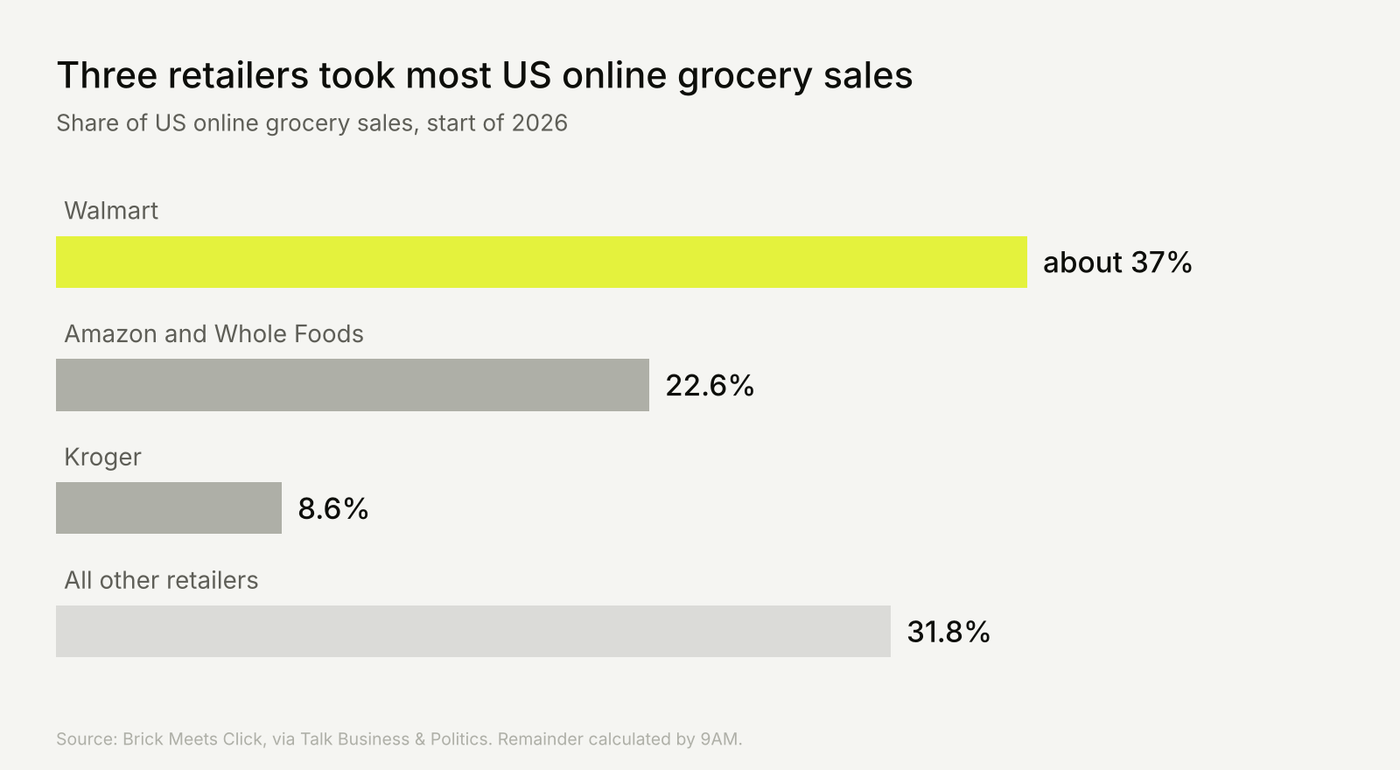
Three retailers took most US online grocery sales in 2025. Source: Brick Meets Click, via Talk Business & Politics; remainder calculated by 9AM.
How Do DTC, Amazon and Grocery Retailer Ecommerce Compare for Food and Beverage Brands?
The three destinations differ most on customer data, checkout conversion, delivery and reporting. In our experience, each destination has its own job: DTC for margin and data, Amazon for volume and discovery, retail for credibility. That shorthand is useful, though each role still needs checking against the product's economics.
Criterion | DTC website | Amazon | Grocery retailer ecommerce |
|---|---|---|---|
Customer data | Full: email, orders, subscriptions | Limited to Amazon's reports | Limited to the retailer's reports |
Checkout trust | Depends on brand awareness | High, familiar checkout | High for the retailer's own shoppers |
Basket | Your brand's products only | Mixed, often single items | Weekly grocery basket |
Delivery | Parcel shipping, cost paid by you | Amazon fulfillment | Pickup, delivery from stores |
Reporting | Full site analytics | Amazon Ads attribution | Retail media and syndicated data |
Customer Data and Repeat Purchase
The biggest difference between the three is who owns the customer record.
On DTC, you do: email, order history and subscription status stay with you. That matters for products bought every few weeks, because you can run email, subscription and replenishment offers to bring buyers back.
On Amazon and retailer sites, the platform owns that record instead. Repeat purchases happen inside the platform, so you can't email or subscribe those buyers, and you see only the reports it shares.
That's why observed repeat orders can justify paying more to acquire a DTC customer than a marketplace one, because that customer stays in your records. Our guide to retention marketing for acquisition teams covers how repeat value changes acquisition targets.
Checkout Conversion and Shopper Trust
A shopper who has never heard of your brand may hesitate at an unfamiliar checkout like, for example, the one on your website, especially if the page is clunky or requires lots of personal data.
Amazon and large retailers remove that friction because the shopper already has an account and a saved payment method.
A known brand, or a product with strong creator proof, can convert well on its own site, too, though.
For example, Hurom’s checkout asks for sensitive data (address, phone, and further down, card details), yet it softens the hesitation in two ways.
At the top, Shop Pay and PayPal let shoppers skip the form and pay with accounts they already trust.
On the right, the page repeats its reassurances: a 30-day money-back guarantee, a 15-year motor and parts warranty, free shipping and installment options.
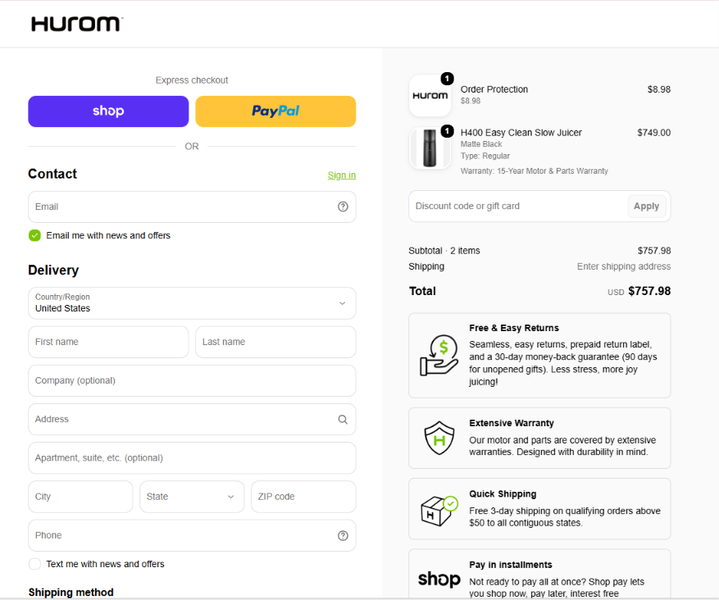
Hurom's checkout pairs express payment buttons at the top with guarantee, warranty, shipping and installment reassurances beside the order. Source: Hurom checkout page.
Hurom is well known, but a lesser-known brand would benefit even more from these trust signals.
Availability, Shipping and Delivery
DTC ships parcels, so the cost per order depends on weight, packaging and delivery speed. That works for shelf-stable goods. It gets expensive for heavy or bulky items and for chilled food, which needs insulated packaging and faster shipping and carries a higher risk of damaged or spoiled orders. Check how much shelf life is left when the order arrives.
Amazon stores, packs and delivers eligible products through its fulfillment program, and charges fees for each step. Eligibility depends on the product: items with expiration dates have extra requirements, and frozen or refrigerated food isn't eligible for that program, so confirm that yours qualifies before you plan around it.
Grocery retailers deliver from stores or offer pickup, so your product must be stocked in the stores near your shopper. Stock differs by store, and a shopper can only order what the nearest store has on the shelf, so check which locations carry your product before you send traffic.
Reports and Attribution Rules
Each destination reports sales differently, so the numbers can’t be compared one to one. Three things change how a result reads: who does the counting, how long after an ad a sale still gets credited (the attribution window), and what counts as a sale.
DTC website
Advantage: A DTC site reports through your own analytics, so you see the order itself, tied to the customer. That lets you follow it into email, subscriptions and repeat purchases.
Limit: Several tools report the same sale differently. By default, Meta credits a purchase within 7 days of a click or 1 day of a view, while Google Analytics 4 uses its own data-driven model. The platforms’ totals rarely match each other or your store’s order count.
Amazon
Advantage: Sales are real Amazon orders. Amazon Attribution, a free tool for brand-registered sellers and vendors, can also link ads you run elsewhere, such as social or email, to purchases on your listing.
Limit: Windows vary by ad type and account. Amazon’s Sponsored Products reports credit purchases within 7 days for sellers and 14 days for vendors, while Sponsored Brands and Sponsored Display use 14. Results stay inside Amazon’s reports, with no customer-level data to take away, and Attribution data lives in Amazon’s console rather than in your own analytics.
Grocery retailer ecommerce
Advantage: Retail media networks can often match ad exposure to purchases, including in-store ones, through loyalty cards or logged-in accounts. Kroger Precision Marketing and Instacart Ads both offer this kind of closed-loop measurement, and Walmart Connect can report in-store sales next to online ones.
Limit: The window is a choice in the report. Walmart Connect reporting offers 3-, 14- and 30-day windows, and a longer window credits more sales to the same ad, so a 30-day result looks better than a 3-day one. You also see only what the retailer shares, and what you can measure differs by retailer. Syndicated data from third-party measurement firms adds a market-wide view of retail sales, but it isn’t tied to your individual campaigns.
Because each report follows its own rules, don’t compare a return on ad spend from one destination with another’s. Read each one against its own window, and judge the business with one shared measure, such as total revenue divided by total ad spend. Our guide to attribution windows explains why those differences change how results read.
How Much Does Selling Food Online Cost Per Order on Each Destination?
Each destination takes a different share of the order. DTC carries shipping and payment costs, Amazon charges referral and fulfillment fees, and a grocery retailer keeps its margin and usually expects promotion funding.
DTC Costs: Ads, Shipping, Fulfillment and Returns
On your own site, you pay for the ad, the pick and pack, the parcel, insulated packaging for chilled items, payment processing and damaged-order replacements.
Pick and pack and the parcel are charged per order, payment processing takes a share of each sale, and replacements for damaged orders come out of that order's margin.
With the ad on top, one small order can carry a lot of cost.
Shipping is usually the largest line for food, so order size matters: a bundle spreads the shipping cost across more units.
A single six-pack carries the full parcel cost, while a bigger or mixed order shares it, and a free-shipping threshold can nudge shoppers toward a larger basket.
Chilled food adds insulated packaging and faster delivery on top.
To compare destinations fairly, decide which acquisition cost you count.
Paid CAC divides ad spend by the customers those ads brought in, while blended CAC divides all marketing spend by all new customers, so the choice between blended and paid CAC can change which destination looks best.
Amazon Costs: Referral, Fulfillment and Advertising Fees
Amazon's Grocery and Gourmet category charges a referral fee of 8% on items priced at $15 or less and 15% above $15, applied to the full price.
Fulfillment fees, storage and inbound shipping come on top.
In our experience, Amazon is in many cases the lowest-margin channel once referral, fulfillment and ad fees stack up.
Brands that send outside traffic to Amazon can offset part of that: Amazon's Brand Referral Bonus pays a credit averaging 10% of qualifying sales from off-Amazon marketing, with rates that vary by category.
Grocery Retailer Costs: Trade Terms, Retailer Ad Fees and Promotion Funding
A retailer buys at wholesale and sets the shelf price, so your revenue per unit is lower than the price the shopper pays.
Retail media fees, promotion funding and freight reduce it further.
Our comparison of retail media and trade spend explains how to assign those costs to the right budget.
How to Calculate Contribution Per Order for Each Food Ecommerce Destination
Contribution per order is what you keep from one order after every variable cost, before advertising. Calculate it the same way for each destination, then compare.
1. Record the Order Revenue for the Destination
Use what your brand receives. On DTC and as an Amazon seller, that is the price the shopper pays. As an Amazon vendor, use the wholesale price, as with a retailer. With a grocery retailer, it is the wholesale price after the retailer's and distributor's share.
2. Subtract Product and Variable Costs
Take out the cost of goods for every unit in the order, including packaging made for that destination.
3. Subtract Destination Fees and Fulfillment
For DTC, subtract shipping, pick and pack, payment fees and an allowance for damaged orders. For Amazon, subtract the referral fee, fulfillment and inbound shipping. For a retailer, subtract freight.
4. Subtract Promotion and Discount Funding
Take out any discount, coupon or retailer promotion you pay for. Our contribution margin guide covers how to treat each input.
5. Set the Acquisition Ceiling and Break-Even Return on Ad Spend
Contribution per order is the most you can spend to win that order and still break even. Divide the order value the ad platform reports by contribution to get the break-even ROAS. The table uses imaginary numbers for a six-pack of the same snack on each destination.
Line | DTC website | Amazon | Grocery retailer |
|---|---|---|---|
Price the shopper pays | $36.00 | $30.00 | $30.00 |
Your order revenue | $36.00 | $30.00 | $16.50 wholesale |
Product costs | $9.00 | $9.00 | $9.00 |
Destination fees and fulfillment | $9.80 shipping, payment, damage allowance | $12.00 referral, fulfillment, inbound | $0.75 freight |
Promotion funding | $3.60 | $1.50 | $1.50 |
Contribution per order | $13.60 | $7.50 | $5.25 |
Break-even ROAS on reported sales | 2.65x | 4.00x | 5.71x |
In this example, the grocery retailer needs more than twice the reported return of the DTC site to break even, because the platform reports $30 of sales while you keep $5.25 of contribution from them.
Retail campaigns tend to show the highest ROAS in a media report, and this is why that figure needs a margin check before reallocating budget.
The ranking depends on your own inputs: in this example, the retailer's 45% share leaves you less than Amazon's fees do.
(Nerdy) side note: The DTC price is set above the other two here as an assumption, to show how much of DTC's advantage depends on price. At $30, with the same costs, DTC contribution falls to $7.60 and break-even ROAS rises to 3.95x, close to Amazon's 4.00x. In practice, keep the price of the same pack close across destinations, as the section on channel conflict advises.
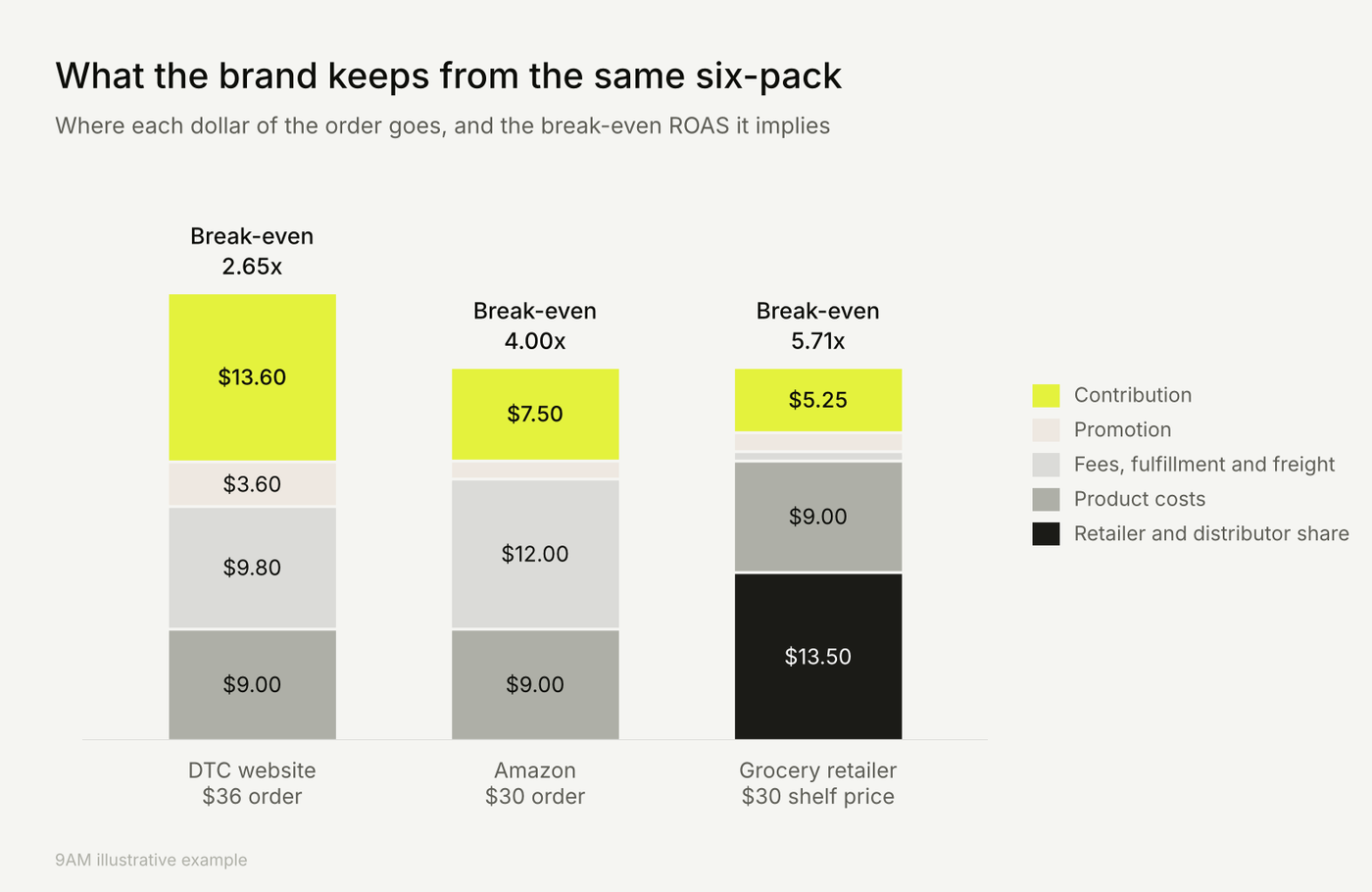
The same six-pack leaves $13.60, $7.50 and $5.25 of contribution depending on where the shopper buys it. Source: 9AM example.
Subscriptions change the comparison.
A DTC subscriber who reorders spreads the acquisition cost across several orders. Use repeat orders you have observed, and keep projected lifetime value out of the first test.
Which Destination Should Food Ecommerce Ads Use for Each Product and Shopper Goal?
Send paid ads to the destination where your product is available and where the order leaves the most contribution for the goal you're testing. The table gives a starting rule for six common situations.
Situation | First destination to test | Why | What to verify |
|---|---|---|---|
Unfamiliar product that needs trial | Retailer if stocked nearby, otherwise a DTC sampler | Low commitment at retail, email capture from a DTC sampler | Single-unit availability |
Repeat-purchase pantry staple | Amazon or the retailer the shopper already uses | Easy reorder | Contribution after fees |
Chilled or perishable product | Grocery retailer | Cold chain and store delivery | Stock in nearby stores |
Multipack or bundle | DTC or Amazon | Higher order value covers shipping | Shipping cost per order |
Your brand has grocery retailer distribution | Retailer product pages and store locator | Sells where your product already is | Listings and stock |
Your brand has no retail distribution | DTC, then Amazon | The only places it can be bought | Payback on acquisition |
Some operators argue for a looser rule: win the first purchase wherever the shopper prefers to buy, then build the relationship.
That works when every destination leaves positive contribution per order.
When one destination loses money on each order, the table decides where paid traffic goes.
Unfamiliar Product That Needs Trial
A first purchase needs a low commitment.
If a retailer stocks a single unit near the shopper, send the ad there.
If not, a DTC sampler box lets you capture each customer's email and follow up.
Repeat-Purchase Pantry Staple
Staples are reordered with the rest of the basket, so the shopper's usual store or Amazon usually converts best.
Pro tip: Our Amazon advertising team plans this mix for brands that sell staples on Amazon and through retailers.
Check contribution after Amazon's fees before scaling.
DTC keeps the customer record, so a staple with observed repeat orders can move to a DTC subscription once its economics work.
Chilled or Perishable Product
Shipping chilled food in parcels adds insulated packaging and faster shipping to every order.
A grocery retailer that already holds your product in a cold case can deliver it without parcel shipping or insulated packaging costs for you, so it is usually the better first destination.
Multipack or Bundle
A larger order spreads fixed shipping and fulfillment costs across more units. Bundles and variety packs can leave the most contribution on DTC or Amazon, where you control the pack.
Your Brand Has Grocery Retailer Distribution
When your product is on shelf, send ads to the retailer's product page or a store locator. This supports the sales the retailer measures, and strong sales there strengthen your case when the retailer decides whether to keep or expand your listing.
That benefit comes with a cost. In the example above, the retailer left the least contribution per order, so a retail ad has to clear the highest break-even ROAS (5.71x).
Hold these ads to that number and confirm with a lift test, so the listing benefit doesn't hide a campaign that loses money.
Your Brand Has No Retail Distribution
Without retail listings, DTC and Amazon are the only routes. Start with the one whose contribution per order supports the acquisition cost, and track how long each customer takes to pay back.
Our guide to CAC payback for DTC brands covers that calculation.
Which Readiness Checks Does Each Food Ecommerce Destination Need Before Launch?
Each destination needs its own checks before your first ad goes live. The goal is the same in all three: a shopper who clicks can buy the exact product your ad shows.
DTC Readiness: Shipping, Shelf Life and Subscription Terms
Confirm the shipping zones and costs for the target regions, the remaining shelf life on arrival and the subscription terms.
Test the full checkout on a phone, since most paid social traffic arrives on mobile.
Amazon Readiness: Listing Quality, Reviews and Stock
Check that your listing shows the right pack, the images and claims match your ad, and your stock covers the planned spend.
A new listing with few reviews converts poorly, so build reviews through Amazon's approved programs before scaling traffic.
Grocery Retailer Readiness: Listing, Locations and Stock
Confirm that the retailer's site lists your product, that nearby stores stock it for pickup and delivery, and that the price matches your ad.
Our retail rollout guide covers how to coordinate those checks with sales and supply.
How to Set Up Paid Campaigns for Each Food Ecommerce Destination
Campaign setup follows the destination: ads to a DTC site optimize for site purchases, ads to Amazon use Amazon's ad products and tagged outside traffic, and ads to a retailer combine retail media with traffic to the retailer's pages.
Paid Social and Search to a DTC Website
Run Meta, TikTok and Google campaigns that optimize for purchases on the site, with a landing page built for the offer in your ad. Test hooks and formats on a schedule, since food creative wears out quickly.
For example, UK online sweet shop PickandMix.com ran Performance Max campaigns alongside Search, with its product feed synced from its store. The founder reports a nearly eight-fold rise in average ROAS and an 11X return on ad spend in peak season.
Our guide to creative testing and ad refresh covers the cadence.
Amazon Advertising and Off-Amazon Traffic to a Listing
Inside Amazon, Sponsored Products and Sponsored Brands capture shoppers searching the category.
Outside Amazon, social and search ads can point to your listing with Amazon Attribution tags, which measure the visits and purchases and qualify sales for the Brand Referral Bonus.
Pro tip: Keep the pack in your ad and the pack on your listing the same, so the click lands on the product the shopper saw.
Retail Media and Paid Social to a Grocery Retailer Listing
Retail media networks reach shoppers on the retailer's site and connect the ad to the retailer's sales data.
Paid social and search can send shoppers to the same product page or to a store locator.
Read Next: Our Walmart Connect team runs this setup for food brands stocked at Walmart.
How Should a Food Brand Split Its Paid Ad Budget Across Destinations?
Split the budget in four steps, starting with availability and ending with a fixed review:
Fund the destination with verified availability first. Spend goes where your product can be bought today.
Set a test budget from contribution per order. Use the break-even ROAS from the contribution table to set each destination's target and maximum loss.
Reserve budget for demand capture. Keep part of the budget for branded and category search on Amazon, Google and the retailer, where existing demand converts.
Review the split on a fixed schedule. Move budget monthly, after each destination's attribution window has closed. Our guide to marketing budget pacing covers how to manage spend between reviews.
How to Avoid Channel Conflict Between DTC, Amazon and Grocery Retailers
Channel conflict happens when your destinations compete for the same shopper, usually through price, promotions or overlapping ads. Three checks reduce it.
Keep Price and Pack Consistent
A DTC price well below the retailer's shelf price can strain your retail relationship, and a lower Amazon price can pull shoppers away from both. Keep prices for the same pack close across destinations, and use pack size or bundles to differentiate.
Separate Offers and Promotion Dates
Schedule DTC discounts, Amazon coupons and retailer promotions so they don't run on the same product in the same week. Overlapping offers make the results hard to read and cut contribution on every destination at once.
Avoid Paying Twice for the Same Shopper
Branded search on Google, Sponsored Brands on Amazon and retargeting on social can all reach a shopper who was already going to buy. Separate branded and category spend in reporting, and cap retargeting frequency across destinations.
How to Measure Food Ecommerce Results Across Destinations
Measure the three destinations against one view of total revenue and contribution, then test what each destination adds. The steps run in order.
1. Build One View of Total Revenue and Contribution
Combine DTC sales, Amazon sales and retailer sales into one weekly view, with contribution per order for each. The marketing efficiency ratio gives a total view of revenue against spend that platform reports can't distort.
2. Compare Attribution Windows and Definitions
Platform reports use different windows and definitions. Put each destination's results on the same window, label the ones that differ and compare new-to-brand buyers on the same lookback: both Amazon and Walmart Connect use a 12-month new-to-brand definition.
3. Run a Lift Test Where the Platform Allows It
Platform attribution shows credited sales. A lift test shows what the ads added. Compare regions with and without the campaign, and include retailer sales in the readout where you can get them. Our geo-lift testing guide covers the design.
4. Read Results by Destination and Decide the Next Test
Keep the destination when contribution after media is positive and the lift test supports it. Fix the setup when stock, listings or prices prevented a fair test. Move budget only after each destination's results have matured.
How Can a Food Brand Turn Marketplace and Retail Buyers Into Direct Customers?
You can move some buyers to DTC by giving them something only your site offers, within each platform's rules. Amazon prohibits sellers from trying to divert Amazon customers to another website, so this work happens outside Amazon orders.
Offer a Reason to Buy Direct
Exclusive flavors, variety bundles, subscriptions with flexible delivery and early access to new products give shoppers a reason to order from you. Price cuts alone can create channel conflict.
Use Packaging and Post-Purchase Moments
Packaging sold through retail stores and DTC orders can carry your site, recipes and a sign-up offer. Our guide to post-purchase moments covers which messages work after the first order.
Capture Email and Subscription Sign-Ups
Social content, recipe pages and sampling events can collect email addresses from shoppers who bought elsewhere. Start them on a sample or subscription offer, then measure how many become repeat DTC customers.
Common Mistakes When Choosing a Destination for Food Ecommerce Ads
Most destination mistakes come from judging the channel by its media report alone. These come up most often:
Sending all traffic to DTC for the data. Customer data is valuable, and a destination with weak conversion or high shipping cost can still lose money on every order.
Judging retail campaigns by platform ROAS. The report shows the shelf price, while you keep the wholesale price.
Leaving shipping out of DTC economics. Shipping and packaging often decide whether a food order is profitable.
Advertising packs that aren't stocked. Traffic to an out-of-stock listing or an unstocked store wastes the spend.
Running different prices for the same pack. Shoppers notice, and retailers do too.
Adding up attributed sales across platforms. Each platform can credit the same purchase, so the total overstates the result.
Examples of Food Brands Balancing DTC, Amazon and Retail Ads
Each brand below chose its destination for a reason that maps to the decision table above.
Subscription Model: DTC
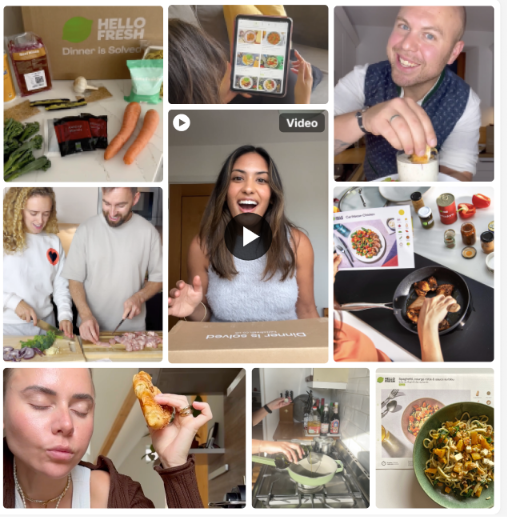
HelloFresh sells meal kits direct to consumers. 9AM sourced local creators and market-specific content for its acquisition program across 17 countries, and the wider program lowered HelloFresh’s global CPA by 20%.
The Farmer’s Dog sells fresh pet food by subscription.
9AM developed and tested creator videos and static ads for its acquisition program, and our ads recorded 30% more purchases at a 15% lower CPA.

What it means for you: When the business runs on subscriptions, the order and the customer relationship are the same thing, so DTC is the destination and creative that converts on your own site carries the program. Chilled products usually fit a retailer better, but a brand whose whole model is subscription delivery can make DTC work.
Costly Fulfillment: Move to Retail and Amazon
Pear Commerce, a retail ecommerce software company, describes how Liquid Death started with DTC subscriptions, then made retail and Amazon its core channels in July 2022 after DTC fulfillment became too expensive and distracting.
What it means for you: If shipping and fulfillment keep contribution per order too low, the fix may be to point your ads at a different destination rather than to improve the ads.
Trial Product: Retail or Amazon First, DTC for Repeat Orders
Pear Commerce also describes Siete Family Foods using retail ecommerce and Amazon to reach new shoppers, then bringing loyal ones back through its DTC channel. Shoppers, in many cases, prefer to try a single product before committing to a larger online order or a subscription.
What it means for you: Match the destination to the stage. Send first-purchase ads where a single unit is easy to buy, and send repeat offers to DTC.
Two things decided each case: how the product has to be delivered, and whether the margin per order could keep paying for acquisition.
Neither depended on which platform reports the highest ROAS.
Disclaimer: Treat these as illustrations since the figures come from the brands and their partners, and test your own destinations against the contribution table above.
Plan Food Ecommerce Ads with 9AM
9AM helps food brands decide where each paid ad should send shoppers. We calculate contribution per order for each destination, check availability, and plan paid social, search, Amazon and retail media around the destination that pays back.
As distribution changes, we update the split, so each new retailer, listing or product starts with a clear destination and a test.
Book a strategy call and we'll compare your DTC, Amazon and retailer economics and build the first destination test with you, then grow your brand together.
Frequently Asked Questions
Is food ecommerce still profitable in 2026?
Online grocery is growing, but growth alone doesn't make an order profitable. Profit depends on contribution per order after shipping, fees and promotions, so it varies by destination and pack.
What conversion rate should a food DTC website expect?
Published benchmarks disagree. Shogun's data for Shopify stores in the first half of 2026 puts the food and beverage median at 2.99% and the mean at 4.42%. Use your own site's rate by traffic source as the baseline, and compare paid traffic with it.
Do you need a license to sell food online?
Requirements depend on the product, the state and how the food is made. Check with the state's agriculture or health department and the FDA before selling, especially for products made in a home kitchen or shipped across state lines.
Can the same ad creative work for DTC, Amazon and a grocery retailer?
The core idea can carry across, while the call to action and the pack shown should change with the destination. An ad that sends shoppers to a retailer should show the pack that retailer stocks, and an ad for DTC can show the bundle sold only there.
How long should a food brand test one destination before moving budget?
Run each destination for at least four weeks, then wait for its attribution window to close before deciding. With a 14-day window, a four-week test has complete results by day 42.
Does Amazon Subscribe & Save replace a DTC subscription program?
Subscribe & Save handles repeat delivery on Amazon, and the customer relationship stays with Amazon. A DTC subscription gives you your customers' contact details and order history. Many brands run both, with different packs or offers.
About Corentin Grisoni
Corentin Grisoni helps DTC and wellness brands turn paid media into a connected growth system. As Retail Media Lead at inBeat Agency, he works across Amazon, Meta, TikTok, and Google to build omnichannel campaigns that are measurable, scalable, and tied to business outcomes.
His work brings together retail media strategy, paid social and search, attribution modeling, UGC, and performance creative. He focuses on helping retail, technology, and wellness brands understand where their media budget is working and create a system that compounds what performs.
More from Corentin Grisoni