Beverage Advertising: Build a Paid-Media Brief Around the Buying Occasion
Plan beverage advertising around the buying occasion: check stock and margin, then write a paid-media brief for audience, channels, creative and proof.

· 17 min read
A chilled can bought for tonight's party and a 12-pack added to Sunday's grocery order can come from the same brand and the same ad account.
They are still different sales.
Each happens in a different place and starts from a different decision.
The problem is that most beverage advertising plans start with the channel.
This guide is different: we start with the buying occasion, then build the paid-media brief around it: what to check before spending, which fields the brief needs, which strategies fit each occasion and how to read the results.
Besides, at 9AM, we plan beverage media from the stocked product out.
If shoppers can't buy the pack the ad shows, in the place the ad points to, better targeting won't rescue your campaign.
The occasion shapes the brief, and contribution margin sets how much it can spend. Paid media is where each occasion proves itself, so every brief ends in a test with a decision date.
P.S. Our food and beverage media buying team builds briefs like this for beverage launches and retail rollouts.
What Is Beverage Advertising, and Why Plan It Around the Buying Occasion?
Beverage advertising is paid promotion of drinks across social, search, retail media and streaming video, and it performs best when each campaign is built around one buying occasion. A buying occasion combines four things:
Who buys: the household shopper, the person drinking it, or someone buying for a group.
The moment: a weekly stock-up, a hot afternoon, a party, a morning routine.
The place of purchase: a grocery app, a convenience store, a retailer's shelf, a brand's own site.
The pack: a single chilled bottle, a 12-pack, a variety case.
Drinks are bought for moments. Tastewise's analysis of the category describes beverage marketing as leading with identity, occasion and ritual.
Occasion also links an ad to a sale.
The ad runs on social or search, while the sale often happens at a retailer, so the campaign has to know where the shopper will pick up the product.
This guide covers paid social, search, retail media and streaming. Out-of-home and event sponsorship need different planning and sit outside its scope. For the wider channel picture across packaged goods, our CPG digital marketing guide covers the full mix.
How Do You Map the Buying Occasion Before Choosing a Channel?
Start with the occasion, because it decides the purchase route, the pack and the proof you need before spending. The five occasions below are a practical way to group beverage purchases.
Occasion | Typical purchase route | Pack and format | Proof of readiness to check |
|---|---|---|---|
Stock-up trip | Retailer app or website, weekly grocery visit | Multipack, case | Listed and in stock at the retailers the ads point to |
Immediate consumption | Convenience store, grocery chiller | Single chilled bottle or can | Cold-shelf presence in the target area |
Social gathering and gifting | Grocery and club stores before weekends and holidays | Party pack, variety case | Seasonal stock and promotion dates |
Functional routine | Grocery app, brand site, subscription | Single serve or multipack | Repeat purchase data and approved claims |
First-time trial | Any route that sells a single unit | Single serve, sample, small pack | Trial-size availability and a clear reason to try |
Stock-Up Trip
The shopper is building a basket and already knows the category. Retail search and retailer product pages do most of the work here, because the decision happens on the list. Lead with the pack and the price per can.
Immediate Consumption
The shopper wants a cold drink now. The route is a nearby store, so the destination is a store locator or a delivery option with the chilled single in stock. A campaign that points to a warm 12-pack misses this moment entirely.
McDonalds wins here:
Social Gathering and Gifting
Purchases cluster before weekends, holidays and events. Creator videos shot at real gatherings work well for this occasion, and our guide to writing UGC briefs that convert covers how to brief them. Plan creative and spend around the dates the retailer has party packs on shelf, and check the promotion calendar so the ad's offer matches the shelf.
Functional Routine
Energy, hydration and recovery drinks are bought as habits. The creative explains when the drink fits the day, and creators who live that routine explain it well. Claims need evidence before they go in the ad, which section seven covers.
Starbucks' protein drinks are a good example:
First-Time Trial
An unfamiliar drink needs a reason to try it before any shelf can sell it. Taste tests and reaction videos do this job well. For Mogu Mogu, a coconut jelly drink new to most US shoppers, 9AM worked with 65+ local micro-influencers on reaction content that reached 30M+ accounts at under 2 cents per engagement.
How Do You Verify Availability and Contribution Before Funding an Occasion?
Before an occasion earns budget, confirm two things: shoppers can buy the advertised pack, and each sale leaves enough money to pay for the media.
Availability checks come first:
The advertised pack is listed at the retailers and in the regions the ads target.
Chilled products have cold-shelf presence, since a warm bottle on the shelf fails the immediate-consumption occasion.
Regional distribution matches the campaign's geography.
Listings show the correct flavor, size and pack count.
Distribution lists overstate this.
Imagine a launch where the retailer lists 120 stores as authorized to carry the drink.
A stock check finds it on the shelf in only 96 of them; say the other 24 are out of stock or haven't received it yet.
The campaign's location targeting then reaches only 72 of those 96, because the rest sit outside the areas the selected campaign can target.
The media plan should follow the 72.
Pro tip: Our retail rollout guide covers how to coordinate those dates across sales, supply and media.
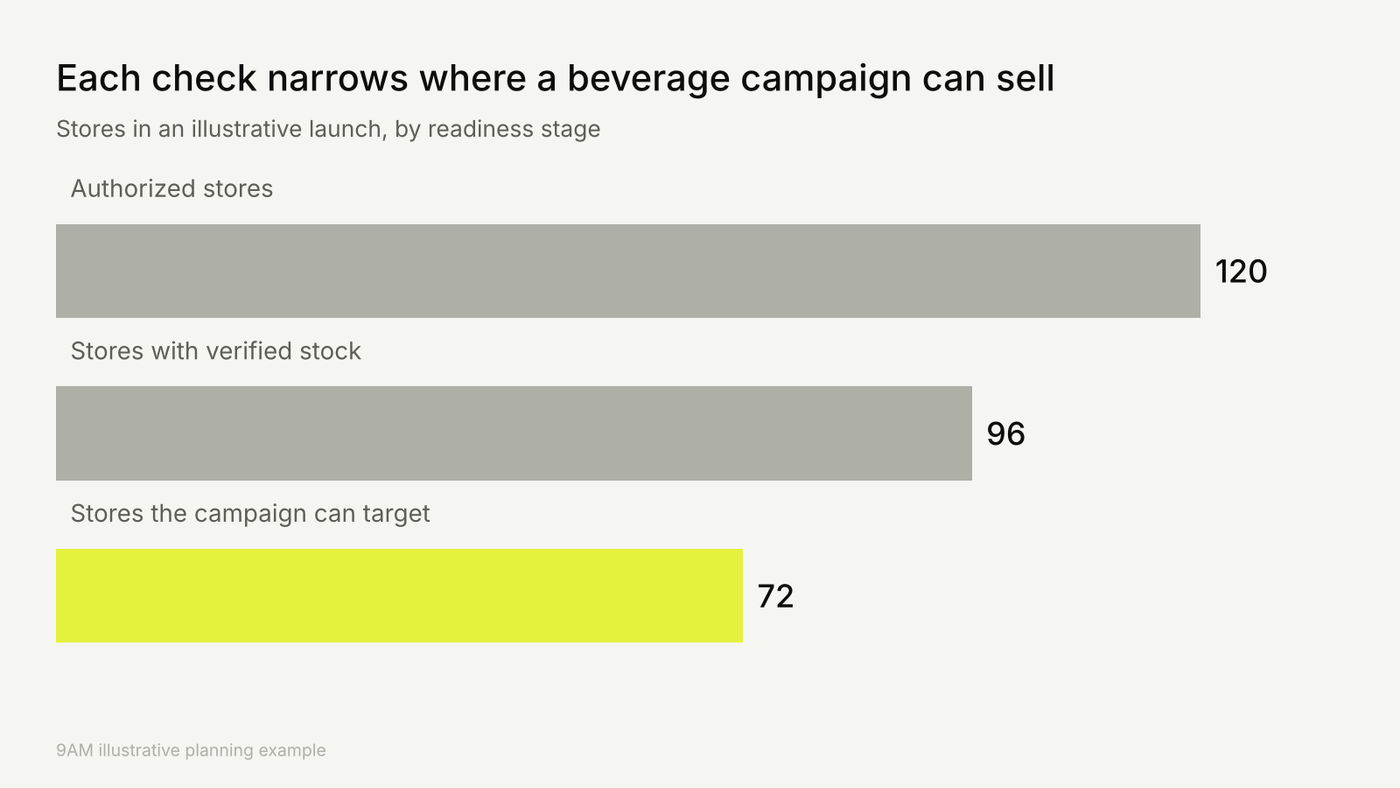
Each check narrows the footprint a beverage campaign can support. Source: 9AM planning example with sample numbers.
Then check the economics.
Imagine a can that sells for $5.49 on shelf (of course, for a multipack, run the same steps on the pack's price and contribution).
After the retailer's and distributor's share, the brand receives $3.20.
Product and variable costs take $1.80, leaving $1.40 of contribution per unit before media.
The retailer's report counts sales at shelf price ($5.49), but the brand only keeps $1.40 per can after costs. So each $1 of ad spend must bring in 3.92 of reported sales (5.49 ÷ $1.40) just to give back $1 of contribution. Below 3.92x, the ad loses money.
Write the Paid-Media Brief in Five Fields
A beverage paid-media brief needs five fields, filled in order: the occasion and purchase route, the audience and geography, each channel's role, the creative and claims, and the success measure. The table shows the template with an imagined example for a sparkling-water 12-pack on a stock-up occasion.
Field | What to decide | Example: sparkling-water 12-pack |
|---|---|---|
1. Occasion and purchase route | The occasion, the destination and the exact pack | Stock-up trip, retailer product page, 12 × 12 oz |
2. Audience, geography and timing | Who, where and when, limited to verified stock | Household shoppers within reach of the 72 stocked stores, four weeks |
3. Channel role | One job per channel | Paid social introduces, search helps shoppers find, retail media converts |
4. Creative and claims | Hook, pack shot, permitted claims, usage rights | "Fridge pack for the week" hook, price per can, no health claims |
5. Success measure and evidence | What counts as success and how it will be measured | Retailer sales lift in stocked stores against matched control stores |
Field 1: Occasion and Purchase Route
Name one occasion per brief.
Then name the destination, the page or store where the purchase happens, and the exact pack. If the ad shows a 12-pack, the destination must sell that 12-pack.
When the destination is the brand's own site, check the shipping cost per case first: liquids are heavy, so shipping can take a large share of each order.
A brief that covers two occasions usually ends up with creative that fits neither.
Field 2: Audience, Geography and Timing
The audience is the person making the purchase decision for that occasion, and the geography is the verified footprint from the availability check.
Timing follows the occasion: weekly for stock-up, daily weather or event windows for immediate consumption, and the retailer calendar for gatherings.
Write the start date after stock and listings are confirmed.
Field 3: Channel Role
Each channel gets one job in the occasion, and the brief says how that job will be judged.
Channel | Job in the occasion | Destination | How to read it |
|---|---|---|---|
Paid social and creators | Introduce the drink and the moment | Retailer page, store locator or brand site | Reach in stocked areas, then sales lift in those areas |
Search | Help interested shoppers find it | Product page or store locator | Branded and category search separately |
Retail media | Support the purchase at the retailer | Retailer product page | Attributed sales, with incrementality checked |
Streaming video | Build broad awareness for an occasion | Usually none | Lift tests and later search and sales trends |
Field 4: Creative and Claims
Open with the occasion, then the pack.
A hook about the moment, a clear pack shot and the next step make most beverage ads work.
This ad offers a good example:
Record usage rights for any creator content you plan to run as paid, and check our guide to creator whitelisting before the contract is signed. List every claim the ad makes and the evidence behind it. Alcohol, functional and children's products have extra rules, covered in section seven.
Field 5: Success Measure and Evidence
Decide what counts as success before launch. Attributed sales show which purchases a platform credits to an ad; incremental sales are the ones that would not have happened without it. The brief should name which of the two the test will judge.
Platforms also credit purchases over different windows.
Amazon's Sponsored Products reports credit purchases within 7 days for sellers and 14 days for vendors. Walmart Connect reporting offers 3-, 14- and 30-day windows.
Both Amazon and Walmart Connect define a new-to-brand buyer by the previous 12 months of purchases.
Compare results on the same window, and see our guide to attribution windows for how recent periods understate results.
Beverage Advertising Strategies by Occasion
Six strategies cover most beverage campaigns. Five fit one or two occasions, lift-tested awareness fits any, and each needs a specific proof before it gets more budget.
Strategy | Best occasion | Primary channel | Proof to require before scaling |
|---|---|---|---|
Trial-first creator seeding | First-time trial | Creators plus paid social | Trial-size sales in the areas reached |
Geo-fenced social around stocked stores | Immediate consumption, stock-up | Paid social, search | Sales lift in targeted store areas |
Video-led launch with shopper audiences | First-time trial, functional routine | Retailer-linked social and onsite media | Closed-loop sales against a baseline |
Category-term capture | Stock-up trip | Retail search, Google Search | Share of category searches and new buyers |
Seasonal and event bursts | Social gathering and gifting | Paid social, retail media | Sales during the window against the same window last year |
Lift-tested awareness | Any occasion | Streaming video, social video | A geo lift result |
Matching each strategy to an occasion and a proof is where our CPG media buying team spends most of its planning time with beverage brands.
Trial-First Creator Seeding with Paid Amplification
Creators show the first taste, and paid social extends the best videos to people near stores that stock the drink. The Mogu Mogu program above shows the creator-seeding half of this strategy.
Scale it when trial-size sales rise in the reached areas.
Engagement by itself doesn't justify more spend, so keep the paid budget on the videos that drove trial in stocked areas.
Geo-Fenced Social Around Stocked Stores
Target the areas around stores with verified stock and send shoppers to a store locator or the retailer's page. This links digital spend to physical availability.
Our guide to Google Ads location targeting covers the settings that keep search spend inside the stocked footprint.
Video-Led Launch with First-Party Shopper Audiences
Retailer networks can match social video exposure to their own sales data. In a 2022 Meta case study, Tropicana added Reels to its usual video placements, and an NCSolutions study matched ad exposure to in-store purchases with test and control groups.
It found a 2.4X return on ad spend and a 1.1% lift in in-store sales.
Category-Term Capture on Retail and Search
When shoppers search for the category, such as sparkling water or energy drinks, retail search and Google Search can put the stocked pack in front of them.
This captures demand that already exists.
In our experience, retailer-reported ROAS can credit an ad with sales that would have happened anyway when the shopper was already searching for the product, so judge this strategy on new buyers and category share alongside ROAS.
Seasonal and Event Bursts Timed to Retailer Resets
Summer, game days and holidays drive party-pack sales. Plan the burst to start when the retailer's seasonal stock and promotion are live, and end it with them. Compare sales in the window with the same window the year before, adjusted for distribution changes.
Lift-Tested Awareness
Streaming and social video build awareness that last-click reports miss. Test it before scaling. TikTok and Circana analyzed 97 geo lift studies across the UK, France, Germany, Spain, Italy and the Netherlands to measure in-store sales effects for consumer goods. A geo test compares regions with and without the campaign. Our geo-lift testing guide covers how to design one.
How Much Should a Beverage Brand Spend on a First Test?
Size the first test from contribution per unit and the question the test must answer, then cap the loss before launch. Some agencies use a percentage of revenue: our data suggests growing food and beverage brands spend roughly 10 to 20% of revenue on paid media. That sets a ceiling for the program. It says little about whether one test can pay back.
Use these steps for a first test:
Calculate the units the test must add. Divide the test budget by contribution per unit. Imagine a $1,500 test at $1.40 per can: it needs about 1,071 additional cans to break even. Our contribution margin guide covers how to set each input.
Translate that into a store-level rate. Across 72 stocked stores and four weeks, that is 288 store-weeks, or about 3.7 additional cans per store per week. Compare that figure with recent sales in those stores to see whether it is plausible.
Set the maximum learning loss. Agree in advance how much the brand will accept losing if the test fails, and what the test must show to earn more budget.
Name an owner and a decision date. One person reads the results on a fixed date, after the attribution window has closed.
Pace the spend. Spread the budget evenly across the test so early weeks don't use it up.
Promotion costs belong in the same calculation. If the test runs alongside a discount, the discount reduces contribution per unit, and the media has to cover a smaller margin. Agree with the trade team which budget pays for the offer before launch. Our comparison of retail media and trade spend explains how to split that responsibility.
Adjust the Brief for Alcohol, Functional and Children's Beverages
Three beverage types change the brief: alcohol, functional drinks and products aimed at children. Each adds rules to the audience, creative and claims fields.
Beverage type | What changes in the brief | Rule to check |
|---|---|---|
Alcohol | Age and location targeting, required disclosures, claim limits | TTB, state law, each platform's alcohol policy |
Functional | Evidence for every health or performance claim | FTC substantiation guidance, platform health-claim rules |
Children's | Audience age, product nutrition, school settings | CFBAI commitments, platform protections for minors |
Are You Allowed to Advertise Alcohol? Platform Rules for Alcohol Advertising
Yes, alcohol brands can advertise on the major US platforms, provided the ads follow federal and state law, target only adults of legal drinking age and avoid restricted claims.
At the federal level, the TTB applies the FAA Act to wine with at least 7% alcohol, distilled spirits and malt beverages.
The TTB doesn't pre-approve ads, though it reviews them on request, and its Industry Circular 2024-1 covers social media.
States can add their own rules.
Platform | Alcohol ads | Age and location rule | Claim limits |
|---|---|---|---|
Meta | Allowed with conditions | Age and country targeting required, never under 18; 21+ in the US | Must follow local laws and industry codes |
Allowed in approved locations | Never below legal drinking age; hidden from SafeSearch users on Search | No implied gains (social, sexual, professional, intellectual or athletic) | |
TikTok | Allowed in some markets | Country-by-country policy; 25+ for US ads since July 2024 | No one under 25 in ads, no excess drinking, alcohol content and a responsible drinking line |
Retail media networks | Varies by network | Set by each network | Check each network's policy before briefing |
Platforms are tightening checks too. In June 2024, Google, Meta, Pinterest, Snap, TikTok and X agreed with major alcohol brands on stronger age-assurance standards. Creator content needs extra care: TikTok's 2026 guidance for alcohol brands treats content promoted through creators as branded content that must be age-gated and geo-fenced, so confirm the current rule before booking creators.
TikTok's alcohol ad policy also restricts ads that promote the sale or delivery of alcohol, and the rule differs by market. Check it before sending alcohol ads on TikTok to a retailer page or a delivery link.
Here's a more in-depth look at Google's alcohol advertising policy:
Functional Beverages
Energy, hydration, protein and gut-health drinks carry health or performance claims in many cases. The FTC expects health claims in advertising to be substantiated, and the evidence has to match the finished product and the exact claim. Keep that evidence in the brief's claims field, and check each platform's health-claim policy before submitting creative.
Children's Beverages
Brands participating in CFBAI commit, in advertising primarily directed to children under 13, to feature only products that meet its Uniform Nutrition Criteria or not to advertise to that group. Participants also commit not to advertise in elementary and middle schools, pre-K through 8th grade.
The program updated its Core Principles in January 2026. Non-participants can still use the criteria as a planning standard.
Read Results by Occasion and Choose the Next Test
Read each campaign against the occasion and the success measure in its brief, and wait for the attribution window to close. A four-week test on a 14-day window has complete results from day 42.
What you see | Likely cause | What to check next |
|---|---|---|
Low spend and few impressions | Narrow footprint, low stock or weak bids | Listings and stock in the targeted areas |
Clicks without purchases | Wrong pack at the destination or a price gap | The destination page and the shelf price |
Strong ROAS, few new buyers | Existing demand captured | New-to-brand share and branded search |
Sales rise during a promotion | The offer and the media overlap | Sales in control areas with the same offer |
Good attributed sales, poor contribution | Discounts or low-margin packs | Contribution per unit by pack |
Many platform reports favor the last click before purchase, which can credit search and retail media for demand that social or video created. Our article on the last-click attribution problem explains how to correct for it.
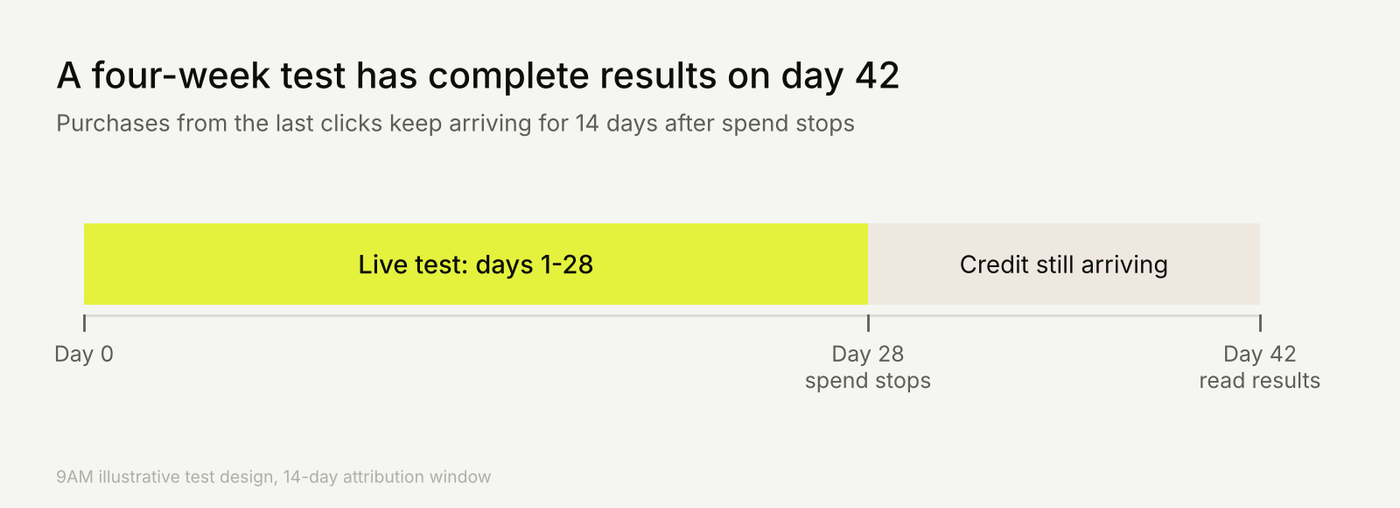
Results for a four-week test on a 14-day window are complete on day 42. Source: 9AM sample test design.
Then decide the next test.
Keep the strategy when it met the brief's measure and stock can support more sales.
Fix the setup when a listing, a price or a pack mismatch prevented a fair test.
Stop when mature results missed the measure and more spend has no new question to answer.
Build a Beverage Media Plan with 9AM
9AM works as a long-term growth partner for beverage brands, planning media around the occasion and the stocked product. We start by mapping the occasions your range sells into and checking availability and contribution. Then we run the plan, tying creators, paid social, search and retail media to one sales measure and reading every test against it.
As distribution grows, we grow the plan with it: each new retailer, region or product starts with a clear occasion, a test and a decision date, and what each test shows sets the next budget.
Book a strategy call and we'll map your buying occasions, check your stocked footprint and plan the first test with you, then keep growing the program from there.
FAQs
How do you budget for an occasion that sells in only part of the country?
Budget for the stocked footprint only. Limit geography to the areas with verified stock, and size the test from contribution per unit in those stores. For a sales-driven campaign, national reach adds cost without adding buyers who can find the product. Awareness tests are the exception, and a geo lift result is their measure.
When should a beverage brand judge a test on retail sales data?
Use retail sales data when the success measure is incremental sales and most purchases happen in stores. Platform ROAS shows credited purchases, while store-level sales against control areas show what changed. Check the retailer's reporting lag before setting the decision date.
Can one creative asset serve a trial occasion and a stock-up occasion?
Usually it can't do both well. Trial creative explains the taste and the moment, while stock-up creative leads with the pack and the price per unit. Test them as separate assets with separate destinations.
How do you stop branded search from taking credit for demand social created?
Separate branded and category search in reporting, and compare branded search volume in areas with and without the social campaign. A geo test shows how much branded demand the social spend created.
What should change in the brief when a retailer reset moves shelf placement mid-flight?
Update the availability and destination fields first. Pause spend in stores where the product moved or disappeared, then restart once listings and shelf placement are confirmed. Our guide to marketing budget pacing covers how to rebalance the remaining budget. Note the change date so the results analysis treats it as a break.
About Corentin Grisoni
Corentin Grisoni helps DTC and wellness brands turn paid media into a connected growth system. As Retail Media Lead at inBeat Agency, he works across Amazon, Meta, TikTok, and Google to build omnichannel campaigns that are measurable, scalable, and tied to business outcomes.
His work brings together retail media strategy, paid social and search, attribution modeling, UGC, and performance creative. He focuses on helping retail, technology, and wellness brands understand where their media budget is working and create a system that compounds what performs.
More from Corentin Grisoni