
Instacart Advertising for Food and Beverage Brands: What to Check Before Your First Campaign
Plan your first Instacart advertising campaign with checks for stock, margins, promotions, creative, bidding and measurement for food and beverage brands.

· 22 min read
Instacart reported $331 million in advertising and other revenue in Q3 2026, up 23% year over year, and more than 9,000 brands advertised on the platform in Q4 2025.
For food and beverage brands, that means competing for attention at the moment shoppers fill their carts.
But visibility only pays off if shoppers can actually buy the product.
Distribution, stock levels and the margin left after trade spend decide whether a campaign pays back. This guide walks through those checks before you spend your first dollar on Instacart ads.
P.S. Our food and beverage retail media team aligns retailer planning with product availability and sales measurement.
At 9AM, we treat retail media as a commercial test. Get the product onto the shelf, calculate how much each additional sale contributes, then fund a campaign that can answer a specific question. Reported ROAS helps diagnose the campaign. Incremental contribution determines whether it deserves more budget.
What Is Instacart Advertising?
Instacart advertising lets food and beverage brands promote products while shoppers buy groceries online. Brands manage self-serve campaigns through Instacart Ads Manager, and eligible ads can run on Instacart's marketplace, partner shopping sites and other supported placements.
Where Instacart Ads Appear
The two main shopping environments are the Instacart Marketplace and retailers' own ecommerce sites.
Marketplace ads reach shoppers as they search and browse products on Instacart.
Carrot Ads brings Instacart's advertising technology to partner shopping sites, so brands can also reach shoppers buying directly from participating retailers.
The wider network also includes Caper smart carts and offsite media partnerships. Each format has its own available placements; sponsored product campaigns run only on placements eligible for that format.
Instacart's February 2026 results release described more than 2,200 retail banners representing nearly 100,000 stores. For an F&B brand, this creates opportunities to reach shoppers across participating retailer banners, subject to each product's listing and availability.
Instacart Ad Formats for Food and Beverage Brands
F&B brands can use sponsored products, display and video, inspiration ads, promotions and offsite advertising. Free Pages provide a shoppable destination for the range. The table below shows where each option fits.
Format | Where it shows | Buying model / costs | Best first use for an F&B brand |
|---|---|---|---|
Sponsored products | Search, browse and other eligible shopping placements | CPC; second-price auction | Test demand for stocked products |
Display | Eligible shopping discovery and search surfaces | CPM; first-price auction, minimum bid starts at $15 CPM | Introduce a range or purchase occasion |
Shoppable display and video | Supported shopping placements; selected cart inventory for supported formats | CPM; terms depend on the selected format and placement | Demonstrate taste, preparation or use with a shopping path |
Recipe and discovery placements | CPM; first-price auction | Connect ingredients with a meal occasion | |
Pages | A shoppable destination within Instacart | Free to build; paid traffic costs extra | Organize the range and support display traffic |
Promotions and coupons | Eligible product and checkout experiences | Offer funding and applicable program charges | Test trial or basket building |
Offsite and CTV | Supported external publishers, social and streaming partners | Buying terms vary by activation | Extend reach after defining the sales test |
Choose the format around the job the campaign needs to do.
Sponsored products can put a stocked item in front of shoppers considering what to buy. Display and video give a brand more room to explain a flavor, preparation method or purchase occasion. Promotions add a purchase incentive, with offer costs included in the test.
Pages support these campaigns by organizing the products shoppers can buy.
Why Food and Beverage Brands Advertise on Instacart
F&B brands advertise on Instacart to reach shoppers during a grocery purchase, introduce products beyond category searches and track purchases following ad interactions. Those benefits serve different jobs, so the campaign format should follow the brand's immediate sales objective.
Reach Shoppers While They Build a Grocery Order
Sponsored products give a brand a chance to appear when shoppers search or browse for something to buy. For a beverage brand, that could mean appearing while someone chooses drinks for the week.
Shoppers can then add the advertised product to the grocery order they're already building.
Help More Shoppers Discover the Range
Display and video can show shoppers a flavor or use occasion they weren't actively searching for. That gives these formats a different role from sponsored products: they can expand who encounters the brand, while product ads help capture interest during shopping.
Instacart's Q4 2025 shareholder letter reported that, on average, half the shoppers reached by a brand's display ads hadn't been reached by its sponsored product ads.
In other words, display expanded reach beyond the brand's sponsored product audience.
Extra reach is not the same as extra sales, and this is an Instacart-reported average. The same letter adds that over one-third of new-to-brand sales from display ads came from customers the brand's sponsored product ads had not reached. Together, those figures support testing the formats side by side when broader discovery is the objective.
See Which Products Shoppers Buy After an Ad Interaction
Ads Manager reports attributed sales and units, so you can review which advertised products receive purchase credit. That is more useful for a sales test than tracking just clicks: a campaign can attract attention while producing too few purchases to cover its cost.
Use that reporting to investigate the product mix and compare sales with spend.
The pre-launch measurement checks below explain how to interpret attribution and test whether those purchases were additional.
How Instacart Compares with Amazon Ads and Walmart Connect
Instacart reaches shoppers across multiple grocery retailers; Amazon Ads centers on Amazon, and Walmart Connect centers on Walmart.
For an F&B brand, the first choice is where the stocked range is available and shoppers can buy it. This comparison focuses on sponsored products; other formats have different buying and reporting rules.
Check | Instacart | Amazon Ads | Walmart Connect |
|---|---|---|---|
Where the sale happens | Instacart Marketplace and supported partner shopping properties | Amazon's online store | Walmart site and app; eligible reporting also measures store sales |
Shopping network | Instacart's marketplace plus participating retailer sites | Amazon's owned shopping properties | Walmart's owned shopping properties |
Auction | CPC, second-price | CPC auction; bidding strategy can adjust the bid | CPC, advanced second-price auction |
Purchase attribution | 14 days after a sponsored product click | Sellers: 7-day click; vendors: 14-day click | 3-, 14- and 30-day reporting windows; confirm the selected report |
New-to-brand lookback | 26 weeks | 365 days where the metric is available | 12 months in Walmart's published brand reporting |
The reporting windows also change how results should be read.
Amazon's sponsored product window differs for sellers and vendors, while Walmart offers several reporting windows. Comparing a seven-day result with a fourteen-day result gives purchases different amounts of time to receive credit.
Use comparable windows where available and label any remaining difference.
“New-to-brand” also has different meanings:
Instacart uses a 26-week purchase lookback, while Amazon and Walmart use roughly a year where the metric is available. A returning shopper can qualify under the shorter window and fail to qualify under the longer one.
New-to-brand rates therefore aren't directly comparable across platforms.
Start with the retailer opportunity, then check whether its reporting can answer your campaign's question. A brand with a well-stocked Walmart range may have a clearer first test there than across a thin Instacart footprint. Our Walmart Connect guide explains that retailer's launch requirements.
How to Prepare for Your First Instacart Campaign, Step by Step
Prepare an Instacart campaign by confirming product availability, brand access, margins, promotions, creative, budget and measurement. Complete the seven checks below before launch, with supporting evidence for each one.
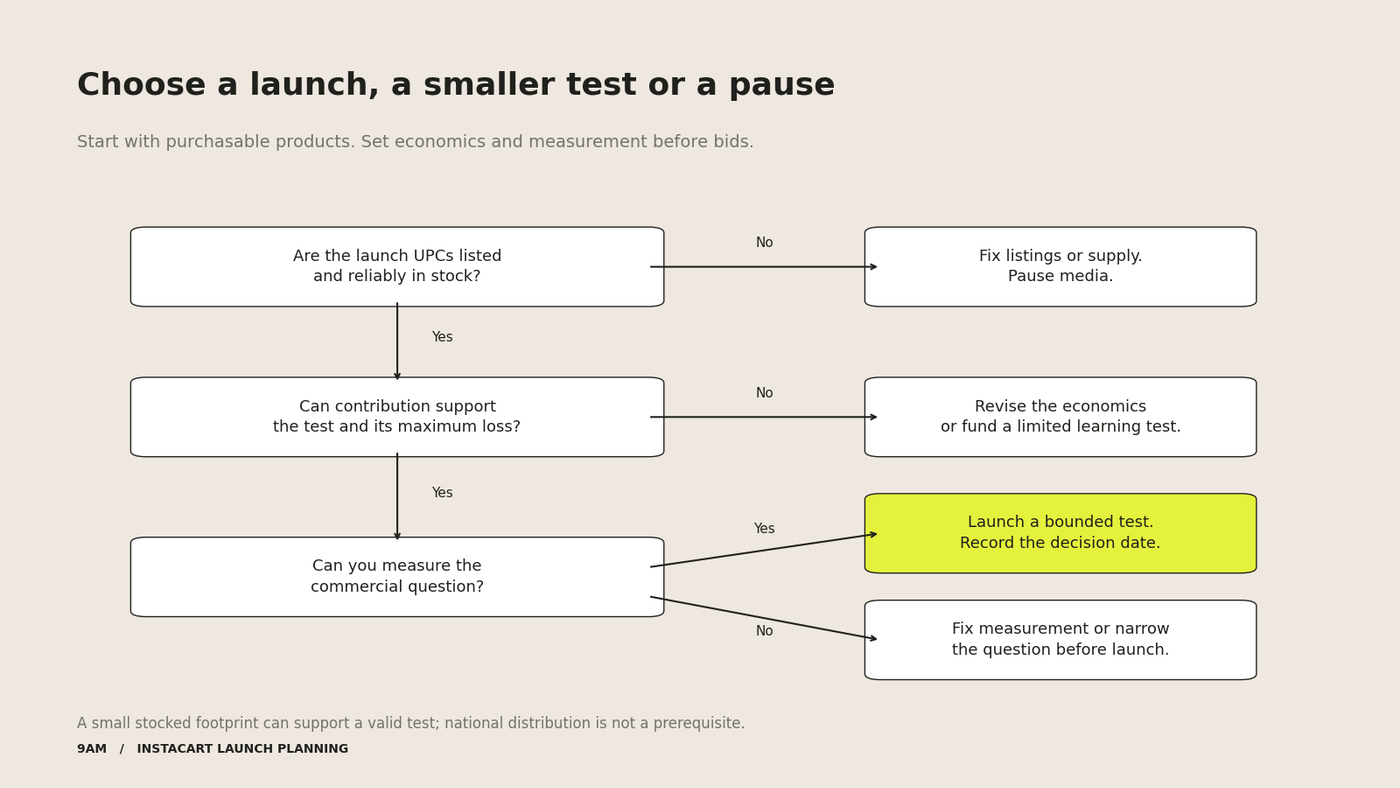
Resolve availability, economics and measurement access before choosing between a launch, a smaller test and a pause. Source: 9AM framework.
Confirm retailer distribution and in-stock coverage.
Claim the brand and clean the product library.
Calculate break-even ROAS from contribution margin.
Align promotions with the trade calendar.
Review creative and claims against ad policies.
Set the budget, bidding mode and test length.
Set up measurement before launch.
1. Confirm Retailer Distribution and In-Stock Coverage
Start with a UPC-level list of the products you intend to advertise. For each product, record:
Retailer banners carrying the UPC.
Relevant markets.
Current stock evidence.
The next replenishment date.
Check the actual shopper experience using representative delivery locations.
Physical distribution and digital eligibility are separate checks. A retailer may carry the brand but have the wrong pack size in its Instacart catalog. An item can also be listed while unavailable to the shopper viewing the ad.
These listing and stock checks matter because a campaign needs eligible products to serve.
Pro tip: Instacart lists low UPC availability as one possible reason a display ad receives no impressions. If availability is the constraint, a higher bid won't resolve it. Correct the listing or stock issue, or launch with the products shoppers can reliably buy.
Distribution signal | What it means for ads | What to do |
|---|---|---|
Listed and consistently available | Product can enter eligible auctions | Include it in the launch range |
Listed, frequently unavailable | Delivery opportunity changes with stock | Resolve replenishment and monitor eligibility |
Missing or incorrect UPC | The intended item may be unavailable to advertise | Correct the retailer listing and brand association |
Thin regional coverage | Limited eligible demand | Match expectations and spend to the reachable market |
A regional brand, including a single-SKU brand, can test without national distribution. It needs enough stocked locations and eligible shoppers to make the planned spend useful. Ask the sales team to resolve any listing or replenishment exceptions before setting the campaign's sales target.
2. Claim the Brand and Clean the Product Library
Claim the brand, add any missing UPCs and verify the live product details before adding products to an ad group. Allow time for the three separate processes in the product library:
Brand claim: Instacart says it responds within five business days.
Missing UPC additions: approved products can take up to three business days to appear.
Approved edits: publishing can take 48 hours after approval. Allow additional time for review.
Check every flavor, size and unit count against the pack shoppers receive. A photograph of a multipack attached to a single bottle can change conversion and create an inaccurate shopping experience.
For product images, check these Instacart specifications:
Square aspect ratio, with an ideal resolution of 1,000 × 1,000 pixels at 300 ppi.
Maximum file size of 3 MB.
The actual product against a clear, transparent or white background.
No extra text or graphics.
Product packaging filling at least 85% of the image.
After approval, inspect the live listing: retailers can prioritize their own product data, so the published detail may differ from the submitted edit. Once the listing is correct, select the UPC in the intended ad group.
Products must then be selected in an ad group to run as ads.
Work backward from the promotion date when scheduling these tasks. A launch that depends on an unresolved brand claim or missing UPC can miss the period the media was meant to support.
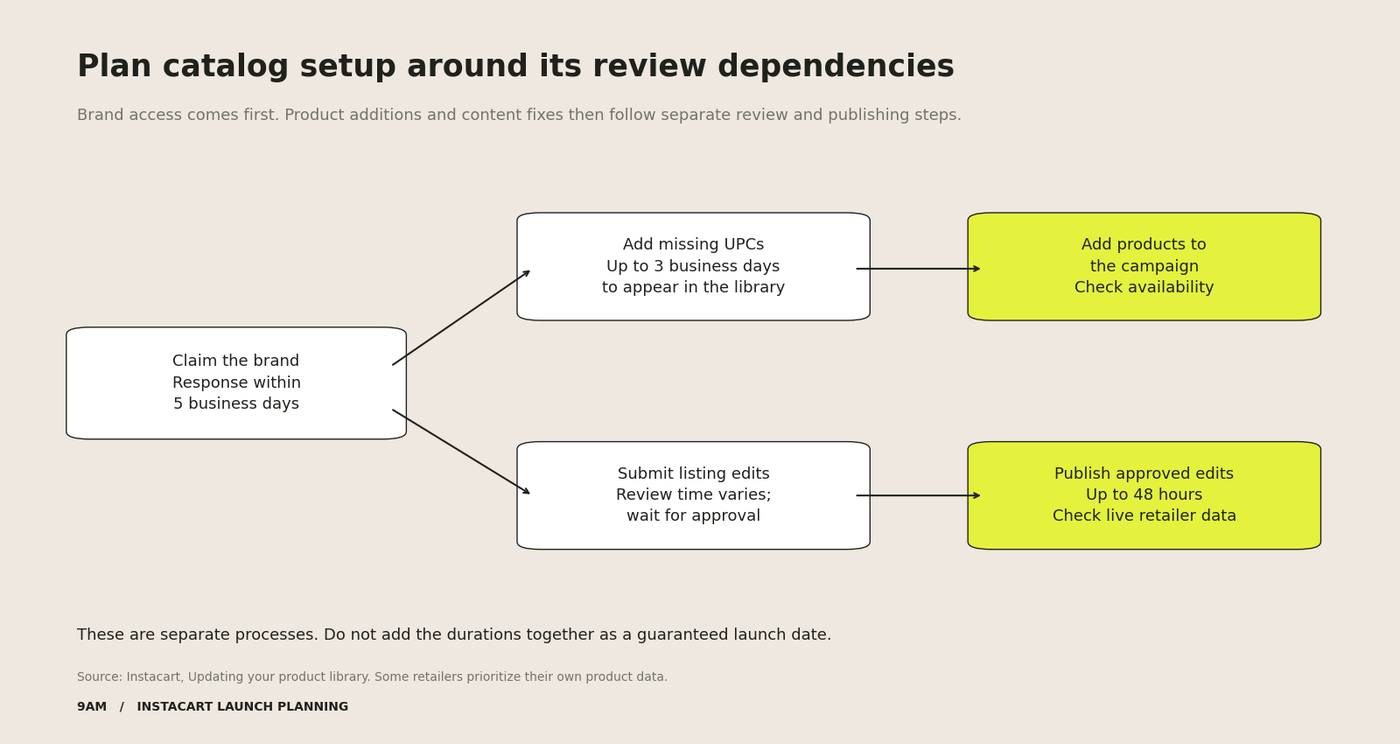
Brand access comes first; missing UPC additions and listing edits then follow separate review and publishing steps. Source: Instacart product library documentation.
3. Calculate Break-Even ROAS From Contribution Margin
Calculate break-even retail ROAS by dividing the reported retail sales value per unit by the brand's contribution per incremental unit. This accounts for the difference between the shopper's purchase price and the amount the brand has left to fund advertising.
Let’s work through one illustrative product:
Shopper price: $5.49.
Brand receipts after retailer and distributor economics: $3.20.
Product cost, variable fulfillment and other variable costs: $1.80.
Contribution before media, agency fees and fixed overhead: $1.40 per unit.
The media-only calculation is:
Break-even retail ROAS = retail sales value per unit ÷ contribution per incremental unit
$5.49 ÷ $1.40 = 3.92x
At 2.5x reported ROAS, a $5.49 sale costs about $2.20 in advertising. The product contributes $1.40 before media, leaving roughly $0.80 uncovered.
Under these example economics, even fully incremental sales would lose money at 2.5x reported ROAS: the campaign would need roughly 3.9x just to cover media. We chose round example numbers to show how the break-even hurdle works.
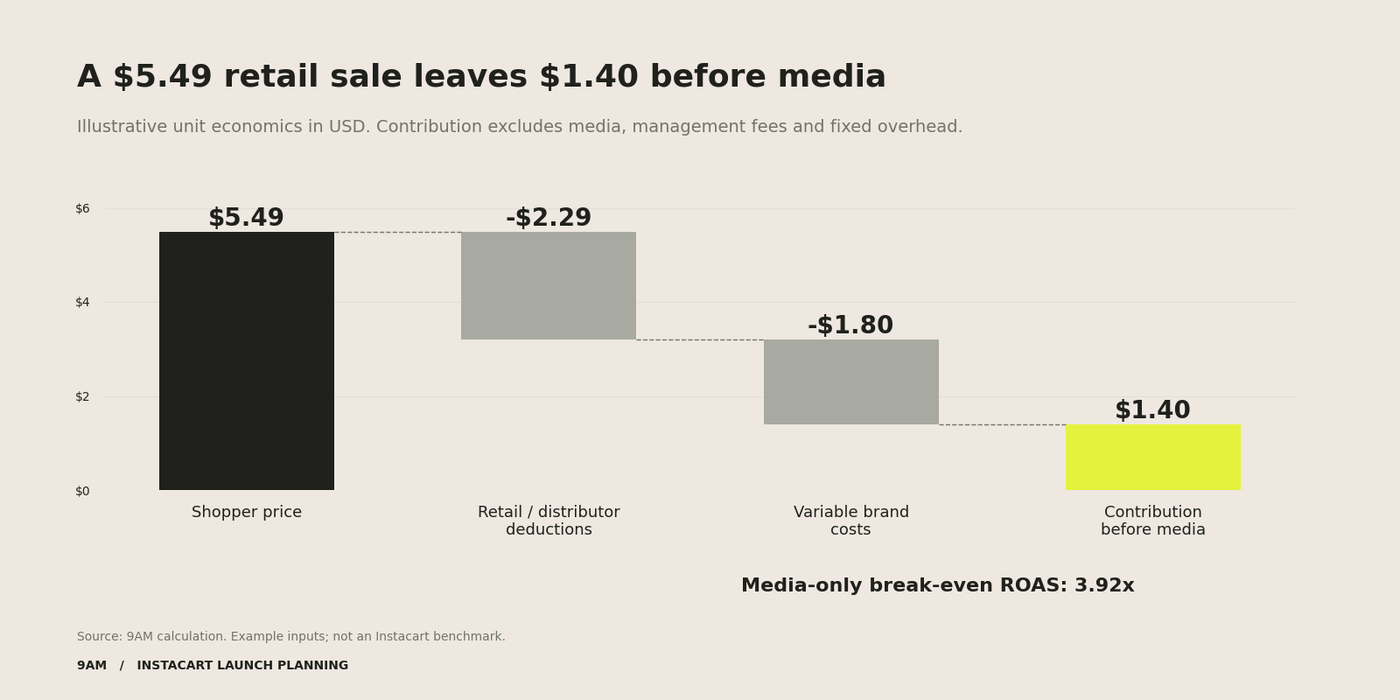
An illustrative $5.49 retail sale leaves $1.40 available for media before fixed costs. These are example inputs, not an Instacart benchmark. Source: 9AM calculation.
Finance should supply the actual net receipts, promotion funding and variable costs for each launch SKU. Our contribution margin guide explains how those inputs set the acquisition target.
Use the product mix sold during the campaign, since different pack sizes, prices and margins can change the break-even result.
The calculation also assumes the attributed purchases are additional.
If only half the attributed units are incremental, only half generate new contribution to cover media, and the illustrative ROAS hurdle doubles to 7.84x.
This is why attributed ROAS needs to be read alongside incrementality.
For a multi-SKU campaign, calculate contribution across the actual sales mix and include management and creative costs in the full test P&L. A brand may choose to fund an initial launch loss. Agree on that loss in advance and require evidence before using future repeat purchases to justify it.
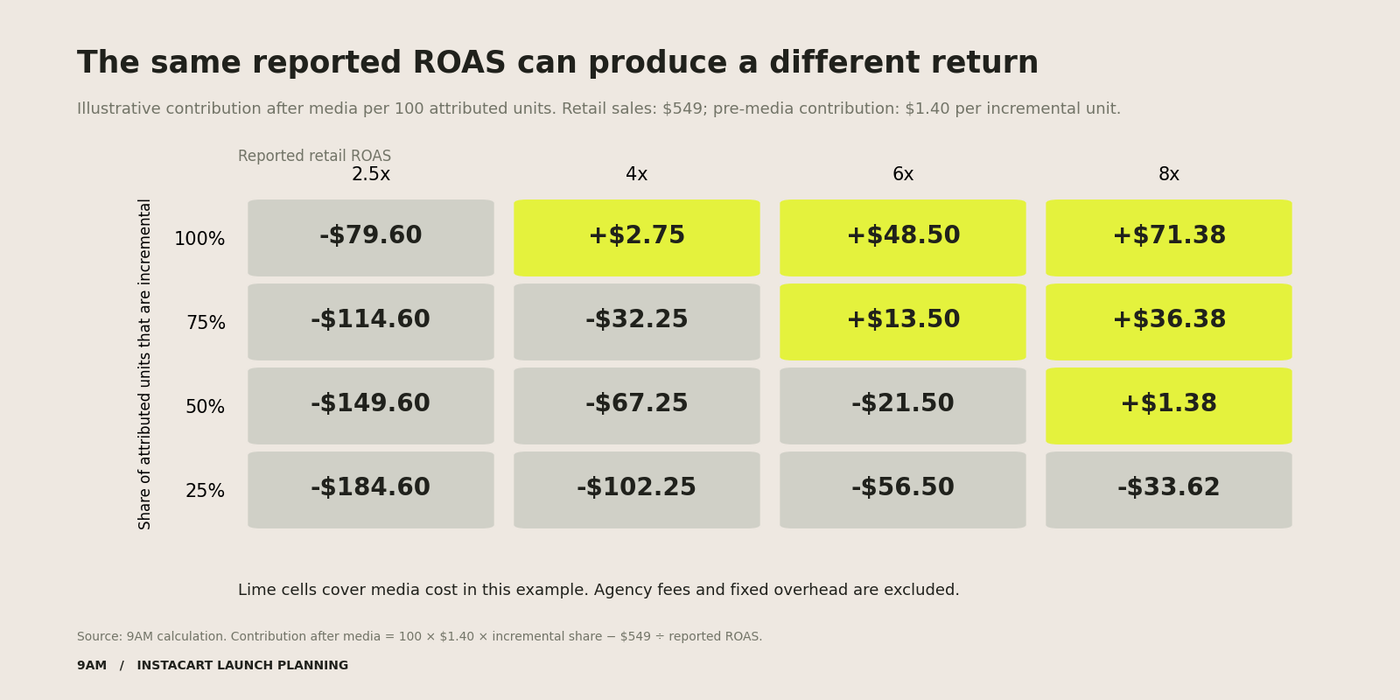
The same reported ROAS can cover media costs or lose money as the incremental share of sales changes. All inputs are illustrative. Source: 9AM calculation.
4. Align Instacart Promotions with the Trade Calendar
Match the Instacart offer to the retailer's existing deals so the final shopper price and discount funding are clear. Start with the account team's promotion calendar, including temporary price reductions and coupon commitments.
The type of offer affects what can run together.
Instacart's promotion rules distinguish CPG-funded product offers from retailer basket offers. Its documented rules say CPG-funded offers and coupons from Ibotta, a grocery rewards and cash-back platform, don't stack with temporary price reductions; retailer basket offers can stack with other basket mechanics.
Pro tip: That tutorial is written for retailers, so confirm with your Instacart account team how the same rules apply to a brand-funded offer.
Confirm three things before submitting a promotion:
Which offer the shopper will actually receive.
Which retailer accepts the intended mechanic.
Which party funds each redemption.
Don't assume an offer available at one banner works at another.
Decide whether the test measures media at the normal price or media supporting an offer. If both change together, the result estimates their combined effect. Keep the price and promotion history beside the campaign log.
Assign the offer costs to trade or marketing before launch, including redemptions and program fees. The trade-spend guide explains how to agree that responsibility. Record the discount once in the test P&L, even when a different team pays for it.
5. Review Creative and Claims Against Instacart Ad Policies
Review the headline, imagery, featured products and landing Page against Instacart's policies before submission. Review all of them together and remember: acceptable headline wording doesn't make a restricted image or destination acceptable.
Policy check | Launch requirement |
|---|---|
Alcohol | Confirm audience, placement and contractual restrictions; avoid underage drinking, intoxication and performance claims |
Weight loss | Remove direct or indirect weight-loss claims and prohibited weight-loss products or imagery |
Health claims | Keep evidence for the precise advertised benefit and submit acceptable wording for review |
CTA wording | Use permitted wording: "Shop," "Shop now," "Shop savings" or "Shop [brand name]" |
QR codes and URLs | Exclude them from creative images and text fields |
Alt text | Describe the visual and include displayed text, CTA and fine print, excluding text on logos |
Use Instacart's policies for platform approval, and retain evidence for the product claims themselves. The FTC's guidance explains that health-related advertising claims must be substantiated; platform approval and claim substantiation are separate requirements.
For example, for a functional beverage, keep the evidence and approved claim wording beside the brief. Evidence for just an ingredient may be insufficient to substantiate a claim about the finished drink. So, check that the dosage, product and claimed effect match the evidence.
Also verify the current asset specifications for the selected format.
Product-library image requirements don't replace display or video requirements. Give the reviewer a complete submission, including the Page, featured UPCs and accessibility text.
6. Set the Budget, Bidding Mode and Test Length
Set a budget the stocked range can support, choose the bidding mode that fits the objective and plan enough live activity to evaluate it. For a first test, our starting recommendation is at least four weeks, followed by time for the final clicks to receive purchase credit. Low-volume campaigns may need longer.
Instacart's daily budget is an average. Spend can reach twice that amount on a single day.
With an unchanged daily budget and no lifetime cap, the documented monthly limit is 30.4 times the daily amount.
A $100 daily setting can therefore spend $200 on a busy day and up to $3,040 across the month.
The sponsored product bidding options are:
Maximize sales optimized bidding, using a target ROAS.
New-to-brand optimized bidding, which can bid more for qualifying shoppers.
Manual bidding, for direct keyword and bid control.
The choice affects how much keyword control the team has.
Optimized campaigns choose keywords automatically; manual sponsored product keyword bids use exact match. Display supports different match options, so its keyword setup needs a separate review.
After launch, give optimized bidding time to respond before making repeated changes.
Instacart describes a learning period of roughly three to seven days after meaningful changes. If delivery is weak, check stock, eligibility and bid competitiveness together: a restrictive ROAS target is one possible cause, not the only one.
Connect the target ROAS to the break-even hurdle from step 3.
Instacart notes that a target ROAS set too high can reduce spend, sales and win rate, and that optimized bidding works best with a low target. If your hurdle is high, as in the example above, expect a trade-off between delivery and payback, and agree in advance which one the test prioritizes.
Set the maximum test loss and pacing limits before activation, then log any budget or bidding changes.
That gives the team a record of what changed when performance moved. Our budget pacing guide explains how to manage spend without treating every daily fluctuation as a reason to change strategy.
7. Set Up Measurement Before Launch
Define which purchases receive credit, how sales are grouped and what commercial result will justify more spend. Record those definitions before launch so finance and media evaluate the same campaign outcome.
Start with the purchase window.
Sponsored products credit eligible purchases within a 14-day click window. Display also uses a 14-day window and can credit purchases after clicks or views. Keep the format and interaction type visible when comparing results.
Then choose a consistent attribution model.
Instacart primarily uses linear attribution, which shares purchase credit across eligible ad interactions, and offers a last-touch comparison. Since April 1, 2025, a path containing both clicks and views shares linear credit among the clicks. Switching models changes the allocation, even when the underlying purchases are the same.
Check the sales scope as well. Instacart's direct and halo figures use different product sets and credit allocation:
Direct sales cover the eligible products featured in the campaign.
Halo reporting extends to related products, such as other flavors or pack sizes, and can overlap the products counted in direct sales.
Because halo credit is allocated differently, its reported value can be lower than direct sales.
Don't add direct and halo sales together: the figures represent overlapping purchase credit, which means they are not separate revenue pools.
Finally, allow the reporting window to mature.
If a campaign stops after day 28, purchases from its final clicks can still receive credit through day 42. The attribution-window guide explains why a recent period can look weaker before all its purchases arrive.
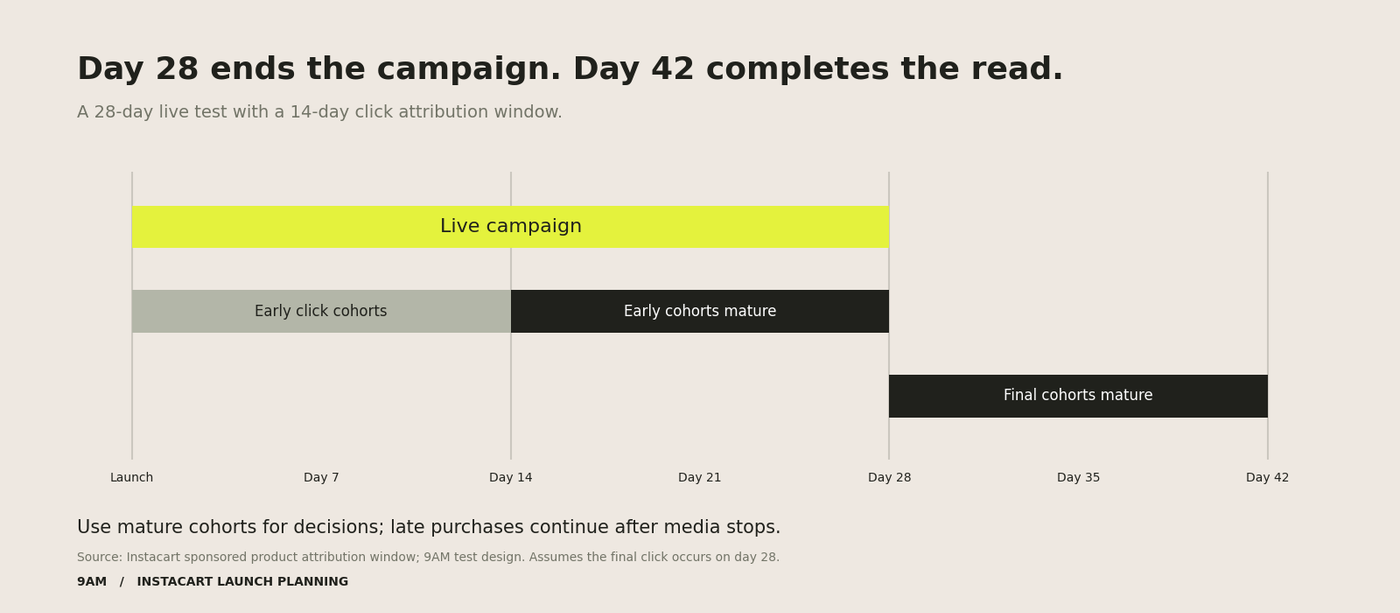
A four-week live test needs a further 14 days for the last click cohort to mature. Source: Instacart sponsored product attribution window; 9AM test design.
These settings establish how Instacart assigns credit.
To evaluate additional sales, also collect a pre-launch retailer or syndicated-sales baseline at the SKU and geography level available to the brand. Track stock, distribution, price and promotions over the same dates so those changes can be considered in the analysis.
A controlled geographic test can compare areas receiving the campaign with areas held out from it. First confirm that the campaign's targeting or exclusion options allow that separation. If they don't, the team needs another design; a simple regional sales comparison provides observational evidence rather than a randomized holdout.
Randomize where feasible, or use a suitable matched-market design with comparable pre-period trends and explicit assumptions.
The geo-lift guide covers those choices.
Evaluate uncertainty and promotion differences before drawing a causal conclusion. Where a credible test isn't possible, report attributed results and the limits of the sales analysis.
Remember: The same logic applies if you want to know whether the campaign also moved in-store sales: that needs retailer or syndicated store data and a control group.
Instacart Pre-Launch Checklist
The campaign is ready when the team can show that the products are purchasable, the commercial target is approved and measurement is in place. Use this checklist to confirm the evidence for each launch task.
Check | Ready when | Where to verify | Lead time |
|---|---|---|---|
Distribution and stock | Launch UPCs are purchasable in intended markets | Retailer data and shopper checks | Before committing media |
Brand claim | Brand ownership is confirmed | Ads Manager library and email | Response within 5 business days |
Missing UPCs | Approved products appear in the library | Product library | Up to 3 business days |
Listing edits | Approved changes appear on live listings | Library status and storefront | Up to 48 hours after approval |
Unit economics | Finance approves the ROAS hurdle and maximum loss | SKU contribution model | Before setting targets |
Offers | Funding, retailer support and stacking rules are confirmed | Trade calendar and offer setup | Before promotion submission |
Creative | Assets, claims and destination pass review | Ad review status and evidence file | Allow review and revision time |
Bids and budget | Bidding mode, pacing and end date match the test | Campaign settings | Before activation |
Measurement | Baseline, definitions and decision date are recorded | Measurement plan and exports | Before the first impression |
What to Monitor in the First 30 Days of Instacart Ads
In the first 30 days, monitor delivery, product availability, search relevance, purchase conversion and contribution. Check those signals in that order: a campaign that can't serve reliably needs a delivery fix before its sales performance can be judged.
Use the measurement definitions agreed before launch to keep the weekly review consistent.
Our measurement team can reconcile campaign exports against the brand's available sales data, so the review shows what is known and what still needs investigation.
Days 1–7: check campaign, ad group and product status. Verify spend, impressions, available UPCs and the shopper destination. Correct errors immediately; keep strategic changes limited while bidding learns.
Days 8–14: review search relevance, product mix, CPC and early conversion. Separate branded demand from category discovery where reporting permits. Log promotions and stock changes alongside any intervention.
Days 15–21: review the earliest click cohorts whose full purchase window has elapsed. Compare their ROAS with the contribution hurdle and check whether the total hides a low-margin SKU or heavy reliance on returning buyers.
Days 22–30: decide which delivery problems to fix and which hypotheses deserve another test. Prepare the commercial readout, but schedule the final judgment after the last clicks mature.
Use comparable weekdays and mature cohorts where possible. Looking at yesterday's ROAS beside a fully matured week gives the recent period a built-in disadvantage.
Read those results against the original objective. A campaign intended to reach new buyers should be judged partly on qualifying new-to-brand purchases, using Instacart's 26-week lookback. A campaign intended to capture existing branded demand answers a different question.
Keep that distinction visible before transferring budget.
What you see | Likely cause | What to check |
|---|---|---|
Little spend and few impressions | Low availability, narrow eligibility or uncompetitive bids | UPC stock, scope, status and bid strength |
Clicks with few purchases | Listing, price or relevance problem; recent clicks may be immature | Pack accuracy, shopper price and mature cohorts |
Strong ROAS, little new-to-brand volume | Existing demand may dominate | Brand/category query mix and acquisition objective |
Sales rise during a promotion | Media and offer effects overlap | Discount funding and baseline or control-market behavior |
Good attributed ROAS, poor contribution | Retail sales value exceeds the brand's retained economics | SKU margin, promotion costs and incrementality |
At the day-30 review, make a provisional decision: keep the test running under agreed limits, fix an identified problem or pause spend.
Reserve the final commercial continue/revise/stop decision for at least 14 days after the last day of spend (day 42 for a 28-day test, day 44 for a 30-day test), once the last click cohort has matured.
The retail media mistakes guide covers the wider allocation issues; this first review should explain what the Instacart spend established.
At the final review, continue when mature results meet the agreed economics and stock can support more sales.
Revise when a fixable issue, such as an incorrect listing, prevented a fair test.
Stop when mature results miss the commercial target and further spend has no defined learning objective.
Assign an owner and deadline to the next action, including any retailer or finance dependencies.
Grow Food and Beverage Sales on Instacart with 9AM
9AM helps food and beverage brands plan Instacart media around stocked products, contribution margin and a clear sales objective. Our F&B media buying team translates launch readiness into campaign planning, creative and measurement.
The work continues as distribution, promotions and shopper demand change.
We review which products the campaign can support, where spend is delivering purchases and whether those sales justify the cost. Where the data and campaign controls permit it, we can also define a test of incremental sales.
For a first launch, bring the retailer footprint, priority UPCs and product economics.
Together, we can identify what needs fixing before activation and what a funded campaign should establish.
That gives your sales, finance and media teams a shared basis for the next budget decision.
Book a strategy call and we’ll map your retail footprint, set up a first Instacart test, and build a retail media plan that grows with your distribution.
FAQs
Do Instacart ads lift in-store sales, and how do you check it?
Instacart ads may influence in-store purchases, but the platform's attributed sales don't prove that lift. Check retailer or syndicated store-sales data using a suitable controlled test, accounting for distribution, price and promotions. The design must let the team distinguish campaign exposure from other reasons sales changed.
Should a regional beverage brand advertise before it has national distribution?
Yes, a regional brand can test when its stocked footprint provides enough eligible shoppers and sales volume. Set the budget around that footprint. Reliable availability and workable economics matter more than national distribution.
Can alcohol brands run Instacart ads?
Yes, eligible alcohol brands can advertise, subject to placement, audience, contractual and applicable legal restrictions. Instacart prohibits content involving underage drinking, intoxication and performance claims. Check the product set and campaign against its policies before committing creative or budget.
What is a good CTR for Instacart ads?
Instacart doesn't publish a universal CTR benchmark for F&B campaigns in its public documentation. Compare campaigns with similar formats, placements and product categories, using the same impression definition. A higher CTR is useful only if those clicks also produce purchases at a workable cost.
Does the DoorDash acquisition change anything for advertisers?
As of November 2026, DoorDash's announced acquisition of Instacart has not led to any announced change in advertiser access or reporting; until closing, the two companies continue to operate as separate, independent companies. DoorDash expects the transaction to close by the end of 2027 or in the first half of 2028, subject to regulatory, shareholder and other approvals. For current campaign decisions, follow Instacart Ads Manager terms and check the official transaction announcement for updates.
About Corentin Grisoni
Corentin Grisoni helps DTC and wellness brands turn paid media into a connected growth system. As Retail Media Lead at inBeat Agency, he works across Amazon, Meta, TikTok, and Google to build omnichannel campaigns that are measurable, scalable, and tied to business outcomes.
His work brings together retail media strategy, paid social and search, attribution modeling, UGC, and performance creative. He focuses on helping retail, technology, and wellness brands understand where their media budget is working and create a system that compounds what performs.
More from Corentin GrisoniKeep exploring.
Insights
Retail Velocity for Food and Beverage Brands: Separate Distribution Growth from More Units per Store
November 12, 2026
Insights
Grocery Retail Media: How Food Brands Choose a Network Their Distribution Can Support
November 12, 2026
Insights
Amazon Fresh Advertising vs Amazon.com Ads: What Food Brands Must Verify Before Buying Media
November 12, 2026