
Grocery Retail Media: How Food Brands Choose a Network Their Distribution Can Support
Choose a grocery retail media network around your stocked retailers, campaign access, buying costs and sales reporting. A practical guide for food brands.

· 16 min read
A grocery retailer can carry your brand without carrying every flavor in every store. That creates a problem when the media proposal covers a wider audience than the products shoppers can actually buy.
The network's audience figures won't resolve that mismatch. Before committing budget, you need to know which products are available, which locations the campaign can support and what sales evidence you'll receive.
This guide compares five US grocery retail media options and walks through the checks that turn a shortlist into a workable first test.
At 9AM, the stocked product comes before the media commitment. We connect the retailer plan with creative, spend and measurement, so each campaign has a clear commercial job. As availability changes, the plan should change with it.
P.S. Our food and beverage team can help review that fit before launch.
What Is Grocery Retail Media?
Grocery retail media is advertising sold using a grocery retailer's shopping inventory or shopper data. It includes retailer-owned networks and multi-retailer shopping services such as Instacart.
Ads can appear on shopping sites and apps, across external media, or in stores. These placements serve different purchase paths. A sponsored product can lead straight to an online listing; an in-store screen reaches someone already visiting a location.
For example, AD Retail Media's Edge launch brought sponsored search, onsite display and in-store digital screens into one platform in January 2026. That gives advertisers different ways to reach shoppers within the same retailer group.
Remember: More placements mean more ways to spend. So choose the purchase opportunity first, then the placement that fits it.
The next question is where retail media fits alongside the other channels supporting that sale.
How Should Grocery Retail Media Fit with Paid Social and Search?
Grocery retail media should have a defined job alongside paid social and search: introduce a product, help shoppers find it or support a purchase at a stocked retailer. Allocate spend around that job and the available evidence.
Create a Reason to Try the Product
A shopper may need to understand a food product before wanting to search for it. That is especially relevant when the taste, texture or preparation method is unfamiliar.
A short demonstration can make the appeal concrete.
For a sauce brand, showing a quick weekday meal explains more than a pack shot alone.
Paid social and eligible retail discovery placements can carry that idea to shoppers.
Prego’s Quick Skillet Ziti shows this approach in practice. The recipe turns its sauce into a five-ingredient dinner ready in 25 minutes. That gives shoppers a concrete use for the product and a reason to consider it for their next weekday meal.
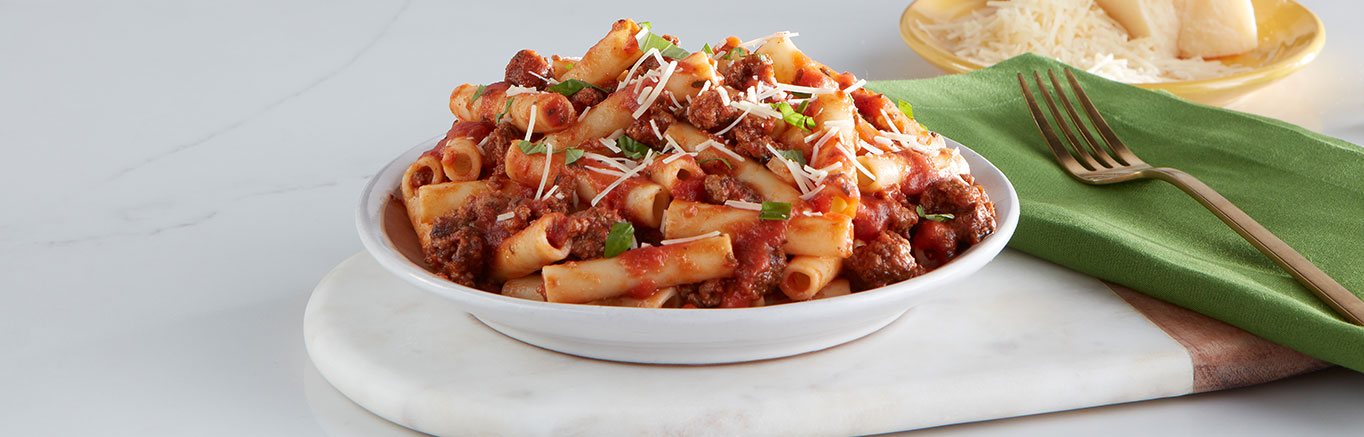
Prego connects its sauce with a practical weeknight meal. Source: Prego.

Remember: The channel choice still depends on access, cost and the intended audience. Discovery is a campaign objective, and several channels can contribute to it.
Make the Stocked Product Easy to Buy
Once someone wants the product, the campaign needs a reliable purchase route.
Retail search can put an eligible item in front of people shopping for the category. Search or social traffic can also lead to a retailer destination or a useful store locator.
That means the creative promise and destination need to agree. If the ad shows a family-size jar, the shopper should arrive at that pack or receive a clear route to find it.
For a first test, give each channel a specific role.
For a sauce brand, that could mean:
Paid social introduces the meal idea. Show how the sauce turns leftover chicken into a quick dinner, then link to a stocked retailer.
Google Search helps interested shoppers find it. Direct searches for the brand or where to buy it to the relevant product page or store locator.
Retail search supports the purchase. Promote the available sauce when shoppers search for relevant products within the retailer’s site or app.
This gives the test a clear structure: introduce a reason to try the sauce, help shoppers find it and support the choice while they build their basket. Read each channel’s results against that job before reallocating the budget.
Otherwise, a retailer campaign may receive purchase credit for demand built elsewhere, and your team may move budget without understanding what each channel contributed.
Our CPG media buying team helps define those roles across retail media, social and search, with creative and reporting planned around the same sales objective.
The first decision, however, is the network: which retailers' campaigns your verified distribution can actually support.
That brings us to the next section.
Which Grocery Retail Media Networks Fit Your Retail Footprint?
Five options to compare are Instacart Ads, Walmart Connect, Kroger Precision Marketing, Albertsons Media Collective and AD Retail Media. Shortlist the networks connected to retailers that carry the launch range, then check their campaign and reporting options.
These five options illustrate different shopping footprints. Use them to build a shortlist for the brand's actual retailer priorities.
Network | Relevant shopping footprint | When to shortlist it | Confirm before spend |
|---|---|---|---|
Instacart Ads | Instacart shopping services and supported partner properties | Products are purchasable through participating retailers | Available campaign scope, eligible products and actual coverage |
Walmart's shopping environment | A stocked Walmart range is a commercial priority | Eligible listings, online/store purchase path and sales reporting | |
Kroger ecommerce sites and apps, with other media options | The range is available through relevant Kroger operations | Self-service access, product eligibility and supported markets | |
Albertsons Media Collective | Albertsons Companies' grocery-banner portfolio | Relevant banners stock the launch range | Actual banner assortment, locations and placement access |
AD Retail Media | Supported Ahold Delhaize USA shopping environments | The stocked range overlaps participating banners | Current banner coverage, available formats and campaign terms |
The buying controls are important here.
Instacart's campaign setup distinguishes ecosystem campaigns from supported partner-specific scopes. That does not establish that every retailer in its Marketplace can be selected individually.
Albertsons describes a portfolio of 22 banners. A brand still needs to establish which of those banners carry its products. Portfolio reach and brand distribution answer different questions.
If Walmart is the strongest stocked opportunity, the Walmart Connect guide covers the retailer-specific preparation.
Apply the same discipline elsewhere: first establish the purchase opportunity, then qualify the proposed campaign.
What If More Than One Retail Network Fits?
When several networks pass the first filter, rank them with three questions, in this order, and stop at the first one that separates them:
Footprint: which network can support the largest share of your verified locations?
Terms: whose commitment, fees and creative requirements fit the planned test, and who lets you pause if stock moves?
Evidence: whose report can answer the test’s business question, including online versus store sales, product and geography detail, and reporting lag?
Audience size comes after all three. A smaller network that passes them gives you a test you can read. A larger one that fails them gives you spend you cannot learn from. The worked example below applies this order.
How to Choose a Grocery Retail Media Network, Step by Step
Choose the network by checking product availability, campaign fit, buying conditions, total cost and sales evidence. Work through these five steps with the sales and media teams before signing a commitment.
1. Map the Products Shoppers Can Actually Buy
Build the shortlist from live product availability, using a product-by-retailer view. A retailer authorization or a shipment to a distributor is only part of that picture. The shopper still needs to find the intended item in the relevant market.
For each launch product, record:
The UPC or product identifier and correct pack size.
The retailer banner and supported locations or regions.
A live listing or confirmed shelf presence.
Recent availability evidence and the replenishment contact.
Any unresolved listing, stock or launch-date issue.
Check representative delivery locations when the purchase happens online. For physical stores, use the retailer or account team's available stock and execution evidence. Note when that evidence was last checked.
This gives the media team a usable launch boundary. Keep unresolved products or markets outside the initial plan until their purchase path is ready.
Pro tip: Instacart lists low UPC availability as one possible reason display ads receive no impressions. So a stock issue can affect both delivery and the shopper's ability to buy. Check that constraint before treating weak delivery as a bidding problem.
Our retail rollout guide explains how to coordinate those changing dates across teams. For network selection, the immediate output is simpler: a verified range, a supported footprint and an owner for each exception.
For our imaginary sauce brand, 120 authorized stores narrow to 96 locations with verified live stock. The selected proposal supports 72 of those locations. The funnel shows why the media plan needs to follow the verified purchase opportunity, even when the commercial distribution list is larger.
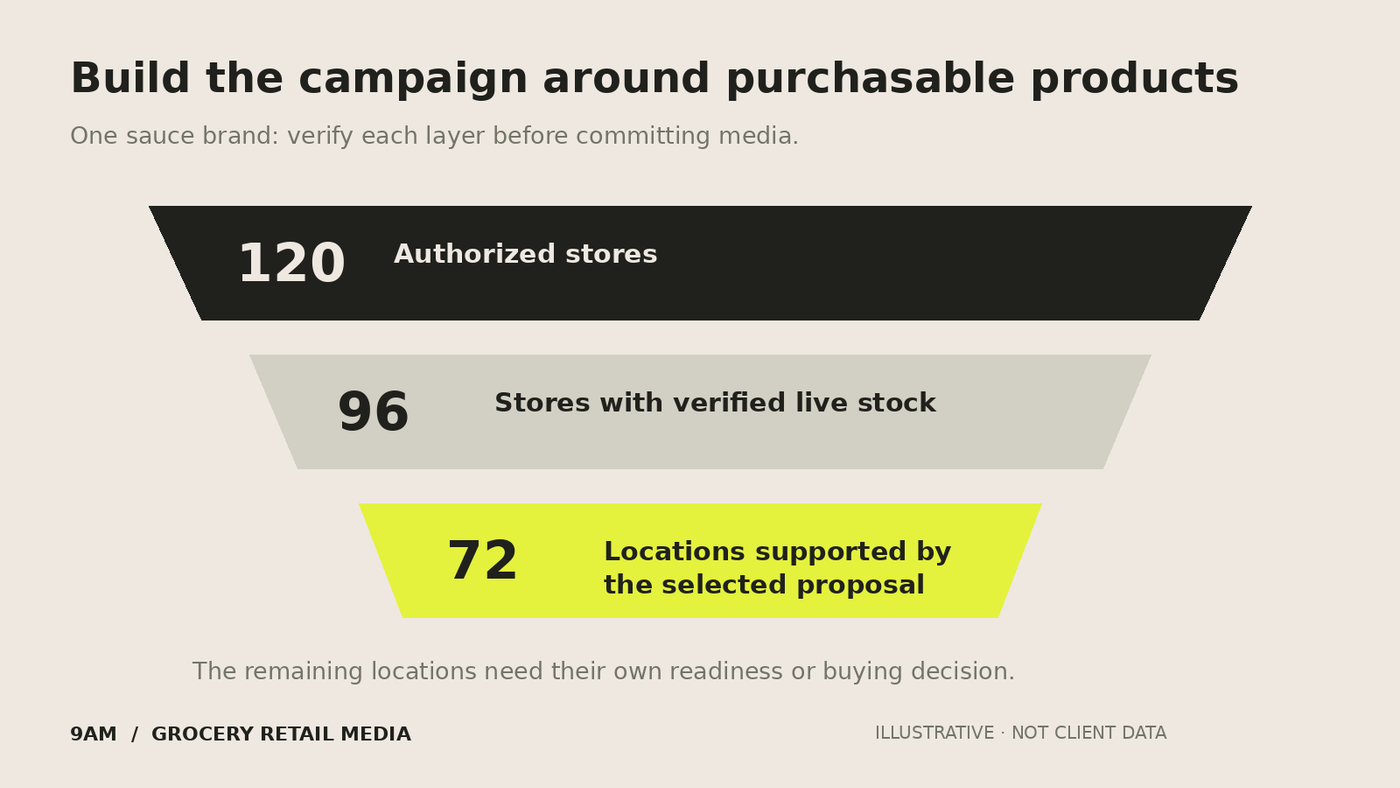
Figure 1. Each check narrows the footprint the first campaign can support. Source: 9AM illustrative planning example; not a client result or network benchmark.
2. Match the Placement to the Sales Job
Choose a placement that fits the shopper action and the creative available to support it. A product search ad, a meal demonstration and an in-store message need different assets and destinations.
Use three short decisions:
Name the action. Should shoppers add a jar to an online basket, explore a flavor or look for it during a store visit?
Check the purchase route. Confirm the relevant listing, retailer page or physical-store opportunity, then verify the campaign controls that can support it.
Prepare the right creative. Make the pack, benefit and next action clear within the selected format's requirements.
For our imaginary sauce brand, a product image needs accurate flavor and pack information. A demonstration can show how the sauce turns leftovers into dinner. If an offer appears in the creative, its dates and eligible products need to match the retailer promotion.
The point is to make the next purchase step easier.
A format with attractive reach is less useful when the team lacks an appropriate destination or the creative needed to explain the product.
3. Confirm Buying Access and Campaign Terms
Identify the account operator, confirm advertiser access and record the buying route and commitment. A promising network can still be a poor first choice if its operating requirements exceed the team's capacity.
Ask the network or buying partner to confirm:
Whether your brand and launch products can use the proposed format.
Who runs the account and who can access the reports.
The minimum commitment, flight dates and applicable fees.
Creative requirements, review timing and revision responsibilities.
What can be paused or changed if stock or launch dates move.
Compare the actual terms offered. A self-service option and a managed package may have different commitments, even within the same network. There is no useful cross-network minimum to assume without a current quote.
Also establish who handles product exceptions. The retailer or commercial team may need to fix a listing or replenishment issue, while the media operator changes the campaign. Clear ownership keeps an unresolved shelf problem from becoming repeated ad-account troubleshooting.
4. Compare the Full Test Cost with the Product Economics
Compare the complete cost of the proposed test with what additional sales can contribute. Media spend alone leaves out costs that may change which network is affordable.
Include creative, management or platform fees, applicable data and measurement charges, and any funded offer. Check which costs are already included in the quoted package so they appear once in the calculation.
Then use the brand's net receipts and relevant variable costs to establish contribution. The retailer's shelf price is the shopper's spend, so it overstates what the brand retains to fund advertising.
Our contribution-margin guide explains that budget calculation. Use it to decide whether the test could pay for itself or answer a question worth funding.
Agree on what the budget must establish.
For example, the first test might assess whether supported local markets can generate additional purchases at an acceptable cost. Set the evaluation period and maximum learning loss before launch.
Bring the promotion calendar into that decision, too.
If the campaign runs with a discount, the test evaluates the combined offer and media activity unless the design separates them. That affects both the result and the contribution per sale.
Our trade-spend guide helps assign the offer costs to the right budget. A discount funded elsewhere in the business still belongs in the commercial assessment.
5. Agree on the Sales Evidence Before Signing
Ask for a sample report and confirm that it can answer the test's business question. A network can deliver ads successfully while leaving the brand with insufficient evidence for its next investment decision.
Check the following before buying:
Whether reported purchases cover online sales, store sales or both.
The product and geography detail available to the brand.
The attribution rules, reporting lag and export access.
The requirements and extra costs of any proposed lift study.
Attribution shows purchases credited under the network's rules. To assess additional sales, the test also needs a credible way to estimate what would have happened without the activity.
IAB's incrementality guidelines recommend choosing the measurement method around what you need to learn. For example, deciding which ad to keep running is a different question from checking whether the campaign generated sales that would not have happened without it.
For you, the question is whether the available design supports campaign optimization, a directional learning exercise or a stronger claim about additional sales.
So, we encourage you to write the test design and data limits into the brief, with a report owner and decision date. That way, the final review judges the campaign against the question it could actually answer.
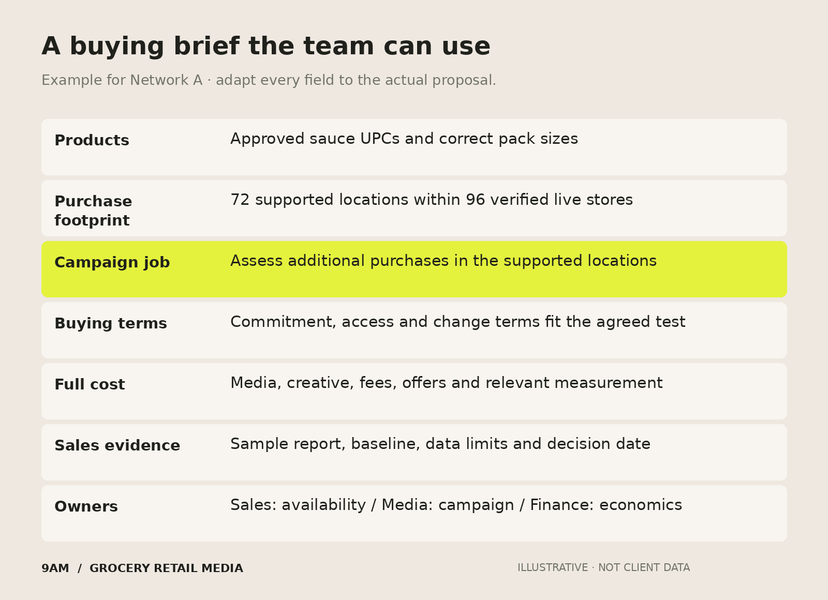
Figure 2. Summarize the five checks in one buying brief. Unconfirmed fields remain open tasks. Source: 9AM original planning template.
A Worked Example: Choose the Network That Can Support the Launch
For our imagined sauce-brand launch below, Network A is ready for a test. The other two candidates need commercial or retail fixes first. The comparison shows why the largest audience alone cannot decide the purchase.
So, let’s imagine a sauce brand with 120 authorized stores. The team verifies live stock for the launch range in 96 locations. It then reviews three hypothetical proposals.
Candidate | Verified purchase footprint | Remaining constraint | First decision |
|---|---|---|---|
Network A | 72 of the verified locations | Supported local campaign, reliable replenishment and usable reporting are confirmed; commitment fits the plan | Proceed to the agreed test |
Network B | 24 of the verified locations | Replenishment is unreliable and the proposed commitment exceeds the planned scope | Hold and resolve both conditions |
Network C | No launch products currently purchasable | Listing and availability are not ready | Complete retail preparation first |
Network A is the workable first choice because the conditions fit together. Network B's smaller footprint is not, by itself, a reason to reject it. A reliable regional opportunity could support a useful test.
Here, its stock and buying terms need work first.
Network C cannot yet support the proposed retailer sell-through campaign. Additional audience reach would not give those shoppers a purchasable product.
These are planning assumptions, of course.
Network A still has to pass the cost test from step 4. Suppose its quote puts the four-week test at $1,500 all-in, and the sauce earns $1.40 per jar after retailer margin and variable costs. The test needs about 1,070 additional jars to break even. Across 72 locations and four weeks (288 store-weeks), that is roughly 3.7 extra jars per location per week, a figure the team can compare with its recent velocity before agreeing to the commitment.
The point is to learn how to turn the same distribution file into different buying decisions without ranking networks by headline reach.
How Should Grocery Retail Media Change with Stock and Distribution?
Adjust the product range, spend and supported markets when availability changes. Expand only after the new purchase opportunity and campaign conditions are confirmed.
Let’s discuss them one at a time:
Adjust Spend When Product Availability Falls
Use stock updates to decide what the campaign can still support:
Identify the affected products and markets. The sales or account team should confirm the availability issue and expected replenishment.
Adjust the campaign. Use the controls available to narrow, pause or redirect activity. For example, Instacart lets advertisers pause and reactivate display ads. Confirm stock has returned before restarting the affected activity.
Read performance alongside availability. A temporary stock issue can reduce sales even when shopper interest remains.
Add Locations Only When Stock and Terms Are Both Ready
Before adding locations to the media plan, confirm that:
The correct products are listed and available.
The campaign can support those locations.
Offer creative matches the promotion’s dates and eligible products.
The buying commitment fits the planned test.
Stock returning may resolve only part of the delay.
For our sauce brand, imagine Network B's locations need replenishment during the next planning period. In the sequence below, stock is ready in week three, but the buying terms only fit the test in week four. Media can start once both conditions are resolved.
Disclaimer: The dates describe this example, so it’s not a standard network setup time.
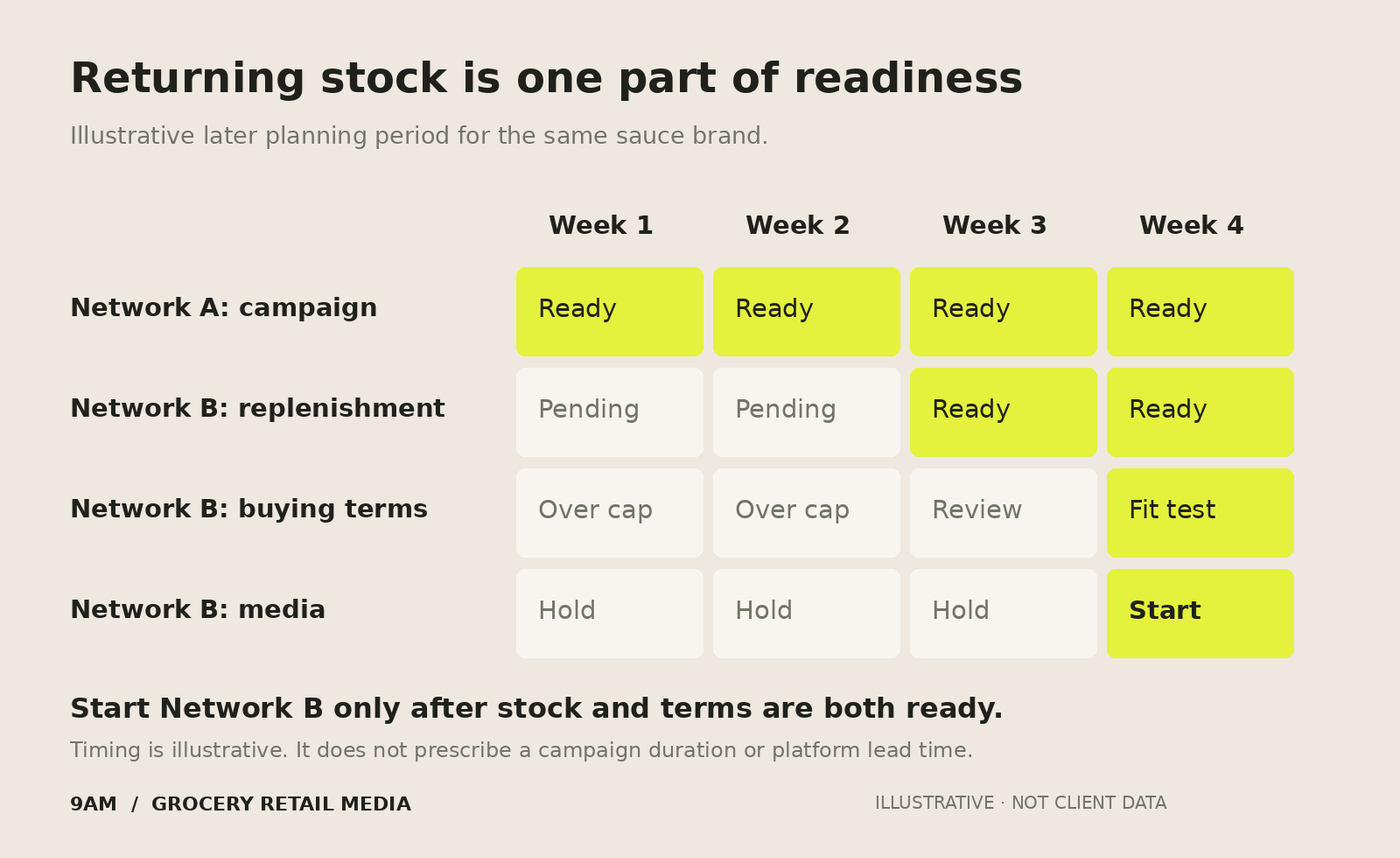
Figure 3. Readiness depends on the remaining conditions, even after stock returns. Source: 9AM illustrative sequence; these are not platform lead times or a prescribed test duration.
Add a Second Network for a Defined Opportunity
Add another network when it serves a clear objective and the team can fund and evaluate it. Before expanding, check:
What it adds: a retailer, shopper group or launch opportunity the current plan does not adequately cover.
What it costs: media, creative, account management and relevant measurement.
Where it overlaps: whether both networks reach similar shoppers or support purchases from the same retailer.
How sales receive credit: whether the reports may attribute the same purchase to more than one campaign. The IAB/MRC guidelines explain the reporting definitions to review.
For example, a retailer’s own ads and an Instacart campaign may support purchases from that retailer. So reconcile their reporting before presenting the combined totals as additional sales.
Grow Your Grocery Presence with 9AM
At 9AM, we work as a growth partner for food brands, connecting retail media with everything that moves the needle: product availability, paid social, search, creative and sales reporting. We start from what matters most, the products shoppers can actually find on shelf, and build campaigns around the commercial goals you’re chasing next.
Whether it’s launching in a newly stocked retailer, timing spend around a key promotion or scaling at the pace your supply allows, we keep media, creative and stock moving together, so every dollar works harder and every launch lands with momentum.
From the first test to the next phase of growth, we help you see what’s working, learn fast and put budget where it pays back.
Book a strategy call and let’s map your next move.
FAQs
Does a food brand need national distribution to use retail media?
No. A reliable regional footprint can support a properly scoped test. Check your stocked products, eligible campaign coverage, buying commitment and sales evidence. National distribution is not the deciding condition.
Can retail media get a product into more grocery stores?
Advertising can support demand where shoppers can buy, but retailer listings and physical distribution need commercial work. Treat shelf access as a separate task. A media commitment does not establish that access.
How much should a food brand budget for its first network?
Use the current proposal's total cost, product economics and learning objective. Include fees, creative and relevant offers alongside media. Confirm any minimum for the selected buying option, then set the return target from your brand's own margins.
Can a brand use Instacart and a retailer's own network together?
Potentially, with appropriate access and a distinct job for each campaign. Check audience overlap, available controls and purchase-credit definitions. Using both channels does not automatically create new retail distribution or prove incremental sales.
About Corentin Grisoni
Corentin Grisoni helps DTC and wellness brands turn paid media into a connected growth system. As Retail Media Lead at inBeat Agency, he works across Amazon, Meta, TikTok, and Google to build omnichannel campaigns that are measurable, scalable, and tied to business outcomes.
His work brings together retail media strategy, paid social and search, attribution modeling, UGC, and performance creative. He focuses on helping retail, technology, and wellness brands understand where their media budget is working and create a system that compounds what performs.
More from Corentin GrisoniKeep exploring.
Insights
Instacart Advertising for Food and Beverage Brands: What to Check Before Your First Campaign
November 12, 2026
Insights
Retail Velocity for Food and Beverage Brands: Separate Distribution Growth from More Units per Store
November 12, 2026
Insights
Amazon Fresh Advertising vs Amazon.com Ads: What Food Brands Must Verify Before Buying Media
November 12, 2026