Retail Media vs Trade Spend: Which Budget Should Fund Your Campaign?
Retail media vs trade spend: how they differ, where each sits on the P&L, and a free template to decide which budget funds your next retail campaign.

· 14 min read
A shopper who sees your product in a sponsored slot on a retailer's site never wonders whether it was paid for by trade or by marketing. Inside a CPG company, that question decides who approves the spend, which KPIs it answers to, and where it lands on the P&L.
The line between the two is blurring.
Industry estimates put 16% to 40% of retail media spend as money shifted from trade and shopper marketing budgets, and the IAB now publishes a framework just to define which is which.
This guide covers what each budget buys, where each sits on the P&L, and a step-by-step way to decide which one should fund your next retail campaign, with an illustrative example.
P.S. If you'd rather plan the next retailer campaign with a team that runs both the media and the measurement, our CPG media buying team does this for consumer packaged goods brands.
TL;DR
Trade spend changes the commercial terms with a retailer: discounts, promotions, slotting, displays. Retail media buys ad placements from the retailer's media network.
Trade spend usually reduces net revenue. Retail media can be treated the same way unless the advertising is a distinct service at fair value, so check with finance.
The budget that pays for a campaign also sets its KPIs, timing, and approvals, so the funding choice shapes the campaign.
Decide in seven steps: separate commitments, name the objective, check retailer requirements, confirm accounting, compare total retailer economics, plan measurement, and record ownership.
Many campaigns work best jointly funded, with each budget paying for the part it's built to measure.
How we approach this at 9AM: media buying and measurement are something we do together, and we want to see genuine results from these decisions we make. Trade and retail media, in many cases, reach the same shopper in the same week, but they're judged by different teams on different numbers. That's how a brand ends up paying twice for the same sale. Deciding the funding source before the campaign, with the measurement plan attached, is the cheapest fix we know.
What Are Trade Spend and Retail Media?
Trade spend is money a CPG brand gives retailers to change the terms of selling its products. Retail media is advertising a brand buys from a retailer's media network. Both are paid to the same retailer, generally for the same shopper, but they work differently.
What Is Trade Spend?
Trade spend, also called trade terms spend, is the funding a CPG company provides to retailers to drive sales of its products.
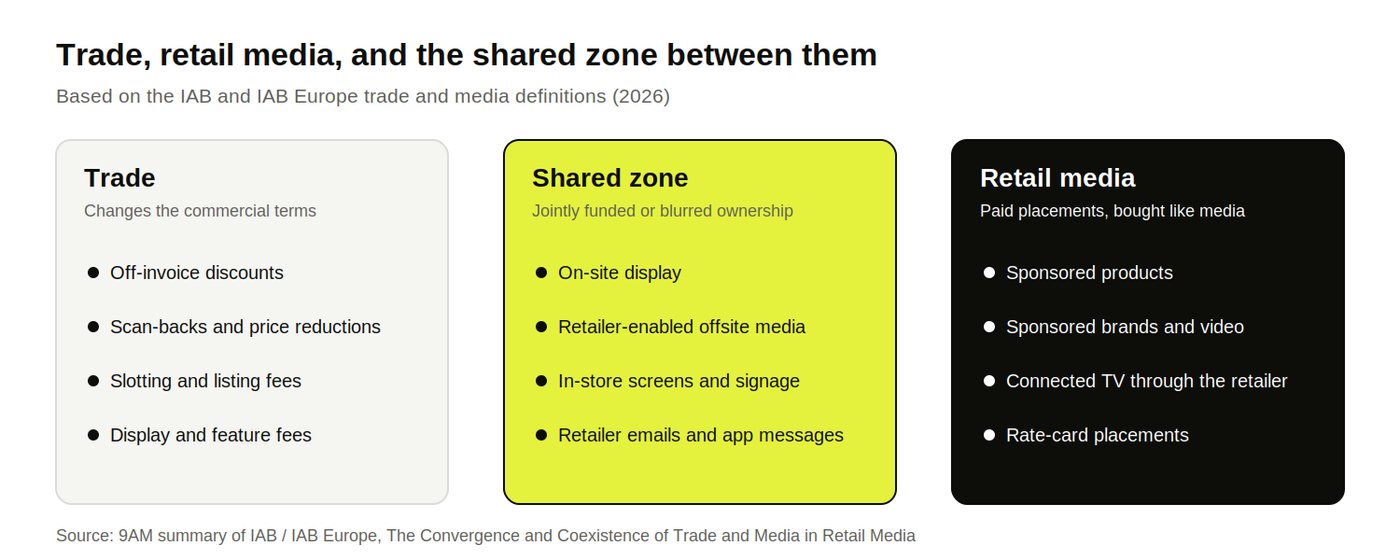
The Defining Trade and Media framework from IAB Europe and IAB US defines trade as commercial mechanisms that alter the economic terms of a transaction between supplier and retailer, usually to drive short-term volume.
The common types:
Off-invoice discounts: a lower price per case at the time of purchase.
Scan-backs and temporary price reductions: payments per unit sold during a promotion.
Slotting and listing fees: payments to get or keep a product on shelf.
Display and feature fees: end caps, circulars, and secondary placements.
Co-op and market development funds: shared promotional funding.
Deductions and chargebacks: penalties and allowances taken from invoices.
Trade spend tends to be a CPG company's second-largest cost after cost of goods sold. Some of it is working spend that shoppers see, like a lower shelf price; the rest keeps the relationship and the listing in place.
What Is Retail Media?
Retail media is advertising sold by a retailer, using its shopper data and its own and partner inventory. It includes sponsored products and display ads on the retailer's site and app, offsite ads targeted with the retailer's data, and digital screens in stores.
It's bought much like other digital media: by auction or rate card, with campaign reporting. Our guide to retail media and brand building covers how the networks work and where they fall short.
Here’s a quick visual explainer:
Retail Media vs Trade Spend: Key Differences
Trade spend changes the price or the deal; retail media buys attention. Here's how the two compare in practice:
Trade spend | Retail media | |
|---|---|---|
Usually owned by | Sales and key account teams, with finance | Shopper, ecommerce, or brand marketing teams |
What it buys | Price, promotion, listing, and placement terms | Ad impressions, clicks, and placements |
How it's priced | Negotiated, often in the annual joint business plan | Auction or rate card, sometimes with minimums |
P&L treatment | Usually a reduction of revenue | Expense or reduction of revenue, depending on the deal (see next section) |
How it's measured | Promotion lift, volume, account profitability | Return on ad spend, new-to-brand sales, incrementality tests |
Lead time | Months; promotions are often planned well ahead | Days to weeks |
Between the two sits a zone the IAB's trade and media definitions describe as jointly funded or shared between trade and media teams: on-site display, retailer-enabled search and CTV, in-store signage and sampling, and retailer emails and app messages. Paid digital in-store screens are explicitly listed as retail media.
The same in-store screen campaign can be funded through a negotiated trade agreement or a separate media buy. The funding route changes who pays; it doesn't change the activity's classification as retail media.
Where Trade Spend and Retail Media Sit on the P&L
Trade spend usually sits above gross profit as a reduction of revenue, between gross sales and net sales. Marketing spend sits below, in selling, general, and administrative expenses. Retail media can land in either place, depending on how the deal with the retailer is structured.
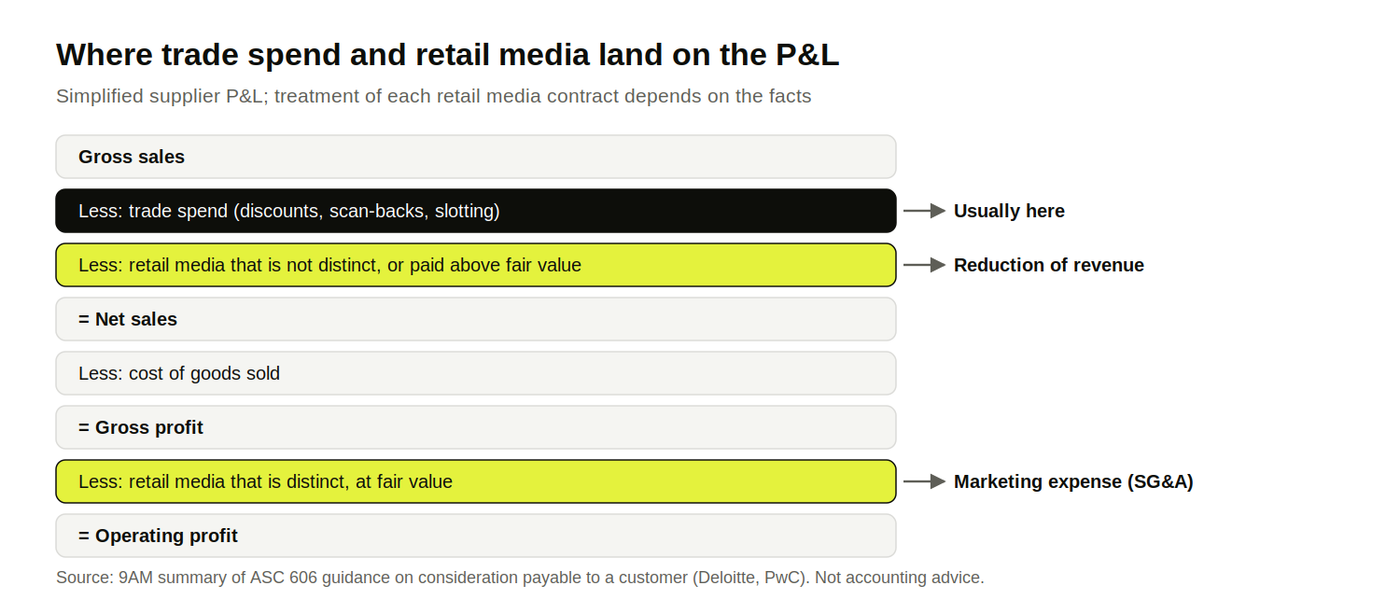
Under US GAAP (ASC 606), money a supplier pays to its customer, here the retailer, is treated as a reduction of revenue unless it buys a distinct good or service at fair value. Retail media is a payment to a customer, so it has to pass that test to be booked as an ordinary advertising expense.
Deloitte's guidance on retail media networks sets out how the test works. If the advertising isn't distinct from the retailer's purchase of your products, the payment is accounted for as a reduction of the supplier's revenue, much like trade.
The questions it raises include:
Would you buy this advertising from the retailer if you weren't also selling it products?
Could you buy the same advertising from someone who isn't your customer?
Does the campaign run on third-party platforms, reaching shoppers beyond the retailer's own site?
Do non-suppliers buy the same ad inventory?
Do shoppers use the retailer's platform for research, not only for buying from that retailer?
If the advertising is distinct, the supplier still has to estimate its fair value. Anything paid above fair value, or the whole amount if fair value can't be estimated, goes back to being a reduction of revenue.
In practice, on-site sponsored product ads that only send shoppers to buy at that retailer are the harder case. Offsite campaigns on third-party platforms are more likely to count as distinct.
Note: This is a summary of published guidance, so don’t take it as accounting advice; the treatment for any specific contract is your finance team's call.
Why the Funding Source Changes the Campaign
The budget that pays for a campaign brings its own owners, KPIs, calendar, and approval rules.
Fund the same retail media campaign from trade and it's judged on volume and account profitability.
Fund it from marketing and it's judged on return on ad spend and new-to-brand sales.
Brands already draw on several pots.
In a p2pi survey of CPG respondents, shopper marketing budgets were the most common source of retail media funding, followed by national media, trade, and dedicated retail media budgets. 63% set retail media budgets once a year, and about a third decide campaign by campaign.
The pool on the trade side is large.
Oliver Wyman estimates total US trade spend at $160 billion, which is why even a small shift from trade to media matters to retailers and brands alike.
Three practical consequences follow from the funding source:
Timing. Trade budgets are often committed in the annual joint business plan, months ahead. Marketing budgets can move mid-quarter.
Decision rights. Key account managers negotiate trade; media teams plan retail media. A campaign in the shared zone needs both at the table.
Measurement. Promotion lift and ROAS answer different questions, and neither alone shows whether the spend added sales that wouldn't have happened anyway.
How to Decide Which Budget Funds the Next Campaign, Step by Step
Deciding which budget funds a retail campaign takes seven steps, from separating money you've already promised to recording who owns the result. Work through them with sales, marketing, and finance in the same room; most bad funding decisions come from one team making the call alone.
Download the retail campaign funding template (Excel).
The template compares up to three funding options for one retailer, from list price down to contribution after trade and media costs, and shows the incremental profit each option needs to break even.

Step 1: Separate Trade Commitments From Discretionary Spend
List what you already owe the retailer under the joint business plan and listing agreements: contracted allowances, slotting, agreed promotions, and any media commitment written into the plan. That money isn't available to fund a new campaign, however the campaign is labeled.
What's left is discretionary: unallocated trade funds, shopper marketing budget, and brand or ecommerce media budget. Only this pool is in play.
Step 2: Name the Campaign Objective
Write one sentence on what the campaign has to achieve, because each budget is built for a different job:
Move volume in a set window (a seasonal event or a sell-in target): trade's natural ground.
Win new buyers or defend search position on the retailer's site: retail media's natural ground.
Launch a product or reach shoppers before they're in the aisle: often a joint job.
Step 3: Check What the Retailer Requires
Ask the retailer what it expects: minimum media spend, media commitments tied to promotions or displays, and whether certain placements are only sold through trade.
In p2pi's survey, about a quarter of brands named minimum spend requirements among the hardest parts of working with retail media networks.
Pro tip: Platform rules matter too. Our Walmart Connect guide for CPG brands covers the readiness checks to clear before spending on one of the largest networks.
Step 4: Confirm the Accounting Treatment With Finance
Show finance the media contract along with the media plan. The questions from the P&L section above decide whether the cost is an expense or a reduction of revenue, which changes reported net sales, gross margin, and how the campaign looks against marketing targets.
A campaign that mixes on-site and offsite placements may be split: part distinct, part not. Settle this before the budget is assigned.
Step 5: Compare Total Retailer Economics
For each option, work out what you keep per unit after list price, trade deductions, and media cost, then how many extra units the option needs to pay for itself.
Use contribution margin because a promotion that lifts volume at a loss per unit looks strong on sales and weak on profit. Gross revenue might mislead you here.
Our guide to contribution margin in marketing shows how to build that per-unit number. The worked example in the next section runs three options through it.
Step 6: Set the Measurement Plan Before Funding
Decide how you'll tell what the campaign added before any money moves.
For trade, that's promotion lift against a clean baseline.
For retail media, an incrementality test with a holdout, or a geo-lift test when the retailer can't split audiences.
If the campaign is jointly funded, agree on one measure of success that both teams accept. Otherwise each budget will claim the same extra sales.
Step 7: Assign Ownership and Record the Decision
Write down which budget pays for which part, who owns the result, which KPIs each part answers to, and when the decision will be reviewed.
Keep it with the joint business plan, so next year's negotiation starts from what actually happened.
Example: One Retailer, Three Ways to Spend the Same Budget
The right funding source depends on how many extra units each option produces and what each extra unit is worth. This illustrative example uses invented numbers for one product at one retailer over an eight-week window.
The starting point:
The brand sells the product to the retailer at $4.00 a unit, with standing trade terms of 15%, so it nets $3.40.
Cost of goods is $2.00, which leaves $1.40 of contribution per unit before any campaign cost.
Baseline sales are 500,000 units in the window, and there's $200,000 of discretionary money to spend.
Three ways to spend it:
Option A, deeper price promotion: a $0.30 scan-back on every unit sold during the promotion, funded from trade.
Option B, retail media only: $200,000 of sponsored products and offsite ads, funded from marketing.
Option C, joint event: a shallower $90,000 promotion with $110,000 of retail media timed to it, funded from both.
Metric (illustrative) | Option A: price promotion | Option B: retail media | Option C: joint event |
|---|---|---|---|
Campaign cost | $195,000 | $200,000 | $200,000 |
Incremental units (assumed) | 150,000 | 110,000 | 200,000 |
Incremental contribution at $1.40 | $210,000 | $154,000 | $280,000 |
Profit after campaign cost | +$15,000 | −$46,000 | +$80,000 |
Who the extra units come from | Mostly existing buyers stocking up | Mostly new-to-brand buyers | A mix of both |
Option A barely pays back because the scan-back is paid on all 650,000 units sold, including the 500,000 that would have sold anyway.
Option B loses money inside the window but buys new customers, so its real return depends on how many come back; with a strong repeat rate it can end up ahead of A.
Option C wins here because the media brings new shoppers to a price they're more likely to act on.
The ranking would change with different assumptions, and that is the actual point.
The number that decides it, incremental units, is the one most brands don't measure well, so the measurement plan in step 6 matters as much as the plan itself.
When to Fund Retail Media From Trade, Marketing, or a Joint Budget
Fund retail media from trade when it's part of the commercial deal, from marketing when it's built to win new buyers, and jointly when the media and the promotion are designed as one event. Here's how that plays out by situation:
Situation | Fund from | Why | Measure with |
|---|---|---|---|
Media written into the joint business plan as a condition of a listing or display | Trade | It's part of the commercial terms | Account profitability and promotion lift |
Sponsored products to defend search position on the retailer's site | Marketing (ecommerce or shopper) | It's ongoing paid visibility | Incrementality tests and new-to-brand sales |
New product launch at one retailer | Joint | Listing needs trade; awareness needs media | Trial rate and repeat, plus lift on the launch window |
Seasonal price event with a volume target | Trade, with media support if tested | The goal is volume in a window | Promotion lift against a clean baseline |
Offsite campaign using the retailer's audience data | Marketing | Closest to standard media and more likely to be distinct | Holdout or geo-lift test |
Payment for in-store screens bundled into a supplier agreement | Trade if already committed there; otherwise marketing or joint | It's retail media, but the agreement can determine which budget pays | Store-level sales lift |
The common thread is that the funding source should match the job and the measure. When a campaign does two jobs, split the funding and give each part its own measure.
Plan Your Next Retail Campaign Budget with 9AM
The question "trade or media?" gets easier once it's split into smaller ones: what's already committed, what the campaign has to do, how finance will book it, and how you'll measure what it added. Answered in that order, the funding source usually becomes obvious, and so does the case for joint funding.
At 9AM, we plan and run retail media on networks like Walmart Connect and Amazon Ads, and we build the measurement that shows what each dollar added, so trade and marketing teams can agree on the result.
Book a strategy call and we'll review your next retailer campaign: the commitments already in your plan, the funding options, and the measurement each one needs.
FAQs
Is retail media part of trade spend?
Sometimes. Retail media bought under a joint business plan, or bundled into a listing or promotion deal, often comes from trade funds and may be booked like trade. Retail media bought on its own, especially offsite, is more often funded from marketing. The IAB's framework treats them as separate categories with a shared zone between them.
Where does trade spend sit on a P&L?
Most trade spend reduces gross sales to arrive at net sales, so it sits above gross profit, not in marketing expenses. Certain items, like some retailer advertising and coupons, may be classified differently, so your finance team's policy is the final word.
Should retail media count toward a retailer's JBP commitment?
It can, if the joint business plan says so, and many retailers now ask for media alongside trade terms. Agree in writing which media counts, how it's measured, and whether it replaces or adds to trade commitments. Our guide to integrated retail rollouts covers how to coordinate the pieces.
How do you compare retail media incrementality with trade promotion lift?
Put both on the same unit: extra units, and extra contribution, against what would have sold anyway. Promotion lift uses a pre-promotion or non-promoted baseline; retail media uses a holdout or geo test. Then compare incremental contribution per dollar across both, as part of the wider CPG digital marketing mix.
About Corentin Grisoni
Corentin Grisoni helps DTC and wellness brands turn paid media into a connected growth system. As Retail Media Lead at inBeat, he works across Amazon, Meta, TikTok, and Google to build omnichannel campaigns that are measurable, scalable, and tied to business outcomes.
His work brings together retail media strategy, paid social and search, attribution modeling, UGC, and performance creative. He focuses on helping retail, technology, and wellness brands understand where their media budget is working and create a system that compounds what performs.
More from Corentin Grisoni