Post-Purchase Surveys for Attribution: What Customers Can Tell You
What a post-purchase survey can and can't tell you about attribution, which HDYHAU questions to ask, and a free Excel template to code answers.

· 12 min read
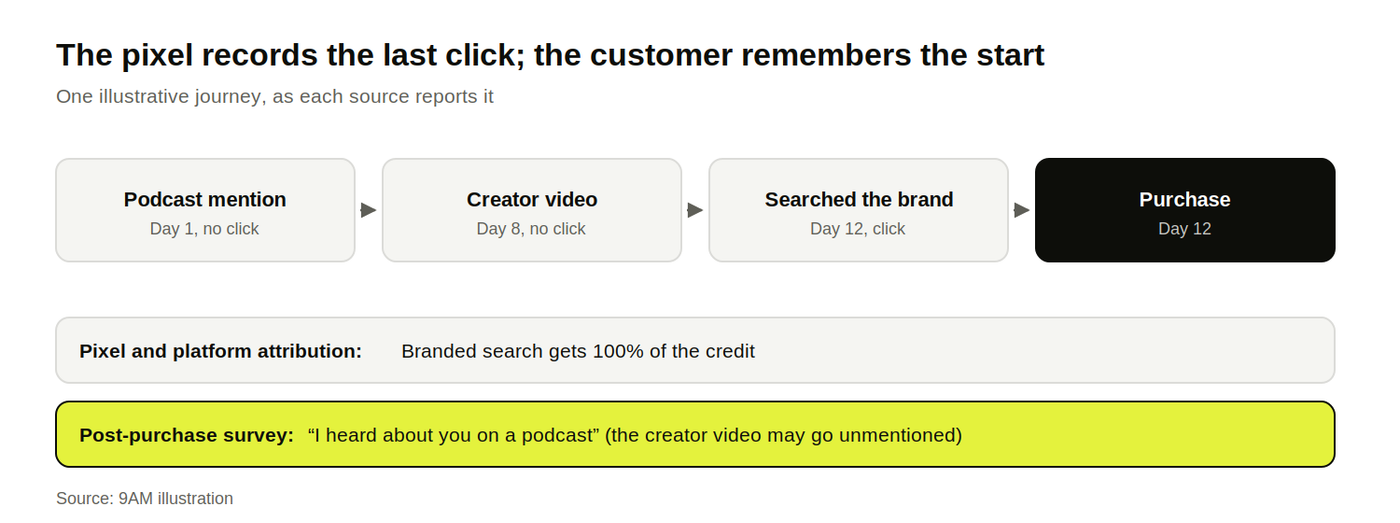
A customer hears about your brand on a podcast, sees a creator mention it a week later, and buys after searching your name. The pixel records a branded search. The podcast and the creator never show up.
That gap is getting bigger as discovery moves to channels without a click.
When Fairing audited brands' post-purchase surveys, 4 out of 5 were missing a real investment from their answer options entirely, so even the survey couldn't see it.
This guide covers what customer answers can and can't tell you about attribution, which questions and answer options to use, and how to read survey data next to platform numbers without mistaking it for lift.
P.S. If you want help setting up the survey, the coding, and the comparison with your ad platforms, our analytics team does this for DTC brands.
TL;DR
A post-purchase survey asks buyers how they found you, right after checkout. It's the best tool for channels pixels can't see: podcasts, creators, word of mouth, TV, and AI assistants.
Survey answers show what customers remember. They don't show what caused the purchase, so survey share is never incremental lift.
Ask discovery ("How did you first hear about us?") separately from the purchase trigger ("What led you to buy today?").
Randomize answer options, keep them current with your media plan, and follow up to the creator or show.
Read survey share next to platform attribution and incrementality tests; where they disagree is where to test next.
Our view, before we jump in: we treat social, creators, and conversation as a sensor for where demand starts, and media buying as the lab that proves what earns the next dollar. A post-purchase survey is how that sensor reports back for channels a pixel will never see. It's a strong signal and a weak verdict. Teams that use it to decide what to test grow faster; teams that use it to declare winners end up funding whatever customers happen to remember.
What Is a Post-Purchase Survey?
A post-purchase survey is a short set of questions shown to customers right after they buy, usually on the order confirmation page. For attribution, its core question is "How did you hear about us?", generally shortened to HDYHAU.
The answers are a form of self-reported attribution: the customer says what brought them to you. Because customers give this information directly and on purpose, it's usually called zero-party data.
You can run the survey in three places:
Thank-you page: shown at checkout, while the purchase is fresh. This is where most attribution surveys live.
Email: sent hours or days later, with room for more questions and lower response.
SMS: a single question by text, useful for mobile-heavy audiences.
This guide covers the survey as an acquisition measurement tool. Questions about delivery, satisfaction, and repeat purchase belong to the retention side, which we cover in our guide to post-purchase moments.
What Post-Purchase Survey Answers Can and Cannot Tell You
Post-purchase survey answers tell you which channels customers remember and credit for finding you. They can't tell you whether those channels caused the purchase, which is the question budget decisions actually need answered.
What Survey Answers Can Tell You
Surveys are strongest exactly where tracking is weakest.
Three things a survey adds:
Channels without a click. Podcasts, creator content, TV and connected TV, print, word of mouth, and AI assistants rarely leave a trackable path. Triple Whale now tells merchants to add an AI assistant answer option because many customers never click through from those tools.
The consideration window. Asking when someone first heard of you shows how long the journey runs, which tells you how much short attribution windows are missing.
Placement-level detail. A follow-up question can name the creator, show, or episode. Fairing reported 49% more complete placement-level responses in early tests of its rebuilt survey, at the same response rates.
What Survey Answers Cannot Tell You
Surveys are weakest wherever the question is about cause:
Incrementality. A customer who credits a podcast might have bought anyway. Only a test with a control group shows what the channel added.
The full journey. People tend to name the most memorable or most recent touch. Earlier exposures, and ads they saw but didn't notice, get underreported.
Everyone's answer. Customers who skip the survey may have found you differently from those who answer, so the results describe respondents; they do not reflect all buyers.
Which kind of search. "Google" can mean a paid ad, an organic result, or a branded search after hearing about you somewhere else.
Question you want answered | Can a survey answer it? | Better method |
|---|---|---|
Which channels do customers remember? | Yes | Survey |
Is a podcast or creator reaching buyers at all? | Yes | Survey with placement follow-up |
How long do customers consider before buying? | Mostly | Survey, checked against path data |
Did this channel cause extra sales? | No | Holdout or geo-lift test |
How much budget should a channel get? | Partly | Survey plus incrementality plus MMM |
Which ad or keyword converted? | No | Platform and analytics attribution |
Discovery Questions vs Purchase-Trigger Questions
A discovery question asks where the customer first heard of you; a purchase-trigger question asks what made them buy today. They measure different moments, and mixing them in one question blurs both.
The discovery question, the classic HDYHAU question, works well for new customers and young brands.
For returning customers, or for a brand people have known for years, we recommend the trigger question: asking how someone heard about Dockers gets weak answers, while asking what led them to the store today gets useful ones.
A third question adds timing. "When did you first hear about us?" shows the consideration window, and a long window means platform ROAS is probably undercounting the channels that started the journey.
Question | What it measures | Who should see it | Response options |
|---|---|---|---|
How did you first hear about us? | First discovery channel | New customers | Channel list, then a placement follow-up |
What led you to our store today? | Purchase trigger | Returning customers, well-known brands | Channel list plus email, SMS, and "I'm an existing customer" |
When did you first hear about us? | Consideration window | All customers, or new customers only | Today, a few days ago, over a week ago, over a month ago, over a year ago |
On the confirmation page, two questions is a sensible ceiling for attribution. Put discovery first for new customers, and only add the timing question if you'll use it to judge attribution windows.
If you’re more of a visual learner, you can find more useful questions here:
How Did You Hear About Us Answer Options
Good HDYHAU answer options cover every channel you spend on, in words customers use, with a follow-up that names the specific creator, show, or placement. The list is a living document: a campaign that isn't on it ends up in "Other" or credited to whatever channel sounds closest.
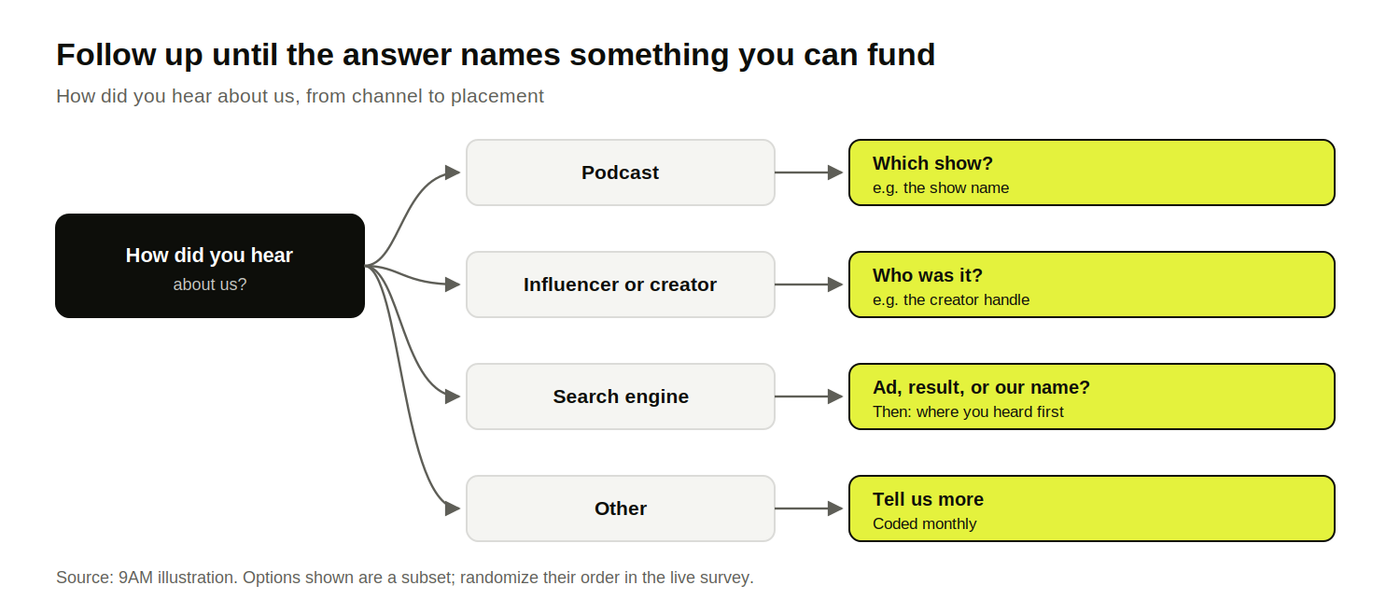
A solid starting set for a DTC brand:
Search engine (Google, Bing)
Facebook or Instagram
TikTok
YouTube
Podcast, with a follow-up for the show
Influencer or creator, with a follow-up for the name
AI assistant (ChatGPT, Perplexity, Gemini)
TV or streaming
Friend or family
News article or blog
Saw it in a store or in person
Can't remember
Other, with a free-text box
Three rules keep the answers usable:
Randomize the order. People favor options near the top of a list. Triple Whale randomizes its attribution answers by default for this reason; keep "Other" and "Can't remember" fixed at the end.
Update the list when the media plan changes. Add a new creator or show before it launches, so its answers don't land in "Other."
Keep "Can't remember." A forced guess is worse data than an honest blank.
How to Run a Post-Purchase Survey for Attribution, Step by Step
Running a post-purchase survey for attribution takes seven steps, from naming the decision it feeds to comparing its answers with platform data. Most of the work sits after launch, in coding and joining the answers.
Download the post-purchase survey attribution template (Excel).
It includes the question set and answer options, a coding sheet for "Other" answers, and a comparison sheet that sets survey share against platform-attributed share by channel and flags the gaps.
Step 1: Name the Budget Decision the Survey Feeds
Write down the decision the survey will inform before writing a question. "Should we renew the podcast sponsorship?" and "Is creator content reaching new customers?" need different follow-ups from "Which channel should get next quarter's extra budget?"
A named decision also tells you which channels need placement-level answers. If you're weighing creator renewals, the follow-up has to name the creator, a point we cover in our guide to performance influencer marketing.
Step 2: Write the Discovery and Trigger Questions
Use the discovery question for new customers and the trigger question for returning ones, with the answer options from the section above. Keep the wording plain and keep it the same over time, because a reworded question starts a new data series.
Step 3: Place the Survey on the Thank-You Page
Put the attribution question on the order confirmation page, as the first question. Response rates there are far higher than by email: KnoCommerce reports an average response rate of 45%* on its post-purchase surveys, against 10 to 15% for typical email surveys.
* Side note: Both figures come from a survey vendor, so treat them as a guide.
More questions can follow on the same page, but attribution goes first, while attention is highest.
Step 4: Track Response Rate and Who Skips the Survey
Track the response rate every week, and compare respondents with non-respondents on what you already know: new versus returning, order value, device, and discount use. If respondents skew toward one group, the survey shares lean the same way.
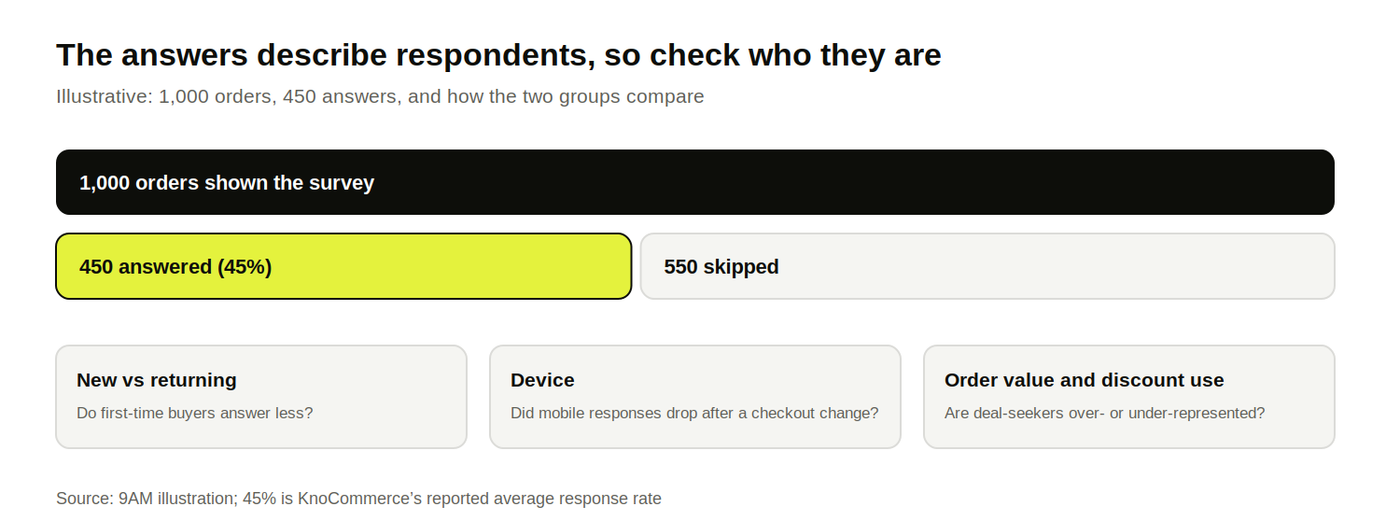
You also need enough answers.
Triple Whale's guidance for its own model is roughly 370 responses for a shop with about 10,000 customers over the period you're analyzing. Fewer than that, and small channels will swing from week to week on a handful of answers.
Step 5: Code Open-Ended and Other Answers
Map every free-text and "Other" answer to a fixed list of channels and placements, using the same rules every time. "Saw it on a reel from Jess" becomes Instagram, creator, Jess.
Keep the coding rules in one sheet, and review "Other" at least monthly. A growing "Other" share is usually a campaign missing from the answer list.
Step 6: Join Answers to Order and Customer Data
Connect each answer to its order so you can split survey share by new and returning customers, order value, and later repeat purchases. A channel that customers credit for small first orders and few repeats is worth less than its share suggests.
This is also where survey data meets your acquisition metrics: survey-informed channel CAC is more useful when it's read alongside blended CAC and paid CAC.
Step 7: Compare Survey Share With Platform Attribution
Put each channel's share of survey answers next to its share of platform-attributed conversions for the same period and the same customers. The gaps between the two columns are the output; the next section explains how to read them.
How to Read Survey Data Next to Platform Attribution and Incrementality
Read survey data as one of three views of the same customers: what customers remember (survey), what tracking recorded (platform and analytics attribution), and what spend actually added (incrementality tests). Where two views agree, you have a stronger signal. Where they disagree, you have your next test.
Pattern | What it likely means | What to do next |
|---|---|---|
High survey share, low platform share | A channel without clicks is reaching buyers: podcast, creator, TV, word of mouth | Run a geo-lift or holdout test before moving budget |
Low survey share, high platform share | Tracking is crediting a late touch: retargeting, brand search, email | Test incrementality on that channel; check what last-click is claiming |
High on both | The channel is visible to customers and to tracking | Scale in measured steps and keep testing |
Low on both | The channel isn't registering with buyers | Review creative and targeting, or cut spend |
The second row is the one platform reports hide most frequently. Our guide to the last-click attribution problem covers why retargeting and brand search tend to look better in dashboards than they are.
A survey share can point in the same direction as a test without matching it.
In one case published by measurement vendor WorkMagic, survey answers credited Meta with 9% of orders. An incrementality test put its contribution at 12%, while Meta reported 25%. That's a useful comparison, and it came from running the test.
The rule that matters most: never report survey share as incremental lift.
"18% of customers said podcast" means 18% remember a podcast. Whether the podcast added 18% of sales, 5%, or 25% is a question for a geo-lift test.
Post-Purchase Survey Mistakes That Skew Attribution
Most survey attribution errors come from how the question is set up and how the answers are read. These are the ones we see most when we audit survey programs:
Mistake | What it does to the data | Fix |
|---|---|---|
Answer options in a fixed order | Inflates whatever sits at the top | Randomize, with "Other" and "Can't remember" last |
Answer list not updated for new campaigns | Live campaigns land in "Other" or a neighboring channel | Add options when a campaign launches |
Question shown to one segment, read as the total | New-customer answers get treated as all customers | Label the segment on every report |
Comparing periods with different response rates | A change in who answers looks like a change in channels | Check the response rate and respondent mix first |
Reading "Google" as paid search | Search answers get credited to ads without knowing what the customer clicked | Ask whether they clicked an ad, a regular result, or can't remember |
Ignoring "Other" | Emerging channels stay invisible | Code "Other" monthly with fixed rules |
Calling survey share lift | Budget follows memory | Confirm with incrementality tests before big shifts |
The response-rate row deserves extra care.
A new checkout layout or app can drop responses from one device type overnight, and the channel mix will move with it even though nothing about your marketing changed.
Turn Customer Answers Into Better Media Decisions with 9AM
A post-purchase survey earns its place when it changes what you test and fund next. Customers point you to the podcasts, creators, and conversations a pixel will never see, and the work is turning those answers into clean, coded data that sits next to platform numbers and test results.
At 9AM, our media buying team relies heavily on analytics.
We set up the questions and answer options, code the responses, join them to order data, and use the gaps between survey and platform attribution to decide which channels to test with geo-lift or holdouts.
Book a strategy call today so we can figure out where customer answers and platform data disagree!
FAQs
What response rate do you need before using survey data in budget decisions?
Look at the number of answers and who gave them before the percentage. A few hundred answers over the period, spread across new and returning customers and across devices, is a workable floor for channel-level shares. Small channels need more, because a handful of answers can swing their share week to week.
Should returning customers see the HDYHAU question?
Show returning customers a purchase-trigger question ("What led you to our store today?") and skip the discovery question. Their discovery happened long ago and is hard to recall, while the trigger is fresh. Keep the two series separate in reports, and use an attribution model audit to see how each lines up with platform data.
How do you handle customers who answer "Google" when they searched your brand name?
Separate what they searched from what they clicked. A brand-name search can end with an ad click or an organic click, so don't put those in the same answer list. To separate paid from organic, ask whether they clicked an ad, a regular result, or can't remember. To trace discovery, ask where they first heard of you.
Can a post-purchase survey measure discovery through AI assistants?
Yes, and it's one of the few ways to measure it today, because many people read an AI answer and then visit the site directly. Add an option such as "AI assistant (ChatGPT, Perplexity, Gemini)" and track it over time. Treat the trend as a signal and confirm its effect with tests before shifting budget.
About Mustafa Alkhtab
Mustafa Alkhtab is Head of Performance Media at inBeat, where he oversees paid media and performance creative results across the agency's accounts. Before inBeat, he built growth programs for ecommerce, lead generation, and mobile app businesses in international markets. He writes about media buying, measurement, and conversion rate optimization.
More from Mustafa Alkhtab