Value-Based Bidding: Is Your Revenue, Profit, or Lead Data Ready?
Value-based bidding in Google Ads only works when your values are reliable. Downloadable readiness scorecard included + when not to move.

· 20 min read
Most Google Ads accounts bid toward the conversion the platform can count: a purchase, a form fill, a call. That works until the cheap conversions and the valuable ones stop being the same people.
Dermapure, a clinic brand whose Google Ads ran through the agency Glassroom, hit that wall. Its leads grew by 550% with zero revenue growth, because bidding optimized for form submissions with no signal about which leads became paying patients.
Value-based bidding fixes that, provided the values you send are good enough to steer it. This guide covers how it works, which value to bid on, a scorecard for checking your data, and the switch step by step.
P.S. If you'd rather hand the bidding and the data work to one team, our media buying team runs Google Ads on revenue, profit, and CRM outcomes.
TL;DR
Value-based bidding tells Smart Bidding what each conversion is worth, so it pays more for the auctions likely to bring more value.
Google offers two strategies: Maximize conversion value and Target ROAS.
Bid on the value closest to profit that you can report within about a week of the click.
Score six things before you switch: value spread, volume, delay, coverage, proxy accuracy, and stability.
Switch through an experiment, and judge it on revenue or profit confirmed outside Google Ads.
Our view, before the mechanics: we run media buying, creative, and measurement as one loop, because each one changes the others. Smart Bidding learns from whatever number you hand it, quickly and without asking where the number came from. That makes the conversion value a measurement decision long before it becomes a bidding setting. When the value tracks real profit, the bidder compounds it. When it doesn't, the bidder compounds the error, and spend that teaches the account the wrong lesson is the most expensive spend there is.
What Is Value-Based Bidding in Google Ads?
Value-based bidding is a group of Smart Bidding strategies that optimize toward the total value of your conversions, within a budget or a return target.
Conversion-based bidding (maximize conversions and target CPA) works differently. It counts every conversion as one unit and tries to buy as many as possible at a given cost.
The value you report can be one of two kinds:
Observed values: what actually happened, like an order total or a signed deal amount.
Proxy values: an estimate of what a conversion is worth, like a lead score or an expected value per sales stage.
Google accepts both, as long as you report two or more unique, non-zero values to the conversion goal you bid on.
A naming note for 2026 and beyond: Google is relabeling bid strategies, so "Maximize conversion value with a Target ROAS" now appears as "Target ROAS." The bidding behavior is the same.
Value-based bidding runs on Search, Shopping, Performance Max, Demand Gen, and Video campaigns. At auction time, the bidder reads signals like device, location, time of day, query, and audience signals alongside your value history.
Side note: Meta has its own version, called value optimization, but this guide covers Google Ads only.
How Does Value-Based Bidding Work?
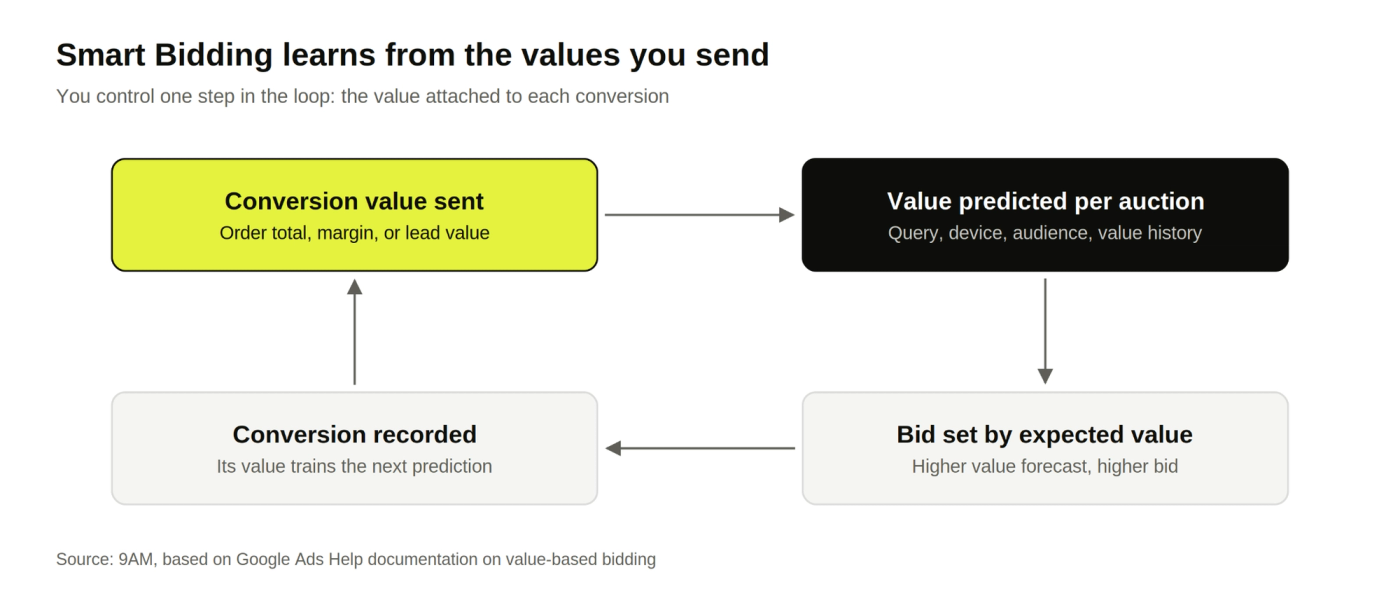
Value-based bidding works by turning each auction into a forecast of value. You report a value with every conversion, Smart Bidding learns which signals come before high-value outcomes, and it bids more where the predicted value is higher.
Here's the difference in practice.
Say two searches each have a 5% chance of converting. One searcher matches the profile of buyers whose average order value is $40; the other matches buyers who spend $400.
Target CPA sees two equal chances of one conversion and bids about the same on both.
Target ROAS sees $2 of expected value in the first auction and $20 in the second, so it can bid up to 10 times more for the second one.
The loop then repeats.
Every new conversion and its value goes back into the model, so the quality of the values decides what the bidder learns next.
Two setup details shape what Google actually sees:
Dynamic or static values. Google lets you send a different value per conversion, like a cart total, or a fixed value per conversion action, like $300 for every qualified lead. Dynamic values give the bidder more to learn from.
Primary and secondary actions. Primary conversion actions feed bidding when their standard goal is selected for the campaign. Secondary actions normally serve reporting only, but they also feed bidding if included in a custom goal used by the campaign.
What Are the Two Types of Value-Based Bidding Strategies?
The two types of value-based bidding strategies in Google Ads are Maximize conversion value and Target ROAS. Both chase value; the difference is whether you put an efficiency floor under the spend.
Maximize Conversion Value
Maximize conversion value spends the full daily budget to bring in as much total value as it can. There's no return target, so the budget is the only limit.
Use it to ramp up a campaign that's new to value bidding, or when hitting a revenue number matters more than a set ROAS. Watch efficiency closely, because nothing stops it from buying expensive value late in the day.
Pro tip: The video below helps you choose between maximize conversions and maximize conversion value:
Target ROAS
Target ROAS brings in as much value as it can at the average return on ad spend you set. A 400% target means $4 of reported conversion value for every $1 of spend, on average.
Google's own guidance is to keep the budget unconstrained when you set a ROAS target and to skip extra limits like CPC caps. Two 2026 changes matter here:
Budget-limited campaigns now track the target. Since August 17, 2026, Target ROAS campaigns marked "Limited by budget" deliver closer to the stated target, and Smart Bidding reacts to target changes in real time.
Profit can be the goal. Google offers a profit optimization goal (beta) for Performance Max and Standard Shopping, built on cart-level conversion data and cost of goods sold in Merchant Center.
Here's how the four main strategies line up:
Strategy | Optimizes for | Limit | Use it when | Main risk |
|---|---|---|---|---|
Maximize conversions | Number of conversions | Daily budget | Conversions are worth about the same | Buys the cheapest conversions |
Target CPA | Number of conversions | Average cost per conversion | You need a predictable acquisition cost | Pays the same for a $40 and a $400 sale |
Maximize conversion value | Total conversion value | Daily budget | Values differ and you're building history | Efficiency can drift without a target |
Target ROAS | Total conversion value | Average return on ad spend | Values differ and you need a set return | A target set too high starves volume |
Why Value-Based Bidding Beats Conversion-Based Bidding When Conversion Values Differ
Conversion-based bidding pays the same for every conversion, so it drifts toward the cheapest ones. Value-based bidding pays more only where it expects more value back, which keeps cost per acquisition from rewarding low-value customers.
The published results show what that's worth when the values hold up:
Dermapure (lead generation): after moving from lead volume to a 12-month expected lifetime value per patient, conversion value rose 210% and CPA fell 54%.
Google's cross-account data: advertisers who moved from Target CPA to Target ROAS saw a median 14% increase in conversion value at a similar ROAS.
Citibanamex (banking): value-based bidding lifted credit card bookings by 27% and cut the cost per booked card by 7%, per Google's best-practices guide.
Profit bidding (retail): Shopping advertisers using gross profit optimization saw an average 15% lift in campaign profit over revenue-only bidding.
Treat these as upper-bound examples.
All four come from Google, and each one rests on values that tracked real business outcomes.
Feed the same strategy a value nobody has checked, and it will optimize just as hard in the wrong direction.
Which Value Should Guide Bidding: Revenue, Profit, or Lead Value?
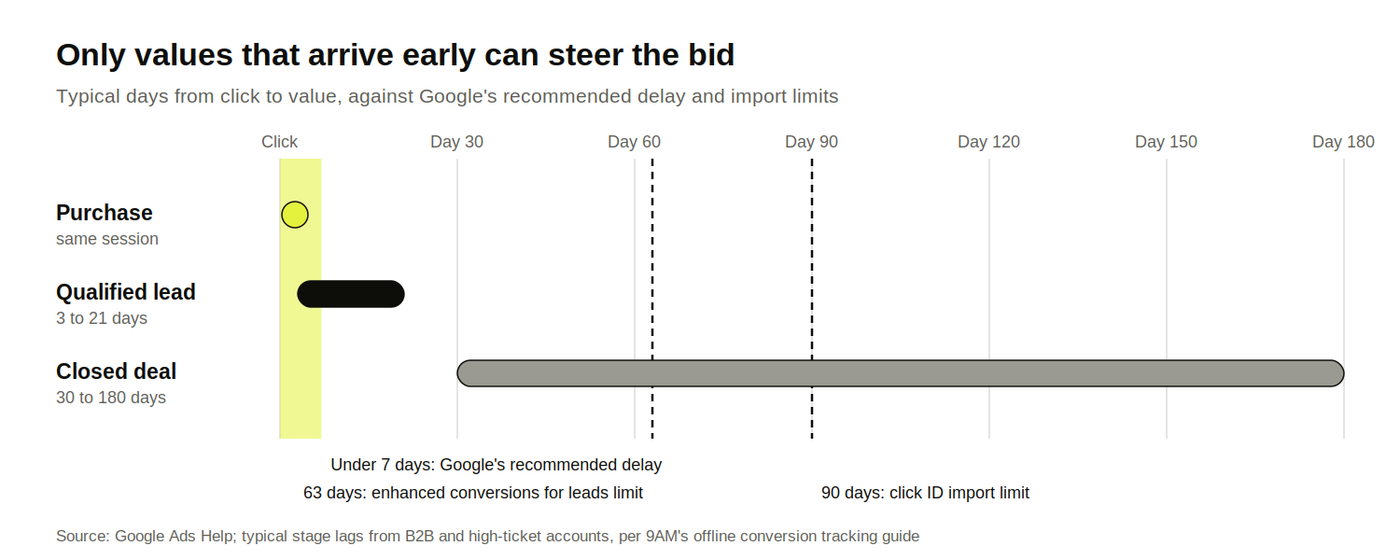
Bid on the value closest to profit that you can report reliably within about a week of the click. Closer to profit means the bidder chases what pays the bills; a week matters because Google recommends conversion delays under 7 days.
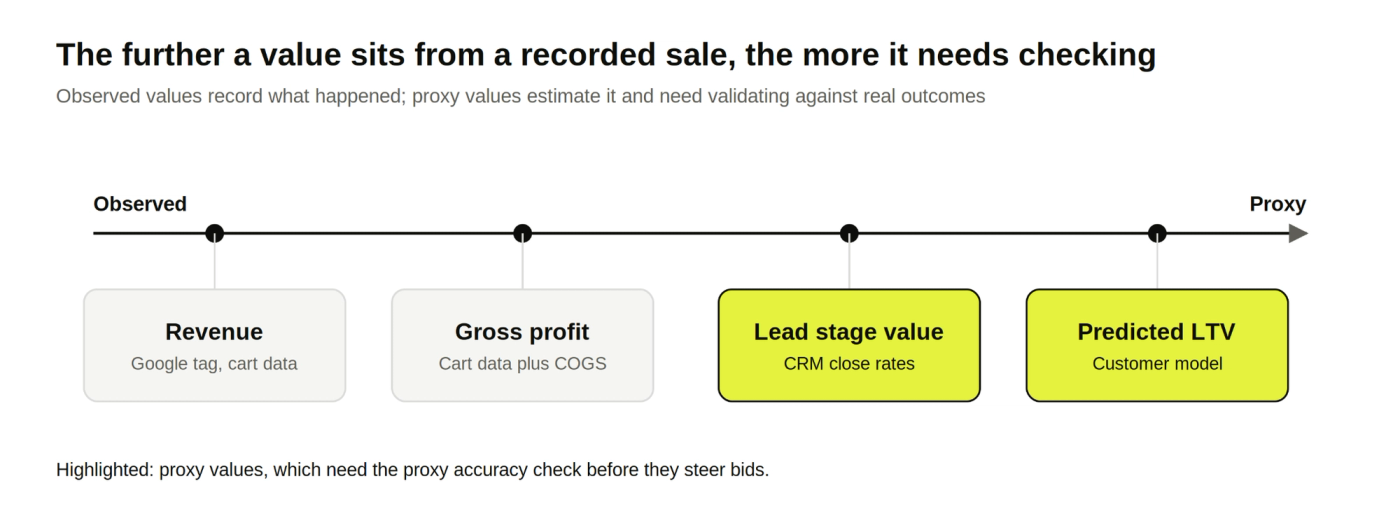
Every option below is either an observed value or a proxy value. Observed values carry less risk. Proxy values arrive sooner but need checking against real outcomes, which the scorecard in the next section covers.
Revenue as the Conversion Value
Revenue is the default for ecommerce: the order total passes through the Google tag or cart data at checkout, with no extra work. It's observed, fast, and hard to get wrong.
It misleads when margins or return rates differ a lot by product, because a $200 order at 15% margin looks better to the bidder than a $150 order at 60%. Conversion value rules can adjust values by location, device, or audience, but they can't fix a margin gap between products.
Profit as the Conversion Value
Profit values tell the bidder what each order actually earns. Google supports this two ways:
Gross profit from cart data: send conversions with cart data and add cost of goods sold in Merchant Center, and Google calculates gross profit per order.
Margin-based values you calculate: send revenue minus product, shipping, fee, and return costs as the conversion value, usually server-side.
The second route is the most precise, and the one we build when margins vary across the catalog. Our guide to contribution margin for paid media shows how to calculate that number per order.
Lead Values for Lead Generation
Lead-gen accounts rarely have an observed value at conversion time, so they bid on proxies. The usual setup gives each qualified sales stage an expected value, based on what a lead is worth at that stage, and imports it from the CRM.
Remember: The proxy is only as good as the CRM behind it.
Average deal size, close rates, and stage definitions all need to come from real pipeline data, refreshed every quarter. The full stage-value method and import setup sit in our guide to offline conversion tracking.
Predicted Lifetime Value
Predicted lifetime value (pLTV) gives a new customer the value you expect them to bring over months or years. It suits subscriptions and repeat-purchase brands whose first order hides most of the value.
It's also the riskiest value to bid on, because it's a forecast on top of a forecast. Before it steers bids, the model needs mature cohorts behind it, which we cover in how much LTV data you need. A simpler middle step is Google's new customer value setting, which adds a fixed premium for first-time buyers.
Value type | Observed or proxy | Comes from | Typical delay | Best for | Main risk |
|---|---|---|---|---|---|
Revenue | Observed | Google tag, cart data | Same session | Ecommerce with similar margins | Rewards high-revenue, low-margin orders |
Gross profit or margin | Observed | Cart data plus COGS, server-side events | Same session to 1 day | Ecommerce with uneven margins | Stale cost inputs |
Lead stage value | Proxy | CRM via offline import | Days to weeks | Lead generation, B2B | Close rates that drift |
Predicted LTV | Proxy | Customer model, data warehouse | Same session to days | Subscription, repeat purchase | Model not checked against cohorts |
How to Score Value Data Readiness Before You Switch
Your value data is ready for value-based bidding when it passes six checks: value spread, conversion volume, conversion delay, value coverage, proxy accuracy, and value stability. One failed check is enough to wait, because the bidder will learn from the weakest part of the data.
Run the checks on the single conversion action you plan to bid on, over the last 90 days.
Value Spread
Value spread is how much your conversion values differ from each other. Google's floor is two or more unique values, but that floor only confirms the setup works.
To check it, sort the last 90 days of conversions by value and compare the average value of the top 20% with the average of the bottom 20%. If the two averages sit close together, value bidding will behave much like Target CPA, with more setup and more risk.
Conversion Volume
For Search and Shopping, Target ROAS requires at least 15 conversions in the past 30 days at the conversion-tracking level. Other campaign types have different requirements, so check eligibility for the campaign you plan to switch.
For example, Demand Gen requires 50 conversions in 35 days within the campaign, including 10 in the past seven days, or 100 across the account’s Demand Gen campaigns in 35 days.
Practitioners usually want 30 to 50 a month before trusting the bidder's judgment.
Count only the conversions that carry the value you plan to bid on. A lead-gen account can have 300 form fills and 12 qualified leads a month, and only the 12 count here.
Conversion Delay and Value Freshness
Conversion delay is the time between the click and the moment Google receives the conversion with its value. Google recommends keeping it under 7 days and uploading offline conversions daily.
Check what share of your final conversion value arrives within 7 days of the click, using the days-to-conversion data in Google Ads attribution reports. If no value lands in that first week, Google warns that the ramp-up can take several months.
Pro tip: Moving events to server-side tracking is generally the fastest way to cut that delay.
Value Coverage
Value coverage means every primary conversion carries a real, non-zero value. Gaps teach the bidder that some conversions are worth nothing, and it adjusts accordingly.
Pull the share of conversions with a zero or default value. Google advises against bidding on zero-value conversions and against uploading zeros you plan to restate later, unless you use conversion adjustments.
Proxy Value Accuracy
Proxy accuracy only applies to estimated values: lead scores, stage values, and pLTV. The check is whether the estimate ranks segments in the same order that real money does.
Rank your campaigns, lead sources, or product lines twice over the last 90 days: once by average assigned value, once by realized revenue or profit per conversion. If the two rankings disagree on the top or bottom segments, the proxy is steering budget in the wrong direction.
Value Stability
Value stability means the value definition and scale haven't changed for at least 4 weeks or 3 conversion cycles, whichever is longer. Google's transition checklist asks for that much consistent value data before you switch.
Any change resets the clock: moving from revenue to profit, updating close rates, or adding a new value rule.
If several checks come back red, our analytics team can audit the value data and fix the pipeline before the bidding changes.
Readiness Scorecard for Value-Based Bidding
Steal this scorecard. It puts the six checks above into one table you can run on any campaign before the switch, in about the time it takes to pull a 90-day report. Score every row; a single "Not ready" means you wait and fix that row first.
Download the readiness scorecard template (Excel).
It has a fill-in tab with a status dropdown for each check and a verdict that updates on its own, plus a filled-in example from a lead-gen account bidding on qualified leads.
Check | How to measure | Ready | Not ready | Fix before switching |
|---|---|---|---|---|
Value spread | Top 20% vs bottom 20% average value, 90 days | Clear gap between the two | Averages close together | Add value detail: margin, lead stage, product line |
Conversion volume | Valued conversions at the bid action, 30 days | 30+ | Under 15 | Bid on an earlier stage or consolidate campaigns |
Conversion delay | Share of value received within 7 days of click | Most of it | None of it | Daily uploads, earlier stage, server-side events |
Value coverage | Share of conversions with zero or default value | None | Some | Assign values or remove those actions from the goal |
Proxy accuracy | Segment rank by assigned value vs realized value | Same order | Top or bottom segments swap | Recalibrate the score from recent CRM data |
Value stability | Weeks since the value definition last changed | 4+ weeks or 3 cycles | Changed recently | Hold the definition and keep collecting |
When Value-Based Bidding Is the Wrong Choice
Stay on Target CPA or Maximize conversions when your conversions are worth about the same, when volume is thin, or when values arrive too late to steer bids. In those cases value bidding adds setup and risk with little for the bidder to learn.
The scorecard above tells you whether the data is ready. This table covers the business situations where the answer is "not yet" or "not at all":
Situation | Why value bidding struggles | Use this strategy | What would change the call |
|---|---|---|---|
Conversions are worth about the same | No value difference to bid on | Target CPA | New products, tiers, or lead types with different values |
Fewer than 15 valued conversions in 30 days | Too little data to predict value | Maximize conversions | Bidding on an earlier stage or merging campaigns |
Sales cycle with no stage inside the 90-day import window | Values arrive after the click can be matched | Target CPA on qualified leads | A qualified stage that lands within weeks of the click |
New account with no conversion history | Nothing to learn from yet | Maximize conversions | 4+ weeks of conversions with values |
Values finance wouldn't sign off on | The bidder optimizes toward a guess | Target CPA | Values rebuilt from CRM or margin data |
Account split into many small campaigns | Each campaign sees too few valued conversions | Consolidate first, then value bidding | Fewer campaigns sharing one conversion goal |
Pro tip: The last row is the one we see most in audits.
Splitting campaigns by program, region, or match type leaves each one with a handful of valuable conversions, and the bidder can't learn from a handful.
Consolidating campaigns around one conversion goal is usually the first change our Google Ads team makes before any switch to value bidding.
How to Switch a Google Ads Campaign to Value-Based Bidding, Step by Step
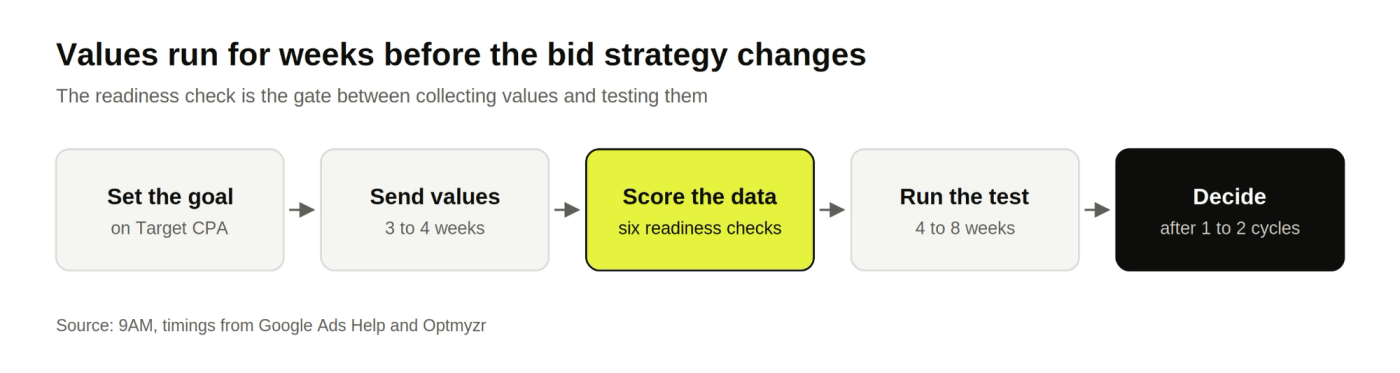
Switch in seven steps: change the conversion goal first, send values while the current strategy keeps running, check the data, then move to value bidding through an experiment. Changing the goal and the strategy on the same day leaves you unable to tell which one moved the results.
Step 1: Choose One Conversion Stage to Bid On
Pick a single stage of the lead-to-sale journey as the bid goal, as Google recommends. Balance accuracy against delay: a purchase or closed deal carries the truest value, and a qualified lead arrives sooner.
If the stage itself is changing (say, from form fills to qualified leads), switch the goal while you're still on Target CPA. Move to value bidding only after the new goal has settled.
Step 2: Set Primary and Secondary Conversion Actions
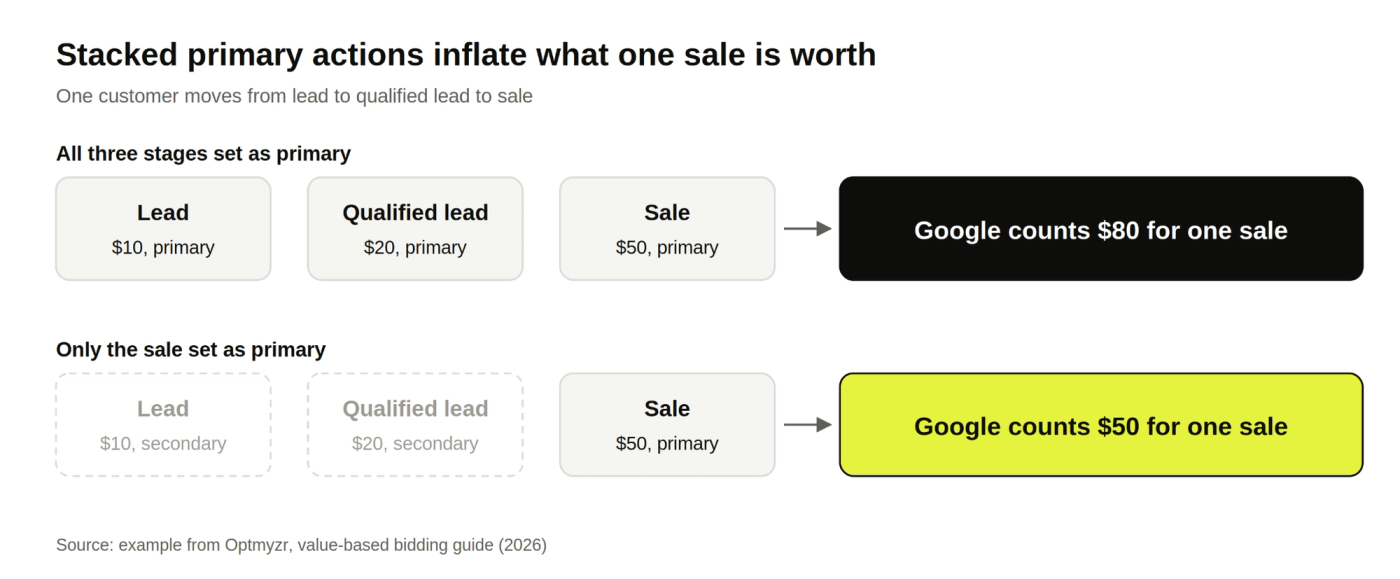
Make the chosen stage the only conversion action used for bidding. For standard goals, set that action to primary and every other stage to secondary.
If the campaign uses a custom goal, remove the other stages from that goal too: included actions feed bidding even when marked secondary.
Remember: Counting multiple stages of the same journey can inflate the total value reported for one sale.
Optmyzr gives a clear example: a lead worth $10, a qualified lead worth $20, and a sale worth $50, all set as primary, report $80 for a single sale. The bidder then overpays for every path that looks like that one.
Step 3: Send Values on the Current Strategy for 3 to 4 Weeks
Start sending values while the campaign stays on Target CPA or Maximize conversions. Google's guidance asks for 3 weeks or 1 to 2 conversion cycles in one place and 4 weeks or 3 cycles in another; use the longer window.
Don't backfill historical values. Google advises against it, because a sudden block of old data distorts what the bidder treats as recent.
Step 4: Run the Readiness Scorecard
Score the values collected in step 3 against the six readiness checks. Fix any red check before going further, and restart the clock if the fix changes the value definition.
Step 5: Pick the Strategy and Set the Starting Target
Choose the strategy based on what the campaign needs to prove:
Maximize conversion value when you're ramping up and the budget is the real limit.
Target ROAS when you need a set return. Start from the campaign's actual ROAS over the last 30 days, and set the target slightly below it so the bidder can still enter auctions.
With a ROAS target, keep the budget unconstrained and remove CPC caps or other limits.
Step 6: Launch as a Campaign Experiment
Run value bidding as a Google Ads campaign experiment with a 50/50 split against the current strategy. Both arms need enough conversions on their own, so plan for roughly double the volume and 4 to 8 weeks of runtime.
Keep the ROAS and CPA targets in line with each other across the two arms, or the test ends up comparing targets. Before reading results, confirm the traffic actually split as planned, using the checks in our guide to sample ratio mismatch.
Step 7: Read Results After 1 to 2 Full Conversion Cycles
Wait at least one to two full conversion cycles before you judge the experiment, then compare the two arms on value (do not compare them on cost per conversion). Value bidding is expected to buy fewer, more valuable conversions, so a higher CPA can be a good sign.
Leave out the most recent days, whose conversions haven't fully arrived yet. If the target needs to move, check Google's bid simulator first: lowering a ROAS target usually buys more total value, and raising it buys efficiency at the cost of volume.
How to Measure Value-Based Bidding Performance After Launch
Measure value-based bidding on value per dollar confirmed outside Google Ads, then check whether that value was incremental. Platform ROAS by itself can't settle it, because it's built from the values you sent.
Work through three layers:
Reconcile with the source of truth. Compare the conversion value Google reports against revenue or profit in your store or CRM for the same weeks. Platform-reported value ROAS uses the values you send, which can drift from the revenue customers actually paid. Our attribution model audit walks through that reconciliation.
Check incrementality. A higher ROAS can still mean the bidder found buyers who would have converted anyway. A holdout or a geo-lift test shows how much value the campaign actually added.
Monitor the values themselves. Track average value per conversion week over week, the share of zero-value conversions, and failed offline uploads. Values degrade quietly, and the bidder keeps optimizing toward whatever arrives.
When something looks off, this table points to the likely cause:
What you see | Likely cause | What to check |
|---|---|---|
Reported ROAS rises, CRM revenue stays flat | Values don't match realized revenue | Value per conversion in Google Ads vs CRM, same cohort |
Conversion value jumps overnight | Duplicate counting or stacked primary actions | Primary action list and order ID deduplication |
Volume drops sharply after the switch | ROAS target set too high | Bid simulator and 30-day actual ROAS |
Average value per conversion falls week over week | Stale close rates or costs, or a broken upload | Last value recalibration date, upload diagnostics |
Lead-gen campaign spends but imports stay flat | Offline import stopped or identifiers missing | Upload history, click ID coverage in the CRM |
One campaign wins, the total doesn't move | Budget shifted between campaigns | Account-level value and revenue |
Bid on Values You Can Trust with 9AM
Value-based bidding rewards the accounts with the best values. The bidder does the same work for everyone; what changes the result is whether revenue, profit, or lead values reflect what the business actually earns.
At 9AM, media buying and analytics sit in one team.
We define the value with your finance or sales team, check it against the scorecard, fix the pipeline that carries it, and run the switch as an experiment with a clear call at the end.
Book a strategy call and we'll review your conversion goals, the spread and delay of your current values, and which campaigns are ready for Target ROAS and which should stay on Target CPA for now.
FAQs
Can a lead-gen account with a 90-day sales cycle use value-based bidding?
Yes, if it bids on a stage that lands within a few weeks of the click, like a sales-qualified lead with an expected value. Closed deals that arrive after 90 days can't be matched to the click for bidding. Keep them for reporting and for recalibrating the stage values every quarter.
Should you send revenue or profit when margins differ by product line?
Send profit when the margin gap between product lines is wide enough to change which products you'd want to push. With similar margins, revenue gives the same ranking with less setup. If you can't calculate profit per order yet, a value rule or separate campaigns by margin tier is a reasonable stopgap.
What happens to a Target ROAS campaign when you switch values from revenue to profit?
The reported ROAS drops overnight, because every conversion value shrinks to its margin. Recalculate the target on the new scale before the switch, or the bidder will chase an impossible return and cut volume. Treat the change as a new test and restart the stability clock.
Does the August 2026 Smart Bidding change affect budget-limited Target ROAS campaigns?
Yes. Since August 17, 2026, Target ROAS campaigns limited by budget deliver closer to the stated target, where before they frequently beat it. If a budget-limited campaign's actual ROAS has been well above its target, review the target, because the gap is likely to close.
About Mustafa Alkhtab
Mustafa Alkhtab is Head of Performance Media at inBeat, where he oversees paid media and performance creative results across the agency's accounts. Before inBeat, he built growth programs for ecommerce, lead generation, and mobile app businesses in international markets. He writes about media buying, measurement, and conversion rate optimization.
More from Mustafa Alkhtab