
Amazon Fresh Advertising vs Amazon.com Ads: What Food Brands Must Verify Before Buying Media
Compare Amazon Fresh and Amazon.com ads for food brands: placements, costs, measurement and what to verify before you split your media budget.

· 20 min read
If you sell food, you already know it isn't bought one way. A refrigerated carton gets tossed into a quick grocery order. A 12-pack gets bought once, for the pantry.
That matters for your media. Two products with the same logo can still need two different plans: one built around Amazon Fresh, one built around Amazon.com.
This comparison covers where Fresh and Amazon.com ads run, which formats support each purchase, and how their strategies and costs differ. You'll also see what to verify before you choose a route or split your budget between them.
Our short answer: if your product is already ready to order on Amazon.com, start there. If it only sells through Fresh, start with Fresh.
One rule holds either way: don't pay to promote a pack shoppers can't buy yet.
TL;DR
In this guide, "core" means the regular Amazon.com store outside Fresh.
Your situation | Better fit | Check first |
|---|---|---|
Your product is already ready to order on Amazon.com | Core Amazon.com ads | The pack, the price and the page shoppers land on |
Your product only sells through Fresh | Fresh ads | Local stock and the exact Fresh format you're buying |
You sell a chilled single and a shelf-stable multipack | One Fresh plan and one core plan, each with its own goal | Which pack sits behind which offer |
Your stock keeps going in and out | Fix supply before you add media | Who owns replenishment and promo dates |
Three things to remember:
A shared ASIN can carry different offers. Map pack and purchase destination before you assign budget.
Set your acquisition ceiling from contribution before ads. That's the most you can pay for one order and still break even. Then compare it with what the campaign really costs.
Read Fresh and core on the same sales definitions. Only then test whether the spend added demand.
Amazon Fresh Advertising and Amazon.com Ads: How Each Route Works
Amazon Fresh ads support purchases inside the Fresh grocery experience. Core campaigns support eligible products through the wider Amazon store and its media placements. So before you pick a route, ask one question: which product are you selling, and where will the shopper order it?
A simple product test works in three steps:
Pick an eligible product.
Choose your targeting and set a budget.
The ad sends the shopper to a permitted destination.
Broader brand campaigns can introduce your product before anyone searches for it.
Say you sell plant-based milk in two versions: a refrigerated carton for the grocery shop and a shelf-stable 12-pack for the pantry. If the first has an eligible Fresh offer and the second an eligible Amazon.com offer, each needs its own media plan. We'll use this hypothetical brand as the running example in the rest of the guide.
Online Grocery Growth and Amazon's Platform Changes
More grocery spending is moving online. Brick Meets Click reported 20.7% year-over-year growth in US online grocery sales in Q3 2026. That makes it worth getting the route right.
Two recent updates are worth knowing:
Amazon's January 2026 grocery announcement outlined US physical Fresh store closures, while online Fresh stays and Same-Day perishables expand on core.
Its September 2026 Ads Agent announcement described a unified buying experience. Even so, your product's eligibility and the ad's destination still need to match your campaign.
Amazon Fresh vs Amazon.com Ads: Key Differences
The differences start with the product you promote and run all the way through placement, cost and measurement. Here's how they stack up:
What to compare | Fresh campaign | Core Amazon.com campaign |
|---|---|---|
Shopping context | A Fresh grocery purchase | The wider Amazon shopping journey, depending on placement |
Product selection | Eligible Fresh offers | Eligible core offers |
Availability | Check Fresh delivery coverage and local assortment | Check the offer's real delivery and fulfillment coverage |
Placements | Format-specific grocery placements; some Fresh-supporting media can run outside Fresh | Search, product pages and broader inventory, depending on format |
Creative | Product-led grocery units or permitted branded assets | Product ads, branded collections, video and wider media options |
Purchase destination | Set by the Fresh format and offer | Product pages, Brand Stores or other supported destinations |
Pricing | Depends on ad product and buying arrangement | Depends on ad product and buying arrangement |
Measurement | Confirm whether reports isolate the Fresh activity you meant to buy | Confirm which products and interactions get sales credit |
In our plant-based milk example:
The single carton fits a trial purchase inside a grocery order.
The 12-pack asks the shopper to spend more and find room in the pantry.
That changes what you need to explain. The multipack may need a clear price-per-carton or stock-up message. Treat those messages as hypotheses, and test them against real conversion and contribution.
The same logic applies to food: a single snack bar in a grocery basket and a pantry box can need different pack-value messages, even when they share a brand.
Ad Placements, Channels and Formats: Fresh vs Amazon.com
Fresh gives you a defined grocery context. Core Amazon.com gives you search and product-page placements alongside broader brand and media options. The trade-off is focus versus the range of ways you can reach and persuade a shopper.
For our plant-based milk brand:
A Fresh Responsive ecommerce ad (REC) can put the single carton in front of someone already shopping Fresh.
A core Sponsored Products ad can reach a search for a 12-pack of plant-based milk.
A Sponsored Brands video can show a breakfast smoothie before sending shoppers to an eligible core destination.
Don't assume Fresh stays on Fresh pages. Static Fresh DSP banners can run outside Fresh, but their permitted destinations differ from REC. Compare the actual formats below.
Fresh Placements and Grocery Display Formats
Amazon's Fresh display specifications list several routes. Their destination rules matter, because they decide how many steps sit between the ad and a purchase:
Fresh format | Published placement or access rule | Destination |
|---|---|---|
Responsive ecommerce ads (REC) | Fresh offers appear on Fresh pages; core offers follow core routing | The matching Fresh or core product page |
Static Fresh DSP banners | The specs also cover inventory outside Fresh | Fresh landing page, search string or Brand Store; no direct product-page link |
Fresh share-of-voice package | Priority placement within Fresh; managed service | Permitted Fresh landing destinations |
REC can use coupon, review or Shop Now variations. The specs still mark grocery add-to-cart as "coming soon," so confirm it's live on your account before you put it in a creative brief.
Choose the format around the purchase you need:
A product-focused unit can push one product.
A branded landing page can introduce the whole range.
Then match your promise to the destination, so a shopper who clicks the single carton lands on the single carton.
Amazon.com Search, Brand and Off-Site Formats
Sponsored Products are cost-per-click ads for individual products. They can appear in Amazon search results and on product pages, and in eligible placements on premium publishers outside Amazon.
Sponsored Brands support video, images and product collections, with Brand Stores and detail pages as destinations. That space helps when shoppers need to see a serving idea or understand why your product is worth trying.
Programmatic display, video and streaming can reach people who aren't searching yet. Amazon's DVA+ announcement describes these within the newer buying experience, with advanced controls and staged access.
Want a visual overview of the ad families? Watch Introduction to Amazon Ads from Amazon Seller University.
It's an official 2023 video covering sponsored ads, DSP, video and audio. For today's setup and availability, use the current specs linked above.
A format gives you space. Your message still has to earn the purchase.
ASINs, Product Offers and Landing Pages: Fresh vs Amazon.com
An ASIN is Amazon's ID for a product. The offer makes it purchasable through a particular route, with its price and availability. Here's a quick video explaining how they work.
A shared ASIN can have Fresh and core offers. Amazon also recognizes Fresh-exclusive ASINs.
The question you want to ask is which offer the shopper reaches.
Matching the ASIN alone won't settle it.
For example, Fresh REC sends a Fresh offer to its Fresh product page and a core offer to its core page.
Build a simple map for every pack: product and pack → eligible offer → campaign → purchase destination. For our plant-based milk brand, the single refrigerated carton and the shelf-stable 12-pack get separate rows, because similar packaging can hide a very different purchase commitment.
Before you launch, check three things:
Each destination works on mobile and desktop, with a delivery address your shoppers would really use.
The shopper lands on the right pack, sees the advertised price and can order.
If an offer is missing, you've taken the catalog or account issue to Amazon first. A new listing created before you find the cause adds catalog work and leaves the routing problem unsolved.
Amazon Fresh and Amazon.com Campaign Strategies for Food Brands
Fresh strategy starts with an eligible grocery offer and the customers who can order it.
Core strategy can start with a product or category search, then add brand formats when shoppers need more explanation.
Your buying route decides which targeting controls you can use.
For our plant-based milk brand:
A Fresh test might focus on trial where the single carton has distribution.
A core test might focus on relevant searches and the value of buying 12.
These are different purchase decisions, so copying the same targeting brief and creative into both gives you little reason to expect the same result.
Neither route owns discovery or repeat purchase. Both goals need a suitable format, a buyable destination and a message that fits the occasion.
Match Targeting to Availability and Buying Intent
Product and keyword targeting catch demand that already exists. Audience-led media can support discovery or re-engagement, where the buying route allows it.
Test these as separate buckets:
"plant-based milk 12 pack" can reach shoppers comparing options.
"[your brand] plant-based milk" captures people already looking for you.
Why separate them?
If you don't, your branded ROAS (return on ad spend) can look strong while you're barely winning new shoppers.
If your product is locally stocked, build the plan around real delivery coverage. Use the geographic controls your chosen buying route offers. Manual ZIP-code bidding isn't a standard control across all sponsored formats.
But if the audience buys groceries, doesn't that make it a Fresh campaign?
No.
Your audience decides who may see the ad. Your destination decides where they can buy. A Fresh goal needs both to line up.
Separate First Purchase, Repeat Purchase and Discovery
A new flavor may need a serving idea before anyone understands why they want it.
A familiar bestseller may have a stronger repeat-purchase opportunity.
Those campaigns need different briefs, because they ask the shopper for different actions.
If a demo earns attention but few orders, inspect the offer and destination first:
An unavailable pack needs an operational fix.
A buyable pack with weak conversion needs a stronger reason to choose it.
Buying more impressions won't make a product explain itself.
A Real Example: General Mills
For its US back-to-school campaign, General Mills paired meal ideas and creator-led Amazon Live content with a stock-up promotion and a custom landing page. The content also ran across sponsored ads, DSP and video. Amazon reports 25% year-over-year sales growth for the promoted products, using July–September 2024 data.
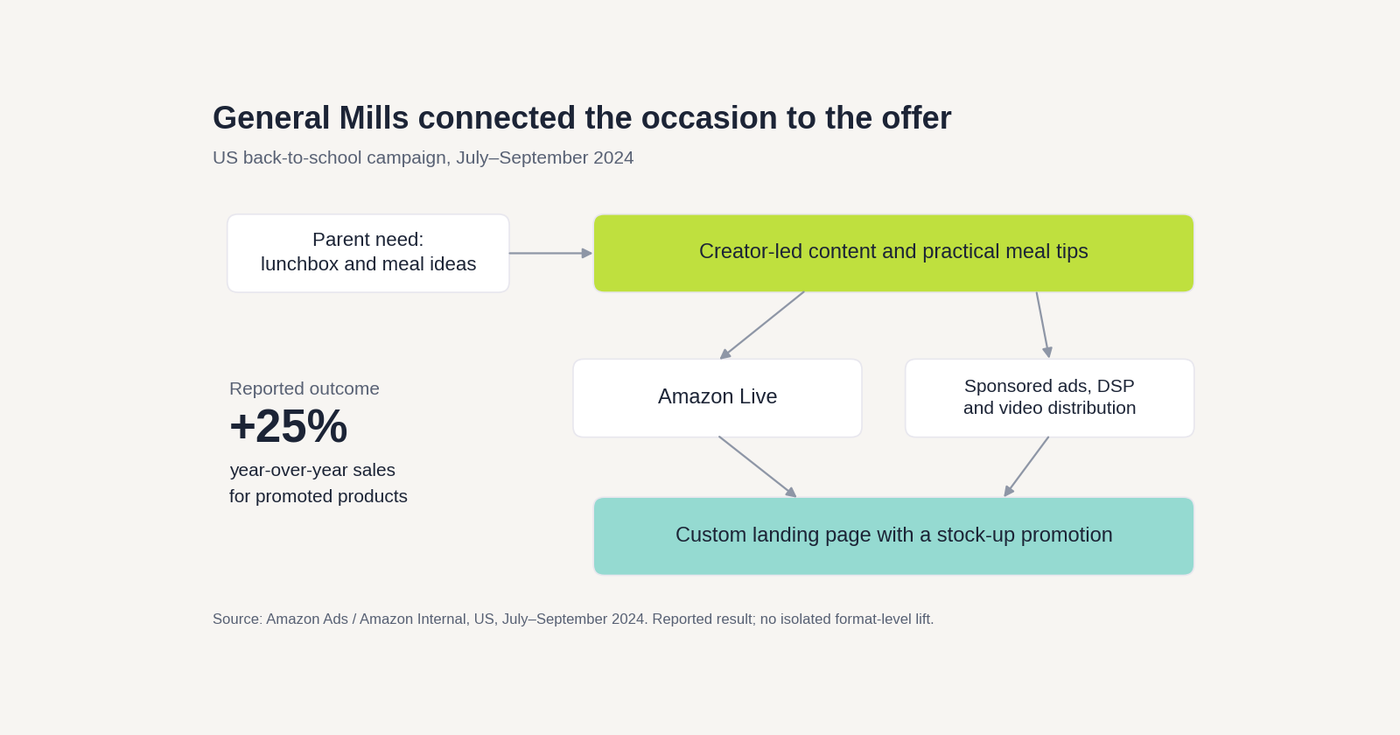
The campaign connected creator-led meal ideas with a stock-up offer. Source: Amazon Ads, US campaign, July–September 2024.
The lesson is how the occasion, the message and the offer connect. Parents saw practical lunchbox ideas and a relevant saving where they could buy.
For a smaller brand, test the same logic with one occasion and a small range, then expand production once the offer and message have shown they can sell.
Also avoid the retail media brand-building mistake of expecting product listings to do every job.
Amazon Fresh vs Amazon.com Advertising Costs and Budgets
Fresh and core are retail environments, so neither has one universal media price. Compare the specific proposals:
A core Sponsored Products test buys clicks with a budget you set.
A Fresh display proposal may use a different buying arrangement.
A managed package may require a larger commitment.
A smaller starting budget can make a core search test easier to fund, but it doesn't guarantee a lower cost per order. Fresh may earn its place if the eligible grocery offer converts within its own margin. The comparison needs total cost, conversion and contribution for each pack.
What Amazon Publishes About Minimums and Fresh Costs
Amazon publishes a typical $50,000 minimum for managed-service advertising. It also describes self-service sponsored ads with budgets you set and no upfront fees. The $50,000 figure applies to the managed-service route.
The Amazon public pages we reviewed for this guide don't give a comparable Fresh-versus-core grocery CPC range. So treat any claim that Fresh is automatically cheaper as an unproven sales pitch.
Two terms, and why neither is enough on its own:
Cost per click (CPC) prices the click.
Cost per thousand impressions (CPM) prices exposure.
Neither tells you what a sale costs. For that, you need your purchase rate and the contribution each order leaves. A quick illustration:
Spend $0.60 per click and convert 10% of clicks into orders: each order costs you $6.
Convert 20% at the same click price: each order costs $3.
The click price didn't move. The purchase rate changed the economics. That's why a fair Fresh-versus-core comparison needs conversion and revenue next to CPC.
Ask for media, creative and agency fees separately. Include any package commitment, and the terms that apply if the promoted product becomes unavailable.
Break-Even ROAS for Each Product Offer
Your contribution before ads is the money an order leaves after the variable costs that apply to it. It sets your first acquisition ceiling. Here's an imaginary seller example:
Item | Per order |
|---|---|
Net revenue | $20 |
Product and other variable non-media costs | $15 |
Contribution before ads | $5 |
Acquisition ceiling (spend all $5 on ads) | $5 |
Contribution left after ads | $0 |
The calculation is $20 ÷ $5 = 4x break-even ROAS, before fixed overhead.
So is a 4x result a win? At that margin, it has paid your variable costs and your ads, and nothing more. The order still has to help fund fixed overhead and profit. If first-order profit is your goal, set a lower acquisition target.
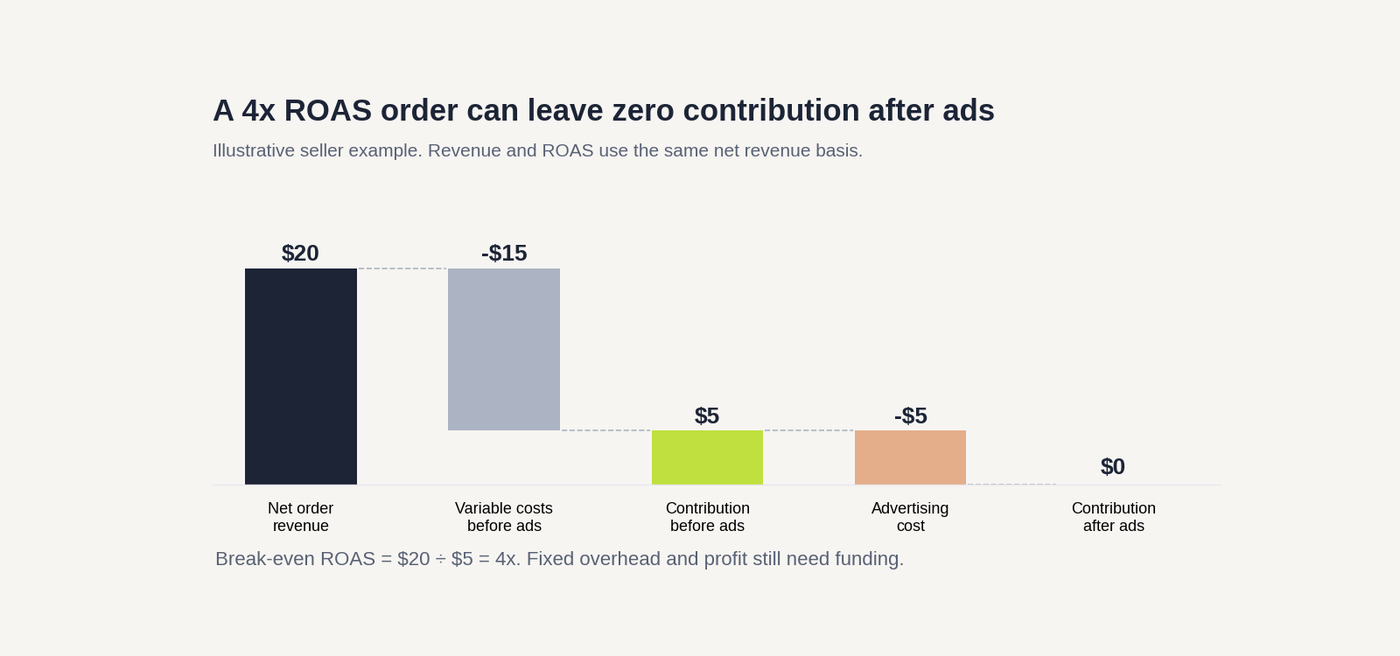
Illustrative seller economics. Break-even ROAS is 4x before fixed overhead, using the same $20 revenue basis for both margin and ROAS.
Two things to check before you trust any ROAS:
If you sell directly to Amazon as a vendor, calculate contribution from wholesale receipts, not retail sales.
Record which budget pays for any discount, so a healthy-looking ROAS doesn't hide the margin it consumed. In CPG digital marketing, media, retailer promotions and distribution work together.
Stock, Delivery Coverage and Promotions: Fresh vs Amazon.com
Reach works differently on each route:
Fresh reach depends on where the promoted grocery offer is available.
Core reach depends on the advertised offer's delivery and fulfillment coverage.
Besides, food campaigns need a product shoppers can buy for the whole selling period. Check availability at the offer and delivery-area level, then line up your spend with replenishment.
In our plant-based milk example, a shelf-stable 12-pack eligible for wider delivery may support a broader test than a chilled single with limited Fresh coverage. Your actual offers decide whether that advantage exists.
Expansion looks different too:
For Fresh, it may mean adding delivery areas with reliable assortment.
For core, it may mean extending a working search campaign while fulfillment can keep up.
In both cases, more media needs more buyable stock.
Imagine a summer campaign that's producing affordable orders. One delivery area loses the promoted pack, while another stays stocked. Your overall report can still look healthy, because the stocked areas keep selling.
Before you raise the whole budget, find out which offers and areas can support more demand.
Promotions work the same way. A price-led ad needs a live offer at the destination:
If the discount ends before your media does, shoppers arrive at a different price. The conversion drop can then look like a targeting problem, when the offer is what changed.
To keep this from happening, name three owners:
Stock and replenishment dates: one named owner.
Promotional calendar: one named owner.
Budget changes: one person who can approve them.
A shared update and a clear owner beat waiting for the ad report to reveal the problem.
Make your marketing budget pacing respond to selling conditions.
If stock recovers late in the month, release budget in stages, based on purchase performance and supply cover. Hitting a monthly spend target is a weak reason to speed up an unstable offer.
Our CPG media buying team can help you align your test budget with distribution, replenishment and your promotional calendar.
Fresh vs Amazon.com Measurement and Attribution
Fresh and core need different proof:
Fresh needs to show whether the eligible grocery offer sold.
Core may need to show whether a multipack sold, a brand gained buyers or a demo helped generate demand.
Those different goals make a single headline ROAS a weak basis for moving budget.
So compare equivalent sales first. If Fresh funds a chilled-single launch and core funds a pantry case, judge each against its contribution and intended buyer outcome. Then decide which one deserves the next dollar.
Compare Equivalent Sales and Attribution Definitions
Use comparable attribution windows and revenue definitions first:
A longer window can credit more purchases to the same spend, which can make one campaign look more efficient when the only difference is reporting.
Separate sales of the advertised product from sales of other products, and click credit from view credit.
Amazon's attribution methodology currently distinguishes Sponsored Products seller and vendor reporting, with seven-day and 14-day lookback windows respectively. In practice, a purchase on day 10 falls outside a seven-day click window and inside a 14-day one.
It’s obviously the same purchase, but different credit.
Those windows are account and program distinctions, not a Fresh-versus-core difference.
Before you compare anything:
Start with an export from your real account. It should show the fields available to identify the sales you meant to buy.
If a shared ASIN mixes offers and your reporting can't separate them, label the result as combined and use it for combined decisions. A campaign with "Fresh" in its name can't create a sales breakdown that the data doesn't contain.
Also separate sales of the launch product from sales of the wider brand. Both matter, but only the first answers whether the advertised product sold. Settle that in your reporting brief before the test begins.
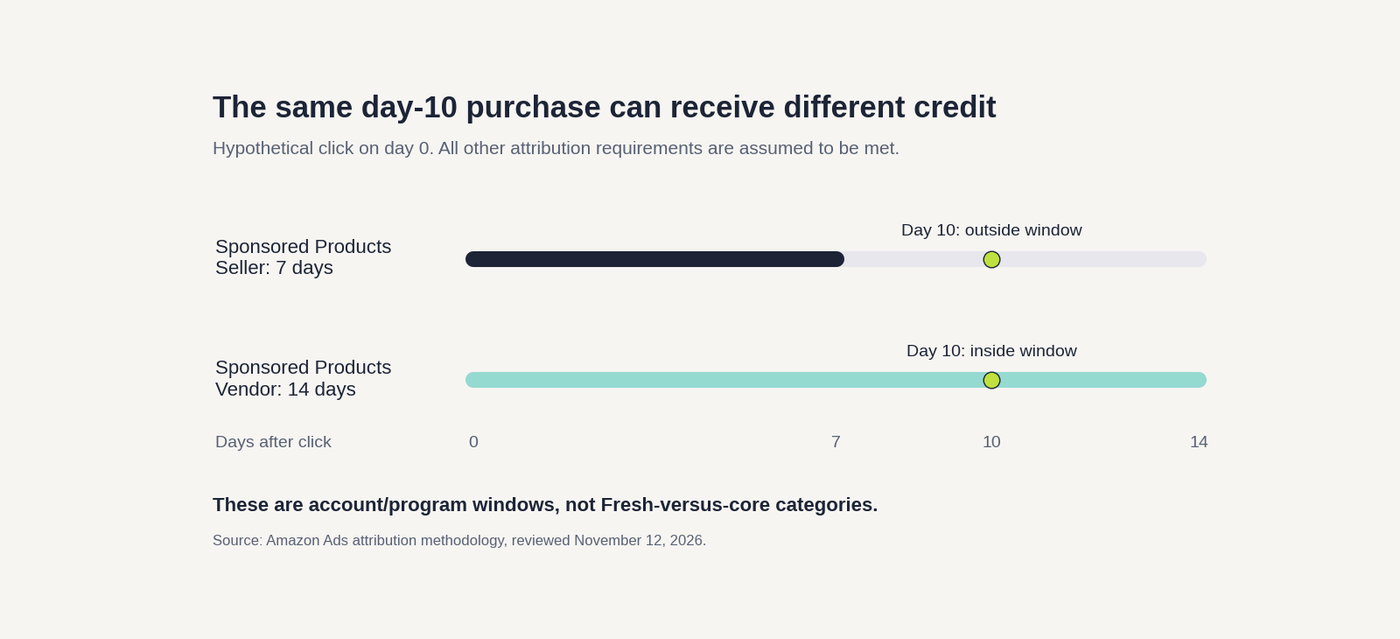
The same purchase can qualify under one lookback window and fall outside another. Window examples follow Amazon's Sponsored Products seller/vendor definitions; they are not Fresh/core categories.
Measure New Customers and Repeat Purchases Separately
Amazon defines a new-to-brand purchase using the shopper's previous 12 months of brand purchase history.
What it does: it lets you tell recent brand buyers from shoppers with no purchase in the lookback period.
What it doesn't do: it doesn't prove cause and effect. That needs a separate incrementality design.
How to use it: if you're chasing new households, review new-to-brand evidence next to acquisition cost. Strong sales from existing buyers answer a different business question.
For repeat purchase, use observed cohorts and comparable time periods, and keep actual repeat orders apart from projected customer value. Amazon's campaign reporting guidance covers both standard performance measures and long-term sales metrics, so confirm which one a proposal uses.
Let’s look at an interesting, recent US example: Amazon reports a 12.5% repeat-purchase rate for Bumble Bee Foods against a 10% campaign objective. CA Fortune and Xnurta combined catalog planning, sponsored ads and AMC analysis during the July 2025–March 2026 campaign.
The takeaway: judge repeat behavior alongside launch sales. Those results belong to that campaign, so don't use them to forecast your Fresh performance.
Incremental Demand From Amazon Campaigns
To find out whether your ads added demand, a well-designed geo-lift test can help, where your volume and geographic controls support it. Keep availability and promotions comparable across test and control markets. If one area gains distribution while the other loses stock, the sales gap can come from supply as much as advertising.
Good analytics and measurement should make the next decision clearer. Your options:
Keep testing.
Improve the offer.
Change the creative.
Shift investment.
Let attributed sales mature before you judge the latest campaign period.
When to Choose Fresh, Amazon.com Ads or Both
Our default is core first when your core offer is ready. A focused Sponsored Products test (cost-per-click ads for individual products) lets you read search demand for one pack, with a budget you control. That gives you a useful first answer: can this product win orders within what it can afford to pay?
Fresh earns priority when the grocery sale is the objective or the only eligible route.
Choose core when a buyable core offer and relevant search demand give you a focused first test.
Choose Fresh when your immediate objective is to sell an eligible Fresh offer to shoppers who can order it.
Run both when they serve distinct offers or purchase occasions and you can evaluate each budget.
Fix availability first if neither route is ready.
Your brand situation | Route to evaluate | Potential benefit | Limit to resolve |
|---|---|---|---|
Chilled product with Fresh distribution | Fresh campaign | Support trial inside an eligible grocery journey | Local stock, campaign eligibility and contribution per sale |
Shelf-stable multipack with a strong core offer | Core product and brand ads | Capture relevant searches and explain pack value | Competition, fulfillment cost and product-page conversion |
Unfamiliar food product | Demo-led video or display plus eligible purchase ads | Explain the use occasion before asking for a sale | Creative cost, destination readiness and evaluation period |
Brand with grocery and core offers | A coordinated Fresh and core plan | Support distinct packs or buying occasions | Offer mapping, budget overlap and report separation |
Product with unstable availability | Fix operations before you expand media | Keep budget for periods when shoppers can buy | Who owns supply and distribution |
Spending more on Fresh needs its own objective and affordable economics.
If you're in both environments, give each budget a specific job. Fresh might support a grocery launch while core supports a multipack.
Then judge each one against its job. A successful multipack campaign can't tell you whether your chilled launch gained buyers.
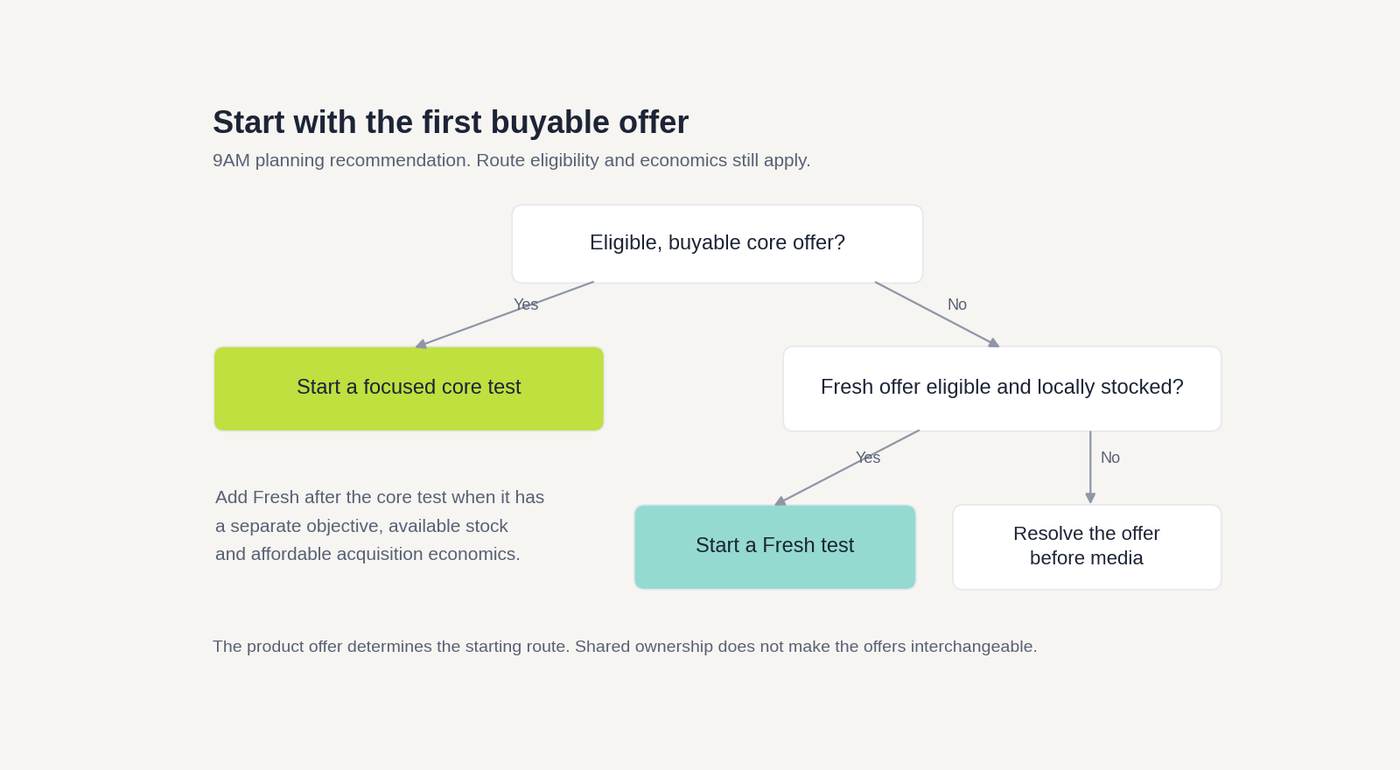
The first test follows a buyable offer. Additional Fresh spend needs a separate objective and affordable economics.
Verify Before You Buy
Before you commit budget to either route, confirm that:
The path works. Pack, offer and purchase destination match, and a real delivery address can complete the order.
The numbers hold. You know your contribution before ads, your acquisition ceiling and the total cost of the test, including any promotion funding.
The test is readable. You have one message tied to one occasion, and you've agreed which sales definition you'll judge it on.
Someone owns supply. Stock, delivery coverage and promo dates have a named owner, and you've agreed who can change spend.
You'll wait for results. You've set a review date and will let attributed sales mature before you scale.
Build Your Amazon Food and Beverage Media Plan with 9AM
Start where your brand can make a sale that's both buyable and measurable. If your core offer is ready, that means a focused core test first. Add Fresh once your product and local assortment support a goal that core alone can't serve. If you're Fresh-only, start with your Fresh route.
At 9AM, we work as your growth partner, so product selection, creative and measurement sit in one media plan. Once your offer can convert, every budget increase should fund a clear chance to add profitable demand.
Book a strategy call and we'll look at your Fresh and core offers, check product availability and build your first Amazon test with you.
Amazon Fresh Advertising FAQ
How can you separate Fresh and core sales when the ASIN is shared?
Use the reporting fields that identify the offer or retail environment, where they exist. Ask for an example export from your real account before you set Fresh-only targets. A campaign name or a shared ASIN isn't enough to assign mixed sales. If the split isn't available, report combined performance and avoid separate Fresh ROAS claims.
How should a $6 chilled single and a $24 multipack have different acquisition ceilings?
Calculate contribution separately for each offer. Say, as an example, the single leaves $1.20 before ads and the multipack leaves $6:
Single: break-even acquisition ceiling of $1.20, break-even ROAS of 5x.
Multipack: break-even acquisition ceiling of $6, break-even ROAS of 4x.
Both use the same revenue basis. Set lower targets if you want to keep profit. If you sell as a vendor, use realized receipts when retail prices differ from your brand revenue.
What happens to budget and attribution when a pack disappears in one delivery area?
Reduce exposure to the affected offer or area where your buying controls allow it. If they don't, reduce or pause the affected campaign until a buyable route returns. Sales earned earlier can still arrive inside their attribution window, so later reported sales don't prove delivery has recovered. Keep your stock log and campaign change log together.
When should Sponsored Brands video come before Fresh display?
Put an eligible core video test first when shoppers need to see the product in use and your core offer already converts. A new product can show a recipe or use occasion before you fund a bigger Fresh activation. Fresh display can come first when your eligible grocery offer and local buying occasion are the immediate priority. Compare the formats against the job each one was given, and against total cost.
About Corentin Grisoni
Corentin Grisoni helps DTC and wellness brands turn paid media into a connected growth system. As Retail Media Lead at inBeat Agency, he works across Amazon, Meta, TikTok, and Google to build omnichannel campaigns that are measurable, scalable, and tied to business outcomes.
His work brings together retail media strategy, paid social and search, attribution modeling, UGC, and performance creative. He focuses on helping retail, technology, and wellness brands understand where their media budget is working and create a system that compounds what performs.
More from Corentin GrisoniKeep exploring.
Insights
Instacart Advertising for Food and Beverage Brands: What to Check Before Your First Campaign
November 12, 2026
Insights
Retail Velocity for Food and Beverage Brands: Separate Distribution Growth from More Units per Store
November 12, 2026
Insights
Grocery Retail Media: How Food Brands Choose a Network Their Distribution Can Support
November 12, 2026