
Which Performance Marketing Agency San Francisco Brands Should Hire for Profitable Growth
San Francisco performance marketing agencies compared on local teams, paid-media depth, incrementality testing, CRO and how each one charges.

Most performance marketing agencies in San Francisco pitch the same promise: lower CAC and higher ROAS. Profitable growth asks for more. It means judging paid media on contribution margin, marketing efficiency ratio (MER) and CAC payback, then proving with holdout tests that the spend caused the revenue.
This shortlist compares agencies on five points: verified paid-media capabilities, measurement, CRO integration, client fit and commercial model.
Each agency also had to show a staffed San Francisco or Bay Area team. One entry is the exception and is labeled as one: 9AM, the publisher of this page, works with Bay Area brands from its New York office. However, it’s reviewed against all the other criteria objectively.
Let’s dive in.
Bay Area Performance Marketing Agencies Compared by Office, Channels and Profit Reporting
Nine of the ten agencies below run a team in San Francisco or the East Bay, and 9AM serves Bay Area brands remotely. Three publish their pricing; for the rest the table shows the fee structure where it is public.
Agency | Bay Area | Paid-media | Measurement and | Commercial model |
|---|---|---|---|---|
9AM | Remote team in | Meta, TikTok, | Incrementality | Not publicly |
Jordan | Office in the | Google, Microsoft, | CRM offline | Not publicly |
AXM (Ars X | Based in San | Paid social, | Bayesian mix model | Custom scope, |
Growth | Founders in SF; | Google, Microsoft, | Landing-page A/B | Not publicly |
Monks | Headquarters in | Search, paid | BI-led testing, | Not publicly |
SevenAtoms | Office in | Google, Microsoft, | Landing-page A/B | Setup fee, then a |
Upgrow | SoMa meetings | Google, Microsoft, | Landing pages, | $2,500 setup, from |
Moburst | Office at 600 | Social, search, ad | App store | Not publicly |
Stackmatix | Office in North | Google, LinkedIn, | Conversion | $5,000 to $7,000 a |
Jives Media | Office in San | Google, LinkedIn, | CRO, analytics, | Quote-based |
How We Checked San Francisco Presence and Profit Proof
We reviewed 20 agencies that appear in San Francisco roundups and directories and kept the ones that passed four checks on their own websites and case studies, reviewed in October 2026.
Local team: a San Francisco or Bay Area office or staffed team shown on the agency's own site or a current profile. A "serving San Francisco" landing page did not count.
Paid-media depth: active management of at least four paid channels, with named platforms.
Profit proof: at least one case study or published result tied to cost per outcome, pipeline, revenue or margin.
Commercial clarity: a published price, fee structure or minimum budget, or a clear statement that pricing is quote-based.
9AM publishes this page and is included under the same checks. It fails the local-team check, so it is labeled as a remote option and placed by its measurement and paid-media results.
Performance Marketing Agencies San Francisco Brands Can Shortlist
Agencies are ordered by how strongly they met the four checks, with profit proof weighted most. Each profile leads with what the agency does differently, then the case evidence behind it.
1. 9AM (remote team serving the Bay Area)
9AM, the publisher of this page, has no San Francisco office; its team works with Bay Area brands from New York, Houston, Chicago, and other US locations. It earns its place on measurement depth. 9AM's analytics practice runs incrementality tests, cohort-based payback tracking and profitability forecasting alongside media buying in CTV, paid social, search and retail media. Its reporting connects to attribution tools such as Triple Whale, Northbeam and Rockerbox.
EVRY Jewels scaled from $6M to $100M+ in yearly revenue while holding 7x+ ROAS on a $1M+ monthly media budget.
For Booksy, cost per business registration fell 92% as registrations grew more than 1,700%.
Fits consumer and B2B brands that want media, creative testing and measurement under one team and do not need in-person meetings.
2. Jordan Digital Marketing
Jordan Digital Marketing builds paid search and paid social around the conversion that pays for the program, which for its B2B and fintech clients is a sales-qualified lead or an install. The Mission District team also runs CRO, lifecycle email and marketing operations, so landing pages and CRM data sit with the people who manage bids.
For Sentry, JDM imported install events from the CRM into Google Ads as offline conversions and bid toward installs. Install volume rose 94% while cost per install fell 27% year over year.
For Secureframe, the team set target CPA by working back from Closed Won goals, then grew pipeline 12% on 4% less spend.
Strongest fit: Series A through growth-stage SaaS, security and fintech teams whose revenue runs through a CRM.
3. AXM (Ars X Machina)
AXM, the San Francisco-based agency formerly called Media Matters Worldwide, plans and buys the full media mix and measures it with its own model. Agile Mix Modeling uses Bayesian inference on daily data, refreshes about weekly and estimates incremental sales by channel, partner and tactic without user-level tracking, so brand and performance budgets are judged in one model.
For Shipt, AXM's modeling moved 50% of the holiday performance budget into brand media; aided awareness rose 7 points and customer acquisition cost fell 18%.
For Nutanix, a 70/30 split between brand and demand media cut cost per MQL 46% year over year.
Works well for brands spending across CTV, audio, retail media and out-of-home as well as search and social.
4. Growth Marketing Pro
Growth Marketing Pro is run by founders who live in San Francisco, with team members in San Diego and Boston. Its paid team pairs Google Ads with landing-page A/B tests and Salesforce conversion data, and its PPC practice page says revenue and profit data drive optimization decisions.
For SmartRecruiters, GMP removed the phone-number field from lead forms, tested landing pages and rebuilt bidding; lead volume grew 37x and cost per lead fell 89% in three months.
Co-founder Mark Spera previously led marketing at PlushCare, which sold for $450 million.
Suits B2B SaaS teams that want paid search, SEO and Reddit under one roof; GMP says most clients need $5,000+ a month in ad spend to see significant results.
5. Monks (formerly Metric Theory)
Metric Theory started as a San Francisco paid media specialist and now operates under Monks, with its headquarters still listed in the Financial District. Its channel range is the widest among the local agencies here: search, paid social, Shopping and feed management, Amazon, programmatic and video sit under one team of about 150 people managing $275MM+ in spend.
The Getaround case study credits business-intelligence analysis and systematic testing for growth in user acquisition.
A HoMedics product launch across Amazon, social and search beat its sales target by 90%.
Most published cases predate the move into Monks, so ask which team will staff your account and request recent results.
Works best for ecommerce and app brands that need marketplace and programmatic depth next to Google and Meta.
6. SevenAtoms
SevenAtoms is a PPC agency in Dublin, in the East Bay, that pairs Google, Meta and LinkedIn campaigns with custom landing pages and ongoing landing-page A/B tests. It holds Google Premier Partner status and treats CRM and HubSpot audits as part of campaign setup, which lets B2B teams pass lead quality back into bidding.
Its longest-running ecommerce client, Seal Skin Covers, grew sales from $2 million to $26 million over 7+ years while cost per order fell 21.57%.
The fee rises with spend after setup, so model what the agency costs at your planned budget in month six as well as month one.
A good match for ecommerce brands and industrial or SaaS lead-gen teams that want media buying and landing-page work from one vendor.
7. Upgrow
Upgrow sells one paid-media package that bundles strategy, ad design, landing pages, tracking and attribution, which removes the handoff between a media buyer and a CRO freelancer. Its San Francisco page invites clients to meet at a SoMa office, while the site's contact address is now San Diego, so confirm who will work with you in person.
Upgrow reports a #34 ranking on the San Francisco Business Times 2022 list of fastest-growing Bay Area companies.
Published PDF case studies cover Orca Security PPC, BioRender and InfluxData.
Built for B2B SaaS, cybersecurity and fintech teams with at least $5,000 to $10,000 a month in ad spend, the floor Upgrow states.
8. Moburst
Moburst is an app-first agency with an office at 600 California Street in the Financial District, alongside New York and Tel Aviv. Founded in 2013, it built its practice on mobile growth before adding web and SEO work. Its media team buys social, search, ad networks, influencers and OTT, while the organic team runs app store optimization and CRO, which matters when the conversion happens on a store listing.
A cross-channel campaign for Samsung's Galaxy App Store delivered nearly 80% download growth and a revenue increase of more than 35%.
Moburst has worked for Google, Uber and Reddit, according to its company profile.
Right for consumer apps that need user acquisition, store-listing tests and creative production from one team.
9. Stackmatix
Stackmatix is a small North Beach team built for venture-backed startups, led by co-founder Matt Pru, previously Head of Sales at MightyHive. It runs paid media on six platforms with conversion tracking setup, and sells SEO and AEO as a separate program. A standalone package of six static ad creatives costs $1,500 without a media retainer, which lets a startup test creative before committing to management fees.
Its client list includes CodeRabbit, Kalshi and Figma. RapidFort reports 37% lower CAC and 40% higher conversion rates in a published testimonial.
Published proof is testimonial-based, so ask for the account data behind it before you sign.
Aimed at seed to Series B companies testing whether paid channels can pay back before they hire an in-house team.
10. Jives Media
Jives Media is a San Francisco full-service agency for small and mid-sized businesses, part of founder Jay Ives' group of companies. Paid ads sit next to SEO, web design, email and reputation management, which suits owners who want one vendor for everything digital.
For Redwood City-based Poshmark, Jives tied CAC, LTV and purchase frequency to retention outcomes and unified campaign tracking across signups and purchases. The same data fed executive decks used in Poshmark's IPO roadshow.
Its intake form starts at monthly budgets under $1,500, the lowest entry point on this list.
Right-sized for local service businesses, professional firms and early ecommerce brands. Teams that need holdout testing will outgrow the scope.
What a Performance Marketing Agency Owns When the Goal Is Profitable Growth
A performance marketing agency plans, buys and optimizes paid media against a business outcome such as revenue, pipeline or app installs. When the goal is profitable growth, the agency also owns conversion tracking, landing-page testing and the reporting that shows margin after ad spend.
That scope matters in San Francisco because most local brands buy media on a tight payback clock.
In Q1 2026 the San Francisco metro took 65.9% of US venture dollars, yet OpenAI, Anthropic, Databricks and World Labs absorbed 91% of the metro's total.
The other 646 Bay Area rounds shared $19.9 billion. For the typical Series A or B company in SoMa or on the Peninsula, every paid channel has to earn back its cost before the next raise.
Performance Marketing Agency vs. Growth Marketing Agency
A growth marketing agency can own product onboarding, referral loops, pricing tests and retention. A performance agency owns paid acquisition against a cost or return target, plus the landing pages and data plumbing that feed it.
Here’s a visual explanation:
Several Bay Area firms that once sold paid media now sell advisory or talent placement, so check that the team you hire will run the ad accounts itself. 9AM's full-funnel media buying is one example of the execution-led model.
B2B SaaS and Ecommerce Performance Agencies in the Bay Area
B2B SaaS, AI and fintech companies need an agency that bids toward sales-qualified leads and closed revenue, which means importing CRM stages back into Google Ads and LinkedIn.
Ecommerce and DTC brands need product-level margin in the feed, so Shopping and Meta campaigns can bid toward gross profit. Few agencies do both well, and the entries below say which side each one serves.
MER, POAS and Break-Even ROAS: The Profit Metrics to Request From an Agency
Ask any agency to report three numbers next to platform ROAS: marketing efficiency ratio (MER), profit on ad spend (POAS) and break-even ROAS. Together they show whether paid media grew margin or only moved revenue between channels.
Budgets explain why.
Gartner's 2025 CMO Spend Survey found budgets flat at 7.7% of revenue, with paid media taking 30.6% of that money. When the pot stops growing, the only way to scale is to make each dollar return more profit.
Marketing Efficiency Ratio (MER) Across All Paid Channels
MER divides total revenue by total marketing spend for the same period. It ignores platform attribution, so it catches the month when Meta and Google both claim the same sale. Ask for weekly MER next to channel ROAS in every report.
Profit on Ad Spend (POAS) and Break-Even ROAS Targets
Break-even ROAS equals 1 divided by gross margin. A product with a 25% margin needs a 4.0 ROAS just to cover its ad cost. POAS goes a step further and divides gross profit by ad spend. Google Ads can report gross profit once you send conversions with cart data and add cost of goods sold to the Merchant Center feed, so ask whether the agency will set that up in the first month.
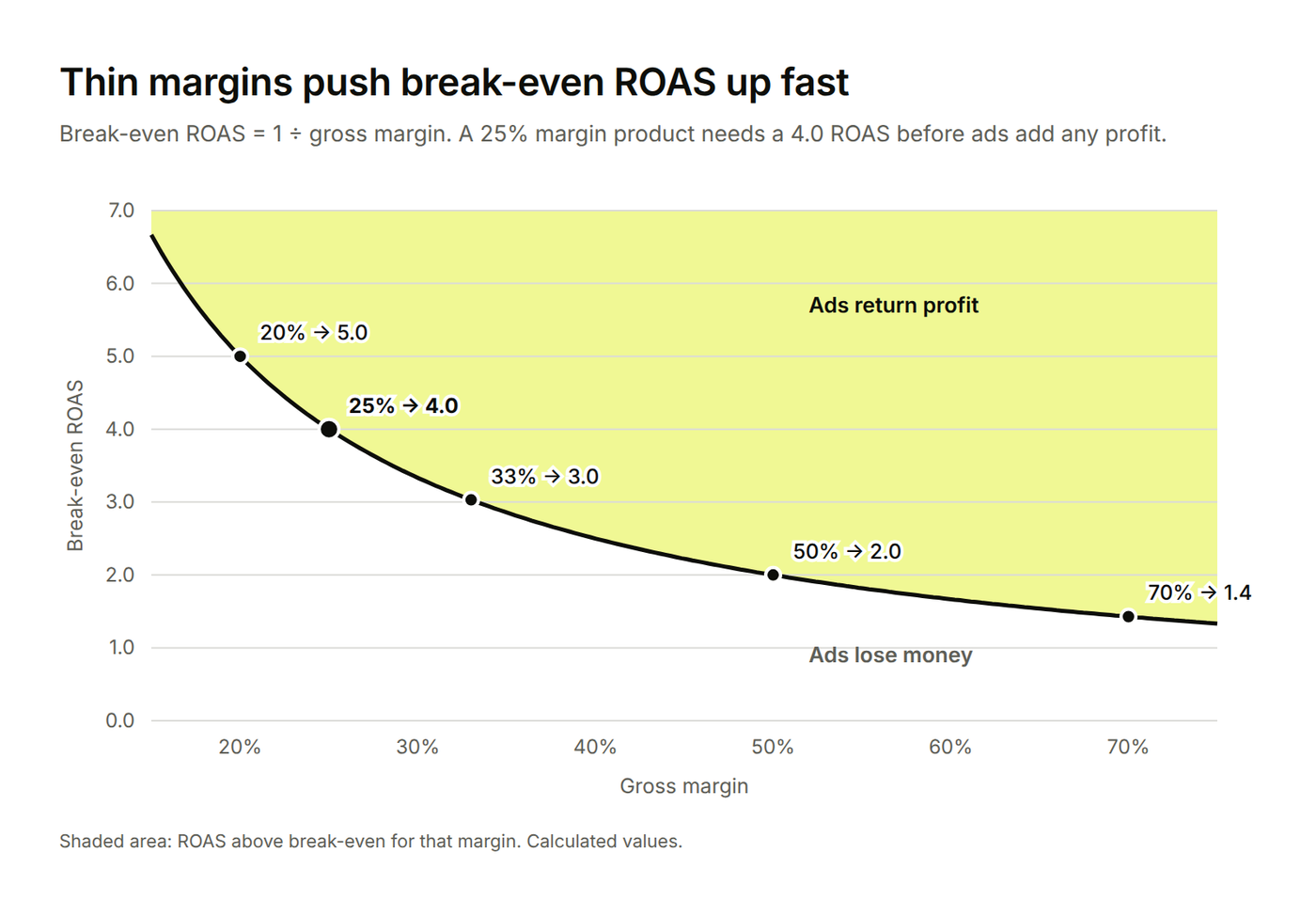
Break-even ROAS equals 1 divided by gross margin, so a 25% margin product needs a 4.0 ROAS before ads add any profit.
CAC Payback and LTV to CAC Ratio for SaaS Accounts
SaaS revenue arrives monthly, so the profit question becomes payback. CAC payback in months equals CAC divided by monthly gross margin per new customer. An agency that bids on sign-ups cannot manage this number; one that imports SQL or closed-won stages from the CRM can. A growth strategy engagement should model payback by channel before budgets move.
How to Check Whether a Performance Agency Runs Incrementality Testing
An agency that runs incrementality testing can show what revenue would have disappeared if a channel went dark. Ask for one completed holdout or lift study, how it was designed and which budget decision it changed.
The bar is lower than it was.
Google says its incrementality experiments now start at about $5,000 in spend, down from upwards of $100,000, and cites a Google/BCG survey in which 80% of US senior marketing analytics professionals said lift-test insights have a high impact on revenue growth.
California adds pressure: since August 1, 2026, registered data brokers must process DROP deletion requests at least every 45 days, which thins third-party audience data on Californians and makes attributed numbers less reliable.
Geo Holdouts and Platform Conversion Lift Studies
A geo holdout pauses spend in matched markets and compares sales against markets where ads keep running. Bay Area brands face a catch: if most customers sit in the San Francisco-Oakland-San Jose market, holding it out hurts. User-level conversion lift studies inside Google or Meta avoid that problem.
Incrementality vs. Attribution in Monthly Agency Reports
Attribution assigns credit along the path to purchase; incrementality measures what the ads caused. A good monthly report shows both for the largest channels and states the gap between them, so you can discount channels that claim more than they add.
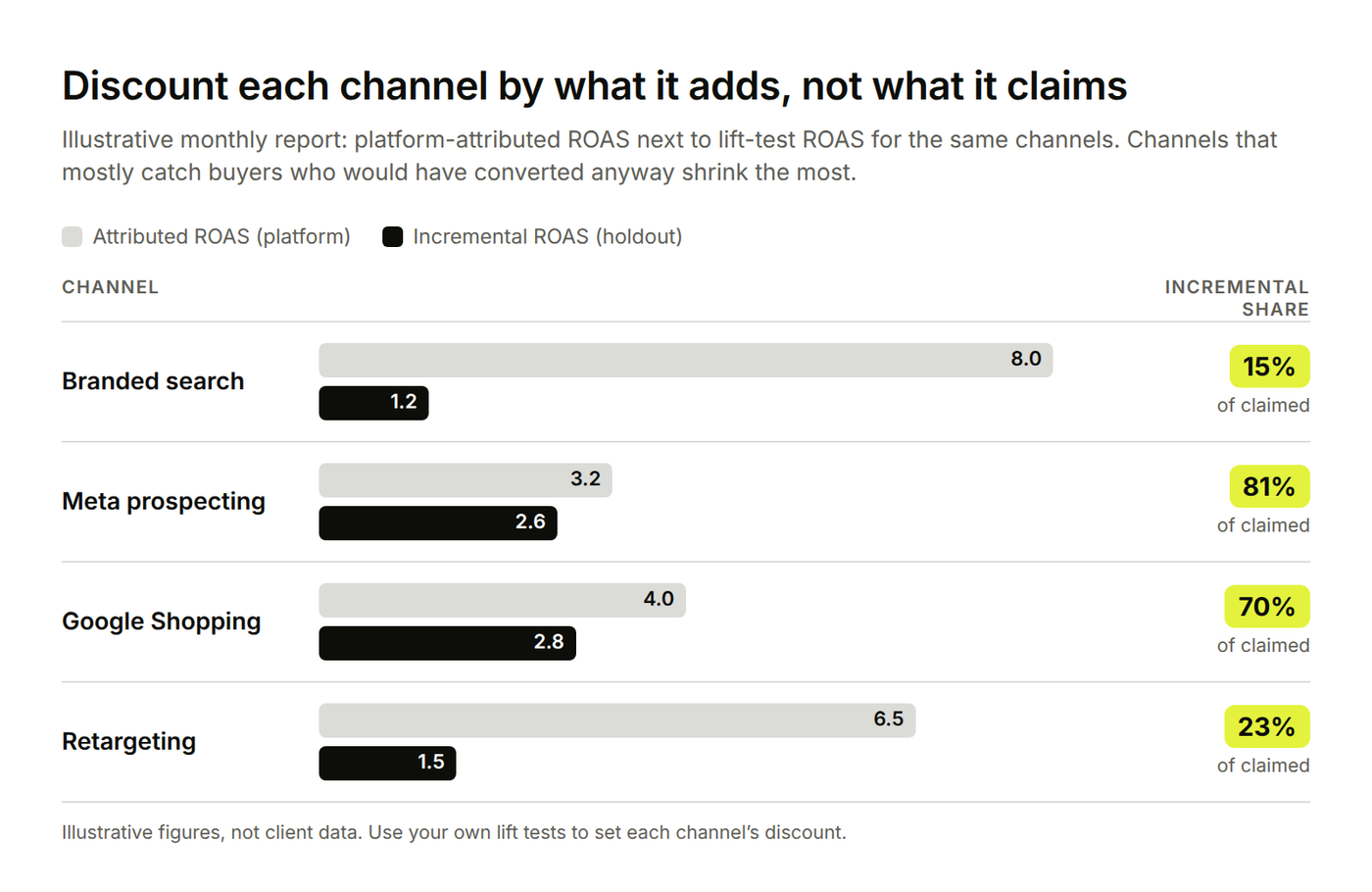
Illustrative example: lift tests typically credit branded search and retargeting with far less revenue than the platforms claim.
Marketing Mix Modeling for Budget Allocation Across Channels
Marketing mix modeling estimates each channel's contribution from spend and sales history, including seasonality and pricing. Google recommends calibrating MMM with lift-test results, so ask the agency how its experiments feed the model and how often the model is refreshed.
Performance Marketing Agency Pricing: Retainers, Percentage of Ad Spend and Pay for Performance
Performance agencies charge a flat retainer, a percentage of ad spend, a fee tied to results, or a mix. Fees dominate: an ANA study found 82% of marketers use fee-based compensation with at least one agency.
Flat Retainers and Percentage-of-Spend Fees
A flat retainer is neutral to spend, which suits brands that may cut budgets when payback slips. A percentage of spend grows with the program and can reward volume over efficiency. Hybrid models charge the higher of a minimum fee or a percentage, so check where the crossover sits at your budget.
Pay-for-Performance and Hybrid Fee Structures
Performance incentives are less popular than they sound. The same ANA research found their use fell to 41% of marketers, from 61% in 2013, and most respondents said they did not know whether the incentives improved agency performance.
A hybrid works better when the bonus pays out on a metric both sides measure the same way.
Which Fee Models Align With Contribution Margin
Tie any bonus to contribution margin or CAC payback and validate it with a holdout test, because agencies cannot inflate those numbers by spending more. Agree on the margin inputs, such as COGS, shipping and payment fees, before the contract starts.
Choose a Performance Marketing Agency in San Francisco for Profitable Growth
Start with the number your board or finance lead already watches. For a SaaS company that is usually CAC payback. For an ecommerce brand it is usually contribution margin after ad spend.
Bring that number to every intro call and ask each agency to show a past account where it moved. The agencies worth a second meeting will open a dashboard. The rest will open a pitch deck.
Next, ask for a 90-day plan with a test built into it: one channel, one holdout, one decision that depends on the result. A plan like this also tells you how the agency will report to you after month three, when early wins fade and budgets get questioned.
If your shortlist needs a team that can run paid media and prove its incremental return in the same monthly report, talk to 9AM about a profit-first media plan for your Bay Area brand.
FAQs
Do I need a San Francisco-based agency or will a remote team work?
A local team helps when you want in-person planning, workshops at your office or quick access to Bay Area creators and events. A remote team works when the agency's measurement and channel depth fit better and your team runs on video calls anyway.
How long before a performance agency shows profitable results?
Expect a ramp-up period. You can expect one to two months of ramp-up, but a clearer picture of campaign effectiveness emerges after the first two to three months. Profit metrics such as CAC payback take longer to read for SaaS.
What is the difference between a performance agency and a paid media agency?
A paid media agency plans and buys ads. A performance agency is paid and judged on outcomes such as revenue, pipeline or margin, so it usually also owns tracking, landing pages and testing.
Keep exploring.

Insights
Performance Marketing Agency Toronto: Shortlist for Ecommerce and Consumer Growth
October 22, 2026

Insights
Click Fraud: How to Investigate Suspicious Paid Traffic Before Buying Protection
October 22, 2026

Insights
Offline Conversion Tracking: How to Feed Qualified Leads and Closed Sales Back Into Paid Search
October 19, 2026