Meta ROAS Up, New-Customer Revenue Down: What to Investigate
Meta ROAS rising while new-customer revenue falls? Use this 7-step check of store data, audience segments, revenue definitions and incrementality.

· 15 min read
Picture this: Meta reports a better return every week, but your store's first-order revenue keeps slipping.
Both numbers can be (and in many cases, they actually are) accurate at the same time, because they measure different things.
Platform ROAS counts every purchase Meta can credit to an ad, including buyers who were coming back anyway.
The problem is bigger than most people assume: across 15 large Facebook experiments, standard measurement methods missed the true lift by a factor of three in half of the studies.
This guide covers what the gap means, why it opens, a seven-step investigation, and what to change once you find the cause.
P.S. If you'd like a second pair of eyes on the account, our Meta advertising team runs this diagnostic for growth brands. Book a strategy call.
TL;DR
Platform ROAS measures credited purchase value; new-customer revenue measures first orders from people who never bought before. They can move in opposite directions.
The usual causes are delivery drifting toward existing customers, attribution credit for purchases that would have happened anyway, and reporting changes.
Start in store data, then break Meta results down by audience segment before adjusting your budgets.
Match Meta's revenue definition to finance's, and judge new customers on cohort value as well as count.
Run a lift test before moving money, then give prospecting and retention separate targets.
A paid account works like a lab (at least that’s how we do it at 9AM). We encourage you to do the same:
Every dollar should teach you which message brings in a customer who wasn't already yours. When the dashboard improves while first orders shrink, the lab is reading the wrong instrument.
We judge Meta on new-customer acquisition cost and the marketing efficiency ratio, use platform ROAS as a diagnostic, and keep creative, media and measurement in the same weekly review so a drift like this shows up within days.
The rest of this guide is how we run that check.
What Does It Mean When Meta ROAS Rises but New-Customer Revenue Falls?
It means Meta is crediting more revenue per dollar while fewer of those dollars produce a first purchase. The account is getting better at closing people who already know the brand, and worse at finding new buyers.
Pro tip: Lower spend, reporting changes and a drop in new-customer order value can produce the same pattern, though, so check these first.
Four terms carry the rest of this article, so here is how we use each one:
Metric | Formula | Source of truth | What it answers |
|---|---|---|---|
Platform ROAS | Meta-attributed purchase value ÷ Meta spend | Ads Manager (website purchase ROAS) | How much revenue Meta can claim per dollar |
New-customer revenue | Revenue from first orders in the period | Store or order data | How much the brand earned from people who never bought before |
New-customer ROAS (ncROAS) | New-customer revenue from Meta ÷ Meta spend | Store data joined to Meta attribution | How efficiently Meta buys first orders |
New-customer acquisition cost (nCAC) | Meta spend ÷ new customers from Meta | Store data joined to Meta attribution | What one new customer costs |
The first metric appears in the platform. The other three need your own order data, which is why the gap stays invisible in a Meta-only report.
If your finance team already tracks the aggregate view, our guide to blended and paid CAC covers that layer. This article stays on the Meta-specific diagnostic.
Why Meta ROAS Can Rise While New-Customer Revenue Falls
Meta ROAS can rise while new-customer revenue falls because the easiest purchases to win, and to credit, come from people who already buy from you. We explained this above. Now, let’s delve into the three mechanisms that usually lead to this issue.
Existing Customers Convert More Cheaply Than New Ones
Existing customers buy more often and need less persuasion, so an algorithm chasing purchase value finds them first. The catch is that many of those purchases would happen without the ad.
eBay's large field experiments show the pattern clearly. When eBay switched off brand search ads, 99.5% of the traffic still arrived through organic results, and the ads had their biggest effect on first-time buyers. For regular buyers, the measured effect was close to zero.
That study covered search, but the logic carries to Meta: credited revenue from loyal buyers inflates ROAS without adding much growth.
Advantage+ Delivery Follows the Easiest Purchases
Advantage+ sales campaigns decide on their own who sees an ad, and existing customers are the cheapest conversions on offer. Until early 2025, advertisers could limit this with an Existing Customer Budget Cap. Meta has since listed that cap as no longer available, pointing advertisers to manual workarounds.
Vendor data suggests the drift is real.
Wicked Reports, an attribution vendor, found average nCAC on Advantage+ rose from $257 to $528 between May 2024 and May 2025 across the campaigns it tracks, while manual campaigns got cheaper over the same period.
Treat that as one vendor's sample, and check your own account before acting on it.
Attribution Credits Purchases the Ad Did Not Cause
Meta credits a purchase to any ad a buyer clicked, engaged with or saw inside the attribution window. A returning customer who sees an ad, then buys from your Tuesday email, still counts toward platform ROAS.
This is the core finding of the Kellogg and Facebook study published in Marketing Science: non-experimental methods generally overstate how much an ad changed behavior. The more of your credited revenue comes from people with high purchase intent already, the larger that overstatement gets.
How to Investigate Rising Meta ROAS and Falling New-Customer Revenue, Step by Step
Start in your store data, then work outward through Meta's reporting, audience mix, revenue definitions and cohort value, and finish with a lift test before moving budget. Follow the order precisely: each step rules out a cause the next one would otherwise misread.
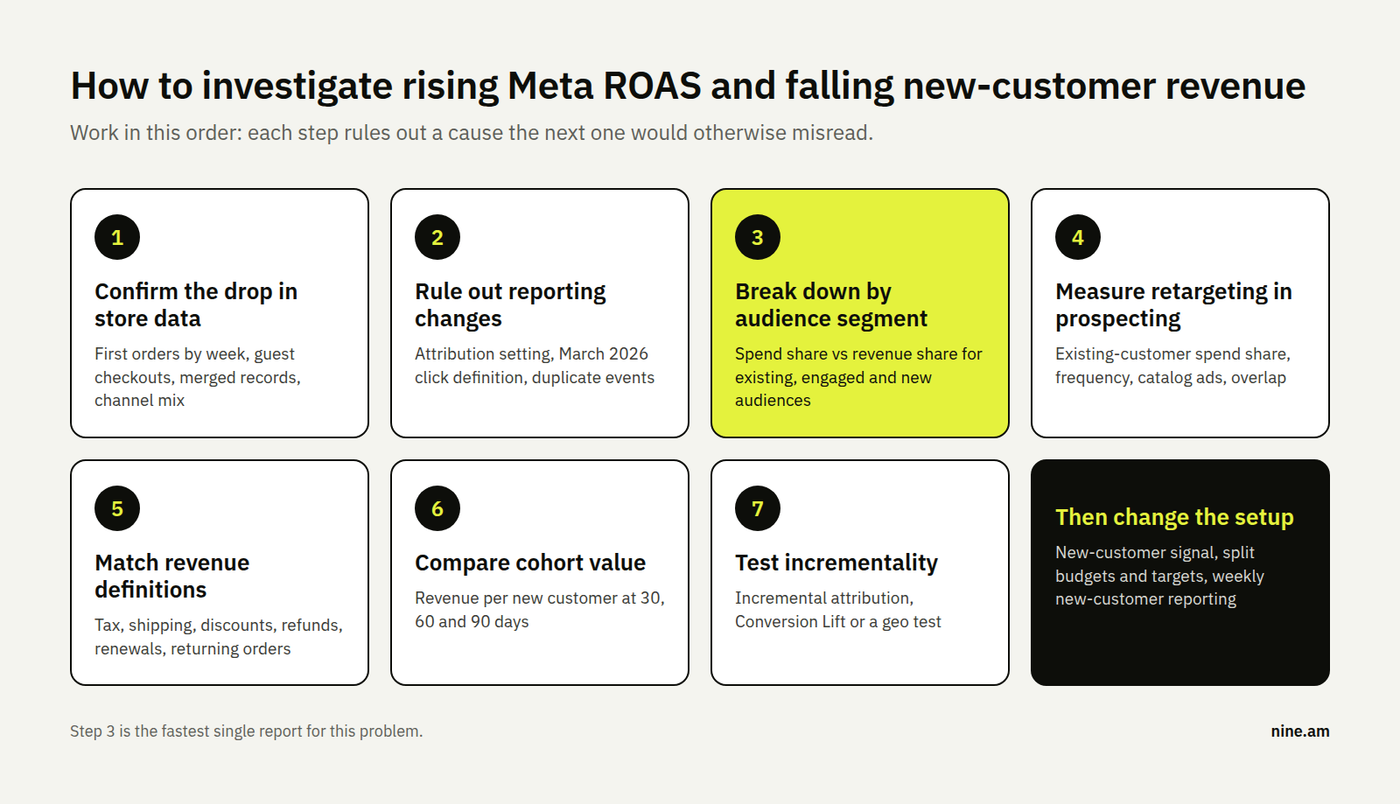
The seven-step investigation order. Source: 9AM original
If you already have a hunch, this table shows where to start:
What you see | Likely cause | Start with step |
|---|---|---|
New customers fell in Meta but not in the store | Tracking or reporting change | Step 2 |
ROAS jumped right after a settings change | Attribution setting or definition shift | Step 2 |
Existing customers take a growing share of spend | Delivery drift toward buyers you already have | Step 3 |
Frequency is climbing in prospecting | Retargeting exposure inside prospecting | Step 4 |
Meta revenue grows faster than finance's revenue | Different revenue definitions | Step 5 |
Fewer new customers, but each one spends more | Cohort mix shift | Step 6 |
Step 1: Confirm the New-Customer Drop in Store Data
Confirm the drop exists outside Meta before you change anything inside it. Pull first orders by week from your store or order system for the last 13 weeks and the same weeks last year.
In Shopify, the First-time vs returning customer sales report does this, and Shopify defines a first-time customer as someone placing their first order with the store. Then run three checks:
Guest checkouts. A returning buyer who checks out as a guest with a new email can look new, which hides part of the drop.
Customer merging. Merged or deleted customer records can reclassify past orders, so compare the same report export over different periods.
Channel mix. Separate first orders from Meta-tagged sessions, other paid channels and direct or organic traffic, so you know whether the drop is Meta-specific.
If first orders fell across every channel at once, the cause may be price, stock or seasonality, which Meta cannot fix.
Step 2: Rule Out Meta Reporting Changes
Rule out a change in how Meta counts before treating a ROAS jump as a delivery problem. Check three things in the account's change history and Events Manager.
Attribution setting. An ad set moved from 7-day click to 7-day click plus 1-day view will report more purchases with no change in buyers. Our guide to Meta attribution windows covers how to compare settings on one basis.
Definition changes. Since March 2026, Meta counts only link clicks as click-through and moves other interactions into a 1-day engage-through bucket. Reports that span that date are not like for like.
Event duplication. A purchase sent by both the pixel and the Conversions API without a shared event ID can be counted twice. Our post on server-side tracking covers how to set up deduplication.
If any of these changed inside your comparison period, rebuild the comparison on matched settings before moving to Step 3.
Step 3: Break Down Meta Results by Audience Segment
Break Meta results down by audience segment to see how much spend and revenue sit with people who already buy from you. This is the single most useful report for this problem, and it takes about ten minutes to set up.
In Advertising Settings, define two audience segments:
Existing customers: purchaser custom audiences from the pixel, a customer list from your store, or both.
Engaged audience: site visitors and eligible customer-list, app or lead-form audiences. Video viewers and Facebook or Instagram profile engagers can't be used to define this reporting segment.
Once both are defined, the Audience Segments breakdown splits results into existing customers, engaged audience and new audience for every sales campaign.
Two details carry weight when you read it, both documented by Jon Loomer: a person in both groups counts only as an existing customer, and the segments are a reporting tool that does not change delivery.
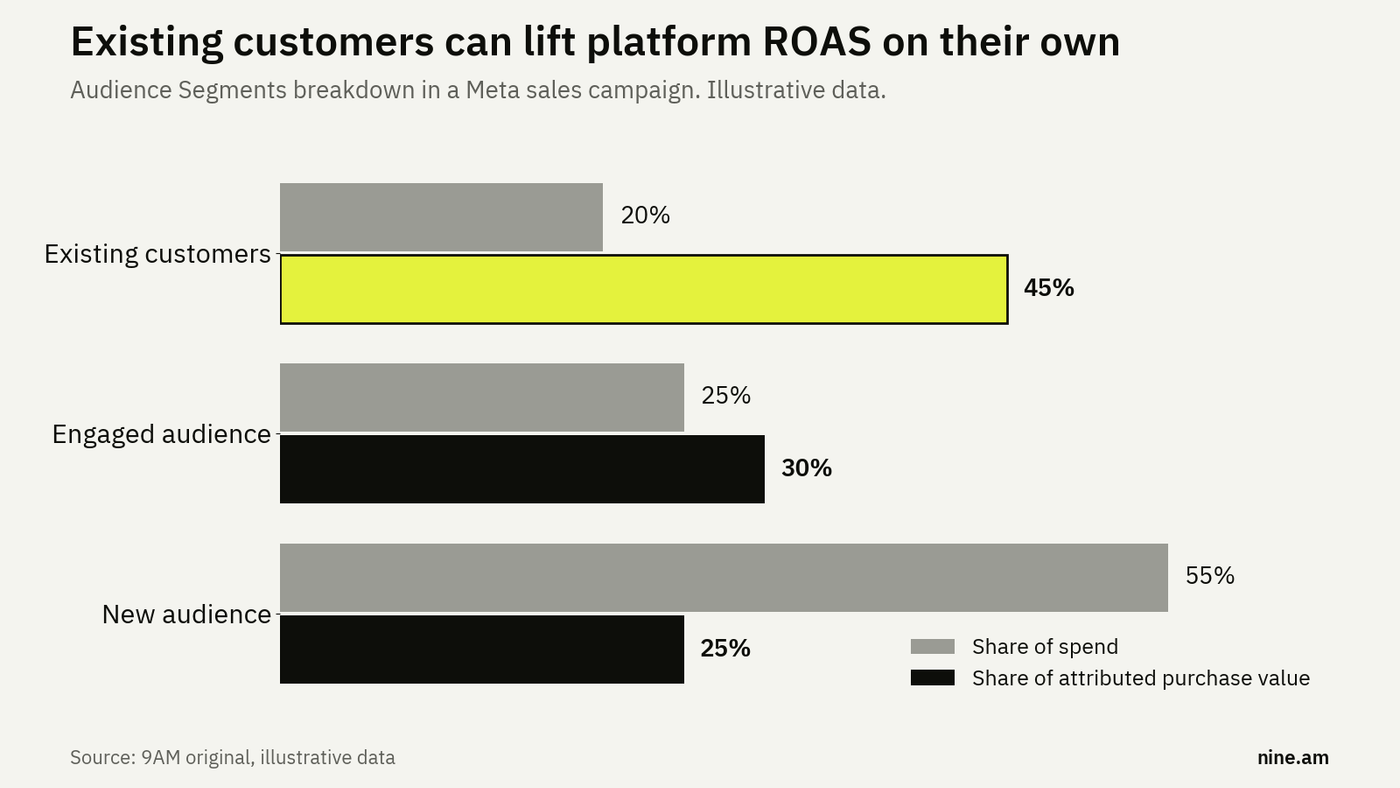
Share of spend compared with share of attributed purchase value by audience segment. Source: 9AM original, illustrative data
Compare each segment's share of spend with its share of attributed purchase value. Existing customers taking 20% of spend and 45% of revenue pull platform ROAS upward, while the new audience row shows performance outside your defined customer and engaged segments.
That row isn't a first-order count, though.
Unmatched past buyers can appear as new, and engaged prospects can place their first order. Use store data to confirm which purchases came from new customers.
Step 4: Measure Retargeting Exposure Inside Prospecting Campaigns
Measure how much of your prospecting budget reaches people who already know you. A prospecting campaign with a rising existing-customer share is doing retention work at a prospecting price.
Work through these checks for each prospecting campaign:
Existing-customer spend share by week. A steady climb over four to six weeks points to delivery drift.
Frequency. Rising frequency on a broad prospecting audience usually means the campaign keeps finding the same warm people.
Catalog and dynamic product ads. These lean on site behavior by design, so they tend to pull budget toward visitors and past buyers.
Overlap with retargeting campaigns. Two campaigns bidding on the same warm audience inflate both and hide which one did the work.
Exclusions. Confirm the existing-customer audience is still populating; a broken customer list sync removes the exclusion.
Step 5: Match Meta's Revenue Definition to Finance's
Match the revenue Meta counts to the revenue finance reports before comparing the two. Meta records whatever purchase value your pixel or Conversions API sends, which, in many cases, differs from net first-order revenue.
Revenue item | In Meta purchase value? | In finance's new-customer revenue? |
|---|---|---|
Sales tax and shipping | Often, depending on the value passed | Usually excluded |
Discount codes | Value after or before discount, depending on setup | After discount |
Refunds and returns | No, Meta keeps the original value | Deducted |
Subscription renewals | Yes, if renewals fire a purchase event | Excluded from first orders |
Orders from returning customers | Yes | Excluded |
Our analytics team usually reconciles these rows before any Meta change, because one mismatched row can explain the whole gap. Subscription brands should check the renewal row first. Renewal events firing through the pixel will raise platform ROAS every month while adding no new customers.
Step 6: Compare New-Customer Cohort Value
Compare what each month's new customers are worth over 60 and 90 days before calling the drop a loss. Fewer new customers with a higher average order value or better repeat rate can be a better trade.
Group first-time buyers by acquisition month and track revenue per customer at 30, 60 and 90 days. Our guide to using LTV data covers how to feed that value back into acquisition targets.
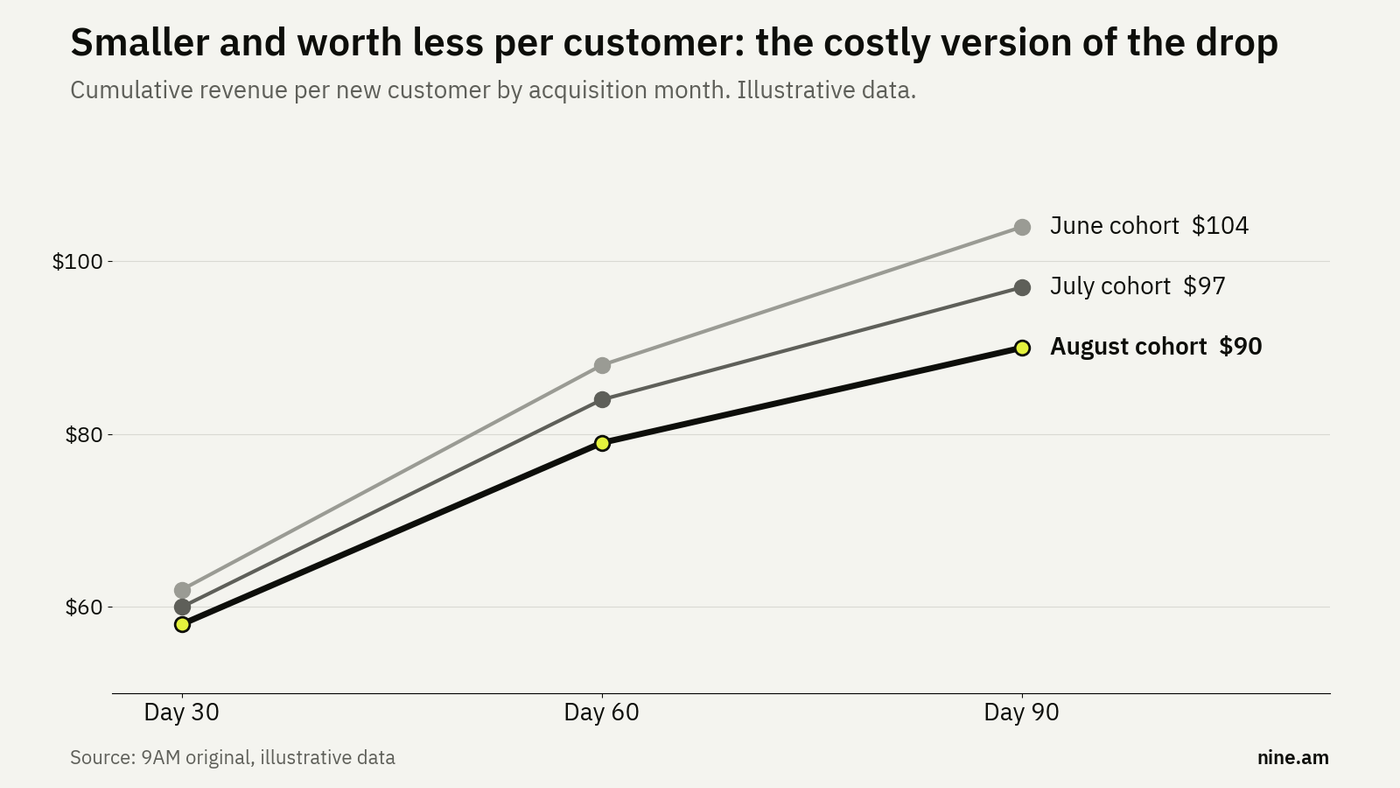
Cumulative revenue per new customer by acquisition cohort. Source: 9AM original, illustrative data
If recent cohorts are both smaller and worth less per customer, the drop is real and costly. If they are smaller but worth more, the next question is whether the higher value covers the lost volume at your contribution margin.
Step 7: Test Incrementality Before Moving Budget
Test how many purchases Meta actually causes before you cut or move spend. Steps 1 to 6 tell you where credit is going; only an experiment tells you what the ads changed. When we scaled Dashing Diva's acquisition program, we judged each step on acquisition cost and brought it down 24% while doubling spend.
You have three options, from least to most effort:
Incremental attribution column. In Ads Manager, Meta offers standard or incremental attribution; add the incremental view through Compare Attribution Settings and look at the gap against standard credit. Use this modeled estimate to decide what to test next; Conversion Lift and geo tests give you the experimental check.
Conversion Lift study. Meta's lift tests randomly hold out a control group that never sees the ads, which gives a causal estimate for the campaigns you choose.
Geo test. Turning spend on or off by region measures the effect on total store revenue, including first orders. Our guide to geo-lift testing covers the setup.
This is where multi-touch attribution tools reach their limit: they redistribute credit, while a holdout measures the purchases the ads added.
What to Change in Meta After the Investigation
Change the signal Meta optimizes for and the targets you judge it on, based on what the investigation found. Most accounts need one or two of the changes below.
Finding | Change in Meta | Change in reporting |
|---|---|---|
Existing customers take a large share of prospecting spend | Exclude existing customers from prospecting ad sets | Report new-audience spend share weekly |
Purchase value includes renewals or returning orders | Send a new-customer purchase event | Report ncROAS next to platform ROAS |
Lift test shows low incrementality | Cut or cap the weakest campaigns | Set budget by incremental return |
New cohorts are worth more per customer | Keep the setup, raise the nCAC ceiling | Report 90-day cohort value |
Send Meta a New-Customer Purchase Signal
Send Meta a purchase event that only fires for first orders, so the algorithm has a new-customer goal to chase. The usual route is a purchase event from the Conversions API carrying a parameter such as customer_type=new, then a custom conversion built on that parameter.
Optimizing toward that event, with a ROAS goal set on new-customer value, points delivery at first orders. Expect fewer reported purchases and a lower platform ROAS, because Meta stops counting the easy repeat buyers toward the goal.
Pro tip: Keep the reporting separate, though. The first-order conversion excludes repeat purchases, but standard purchase columns can still include them. Changing the optimization goal doesn't turn platform ROAS into ncROAS.
If you'd like help setting this up, our media buying team builds new-customer signals and the reporting around them as part of account management.
Split Prospecting and Retention Budgets and Targets
Split prospecting and retention into separate budgets with separate targets. With the existing-customer cap gone, the manual version is to exclude your existing-customer audiences from prospecting ad sets, or to run two ad sets with spending limits on the warm one.
Then judge each budget on its own number:
Prospecting: ncROAS or nCAC against a ceiling set from contribution margin.
Retention: platform ROAS and repeat purchase rate, with a lower spend cap.
Our work with The Farmer's Dog followed this logic: the acquisition program was judged on new purchases, and our creative testing delivered 30% more purchases at a 15% lower cost per acquisition.
Report New-Customer Revenue Weekly Alongside MER
Add new-customer revenue and nCAC to the weekly report, next to MER and platform ROAS. Seeing them side by side catches the next drift within a week or two.
MER tells you whether total marketing spend is paying off; new-customer revenue shows whether that spend is still buying growth underneath it.
When Rising ROAS With Fewer New Customers Is Not a Problem
Rising ROAS with fewer new customers is fine when the shift was planned and the margin still works. Four situations usually explain it:
A deliberate retention push. Moving budget to win-back or replenishment campaigns should lift ROAS and lower first orders. Our guide to retention for acquisition teams covers how to budget for it.
Seasonality. First orders tend to dip after peak season while repeat buyers keep purchasing.
A price or offer change. Ending a first-order discount usually cuts new customers and raises order value.
Higher-value cohorts. Step 6 showed fewer new customers who are worth more.
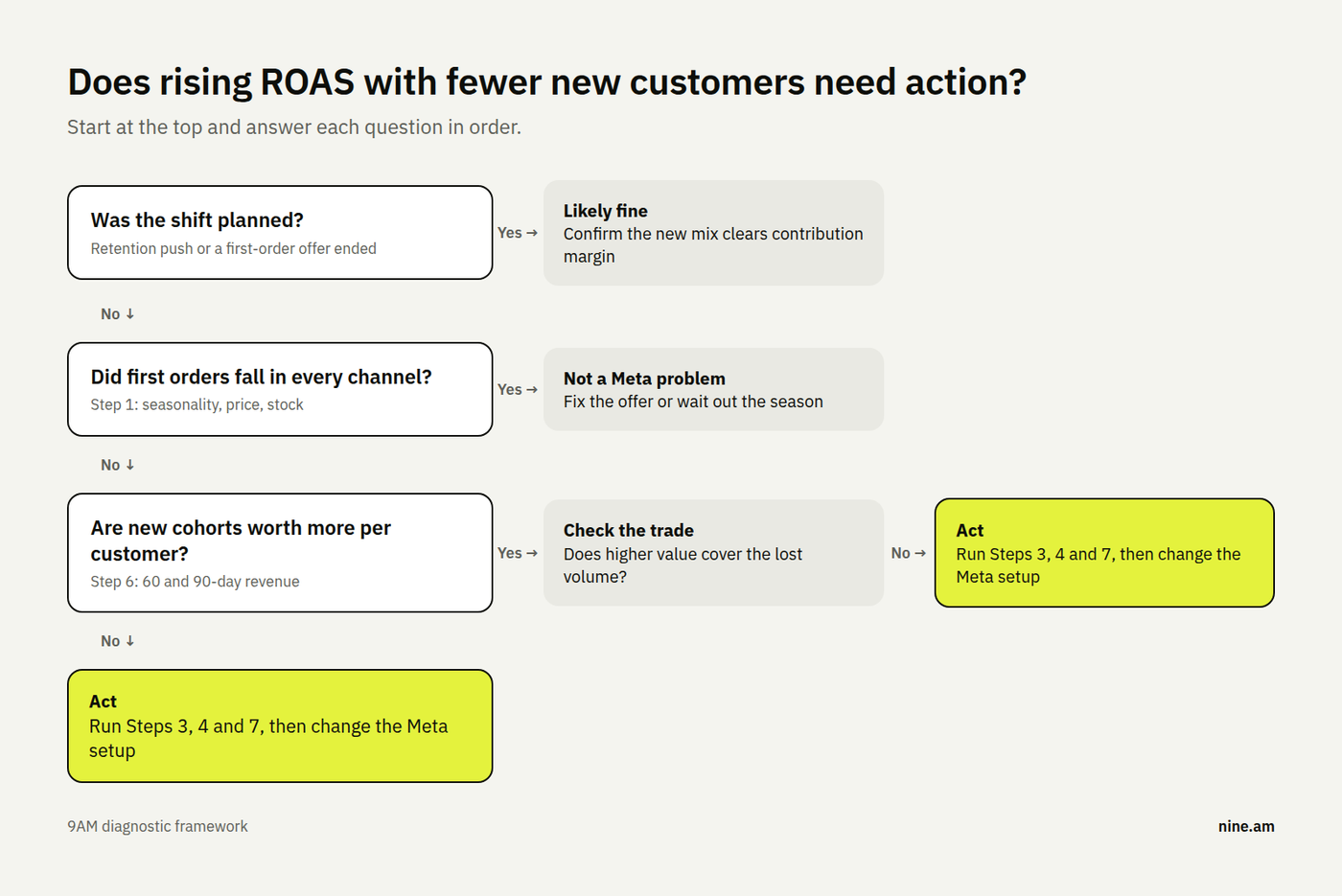
Decision tree for judging whether the gap needs action. Source: 9AM original
In each case, check the result against profit margin. Our guide to contribution margin shows how to test whether the new mix still pays for itself.
Grow New-Customer Revenue on Meta with 9AM
A rising Meta ROAS with falling first orders is a measurement and delivery problem, and it has a clear order of checks. Most of the fix is in the signal you send Meta, the way you split budgets and the numbers your weekly report puts in front of the team.
At 9AM, our media, creative and analytics teams work closely together, so delivery drift, revenue definitions and cohort value get checked together.
We set new-customer targets from contribution margin, build the reporting finance trusts, and run lift tests before allocating your budget.
Book a strategy call and we'll walk through your audience segment breakdown, the new-customer signal you're sending Meta, and where the gap in your account is coming from.
FAQs
Should Advantage+ sales campaigns and manual prospecting share one new-customer ROAS target?
No, set a separate target for each. Advantage+ campaigns usually carry more warm traffic, so the same ncROAS can hide a different mix of buyers. Base each target on that campaign's own audience segment breakdown and lift results.
How should a lapsed customer who returns after a year be counted?
Count them as returning in store data, then track them as a separate reactivated group if win-backs matter to your model. Lumping them into new customers inflates acquisition results; dropping them entirely hides a real source of revenue that Meta can influence.
Does excluding existing customers from prospecting hurt Meta's optimization?
It reduces the conversion volume Meta learns from, so expect a higher reported cost per purchase at first. If the new-customer event still records enough weekly conversions to exit learning, the trade is usually worth it, because the campaign optimizes toward the buyers you actually want.
How long should a new-customer ROAS test run before changing budget?
Run it for at least two full purchase cycles, and no less than four weeks for most ecommerce brands. Shorter tests overweight early buyers who were already close to purchasing, which flatters the old setup.
About Mustafa Alkhtab
Mustafa Alkhtab is Head of Performance Media at inBeat Agency, where he oversees paid media and performance creative results across the agency's accounts. Before inBeat Agency, he built growth programs for ecommerce, lead generation, and mobile app businesses in international markets. He writes about media buying, measurement, and conversion rate optimization.
More from Mustafa Alkhtab