Mental Health Marketing: Turn Patient Questions Into Better Ad Briefs
Turn cost, insurance and first-appointment questions into mental health ad briefs that pass Meta and Google rules and lead to booked therapy sessions.

· 19 min read
Many people who click a therapy ad already know they want help. What stops them is practical: what it costs, whether their insurance applies, how soon they can start and what the first session involves.
The gap between wanting care and getting it is large.
Mental Health America's 2025 report found that 1 in 4 adults with any mental illness reported an unmet need for treatment in 2022 and 2023.
This guide shows how to turn those customer pain points into ad briefs, within Meta and Google rules, and how to judge which message earns booked sessions.
P.S. Want mental health creative that keeps improving against booked appointments? Our healthcare paid social team runs that loop with you, round after round. Book a strategy call today.
We read ad comments, intake calls and search terms as live research, because they show the question a person needed answered before they booked. Platforms no longer let advertisers target people by health interest, so the message inside the creative decides who responds. Media buying then shows which answer earns a booking.
What Is Mental Health Marketing?
Mental health marketing is the promotion of therapy, psychiatry and other behavioral health services to the people who need them, through ads, content, referrals and reviews. Behavioral health marketing is the same practice under a broader name that includes substance use care.
Four constraints set it apart from other service marketing:
Stigma: many people hesitate to be seen engaging with mental health content.
Privacy: health data on sites and in ad platforms carries legal and platform limits.
Clinical ethics: codes such as the APA's restrict how clinicians use testimonials.
Platform rules: Meta and Google limit health targeting and condition-based copy.
This guide focuses on paid acquisition for mental health platforms and group practices. The table shows where each channel fits and the question its message has to answer.
Channel | Role in patient acquisition | Question the message must answer |
|---|---|---|
Paid search | Captures people already looking for care | Is it covered, and can I start soon? |
Paid social | Reaches people before they search | What will it cost, and what is the first session like? |
Creators and UGC | Shows the getting-started process in a familiar voice | What actually happens after I sign up? |
SEO and content | Educates people researching symptoms and options | Is this the right kind of help for me? |
Referral partners | Brings patients from doctors, employers and EAPs | Does this provider accept my plan or benefit? |
Review sites and directories | Supports the final trust check | Do people like me have a good experience here? |
Community events and talks | Builds local trust through schools, employers and community groups | Is this service for people like me? |
Print, radio and TV | Builds awareness with audiences who use fewer digital channels | How do I get started, and is it covered? |
Digital channels are easier to connect to booked sessions, while community events, print and broadcast are harder to track but reach people who don't search for help online.
SEO, content programs, referral partnerships and offline channels deserve their own playbooks, so they appear here only as context for the paid channels.
Why Cost, Insurance, and First-Appointment Questions Drive Mental Health Ad Results
Practical questions drive results because they are what stands between a person who already wants care and a booked session.
The demand exists: 23.4% of US adults, more than 60 million people, experienced a mental illness in 2024, according to Mental Health America’s federal survey data we cited above. In MHA's 2022-2023 data, 9.2% of adults with a mental illness were uninsured.
Those people carry the same few questions into every ad they see:
Cost: what a session costs with and without insurance.
Coverage: whether their plan or employer benefit applies.
Speed: how soon they can see someone.
The first session: what happens, how long it lasts and whether they can switch therapists.
Platform rules make these questions one of the strongest targeting tools left.
That’s because Meta removed detailed targeting options tied to health causes on January 19, 2022, and Google blocks advertiser-curated audiences such as Customer Match and lookalikes for sensitive interest categories. So with fewer audience controls, the question an ad answers selects who stops to read it.
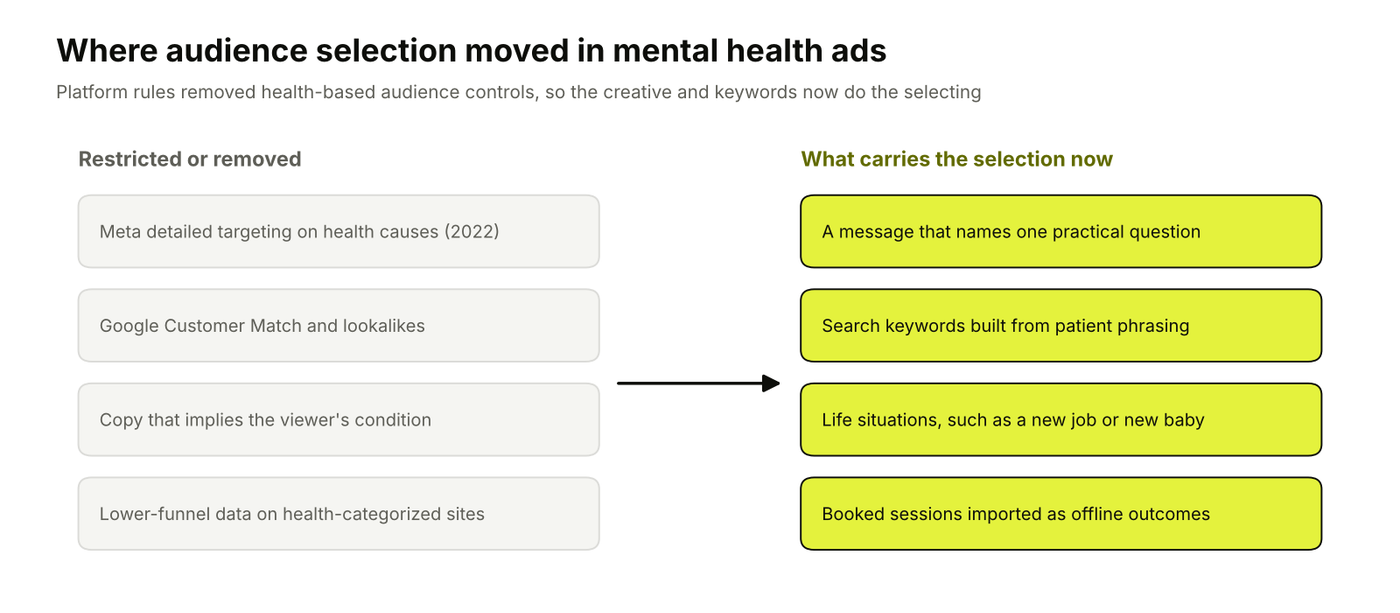
With health targeting restricted, the message and the keywords do most of the audience selection. Diagram by 9AM.
That makes the brief the main lever for mental health ads.
The next section shows how to build one, from the questions patients ask to the metric each message has to move.
How to Turn Patient Questions Into Mental Health Ad Briefs, Step by Step
Turn patient questions into ad briefs in seven steps: collect the questions, rank them, pair each with a message and proof, check the platform rules, pick the messenger, write the brief and set the metric. Each step feeds the next, so run them in order.
Step 1: Collect the Questions Patients Ask Before Booking
Collect questions from the places people ask them before they book. Each source shows a different moment in the decision:
Scheduling and intake calls: the questions asked right before booking.
Support tickets from new clients: confusion about cost, coverage and matching.
Ad comments: objections raised in public, often about price or legitimacy.
Search terms reports: phrasing such as "therapist that takes Aetna" or "therapy cost without insurance."
Post-booking surveys: a short "what almost stopped you?" question after a session is booked.
Our guide to post-purchase surveys covers how to word that question and code the answers.
Keep this research at the theme level. Export counts of question types, never patient-level records, and keep notes free of names, conditions and contact details.
Step 2: Rank the Questions by Booking Impact and Answerability
Rank each question on two things: how often it blocks a booking, and whether the business can answer it truthfully today. A frequent question you can't answer yet belongs with operations before it reaches an ad brief.
Question | Where it shows up | How often | Can the business answer it truthfully? | Evidence available |
|---|---|---|---|---|
How much does a session cost without insurance? | Ad comments, intake calls | High | Yes, if self-pay prices are fixed | Published price list |
Is my insurance plan accepted? | Search terms, intake calls | High | Yes, by payer and state | In-network payer list |
How soon can I start? | Intake calls | Medium | Only with scheduling data | Median days to first session |
What happens in the first session? | Support tickets | Medium | Yes | Clinical lead's description |
Can I switch therapists? | Ad comments | Low | Yes, if the policy allows it | Written switching policy |
Rows are illustrative. Replace the frequency column with your own counts.
Step 3: Match Each Question to One Message and One Proof Point
Give each question one message and one proof point the business can document. Running several answers in one ad makes it hard to read which answer moved bookings.
Write the proof first, then the message. A message without documented proof is a claim the clinical or legal reviewer will remove later.
Patient question | Ad message | Proof | Landing page section that continues the answer |
|---|---|---|---|
How much does a session cost without insurance? | "One flat price per session, shown before you book" | Published price list | Cost and coverage block |
Is my insurance plan accepted? | "Check your coverage in two minutes" | Coverage check tool, payer list, median completion time | Coverage check above the form |
How soon can I start? | "Most new clients see a therapist within a week" | Share of new clients seen within 7 days, last 30 days | Availability statement |
What happens in the first session? | "Your first session: 50 minutes, by video, no prep needed" | Clinical lead's session description | How it works steps |
Messages are illustrative. Use only figures your own data supports.
The page has to finish the answer the ad starts. Our landing page alignment guide covers how to keep the ad's promise visible on the page.
Step 4: Write Mental Health Facebook Ads and Google Ads Within Platform Rules
Write every ad about the service and the people it serves. Meta's advertising standards state that ads must not contain content that asserts or implies personal attributes, including physical or mental health. "Are you struggling with anxiety?" implies the viewer has a condition. "Therapy for anxiety, covered by most major plans" describes the service.
Rule | What it blocks | Brief implication | Example wording |
|---|---|---|---|
Meta personal attributes | Copy that says or implies the viewer has a condition | Brief describes the service and who it serves | "Online therapy for anxiety and stress" |
Meta detailed targeting removal (2022) | Interest targeting on health causes | Creative carries the audience selection | Message names the life situation, such as a new job or a new baby |
Meta data source categories | Lower-funnel data sharing for sites categorized as health and wellness | Optimization may need upper-funnel events, with bookings judged in internal reporting | Plan measurement before launch |
Google restricted targeting | Customer Match, your data segments and lookalikes for sensitive categories | Search and predefined audiences carry most of the targeting | Keyword themes built from patient questions |
Google healthcare policy | Prescription drug services without certification | US telemedicine providers that facilitate prescribing need LegitScript and Google certification | Promote the consultation, with certification in place |
Meta can also categorize a telehealth site as health and wellness, which restricts the data it accepts. Google requires telemedicine providers that facilitate prescribing to hold LegitScript certification and Google healthcare certification.
Have a clinical reviewer and a policy reviewer sign off on each brief. Our list of healthcare PPC compliance questions sets out who reviews what, and how fast.
Step 5: Choose the Messenger and Format for Each Question
Match the messenger to the question. Each question has a person viewers trust most to answer it:
Clinician on camera: what happens in the first session, how matching works.
Client voice: cost, coverage and whether the service felt worth it.
Creator walkthrough: the sign-up and booking steps, filmed as they happen.
Founder or care lead: why the service is priced or structured the way it is.
Testimonials need care in this category.
The APA Ethics Code, Standard 5.05, says psychologists don't solicit testimonials from current therapy clients or from others vulnerable to undue influence. The FTC's rule on reviews and testimonials also makes the business responsible for testimonials it features in ads.
Creators should describe their own real experience.
A creator who has never used the service, or never had the condition named, can't present either as their own story. Our guide to UGC creator briefs covers the brief fields that keep creators accurate.
Also, make sure you respect your customers’ privacy when sharing stories from your practice.
Step 6: Assemble the Brief With Mental-Health-Specific Fields
Add mental-health-specific fields to your standard brief: the patient question, the proof, the required disclaimers and the clinical reviewer. Here is one filled brief for a single question.
Patient question: How much does therapy cost without insurance?
Message: One flat price per session, shown before you book.
Proof: Published self-pay price list, dated.
Messenger: A care lead. Feature a former client only after clinical and legal review confirms the testimonial is allowed.
Format: 20-second vertical video, price shown on screen in the first 3 seconds.
Required disclaimers: Price excludes psychiatry; insurance pricing varies by plan.
Words to avoid: Any phrase implying the viewer has a condition.
Clinical reviewer: Named clinical lead, sign-off before production.
Success metric: Coverage or price check started, then booked first session.
Note: These brief values are illustrative.
If your team wants these briefs built and tested alongside the media plan, our creative strategy service runs that work from question research to iteration.
Step 7: Define the Metric a Winning Message Must Move
Judge each message on the booking event it is meant to move, measured in order:
Hook rate: the share of viewers who watch past the first seconds.
Coverage or price check started: the first sign the answer landed.
Booking started
First session booked
First session attended
Attention metrics show whether the question stopped the scroll. Read hook rate and CTR as diagnostics, because a viewer who absorbs a cost answer may book later through search or a direct visit. A message wins only when it also lifts booked and attended sessions.
Health and wellness data restrictions on Meta can block optimization on lower-funnel events such as bookings.
Pro tip: Judge campaigns on aggregate counts of booked and attended sessions in your own reporting. Uploading those outcomes to a platform is a separate decision that needs a privacy review against HIPAA and the platform's data policies.
Test one question per test cell, so each result maps to one answer. Then feed the winner into the next brief, along with a note on what the test showed.
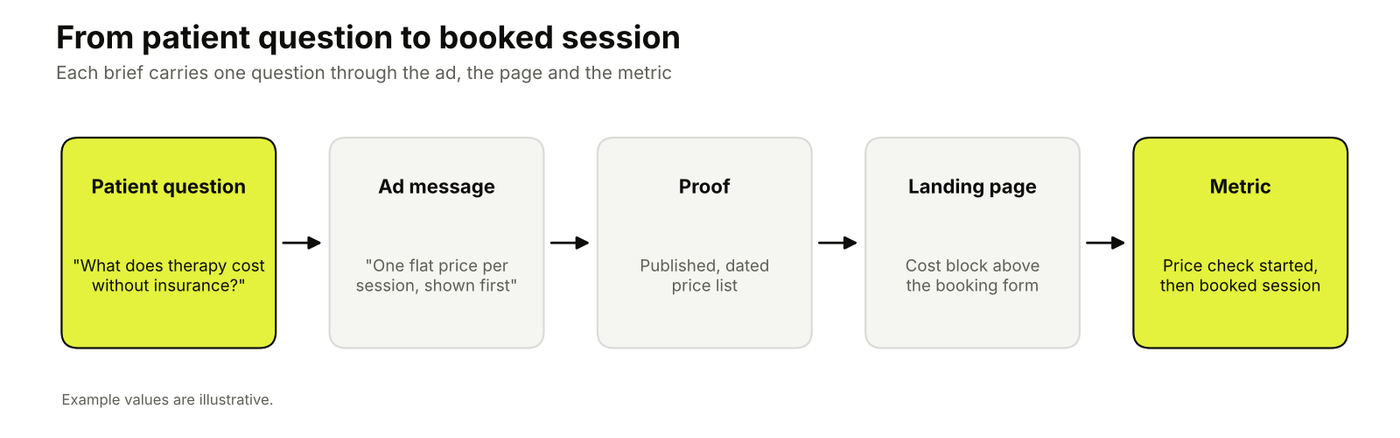
One brief carries one question from the ad to the booked session. Example values are illustrative.
Mental Health Marketing Best Practices
Mental health marketing best practices cover the parts of acquisition that the brief process doesn't: who you target, what your site says, how you show up in local search and how you handle public feedback.
Each one answers the next question a person has after they see an ad or search for care.
Choose a Specific Audience and Service
Pick the audience and service you can serve best, and write for that group: new parents, college students, couples or adults covered by one employer plan. A clear niche sharpens the practical questions, because cost, coverage and first-session concerns differ for each group.
Show Fees, Approach and Providers on the Site
Put service types, fees, the therapy approach and clinician backgrounds where a visitor sees them first. Research backs this.
In a 2024 study of 57 college students reviewing real university clinic websites, participants engaged more with sites that explained services, costs and therapist backgrounds in plain language, and lost interest when sites used jargon or left fees unclear.
The same students asked for:
Clinician details, including specialties, languages and diverse staff photos.
Clear steps to start care and what to bring to a first session.
Crisis numbers on the site.
Information in the languages their communities speak.
Keep Your Google Business Profile Accurate
Keep your Google Business Profile complete and current, because local searches such as "therapist near me" often end there before a website visit.
Match the name, address and phone number to your site, list the services and insurance you accept, and state whether you offer telehealth.
Answer Online Reviews Without Confirming Anyone Is a Patient
Reply to reviews in general terms, and never confirm that the reviewer is a patient. Otherwise, penalties can be severe.
In 2023, HHS's Office for Civil Rights settled with Manasa Health Center, a New Jersey psychiatric practice that paid $30,000 after disclosing a patient's health information in a reply to a negative online review.
A safe reply thanks the reviewer, states the practice's general policy and invites them to contact the office directly, with no details about care.
Publish Educational Content With Clinical Review
Publish content that explains conditions, treatment options and what therapy involves, and have a clinician review it before it goes live.
Educational posts give people who aren't ready to book a reason to come back, and they answer questions an ad has no room for.
Mental Health Campaign Examples
The four campaigns below show what works and what fails in mental health marketing. The first two are brand campaigns highlighted by GWI, and the last two are FTC cases that show how acquisition tactics went wrong. Each one has a lesson for a care provider's ad brief.
1. Calm: 30 Seconds of Silence
During US election night coverage on November 5, 2024, the meditation app Calm bought 30-second ad slots on networks including CNN and ABC and used them to run 30 seconds of silence.
What works well
The message matched the moment. GWI found that just over 4 in 10 Americans said in July 2024 that they were extremely concerned about the election result, so a pause reached an audience that was already anxious.
What could be improved
The spot had no next step beyond the brand name. A care provider can borrow the timing, tying an ad to a moment the audience recognizes, such as a new school term or a job change, and add the practical answer: how soon a first session is available and what it costs.
2. Maybelline: Brave Together
Maybelline's Brave Together program, run with the youth charity Ditch the Label, includes an ad about a girl whose confidence drops under social media pressure. It ends with a friend pointing her to Ditch the Label for support.
What works well
The ad moves from a problem to a specific place to get help, and the partner charity gives the message credibility a cosmetics brand lacks on its own. GWI reports that 18% of Gen Z say social media causes them anxiety, so the story is familiar to the people it targets.
What could be improved
The story runs on emotion. A care provider's version needs the practical answers too, such as cost, coverage and how fast someone can talk to a counselor, because a viewer who relates to the story still has to decide whether to book.
3. BetterHelp: Health Data Used for Ad Targeting
In March 2023, the FTC issued a proposed order requiring BetterHelp to pay $7.8 million to consumers and banning it from sharing health data for advertising.
What went wrong
According to the FTC, BetterHelp promised to keep health information private, then shared email addresses, IP addresses and intake questionnaire answers with Facebook, Snapchat, Criteo and Pinterest for advertising. It used the fact that people had been in therapy to have Facebook find similar users and target them with ads.
What to do instead
Treat customer lists, lookalike audiences and retargeting built from people who used a mental health service as a legal risk, however well they perform. Keep intake data out of ad platforms unless privacy counsel has confirmed the consent and the use.
4. Cerebral: Tracking Tools and Postcards
In April 2024, the telehealth company Cerebral agreed to an FTC order that bans it from using health information for most advertising and requires it to pay more than $7 million.
What went wrong
The FTC said Cerebral shared sensitive information on nearly 3.2 million consumers with platforms such as LinkedIn, Snapchat and TikTok through tracking tools on its website and apps.
It also mailed promotional postcards, without envelopes, to more than 6,000 patients with wording that appeared to reveal their diagnosis and treatment, and it made cancelling hard after promising easy cancellation.
What to do instead
Audit every tag on sign-up and booking pages, apply the same privacy rules to mail and other offline channels as to ads, and make cancelling as simple as signing up.
Mental Health Marketing Mistakes That Get Ads Rejected or Ignored
Most mental health advertising mistakes come from copying tactics that work in other categories: urgency, transformation claims, stock imagery and borrowed testimonials. The platform rules in Step 4 catch some of them. The rest cost trust, and the table below covers those.
Mistake | Why it fails | Fix |
|---|---|---|
Outcome guarantees ("feel better in 30 days") | Unsupported clinical claims, and a broken promise for anyone who doesn't improve | Describe the care process and cite outcome data with its measure and population |
Crisis-adjacent hooks without resources | Can reach people in acute distress with a sales message | Keep acute-distress language out of hooks, and show 988 and 911 on the landing page |
Stock photos of distress | Reads as staged and reinforces stigma | Show real clinicians, real interfaces and ordinary moments |
Availability promises the schedule can't meet | Bookings fall apart when the first slot is weeks away | Tie speed claims to the last 30 days of scheduling data |
Testimonials without consent or context | Breaks clinician ethics codes and FTC rules | Use client stories only after clinical and legal review confirms they're allowed |
One ad answering every question | No result can be traced to a single answer | One question per creative, one question per test cell |
When a message passes review and still underperforms, test it in a structured way before you rewrite the brief. Our guide to creative testing systems shows how to set hypotheses, cells and a learning log. Change one variable per round, so the next brief knows what moved.
Build Mental Health Ad Briefs That Convert With 9AM
Mental health ads convert when they answer the practical question a person brings: cost, coverage, speed or the first session. The brief decides which question each ad answers, the platform rules decide how it can be said, and booked sessions decide which answer stays.
We run that as a cycle.
Each round tests one answer per cell, moves budget toward the answers that produce booked sessions and uses the results in the next set of briefs.
Our healthcare performance creative team runs that cycle with mental health platforms and group practices for the long term. Each round adds to a record of which answers bring in clients who book and attend, and that record shapes the creative, the media plan and the next stage of growth.
Book a strategy call to plan a testing program that keeps improving how your service attracts and books new clients.
FAQs
Can a mental health ad name a condition like anxiety without breaking Meta's personal attributes policy?
Yes, when the copy describes the service and doesn't assert anything about the viewer. "Online therapy for anxiety" names a condition the service treats. "Is your anxiety getting worse?" implies the viewer has it, which Meta's personal attributes policy prohibits.
Should therapy ads lead with price when most patients will use insurance?
Lead with the answer most of your bookings depend on. If most clients use insurance, lead with coverage and show self-pay pricing on the landing page. Test a price-led variant for audiences with high-deductible plans or no coverage.
Can a mental health brand use member testimonials in paid social ads?
Sometimes, and written consent alone isn't enough. The story has to be truthful, pass clinical and legal review and fit professional ethics rules. Psychologists are bound by APA Standard 5.05, which bars soliciting testimonials from current therapy clients. The FTC rule makes the business responsible for testimonials it features.
How do you optimize Meta campaigns once the site is categorized as health and wellness?
Optimize to the deepest event Meta still accepts for that data source, often an upper-funnel event such as a landing page view. Then judge campaigns on booked and attended sessions counted in your own reporting, and review any plan to upload those outcomes against privacy rules and platform policies before you build it. Check the category in Events Manager and request a review if it looks wrong.
How many patient questions should one creative test cover?
One. A test cell that answers both cost and speed can't tell you which answer moved bookings. Run separate cells per question and compare them on booked first sessions.
What are the 5 Cs of mental health marketing?
The 5 Cs of mental health marketing are connection, compassion, clarity, consistency and credibility, a framework adapted for marketing by LMR. Clarity and credibility matter most for paid acquisition: say what you offer, who it's for and how to start, and back claims with credentials and consented reviews. "5 Cs" has other meanings in psychology, so define the term when you use it with clinical teams.
What are the 3 Ps of mental health?
In marketing, the 3 Ps of mental health are prevention, promotion and protection. Prevention and promotion fit educational content that normalizes care, and protection covers the platform rules, privacy practices and review handling described above.
What are the 5 Ps of healthcare marketing?
The 5 Ps of healthcare marketing are product, price, place, promotion and people. For a mental health service, they are the type of care, the cost with and without insurance, where care happens (in person, online or both), the channels that reach patients and the clinicians who deliver care. Price and place answer two of the practical questions this guide is built around.
About Mustafa Alkhtab
Mustafa Alkhtab is Head of Performance Media at inBeat Agency, where he oversees paid media and performance creative results across the agency's accounts. Before inBeat Agency, he built growth programs for ecommerce, lead generation, and mobile app businesses in international markets. He writes about media buying, measurement, and conversion rate optimization.
More from Mustafa Alkhtab