Patient Acquisition Cost: Why Cheap Leads Can Mean Costly Patients
Calculate patient acquisition cost on attended first appointments, read benchmarks with their sample sizes, and lower cost without cutting qualified demand.

· 12 min read
A healthcare campaign can report a healthy cost per lead while new patient numbers stay flat.
The gap opens between the first inquiry and the first visit: people fail to connect, fail to book or never show up, and each loss raises what one real patient costs.
The last of those losses is large on its own. A systematic review of 105 studies found an average no-show rate of about 23%, so roughly one booked appointment in four never happens.
This guide shows how to calculate patient acquisition cost on attended first appointments, how to read published benchmarks and how to lower the number without starving qualified demand.
P.S. Want growth decisions built on patients who actually attend? Our healthcare marketing analytics team sets up that measurement and stays on to grow the program with you. Book a strategy call.
At 9AM, we judge healthcare spend on attended first appointments. Cost per lead in an ad platform shows early whether creative and targeting work, and the number of patients who attend decides the next budget split and the next creative brief.
What Is Patient Acquisition Cost?
Patient acquisition cost (PAC) is the total spend required to acquire one new patient. The basic formula is acquisition spend divided by the number of new patients acquired in the same period.

Acquisition spend usually includes media spend, agency fees, software and the staff time spent on new-patient inquiries. Step 2 sets out which costs belong in each version of PAC.
Patient acquisition covers the whole path from the first ad impression to the first visit, so the result depends on what you count as the finish line.
That is why the patient acquisition cost formula only means something once "new patient" is defined.
Teams use four different denominators:
Leads
Qualified inquiries
Booked appointments
Attended first appointments
Each denominator produces a different funnel metric: spend divided by leads is cost per lead, and spend divided by bookings is cost per booked appointment. In this guide, PAC means acquisition spend divided by new patients who attend their first appointment. The gap between these metrics is where cheap leads turn expensive.
Why a Cheap Lead Can Still Produce an Expensive First Appointment
A cheap lead can produce an expensive patient because each stage after the lead loses people, and channels lose them at different rates. A channel that fills the top of the funnel cheaply, in many cases fills it with inquiries that don't qualify, don't book or don't attend.
The losses start at first contact.
In Patient Prism's 2026 vendor data, 64.63% of calls connected and 53.89% of new-patient callers booked an appointment. Then roughly 23% of booked appointments are missed, per the systematic review cited above.
The table compares two channels with the same spend. The figures are illustrative.
Stage | Channel A | Channel B |
|---|---|---|
Spend | $10,000 | $10,000 |
Leads | 500 | 250 |
Cost per lead | $20 | $40 |
Qualified inquiries | 200 (40%) | 175 (70%) |
Booked appointments | 70 (35% of qualified) | 105 (60% of qualified) |
Attended first appointments | 52 (74% of booked) | 84 (80% of booked) |
PAC on attended first appointments | $192 | $119 |
Channel A's leads cost half as much, and its patients cost about 62% more. Budget moved toward Channel A on cost per lead would buy fewer patients.
That gap is why we usually judge creative, landing page and channel tests on the cost of each attended patient, and treat cost per lead as an early check.
How to Calculate Patient Acquisition Cost, Step by Step
Calculate PAC in six steps: define the new-patient event, set the cost scope, group patients into cohorts, let cohorts mature, calculate cost at each stage and break the result down by channel. The order matters, because a wrong definition in Step 1 carries through every number after it.
Step 1: Define the New-Patient Event
Define a new patient as a person who attends a first appointment, is new to the organization and receives care in a named service line. Booked appointments and leads are useful stages, but only attendance shows that acquisition happened.
Write the definition down and get operations and finance to sign it. Settle three edge cases in writing:
Returning patients: people seen before, after a long gap, stay out of the count.
Reactivated patients: former patients brought back by a campaign get their own metric.
Transfers between service lines: a therapy patient who adds psychiatry isn't a new patient.
Step 2: Set the Cost Scope for Paid PAC and Blended PAC
Decide which costs go into the numerator before you calculate anything. Paid PAC covers what paid acquisition costs. Blended PAC covers everything spent to acquire patients through every channel.
Cost item | Paid PAC | Blended PAC |
|---|---|---|
Media spend on paid channels | Yes | Yes |
Agency or freelancer fees for paid media | Yes | Yes |
Creative production for ads | Yes | Yes |
Call tracking and scheduling tools used for acquisition | Yes | Yes |
Intake staff time spent on new-patient inquiries | Optional, allocated | Yes, allocated |
SEO, content, referral programs and events | No | Yes |
Report both, and label which one each chart shows. Our comparison of blended CAC vs paid CAC explains when finance and marketing should each use which.
Step 3: Group Patients Into Cohorts by Inquiry Date
Assign each attended patient to the month of their first inquiry. Spend in March produces inquiries in March, but some of those patients attend in April or May.
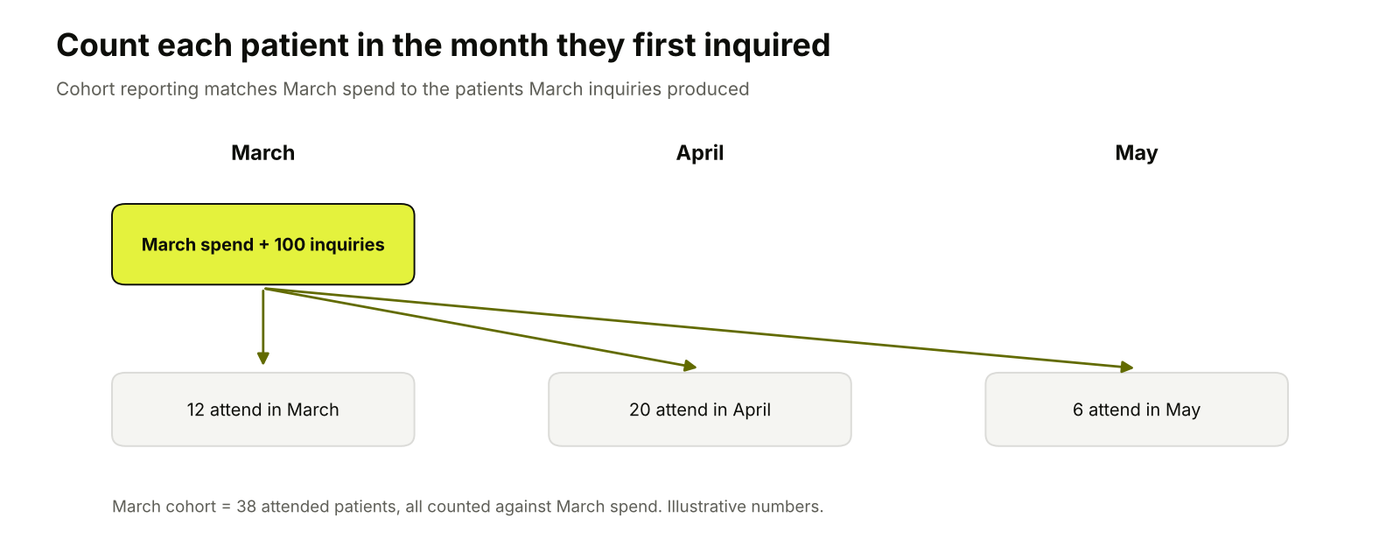
Cohort reporting keeps March spend matched to the patients March inquiries produced. Illustrative numbers.
Visit-month reporting pairs March spend with patients from February's inquiries. That mismatch makes PAC swing when spend changes, even when the funnel hasn't changed at all.
Step 4: Let Each Cohort Mature Before Reporting
Measure two lags before you report a cohort: days from inquiry to booking, and days from booking to the attended visit. Then hold each cohort until most of its expected appointments have taken place.
A workable rule: publish a preliminary PAC once a cohort has passed the 80th percentile of your historical inquiry-to-visit time, and update it as late visits arrive. At that point about one in five of the cohort's eventual patients may still be to come, so a preliminary figure can sit around 25% above the final one.
Our guide to Google Ads conversion lag shows the same pattern in platform reporting and how to set review windows from actual lag.
Step 5: Calculate PAC at Each Funnel Stage
Divide the same spend by each stage's count to see where cost multiplies. Using Channel A from the table above:
Cost per lead: $10,000 / 500 = $20
Cost per qualified inquiry: $10,000 / 200 = $50
Cost per booked appointment: $10,000 / 70 = $143
PAC on attended first appointments: $10,000 / 52 = $192
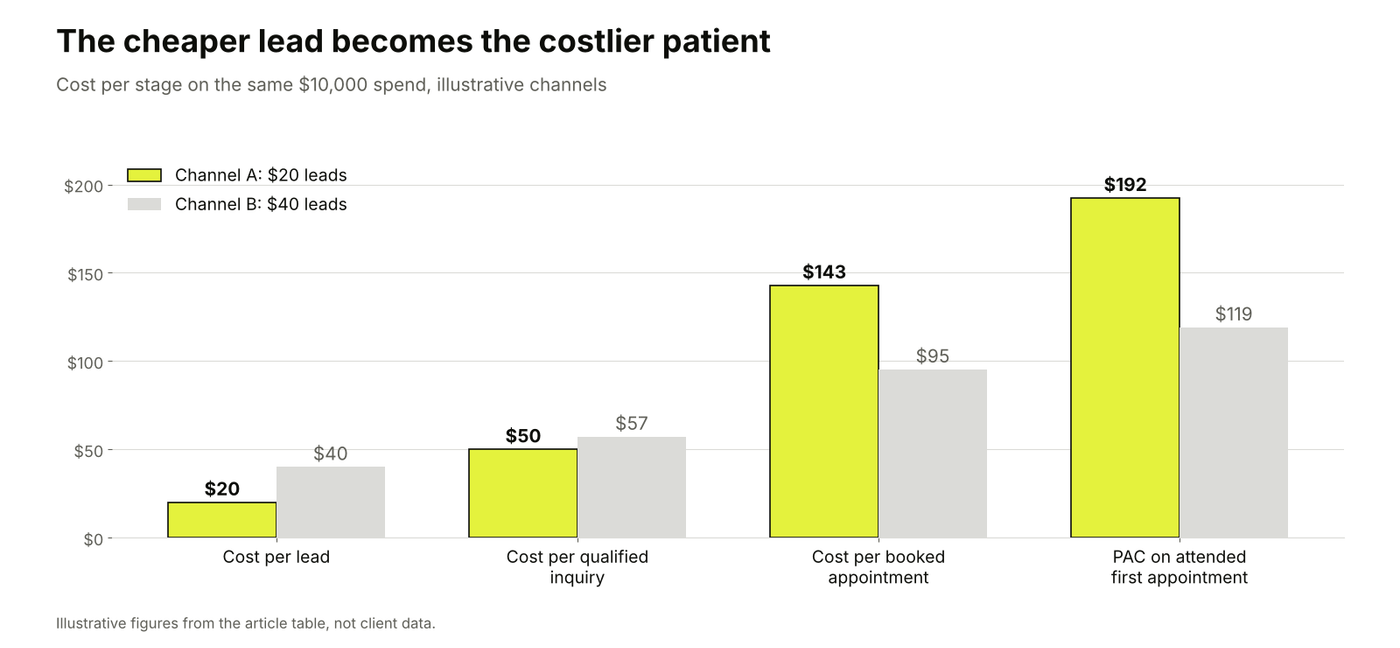
Channel A wins on cost per lead and loses from the booking stage on. Illustrative figures.
The largest jump in Channel A sits between qualified inquiry and booking, where cost almost triples. That is the first stage to investigate. A large cost jump shows where patients drop out, and whether a fix there pays back best depends on what the fix costs. Our funnel leak analysis shows how to value each drop-off by the patients a realistic fix would add.
Step 6: Break PAC Down by Channel, Campaign, Service Line, and Payer Type
Split PAC by the dimensions budget decisions depend on: channel, campaign, service line and payer type. Each split needs outcome data from your scheduling system or CRM joined to the source of the first inquiry. Without that join, PAC stays a blended guess.
Keep the join privacy-safe. Report aggregate counts per channel and cohort, approve every field that leaves the scheduling system, and keep diagnoses and visit reasons out of marketing tools.
Our guide to HIPAA-compliant marketing covers the tracking architecture.
Two rules keep the splits honest:
Small patient counts: treat channel comparisons built on a few dozen attended patients as directional, because a handful of no-shows can swing them. Extend the reporting window and check how much the figure moves from month to month before you reallocate budget.
Payer mix: report self-pay and insured patients separately, because their value and booking rates differ.
What Is a Good Patient Acquisition Cost?
A good patient acquisition cost is one that patient lifetime value comfortably covers, and published benchmarks only help as a rough starting point. Most of them rest on small samples and never say whether "new patient" means a lead, a booking or an attended visit.
First Page Sage's 2026 benchmarks show the problem clearly, because they publish how many practices sit behind each figure.
Practice type | Reported PAC | Practices reporting |
|---|---|---|
Psychiatry | $293 | 5 |
Family practice | $272 | 17 |
General practice | $201 | 19 |
Source: First Page Sage, Average Patient Acquisition Cost 2026. Figures are agency-reported.
A psychiatry figure drawn from five practices can move a long way when one practice is added. Use these numbers to sense-check order of magnitude, never as a target.
The better test compares PAC with what a patient is worth:
Patient lifetime value: contribution from a patient across their expected visits.
Contribution margin: revenue per visit minus clinician pay, billing costs and payer adjustments.
Payback period: how many visits it takes to earn back the PAC.
Relias cites a 3:1 ratio of lifetime value to acquisition cost as a common rule of thumb. Take it as a heuristic, because a high-retention therapy service and a one-visit urgent care offer sit at very different ratios.
Estimating lifetime value well takes enough history.
Early cohorts overstate or understate value until most patients have finished their first course of care, so set targets from cohorts old enough to show typical visit counts.
Margin matters as much as revenue, since payer mix changes what each visit earns. Our walkthrough of contribution margin for marketing shows which costs to subtract before setting a PAC ceiling.
How to Lower Patient Acquisition Cost Without Cutting Qualified Demand
Lower PAC by fixing the stage where cost multiplies, while you keep funding the channels that bring qualified patients. Each H3 below targets one stage of the funnel from Step 5.
Raise Inquiry Quality at the Ad and Landing Page
Raise the share of inquiries that qualify by answering eligibility, cost and coverage before the form. An ad that states the service area and payers screens out people the practice can't treat, and a landing page that repeats those answers keeps the screen in place.
Track qualified-inquiry rate by ad group. A rising rate with steady volume lowers every cost after it.
Answer and Route New-Patient Inquiries Faster
Shorten the time between inquiry and first contact, because unanswered inquiries rarely book. Route calls and forms by service line, staff the hours when inquiries peak and set a response standard for each channel.
Our research on lead response time shows how to measure the gap between inquiry and first contact and where delays cost the most.
Reduce No-Shows at the First Appointment
Cut no-shows with steps that make the first visit easy to keep:
Confirmation: send a confirmation right after booking, with the date, time, format and what to prepare.
Reminders: send reminders by the patient's chosen channel before the visit.
Rescheduling: offer a one-click way to move the appointment, so a conflict becomes a new slot.
Lead time: offer earlier first appointments where capacity allows, since longer waits are linked to more missed visits.
Each attended visit saved lowers PAC without any change in spend.
Shift Budget on Attended-Patient PAC
Move budget using PAC on attended first appointments, read by matured cohort. Channels that look cheap on cost per lead tend to lose that edge once qualification, booking and attendance are counted.
Use attended-patient outcomes in internal reporting to guide budget decisions. Sending them to ad platforms is a separate decision: Google's customer data policies bar conversions related to health from enhanced conversions and store sales uploads, and an appointment tied to an identifier can be protected health information. Before you set up offline conversion uploads or value-based bidding, have privacy counsel confirm that the specific data flow is allowed under HIPAA and each platform's policies. Our guide to value-based bidding explains when patient values are reliable enough to guide bids, once that review is done.
Measure Patient Acquisition Cost on Attended Appointments With 9AM
Patient acquisition cost becomes a decision tool once it counts attended first appointments, by cohort, against what a patient is worth. Cost per lead stays useful as an early signal for creative and targeting, and the attended-patient number decides where the budget goes.
That rule applies to every test we run, from new creative to a reworked booking page.
Healthcare adds privacy review and longer gaps between inquiry and visit, so the reporting takes more setup. The decision rule stays the same: fund what produces attended patients at a cost their value supports.
Our healthcare media buying team works with healthcare brands as a long-term growth partner. We run media, creative testing and measurement as one program, so each quarter's budget builds on what the last quarter's attended patients cost and were worth.
Book a strategy call to plan how your next year of acquisition grows attended patients at a cost your margins can carry.
FAQs
Should a telehealth subscription brand count a patient at the first visit or the first paid month?
Count at the first attended visit for PAC, and track first paid month as a separate conversion. Subscription brands lose people between the first visit and the first renewal in many cases, so report both and judge channels on the one tied to revenue.
Do reactivated former patients belong in the PAC denominator?
No. Reactivation is a different kind of acquisition, with its own costs and return patterns, so mixing it in blurs what new-patient acquisition costs. Give reactivation its own cost metric.
How should PAC handle patients who find the practice in an insurer directory after seeing an ad?
Ask new patients how they heard about you at booking, and count directory-sourced patients in blended PAC. Paid PAC may miss these patients, depending on the attribution method, which is one reason to report blended PAC beside it.
How long should a cohort mature before reporting PAC for mental health services?
Report a preliminary figure once the cohort passes the 80th percentile of your own inquiry-to-first-session time, and keep the preliminary label until the late visits arrive. Mental health services with waitlists can need several weeks, so measure your lag before choosing a reporting window.
Can PAC be reported by campaign without sending patient data to ad platforms?
Yes. Join scheduling outcomes to campaign source inside your own reporting, and report aggregate counts per campaign and cohort. Sending any of that data to ad platforms is a separate step, and aggregation by itself doesn't make it permitted, so have privacy counsel review the data flow against HIPAA and each platform's policies first.
About Mustafa Alkhtab
Mustafa Alkhtab is Head of Performance Media at inBeat Agency, where he oversees paid media and performance creative results across the agency's accounts. Before inBeat Agency, he built growth programs for ecommerce, lead generation, and mobile app businesses in international markets. He writes about media buying, measurement, and conversion rate optimization.
More from Mustafa Alkhtab