Best Pharmaceutical Marketing Agencies for Paid Media and Measurement
Pharma marketing agencies that plan, buy and measure HCP and DTC media, grouped by operating model, with script-lift and FDA notes.

· 15 min read
Most rankings of pharmaceutical marketing agencies are built around creative networks and medical communications shops. This shortlist covers a narrower group: agencies that plan, buy and measure paid media for prescription, OTC and telehealth brands.
That work runs on two tracks.
HCP campaigns use NPI lists, endemic publishers and point-of-care screens.
DTC campaigns use search, social, CTV and programmatic, inside FDA rules that the agency has enforced far more actively since 2025.
Agencies split these two tracks in different ways, so the list groups them by operating model.
Start with the group that fits your stage and budget, then compare proof inside it.
If a pharmaceutical marketing agency cannot show how it measures prescriptions, or qualified patients for a telehealth brand, treat it as a creative partner and keep looking for a media one.
Pharma Media Agencies Compared by Audience, Buying Model and Measurement
The ten agencies below fall into four operating models. Holding-company media agencies bring buying scale, independents bring senior teams, commercialization groups bring media and creative under one contract, and performance agencies bring acquisition metrics for DTC and telehealth brands.
Agency | Operating model | Primary audience | What it measures publicly |
|---|---|---|---|
9AM | Performance media agency | DTC, telehealth, consumer health | CAC, qualified patients |
Accelerated Digital Media | Performance media agency | Telehealth, trial recruitment | Qualified leads, cost per result |
PHM | Holding-company health media (Publicis) | DTC and HCP | Not published on site |
CMI Media Group | Holding-company health media (WPP) | DTC and HCP | Media inflation, audience reach |
Underscore | Independent pharma media | HCP-led launches, plus patients | First prescriptions, media waste |
Butler/Till | Independent, employee-owned | DTC and HCP | Reach efficiency, attribution |
Klick Media | Commercialization group | Patients and HCPs | Site actions, treatment starts |
EVERSANA INTOUCH Media | Commercialization group | HCP and patients | New prescribers, incremental revenue |
Real Chemistry | Commercialization group | Patients, HCPs, consumers | Search lift, closed-loop HCP data |
Fingerpaint Media | Commercialization group | HCP and rare-disease patients | Script lift, NPI-level reach |
Selection Criteria: Media Ownership, HCP Reach and Prescription Measurement
We kept agencies that plan and buy media themselves, show pharma or regulated-health proof on their own pages, and were active in 2026. Creative-led networks such as Ogilvy Health and Inizio Evoke were left out because their media buying sits with other agencies.
Every candidate was checked against the same points from our ranking methodology:
Media ownership. The agency, or its group's media unit, runs the plan and the buy.
Audience depth. Documented HCP targeting, DTC buying, or both.
Measurement. Published results tied to prescriptions, qualified patients or acquisition cost.
Current presence. A live site, 2025-2026 activity and a stated office.
9AM is part of the Fieldtrip network and publishes this article. It was scored on the same criteria. 9AM's healthcare work covers telehealth, mental health and consumer health, so it sits in the group built for those brands. The groups and the entries inside them are not ranked.
Pharmaceutical Marketing Agencies Grouped by Operating Model
Performance Media Agencies for DTC, Telehealth and Consumer-Health Brands
9AM
9AM connects paid media, creative and measurement around patient and customer acquisition for telehealth, mental-health and digital-health brands. The team runs Google, Meta, TikTok, Snapchat, CTV and programmatic, and for OTC and consumer-health products it also buys Amazon, Walmart Connect and Target Roundel media.
Before launch, 9AM separates inquiries, qualified prospects, bookings and attended appointments, so acquisition cost is reported against the outcome the business pays for. Claims, creative and data use are agreed with the client's clinical, legal and privacy teams before campaigns go live.
For consumer-genetics brand Genomelink, 9AM produced 70 unique assets a month across 6 creative formats, which cut CAC by 77% over more than three years. For Grow Therapy, creative concepts built around cost, insurance and getting started became formats the growth team kept funding.
Shortlist it when: you run a telehealth prescribing platform or an OTC line that also sells through Amazon, Walmart or Target, and need media judged against booked appointments and retail sales.
Accelerated Digital Media
Accelerated Digital Media (ADM) is a Chicago performance agency founded by former Google employees, with a healthcare practice covering telehealth, online pharmacies and clinical trial recruitment. Its analytics service includes HIPAA audits and GA4 implementation, and the team says it has acquired 1.7 million new patients for clients.
For pharma company Biohaven, ADM combined audiences that had performed in earlier tests into one larger Meta audience for a trial recruitment campaign that was under-pacing. Year over year, qualified leads rose 62%, connect-to-site conversions rose 250% and cost per result fell 69%. On search, new keyword and Shopping strategies helped telehealth brand NURX grow monthly patient requests by 70%.
Shortlist it when: your trial recruitment or telehealth campaigns run on a capped budget and need more qualified patients from the same spend.
Health Media Agencies Inside Holding Companies
PHM
PHM, formerly Publicis Health Media, is the health-only media agency inside Publicis Groupe. One team plans and buys DTC and HCP media, so national TV and CTV weight can sit in the same plan as professional channels.
PHM also hosts the PHM HealthFront, an invite-only upfront for the health media marketplace. The 2026 edition drew more than 700 health marketers, and Publicis clients use it to get first access to new partner products. Under CEO Andrea Palmer, PHM was again named to MM+M's Agency 100 in 2026.
Shortlist it when: your brand already works with Publicis Health creative agencies and needs one media partner for heavy national DTC and HCP spend.
CMI Media Group
CMI Media Group is WPP's media agency for health, wellness and pharmaceutical brands, and it works only in that category. Its services cover audience development, media strategy, omnichannel buying, performance analytics and financial management.
Targeting runs on what CMI calls an HCP and consumer identity spine of 4.4 million HCPs and 265 million consumers. For budget planning, the agency publishes an annual Media Inflation Report. The 2026 edition forecasts cost changes for endemic content, CTV, point-of-care and EHR platforms, which helps brand teams defend next year's numbers.
With US offices in Philadelphia, Chesterbrook, New York, Chicago, Cherry Hill and Parsippany, plus London and Paris, CMI suits brands planning across markets.
Shortlist it when: you need DTC and HCP targeting at WPP scale and want channel-by-channel cost forecasts your finance team can check before the plan is approved.
Independent Pharma Media Specialists
Underscore
Underscore is an independent, woman-led media and analytics agency founded in 2002 and built for emerging biopharma companies in high-stakes launches. Its team of about 85 works with brands that run lean internal teams, target a small prescriber universe and need to find patients who often don't know they qualify for treatment.
On the solutions page, Underscore describes a brand that assumed every visitor to its HCP site was a clinician; a visitor verification survey put the real share at 31%. Another brand's connected model lifted first prescriptions 10% in six months, and a third cut media waste by 35%. On one launch, the team found that 2.5 to 3 touches beyond the rep came before a first script, a number that reshaped the media plan.
Shortlist it when: you are an emerging biopharma with a small team, a specialty therapy and a prescriber universe of a few thousand names.
Butler/Till
Butler/Till is an independent, women-owned and 100% employee-owned agency, with a health practice that has run healthcare media for 25+ years. Butler/Till Health serves pharma, medtech, women's health and aesthetics, across therapeutic areas from rare disease and gene therapy to oncology and ophthalmology.
The channel list goes beyond search and social into point-of-care and EHR media, endemic professional media, streaming audio and CTV. Its pharma client roster includes Pfizer, Amgen, Bristol Myers Squibb, Jazz Pharmaceuticals and Hologic.
For one pharma client, Butler/Till ran a 60-day head-to-head test with PubMatic. Applying condition-based audiences on the supply side beat the same segments pushed through the DSP, and cost per unique reach improved month over month.
Shortlist it when: you are a mid-size pharma or medtech brand that wants an independent buyer with big-pharma experience and supply-side audience testing across point-of-care, HCP and DTC media.
Commercialization Groups With In-House Media and Analytics
Klick Media
Klick Media is the media arm of Klick Health, which describes itself as the largest independent commercialization partner for life sciences. Its media team handles planning, buying and analytics in-house and works with Klick's creative, medical and regulatory teams.
Rare disease is where its published work is strongest. In one rare disease program, Klick Media used third-party health claim models on social platforms and lifted site visits 58% while cutting cost per site visit 47%. Site actions rose 49% in the same program. For a rare cancer representing about 4% of diagnoses in its category, a connected TV campaign run during the COVID-19 pandemic reached 800+ patients and an estimated 9 to 12 started treatment.
Shortlist it when: your rare disease brand can't reach patients through standard social targeting and needs media, creative and regulatory review run by one organization.
EVERSANA INTOUCH Media
EVERSANA INTOUCH Media plans and buys within EVERSANA, a commercialization company that also runs market access and patient services. The media team covers addressable TV, OTT retargeting, programmatic, search and paid social, with social monitoring for adverse events built into the service.
Its clearest measurement proof is prescriber modeling. Before two competitors entered a market, the team combined more than a dozen data sources with machine learning to identify 1,270 untargeted HCPs likely to start prescribing. Within four months, 117 of them had, and the agency reports $29 million in long-term incremental revenue from the new targets after one year.
Shortlist it when: access, distribution or patient support already sits with EVERSANA and you want media data to connect to those teams.
Real Chemistry
Real Chemistry is a healthcare-only network whose Media & Influence group has 450+ media specialists, supported by a data and analytics team of more than 150.
For HCP work, its MaestroHCP platform, launched in October 2026, connects next-best-action decisions with closed-loop measurement at the individual HCP level. On the consumer side, the MiraLAX "Gut Gap" campaign, built around a comedy partnership, produced a 304% jump in searches within 24 hours, a useful reference for OTC brands. For rare disease, the Friedreich's Back series drew 10 million views and 5,000 website conversions from a patient community of about 15,000.
Shortlist it when: your plan mixes paid media with creators, celebrity partnerships and social content, and you want the same group to model results at the HCP level.
Fingerpaint Media
Fingerpaint Media is the media and activation practice of Fingerpaint Group, an independent agency group with creative roots. The media team grew from three people to about 60 and now gets invited by top-20 pharma companies to pitch media on its own.
In an October 2026 interview, EVP and Head of Media Strategy & Analytics Sheyda Karvar explained how the team builds rare disease audiences from claims data, pushes NPI lists to DSPs and measures reach, frequency and script lift. The team says AI tools automated about 75% of its junior planners' manual tasks, mainly financial and performance management, and the saved time goes into creative and data-segment tests.
Shortlist it when: you want media planned next to the creative team on a rare disease or specialty brand, with audiences built from claims data and reported on script lift.
How Pharma Media Agencies Use NPI Targeting and Endemic Media to Reach HCPs
Pharma media agencies reach HCPs by matching a brand's NPI target list to endemic and programmatic inventory, adding point-of-care placements, then checking that the people reached are clinicians. Ask each agency to walk through all four steps for your specialty.
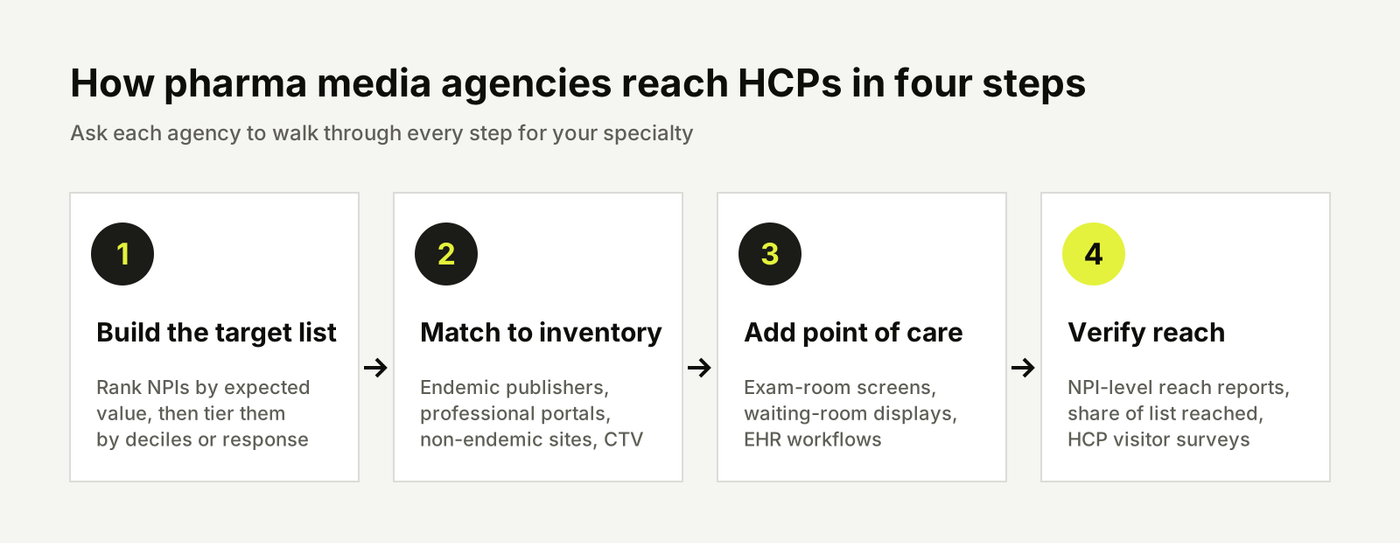
The channels inside those steps are changing.
The 2026 MM+M/Inmar Trend Report found planned use of digital display for HCP marketing down 12%, while brand websites and marketing research rose 20% and 24%.
NPI target lists and prescriber tiers
Every US prescriber has a National Provider Identifier, and HCP media starts from a list of those NPIs ranked by expected value.
That ranking decides where budget goes first, so ask how the agency tiers the list, whether it uses past prescribing deciles or responsiveness to promotion, and how often budget moves when the list refreshes.
Endemic advertising and non-endemic HCP media
Endemic advertising runs on medical publishers and professional portals that clinicians visit for work. Non-endemic media reaches the same NPIs on mainstream sites and CTV through programmatic matching.
Specialists with small universes often need both, so ask for the planned split and the reasoning behind it.
Point-of-care and EHR placements
Point-of-care media places messages on exam-room screens, waiting-room displays and inside EHR workflows.
Each network reaches a different set of practices, so check which ones the agency buys, how frequency is capped per prescriber and which creative formats your MLR team has already approved for these placements.
HCP reach verification
Match rates and onsite verification show whether impressions reached clinicians. The proof is an NPI-level reach report: the share of the target list actually reached, plus any visitor surveys the agency runs on HCP sites.
Script Lift and Pharma Marketing Analytics: What an Agency Should Measure
Pharma marketing analytics should connect media exposure to prescriptions or, for DTC and telehealth brands, to qualified patients and acquisition cost. Script lift, NPI-level attribution and a tracked waste number are the outputs to request in every pitch.
That request matters more as spend moves online. US healthcare and pharma digital ad spending is forecast at $26.2 billion in 2026, against $6.9 billion for traditional media, so a growing share of budgets runs in channels that can be tied to prescriptions or patients.
Script lift and new-to-brand prescription studies
A script lift study compares prescribing among exposed HCPs with a matched control group, using claims data for new-to-brand and total prescriptions.
The result is only as good as that claims data, so ask which vendor supplies it, how long the lag is and how the control group is built.
NPI-level attribution and closed-loop data
Closed-loop measurement links each NPI's media exposure, rep activity and prescribing over time.
Because that history builds up over the contract, ask who owns the data after it ends and whether the model reallocates budget during the flight.
Acquisition outcomes for telehealth and OTC brands
For brands without a rep force, the useful metrics are cost per qualified consult, cost per acquired patient and retail sales.
Our healthcare marketing analytics page explains why each funnel stage needs its own definition.
Media waste and invalid reach
A useful waste metric counts made-for-advertising sites, invalid traffic and impressions outside the target list, and it should fall quarter over quarter.
Pharma Marketing Compliance in Paid Media: MLR Review, Fair Balance and Health Data
Pharma marketing compliance shapes the media plan and the creative. Every asset clears medical, legal and regulatory review, fair balance sets unit length and format, and platform rules limit which advertisers and audiences can run at all.
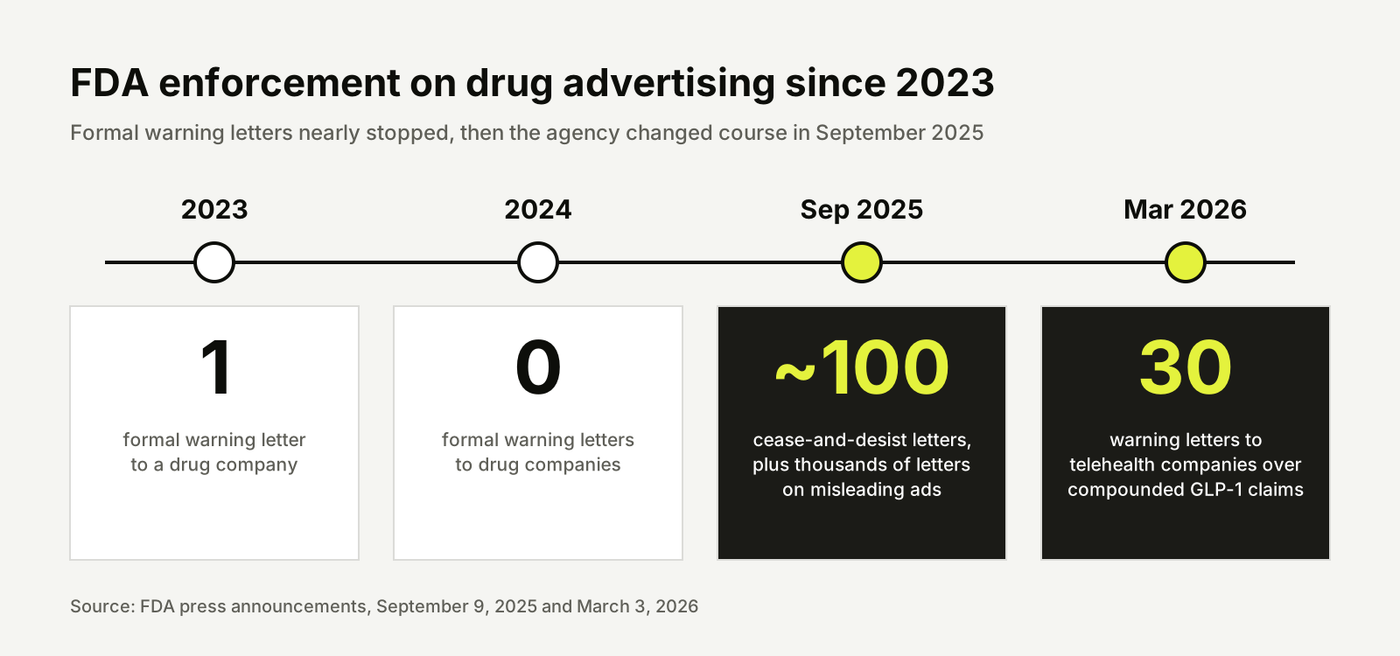
Enforcement has picked up, too.
In September 2025, the FDA launched a crackdown on deceptive ads, sending thousands of letters to drug companies about misleading ads and about 100 cease-and-desist letters. The agency noted that drug companies spend up to 25% of their budget on advertising, while formal warning letters had fallen to one in 2023 and zero in 2024.
MLR review cycles and creative rotation
MLR review can take several rounds, which slows creative rotation and optimization.
Modular creative approved in advance avoids that delay, so ask whether the agency builds it and lets the media team swap messages without restarting review.
Fair balance and FDA enforcement since 2025
The FDA also began rulemaking in September 2025 on the "adequate provision" standard that lets broadcast ads point to other sources for full risk information.
Telehealth brands are already in scope: in March 2026, the FDA sent 30 warning letters to telehealth companies over compounded GLP-1 claims.
With enforcement this active, settle claims with your agency before launch. Our guide to healthcare PPC compliance lists the questions to put to an agency.
Platform health-ad policies and data restrictions
Google requires pharmaceutical manufacturers to be certified before serving prescription drug ads in the US, and telemedicine providers need LegitScript certification.
Tracking pixels on health pages raise separate privacy questions, covered in our guide to HIPAA compliant marketing.
Pharma Media Agency Fit by Launch Stage and Audience
The right agency depends on the question your next budget has to answer. Pre-launch specialty brands need prescriber modeling first, national brands need buying scale, and DTC or telehealth brands need cost per qualified patient.
A practical way to read the list:
Specialty or rare disease launch: start with Underscore, Klick Media or Fingerpaint Media, and ask for a target-list test before media is committed.
National DTC and HCP weight: compare PHM and CMI Media Group on buying terms and data access.
One contract for media, creative and access: EVERSANA INTOUCH Media or Real Chemistry.
Telehealth, OTC or consumer health: judge 9AM and ADM on acquisition cost by funnel stage.
If your brand sells or prescribes directly to patients, 9AM can review your current channels and measurement and show where cost per qualified patient can come down.
See our healthcare paid media service and book a strategy call so we can review your plan.
Pharma Marketing Agency FAQ
What does a pharmaceutical marketing agency do in paid media?
It plans channel budgets, buys DTC and HCP inventory, builds audiences from NPI lists or privacy-safe patient models, and reports results against prescriptions or patient outcomes. Many agencies that use the label only create ads, so confirm who runs the buy.
Is DTC pharma advertising still allowed after the FDA crackdown?
Yes. DTC pharma advertising remains legal in the US, but the FDA is enforcing fair balance more actively and is reviewing how broadcast ads disclose risk. Expect longer review cycles and closer scrutiny of social and influencer content.
How do pharma media agencies charge?
Most charge a percentage of media spend, a monthly retainer or a scoped fee, with media costs billed separately. Ask whether the agency earns anything from the inventory it recommends.
Can a performance marketing agency run prescription drug ads?
It can run campaigns for brands that hold the required platform certifications, such as telehealth providers or manufacturers. Branded Rx launches with HCP targeting usually need a pharma media specialist alongside it.
What is programmatic healthcare advertising?
Programmatic healthcare advertising buys display, video and CTV through automated auctions using privacy-safe audiences such as NPI lists or modeled patient segments. Major platforms restrict health-condition targeting, so contextual and endemic placements carry much of the work.
About Mustafa Alkhtab
Mustafa Alkhtab is Head of Performance Media at inBeat Agency, where he oversees paid media and performance creative results across the agency's accounts. Before inBeat Agency, he built growth programs for ecommerce, lead generation, and mobile app businesses in international markets. He writes about media buying, measurement, and conversion rate optimization.
More from Mustafa Alkhtab