Healthcare Call Tracking: Measure Answered, Qualified and Booked Calls
Healthcare call tracking that separates answered calls, qualified inquiries and bookings, with HIPAA checks, an outcome dictionary and a 6-step setup.

· 15 min read
A paid campaign can drive more calls every month while the schedule stays the same. That happens because a ringing phone, a real patient inquiry and a booked appointment are three different events, and most reports count only the first.
The research proves that this is, indeed, a problem.
In a 2026 secret shopper study of 5,822 calls to mental health clinicians, 61.3% of calls ended produced no definitive outcome. Calls reaching only an answering machine or automated system with no option to speak to staff accounted for 44.2% of all attempts, and only 12.4% led to a booked appointment with any clinician.
If you’re looking for solutions, this guide covers how healthcare call tracking works, what the privacy decisions are, and a six-step method for measuring answered calls, qualified inquiries and bookings separately.
P.S. Want every patient call to shape the next campaign? Our healthcare measurement team sets up call outcomes and reporting, then works with you to grow bookings from them month after month. Book a strategy call.
TL;DR
Healthcare call tracking ties each inbound call to the campaign behind it, then records what happened on the call.
Measure three stages separately: answered calls, qualified inquiries and booked appointments. Each one fails for different reasons.
Ad platforms count call length by default, which says little about whether a patient booked.
Get privacy and legal approval for the vendor, recordings, fields and any data sharing before calls flow through a new tool.
Report the three stages by campaign in aggregate, and fix the stage that drops first.
Paid media earns its budget when it produces patients, and a call is only one step toward that.
We treat every campaign as a test that ends at a booked appointment, so the reporting has to follow the call past the ring. When creative, media and measurement feed off each other, a falling answer rate or a booking backlog shows up as a media decision within days, and the next brief is written around it.
What Is Healthcare Call Tracking?
Healthcare call tracking is the practice of linking each inbound patient call to the ad, listing or page that produced it, and recording the outcome of that call. In healthcare, that outcome tracking matters more than the attribution, because a call can end in many places short of a booking.
We use three terms through the rest of this guide:
Stage | Definition | Recorded in | Common false signal |
|---|---|---|---|
Answered call | A call a person or approved system picked up | Call tracking platform | Calls counted as "conversions" after a set length, including hold time |
Qualified inquiry | A new-patient caller asking for a service you offer, in a location you serve, with coverage you accept | Call outcome tag or intake form | Existing patients, billing questions and refill requests counted as leads |
Booked appointment | An appointment created in the scheduling system and linked to the call | Practice management or scheduling system | A caller told to "call back next week" counted as booked |
Each stage has its own owner. Front-desk staffing drives answered calls, targeting and messaging drive qualified inquiries, and capacity and scheduling rules drive bookings.
How Does Healthcare Call Tracking Work?
Healthcare call tracking works by giving each traffic source its own phone number, then attaching call details and an outcome to every call that number receives. Three technologies do that work.
Static Tracking Numbers for Ads, Listings and Offline Media
A static tracking number is one fixed number per channel: a search ad call asset, a Business Profile listing, a directory profile, a print ad or a referral flyer. Every call to that number is credited to that channel.
For multi-location groups, each location needs its own number set, so a call to the downtown clinic's listing does not land in the suburban clinic's report.
Remember: Keep a tracker of every location, every number and where each one is published; old numbers on printed material keep ringing for months.
Dynamic Number Insertion for Website Visitors
Dynamic number insertion (DNI) swaps the phone number on your website for one from a pool, assigned to each visitor's session. When that visitor calls, the platform knows the campaign, keyword and landing page behind the call.
DNI has one common failure: tracking numbers that forward to a main switchboard skip the department routing patients used to reach. Map each number pool to the right destination before launch, and test every path with a real call.
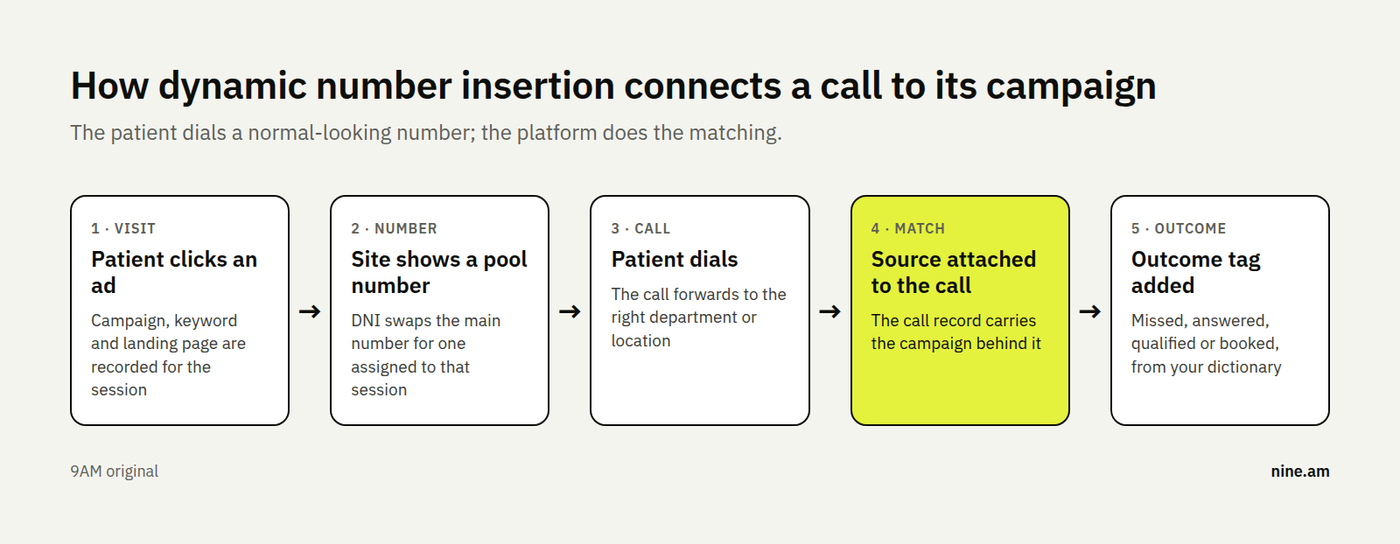
How dynamic number insertion connects a website visit to the campaign behind a call. Source: 9AM original
Call Recording, Transcription and Conversation Intelligence
Call recording and transcription let a platform classify calls, in many cases with AI analytics that tag:
New or existing patient
Service requested
Whether an appointment was booked
This saves hours of manual review once volume passes a few hundred calls a month.
Two cautions apply.
Recordings and transcripts of patient calls usually contain protected health information, so they fall under the privacy decisions in the HIPAA section below. And AI labels need a human spot-check: review a sample of tagged calls every month against the call-outcome dictionary in Step 2.
Why Healthcare Calls Need Three Separate Measures
Healthcare calls need three separate measures because each stage loses patients for a different reason, and a single "calls" number hides which one is failing. Phone calls remain the main entry point: Liine, a call tracking vendor, reports that 58% of new-patient lead interactions happen by phone across the practices it tracks.
Ad Platforms Count Call Length, Not Patient Outcomes
Google Ads counts calls from ads as conversions once they pass a 60-second default length, which you can change. Length is a rough filter for wrong numbers and hang-ups.
It is a poor proxy for a booking. A long call can be four minutes on hold, a billing dispute or an existing patient rescheduling, and each of those counts the same as a new-patient booking.
Missed and Voicemail Calls Hide Before Any Conversation Starts
Many patient calls never reach a person.
In the Ohio State and Stanford study, published in JAMA Health Forum, researchers placed 5,822 calls and most produced no definitive outcome, usually because the caller reached voicemail or an automated system.
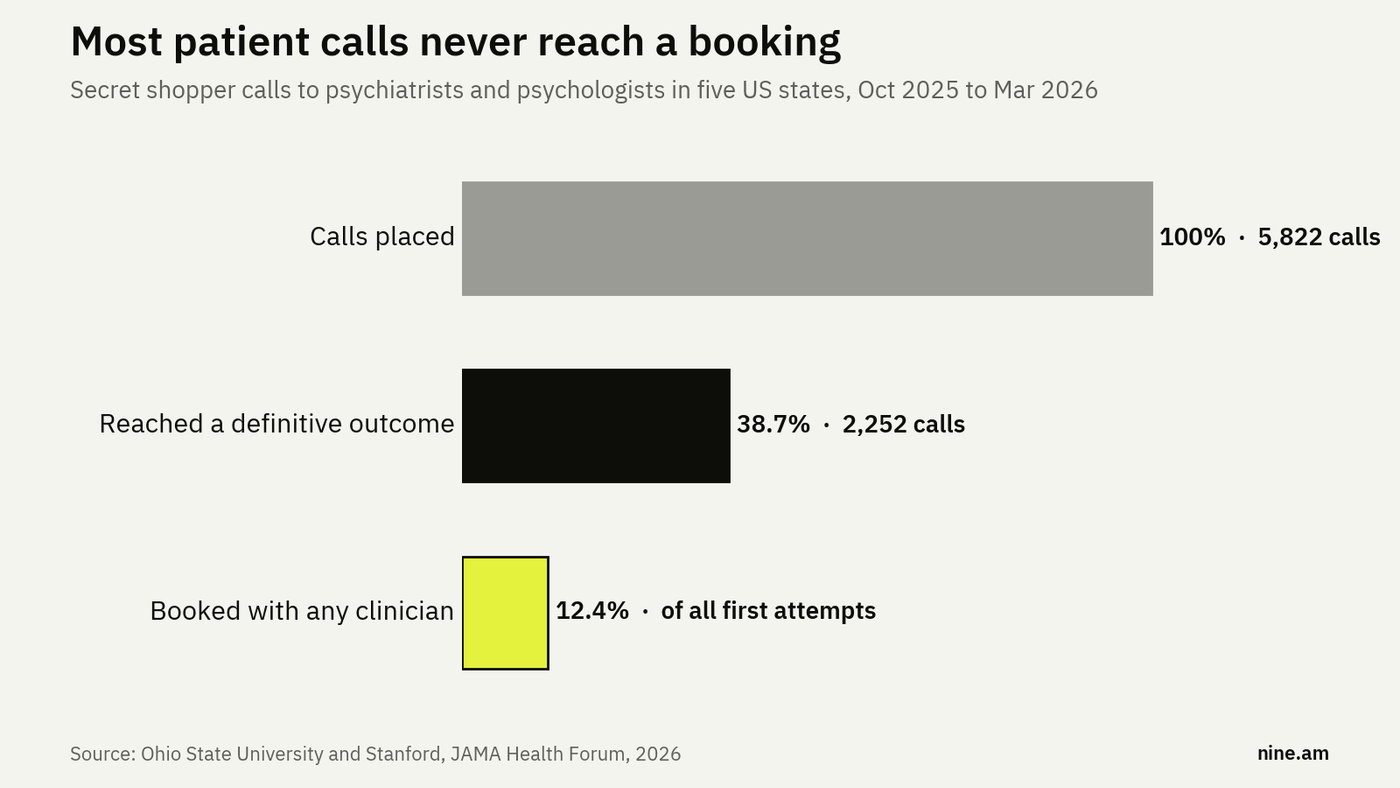
Outcomes of 5,822 secret shopper calls to mental health clinicians. Source: Ohio State University and Stanford, JAMA Health Forum, 2026
Specialty care shows the same pattern.
In a simulated-patient study of new cancer clinic appointments, only 41.5% of calls succeeded, and about a quarter ended at workflow barriers, such as no one being available to schedule new patients.
Our healthcare PPC team checks answer rates before judging any campaign for this reason.
Qualified Inquiries Still Fail at Capacity, Insurance and Scheduling
A caller can be the right patient and still not book. Among the 2,252 evaluable calls in the Ohio State study, 23.6% booked with the listed clinician, and capacity limits such as not accepting new patients blocked 21.6%.
For paid media, that changes the reading of a campaign.
A campaign with strong qualified inquiries and weak bookings needs a capacity or scheduling fix, and cutting its budget would remove patients the practice could have seen once that fix was in place.
Is Healthcare Call Tracking HIPAA Compliant?
Healthcare call tracking can be HIPAA compliant, but compliance comes from the contract, the setup and the data flows.
Remember: No tool is compliant on its own.
Obligations also differ by organization, so your privacy and legal teams should approve the tool, recordings, fields and any sharing.
Our guide to HIPAA-compliant marketing covers the wider privacy architecture; this section covers the decisions specific to calls.
Business Associate Agreements With Call Tracking Vendors
A HIPAA-covered entity needs a signed business associate agreement (BAA) with a call tracking vendor before patient call data flows through the platform. Many vendors offer one on specific plans; CallRail, for example, says its healthcare plans include a BAA.
Pro tip: Ask for the vendor's list of subprocessors for transcription, storage and AI, and confirm the BAA covers them. A BAA on the call tracking platform says nothing about the tools it connects to.
Call Recording Consent, Redaction and Access
Decide whether to record calls at all, and for which call types. Where recording is on, cover these settings:
Disclosure: a recorded notice before the call connects, worded to meet the strictest state consent law that applies to your callers.
Redaction: automatic removal of sensitive details from transcripts where the platform supports it.
Access: marketing sees aggregate attribution; only approved staff open recordings.
Retention: a set deletion period for recordings and transcripts.
Behavioral health and substance use programs may face stricter rules than general medical practices, so get specific legal advice before recording those calls.
Integrations That Pass Call Data to Analytics and Ad Platforms
The biggest call-tracking privacy risk usually sits in the integrations. A default connector can send caller phone numbers, call keywords or transcripts into an analytics or CRM tool that has no BAA.
To avoid this, turn off caller-level integrations by default, then switch on only what your legal team approves. For marketing reporting, aggregate counts by campaign and stage are usually enough.
Side note: Aggregation alone doesn't make a report de-identified, though: small groups and detailed breakdowns can still identify a patient. Have your privacy team approve the report's level of detail before sharing it outside the approved environment.
Which Privacy Rules Apply to Your Organization
Which rules apply depends on what kind of organization you are. HIPAA covers covered entities and their business associates; many health apps and online services outside HIPAA fall under the FTC's Health Breach Notification Rule, updated in 2024.
HHS guidance on online tracking technologies was partly vacated by a federal court in June 2024, and state privacy laws add their own requirements.
Take this as a reason to get a written review for your setup, since no single rulebook covers every healthcare brand.
How to Measure Answered Calls, Qualified Inquiries and Bookings, Step by Step
Measure the three stages by building the call map, the outcome definitions and the booking link first, then reporting them together. Each step below depends on the one before it.
Step 1: Map Every Tracking Number and Call Route
Map every number a patient can dial and where each call ends up. List each one with four details:
Source: ad call asset, website DNI pool, Business Profile, directory listing, print or referral material.
Destination: the IVR menu, department line or location it forwards to.
Hours: when a person answers and what happens after hours.
Owner: the team that answers it.
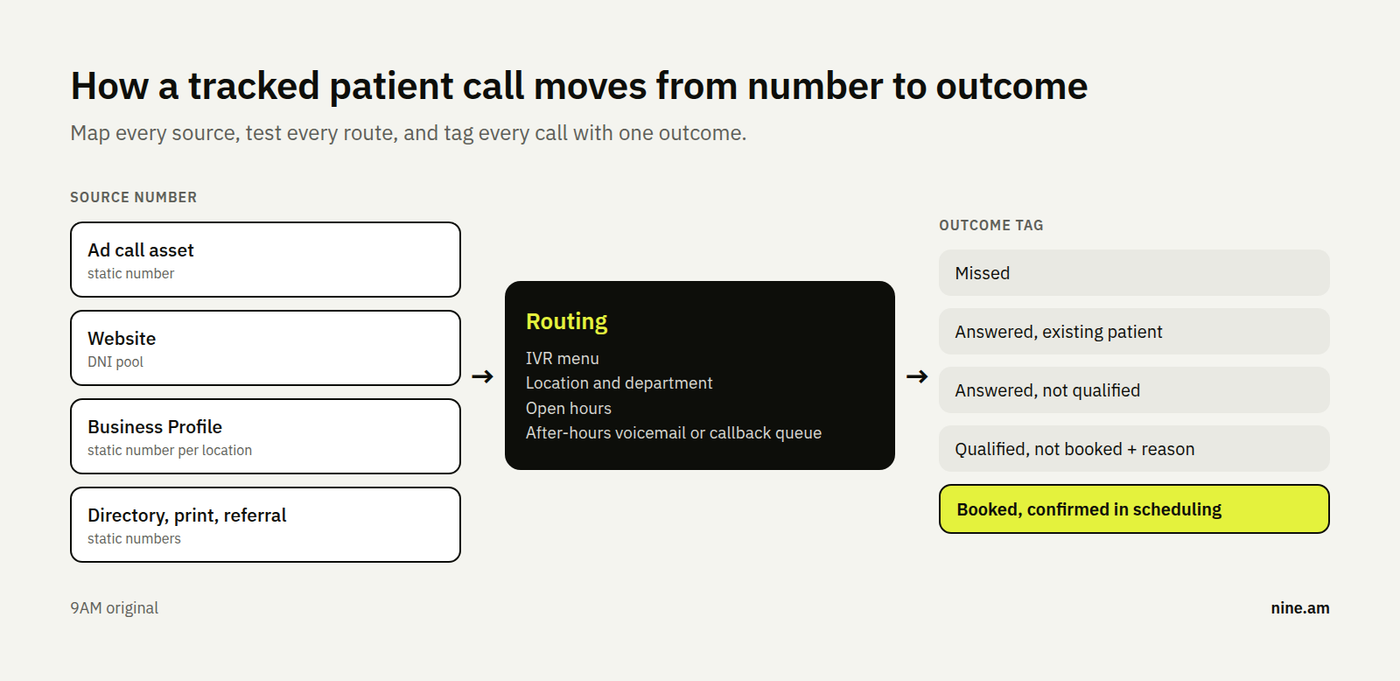
How a tracked patient call moves from source number through routing to an outcome tag. Source: 9AM original
Then place a test call to every number during and after hours. Misrouted numbers are common after a website rebuild or a new location launch.
Step 2: Write a Call-Outcome Dictionary
Write one shared list of call outcomes so front-desk staff, call tracking tags and reports all use the same words. Keep it short enough to apply on a busy morning.
Outcome code | Stage | Definition | Counts toward |
|---|---|---|---|
Missed | Before answer | Rang out, abandoned in IVR or reached voicemail | Missed calls |
Answered, existing patient | Answered | Scheduling, billing, refills or results | Answered calls only |
Answered but not qualified | Answered | Service, location or coverage you can't offer | Answered calls only |
Qualified but not booked | Qualified | Right new patient, no appointment yet; record the reason | Qualified inquiries |
Booked | Booked | Appointment created during or after the call | Bookings |
Add a reason field for qualified callers who did not book: no availability, insurance, price, caller to call back. Those reasons tell you which stage to fix.
Step 3: Deduplicate Repeat Callers, Forms and Online Bookings
Count each patient inquiry once, however many calls it took. A patient who calls three times before reaching someone is one inquiry with two missed attempts, and that inquiry should be credited once.
For this, you need to:
Set a deduplication window, such as seven days, and apply it across channels: a caller who also fills in a form or books online should appear as one lead.
Record missed-then-returned calls separately, since a fast callback can recover a patient the first call lost.
Step 4: Check Answer Rates by Hour, Location and Campaign
Break the answer rate down by hour of day, location and campaign. A campaign running at 7 p.m. into an office that closes at 5 p.m. will look like a weak campaign when the problem is coverage.
Compare ad schedules with staffing hours and adjust one or the other. Our guide to lead response time covers callback speed and after-hours coverage in more detail.
Step 5: Record Bookings From the Scheduling System
Record bookings from the scheduling or practice management system, because a "booked" tag set during the call can't confirm the appointment exists. Match each booking to its call using the call ID, phone match inside an approved system, or a booking time window.
Track booked and attended appointments separately. No-shows are a scheduling and reminder issue, and they shouldn't make a campaign look worse than its bookings.
Step 6: Build a Reconciled Aggregate Report
Build one weekly report that shows all three stages by campaign, in aggregate. Sending booking outcomes back to ad platforms is a separate privacy decision; our guide to offline conversion tracking covers the mechanics once legal approves what can be sent.
A layout like this works:
Campaign | Calls | Answered rate | Qualified inquiries | Bookings | Cost per booking |
|---|---|---|---|---|---|
Search, brand | 220 | 91% | 64 | 41 | $38 |
Search, service terms | 310 | 78% | 122 | 58 | $112 |
Paid social, new patients | 95 | 70% | 30 | 11 | $164 |
Illustrative figures.
Reconcile the totals against the call platform and the scheduling system each week. When the three sources disagree by more than a few percent, check the deduplication window and any numbers missing from the Step 1 map first.
How to Choose a Healthcare Call Tracking Tool
Choose a healthcare call tracking tool by checking it against the outcome reporting above, after privacy has signed off on the vendor. These capabilities separate tools that stop at the ring from tools that support booking measurement, and our list of healthcare PPC compliance questions adds the agency-side questions on tracking and BAAs:
Capability | Why it matters | Question to ask the vendor |
|---|---|---|
BAA on your plan | Required before patient call data flows | Which plans include a BAA, and does it cover your subprocessors? |
Custom outcome tags | Lets staff apply your call-outcome dictionary | Can we define our own tags and reasons? |
Cross-channel deduplication | Counts one patient across calls, forms and online booking | How do you merge a caller who also submits a form? |
Scheduling or EHR integration | Confirms bookings at the source | Which scheduling systems do you connect to, and how? |
Location-level routing and reports | Keeps multi-location data clean | Can each location have its own numbers, hours and reports? |
Integration controls | Stops caller-level data reaching non-BAA tools | Can we turn off each data field per integration? |
Ask for a trial with your own numbers and a week of real calls before signing, so you can test tags, routing and integrations on live traffic.
What to Fix When One Stage Drops
Fix the first stage that drops, because a leak at the top makes every later stage look worse. The three stages point to three different owners, and our funnel leak analysis guide covers sizing each drop before you fix it.
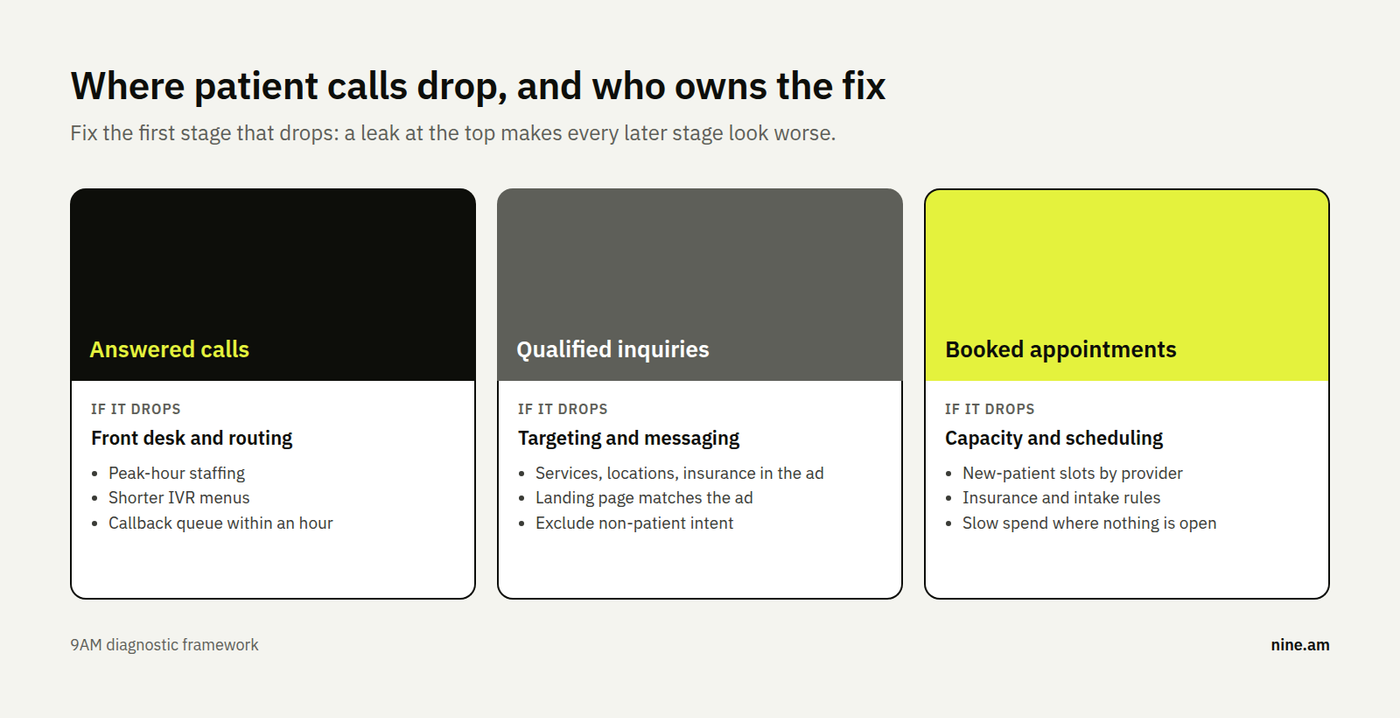
Where patient calls drop off at each stage and which team owns the fix. Source: 9AM original
Low Answer Rate: Staffing, Routing and Missed-Call Recovery
A low answer rate points to staffing, routing or hours. Add coverage at peak call times, shorten IVR menus, and set up a callback queue for missed calls within an hour.
Track the callback rate in the same weekly report, so recovered patients show up next to the calls that were missed.
Low Qualification Rate: Targeting, Ad Copy and Landing Pages
A low qualification rate points to targeting and messaging. State the services, locations and accepted insurance in the ad and on the page, so the wrong callers filter themselves out.
Our guide to landing page alignment covers matching the page to the ad.
Low Booking Rate: Capacity, Insurance and Scheduling
A low booking rate with healthy qualification points to capacity and scheduling.
Check provider availability, new-patient slots and insurance rules, and slow paid spend for the service lines with no open appointments.
Turn Patient Calls Into Booked Appointments with 9AM
Call volume is easy to grow and easy to misread. Measured as answered calls, qualified inquiries and bookings, the same calls tell you whether to change staffing, messaging or budget.
When the problem is messaging, call outcomes give the creative team something specific to address. Repeated questions about cost, insurance or how to book can reveal what the ads and landing pages need to explain earlier.
Those questions belong in healthcare creative.
We usually build ad concepts around exactly these questions: affordability, insurance coverage and how to get started. Call tracking then shows whether they still stand between an inquiry and a booking.
At 9AM, our media, creative and measurement teams work with your privacy and operations teams as an ongoing partner. We define call outcomes, build the reporting and turn each month's findings into changes to campaigns, creative and the booking process, so every round of calls improves the next one.
Book a strategy call to plan how your calls, campaigns and booking process grow new-patient appointments together over the coming year.
FAQs
Should a call under 60 seconds ever count as a qualified inquiry?
Yes, when the outcome tag says so. A new patient who knows which service they want and books quickly can finish in under a minute, so outcome tags should decide qualification. Call length works as a backup filter only when tags are missing.
How do you count a patient who calls three times before booking?
Count one qualified inquiry and one booking, credited to the source of the first call inside your deduplication window. Log the two missed attempts as missed calls, so the answer-rate problem stays visible.
Can call outcomes be sent back to Google Ads in healthcare?
Sometimes, depending on your organization, the data involved and your agreements with each platform. Many teams send only non-identifying signals or keep outcomes in internal reports. Get privacy and legal approval before connecting any outcome data to an ad platform.
Do existing-patient calls belong in paid media reporting?
Keep them in the answered-call count, and exclude them from qualified inquiries and cost per booking. Many existing patients call a number they found through an ad or listing, and counting them as new demand inflates campaign results.
How much does healthcare call tracking cost?
Entry-level healthcare plans with a BAA start around $150 a month, based on CallRail's published pricing. Costs rise with tracking numbers, call minutes, recording, AI classification and scheduling integrations. A single location with very few monthly calls may get enough from asking every new patient how they found the practice at intake.
About Mustafa Alkhtab
Mustafa Alkhtab is Head of Performance Media at inBeat Agency, where he oversees paid media and performance creative results across the agency's accounts. Before inBeat Agency, he built growth programs for ecommerce, lead generation, and mobile app businesses in international markets. He writes about media buying, measurement, and conversion rate optimization.
More from Mustafa Alkhtab