Food Advertising Regulations: Build a Claim-to-Evidence Checklist Before Ads Go Live
Food advertising regulations explained for marketers: who enforces them, the rules for each claim type, and a checklist to fill for every claim before ads run.

· 14 min read
In 2025, the National Advertising Division reviewed food and beverage ads that made health, nutrition and "clean label" claims. In some cases, NAD recommended that brands change or discontinue claims when their evidence did not support the message shoppers could take away.
Most problems start before media goes live, when a script, caption or landing page says more than the evidence supports.
We help you avoid those problems.
This guide covers who regulates food ads, the rules for each claim type, and a checklist to fill for every claim before launch, though final sign-off still belongs with your legal or regulatory reviewer.
P.S. If you want new creative angles tested every month without pulling ads later, our CPG media buying team builds the claim check into the launch plan.
At 9AM we treat the claim check as part of the media plan. A claim that gets an ad rejected or challenged wastes the creative, the test budget and the learning window, so we write claims and evidence side by side from the first brief. That keeps testing fast because every approved line is ready to reuse.
What Are Food Advertising Regulations?
Food advertising regulations are the federal and state rules that require food ads to be truthful, accurate and backed by evidence before they run. In the US, the core rule comes from the FTC Act, which bars deceptive advertising, and from FDA rules on how nutrient and health terms may be used.
Three ideas sit underneath almost every rule:
Net impression. Regulators judge the whole ad, including images, music and wording, by what a reasonable consumer takes away.
Express and implied claims. A picture of a heart next to a cereal bowl can make a heart-health claim without saying one.
Substantiation first. The advertiser needs a reasonable basis for each claim at the moment the ad runs. Gathering evidence after a challenge arrives is too late.
Who Regulates Food Advertising in the US
Several bodies police food claims, and each covers a different part of the picture. Under a working agreement in place since 1954, the FTC takes the lead on food advertising and the FDA takes the lead on food labeling, according to the FTC's food advertising policy statement.
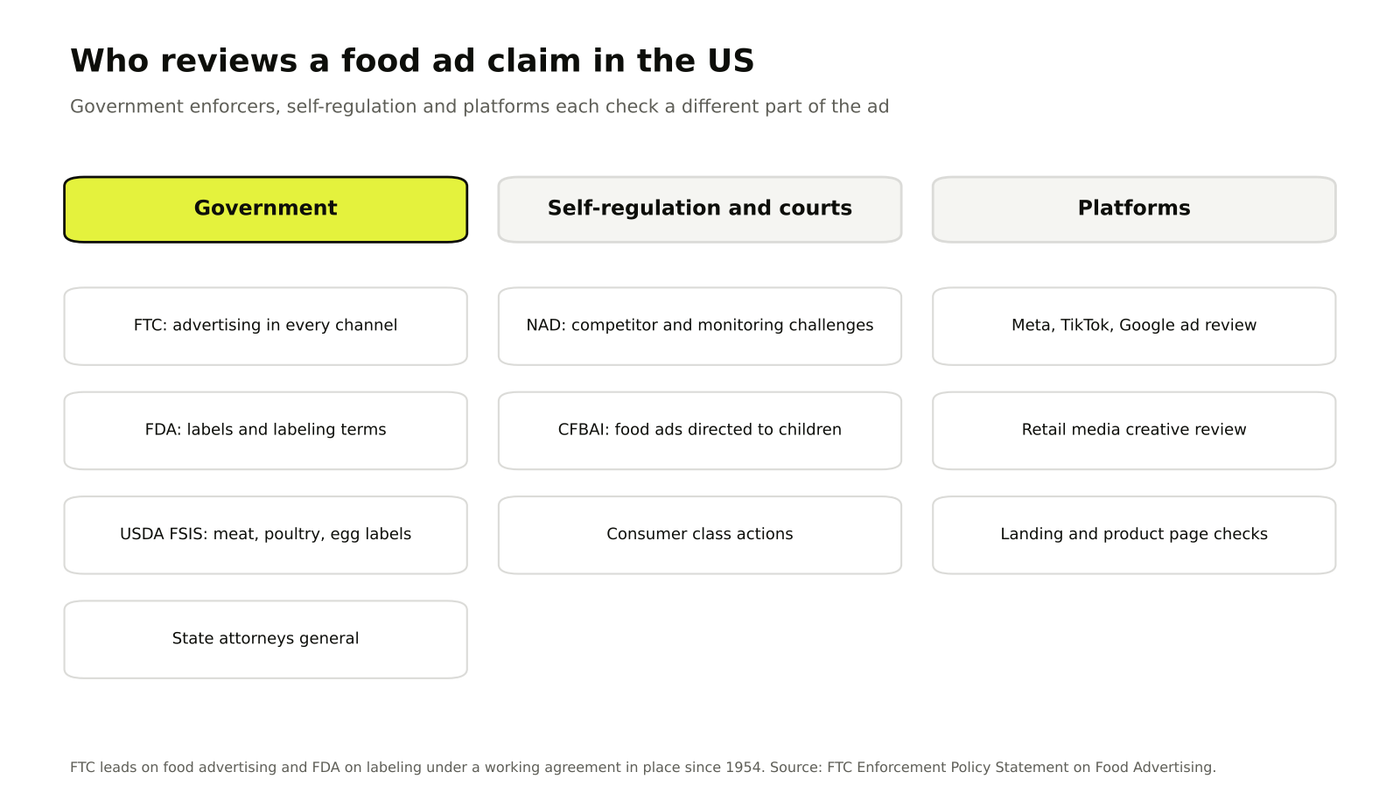
Government enforcers, self-regulation and platforms each review a different part of a food ad. Source: 9AM, based on the FTC food advertising policy statement.
Federal Trade Commission
The FTC enforces the ban on deceptive and unfair advertising across TV, digital, social and creator content. It can investigate brands, agencies and influencers, and it defers heavily to FDA definitions for nutrient and health terms.
Food and Drug Administration
The FDA regulates labels and labeling for most packaged foods, including nutrient content claims, health claims and the Nutrition Facts panel.
The FTC considers FDA definitions and scientific findings when reviewing food advertising, while also looking at the overall impression the ad gives shoppers.
USDA Food Safety and Inspection Service
USDA's FSIS oversees labels for meat, poultry and egg products. Brands selling those products follow FSIS label approval rules, and the FTC applies similar principles to their advertising.
State Attorneys General and Consumer Class Actions
State attorneys general enforce state consumer protection laws, and private plaintiffs file class actions over claims such as "natural" or "no preservatives." In many cases, these suits target packaging and ads together.
National Advertising Division and CFBAI Self-Regulation
The National Advertising Division (NAD), part of BBB National Programs, reviews national ads after competitor challenges or its own monitoring.
The Children's Food and Beverage Advertising Initiative (CFBAI) sets voluntary nutrition standards for food advertised to children by participating companies.
Why Food Brands Need a Claim-to-Evidence Checklist Before Ads Go Live
A checklist catches claims before they cost money. A rejected ad on Meta or TikTok wastes production time; an NAD challenge or class action can force your brand to change creative, packaging and landing pages at once.
The checklist also speeds up creative testing.
When every approved claim already has its evidence and wording on file, writers and creators can build new angles from a library of safe lines.
So if you’re running creator programs, it’s the only practical way to keep dozens of scripts consistent. It’s also how we keep launches moving for the food and beverage brands we work with.
Types of Food Advertising Claims and the Rules for Each
Food ads use seven main types of claims, and each comes with its own rule and evidence level. Functional drinks and better-for-you snacks carry the most risk.
Nutrient Content Claims
Nutrient content claims describe the level of a nutrient, such as "high in fiber," "low sodium" or "good source of protein."
FDA defines these terms, and the FTC expects ads to meet the same definitions.
Pro tip: Implied versions count too: "packed with fiber" can imply "high in fiber."
Health Claims and Qualified Health Claims
Health claims link a food or nutrient to a disease or health condition, such as calcium and osteoporosis.
For food labels, FDA rules set out which health claims may be used and under what conditions. Some meet the agency's significant scientific agreement standard.
Qualified health claims rely on less-established evidence and need language that explains its limits.
For example, a functional drink ad might connect an ingredient to a health benefit. Before you put that promise in a beverage advertising campaign, check the exact wording and the evidence behind it.
Structure/Function Claims
Structure/function claims describe how a nutrient affects the body's normal structure or function, such as "calcium builds strong bones."
For conventional foods, the FDA says these claims should come from the food's nutritive value, and no FDA notification or disclaimer is required.
Dietary supplements follow stricter rules, with a 30-day notification and a disclaimer.
Healthy Claims Under the FDA's Updated Rule
The FDA finalized an updated definition of "healthy" in December 2024, with a compliance date of February 25, 2028.
To qualify, a product must contain a set amount from a recommended food group and stay under limits for added sugars, saturated fat and sodium.
Highly sweetened yogurt and cereal no longer qualify, while nuts, olive oil and salmon now do.
Natural, Clean and Free-From Claims
"Natural" and "clean" can be difficult to support because shoppers may understand them in different ways. The FDA has a longstanding policy on "natural" in food labeling, but no formal regulatory definition for the term.
For example, NAD recommended that a brand discontinue "clean ingredients" for its applesauce. If the brand wanted to use the claim in the future, NAD said it should support and qualify it to make clear what "clean" means.
Free-from claims need their own checks.
For example, "gluten-free" has a specific FDA labeling standard. Review the ingredients, manufacturing process and evidence with your regulatory team before using a claim in an ad.
Taste, Superiority and Comparative Claims
"Tastes great" is usually treated as opinion.
For example, in an ad for Metamucil, one influencer says “Psyllium, the fiber in Metamucil, is my favorite fiber,” which counts as an opinion and doesn’t need concrete evidence.
"Tastes better than Brand X" or "preferred by 2 to 1" is a measurable claim that needs a well-run taste test.
Nutrient comparisons such as "less sugar" need at least a 25% difference and must name the reference food, per the FTC statement.
Origin, Environmental and Made in USA Claims
An unqualified "Made in USA" claim requires the product to be all or virtually all made in the US, including its significant ingredients, and the FTC's 2021 labeling rule adds civil penalties for false labels, online included.
Environmental claims such as "sustainably sourced" or "recyclable packaging" fall under the FTC's Green Guides and need specific support.
Claim type | Example | Main rule | Evidence needed |
|---|---|---|---|
Nutrient content | "High in protein" | FDA definitions, applied by FTC | Lab analysis per serving |
Health | "May reduce the risk of heart disease" | FDA-authorized or qualified wording | Significant scientific agreement or qualified wording |
Structure/function | "Calcium builds strong bones" | Must reflect nutritive value | Competent and reliable scientific evidence |
Healthy | "A healthy snack" | FDA 2024 definition | Formula meets food group and nutrient limits |
Natural, clean, free-from | "No artificial colors" | FTC deception standard, state law | Ingredient and supplier documentation |
Taste and comparative | "Kids prefer it 2 to 1" | FTC substantiation | Valid consumer taste test |
Origin and environmental | "Made in USA" | FTC Made in USA rule, Green Guides | Sourcing and cost records |
FTC Claim Substantiation Standards for Food Ads
FTC claim substantiation requires a reasonable basis for every objective claim at the time the ad runs. For nutrient and health claims, that usually means competent and reliable scientific evidence: tests, analyses or studies run objectively by qualified people, using accepted methods.
Three details trip food brands up most often:
Dose. The evidence must match the amount in your product. NAD found one brand could not say its applesauce "promotes brain health" because it contained less DHA than the studies tested.
Fit. The study must test what the ad claims. In November 2026, NAD recommended IQ BAR stop saying superior brain and body nutrition because its evidence was not a good fit.
Totality. One favorable study does not outweigh a larger body of contrary research.
How Food Labeling Regulations Carry Into Food Advertising
Your ad and product label need to tell a consistent story. The FTC considers FDA definitions when reviewing food ads, so a claim that does not fit the product's nutrient content can cause problems in both places.
Watch three places where label rules shape ad wording:
Serving sizes. If an ad shows a larger or smaller serving than the label's reference amount, the FTC expects the claim to hold for both.
Risk nutrients. A claim that highlights one benefit can mislead if the product is high in sodium, sugar or saturated fat; the FTC cited soup ads that touted heart health while omitting sodium levels.
Nutrition Facts consistency. Numbers in ads should match the Nutrition Facts panel on the pack sold in the same market.
Upcoming label changes matter too: the FDA has said it intends to finalize front-of-pack nutrition labeling, which may change how "healthy" positioning reads next to the pack.
Food Advertising Compliance Checklist Fields for Every Claim
A food advertising compliance checklist records one row per claim, with the fields below filled before the ad goes to media. Build it as a shared sheet so writers, media buyers and legal work from the same file.
Claim as Written, Word for Word
Copy the exact wording from the script, caption, voiceover or on-screen text. Small edits change meaning, so never paraphrase here.
Implied Claims a Viewer Could Take Away
List what a reasonable viewer might conclude from the claim plus its images, music and context. A runner eating a bar after a race can imply an energy or recovery benefit.
This ad offers a good example because we can see this influencer lifting heavy weights after supposedly eating her breakfast based on the brand she promotes:
https://www.facebook.com/ads/library/?id=1149322620766904
Claim Type and the Rule That Governs It
Tag each claim as nutrient content, health, structure/function, healthy, natural or free-from, taste or comparative, or origin and environmental. The tag tells the reviewer which rule applies.
Evidence on File and Its Source
Link the lab report, study, taste test or supplier certificate behind the claim. Note the product version and serving size the evidence covers.
Required Qualifier or Disclosure
Write the exact qualifier, for example "when part of a balanced diet" or "per 2-bar serving." If no qualifier can make the claim accurate, the claim goes.
Disclosure Placement, Duration and Format
Record where the disclosure appears and how viewers will see or hear it. For video, check the disclosure in the finished creative, not just the script. Someone watching on a phone needs enough time to notice and understand it.
Channels and Audiences the Ad Will Run In
List each platform and the audience settings. Some claims are fine for adults but restricted for teens, and child-directed placements bring extra rules.
Reviewer, Approval Date and Re-Review Trigger
Record who approved the claim, when, and what would force a new review: a reformulation, new research, a new market or a creative refresh. Tie re-review to your creative refresh calendar so old approvals do not drift onto new ads.
Field | Example entry |
|---|---|
Claim as written | "12g of protein per 2-bar serving" |
Implied claims | Check the visuals and surrounding copy for any additional energy or satiety claims |
Claim type | Quantitative nutrient statement |
Evidence | Lab report or reliable formulation data confirming 12g of protein per 2-bar serving |
Qualifier | "Per 2-bar serving," placed clearly next to the protein amount |
Placement | On-screen next to the claim, long enough to notice and read; spoken in the voiceover where appropriate |
Channels | Meta and TikTok, adults 18+ |
Reviewer and trigger | Regulatory lead, re-review on reformulation |
In this example, the evidence supports the amount of protein. If the ad also suggests that the bars keep you full or provide lasting energy, add evidence for those benefits or remove the claim.
How to Run a Food Ad Claim Review Step by Step
Run a food ad claim review by collecting every claim, matching each to evidence, fixing the gaps and recording the approval. The eight steps below fill the checklist from start to finish.
1. Collect Every Claim From Scripts, Visuals, Captions and Landing Pages
Pull claims from every asset the viewer will see: video scripts, voiceovers, on-screen text, captions, thumbnails, product detail pages and landing pages. Landing pages count, since platforms and regulators review them with the ad.
2. Assign Each Claim Its Claim Type
Tag each claim with its type using the seven categories above. When a claim fits two types, apply the stricter rule.
3. Match Each Claim to Evidence on File
Attach the evidence and check dose, product version and serving size. Evidence for last year's formula does not support this year's pack.
4. Rewrite or Remove Claims Without Adequate Support
Soften or narrow claims the evidence cannot carry. "Supports energy" can become "12g of protein per serving" if only the protein number is proven. Delete claims nobody can support.
For example, in the ad below we can see the product promises “91% less sugar than traditional foam candy,” but there’s no clear evidence that’s true.
https://www.facebook.com/ads/library/?id=1068741549043429
5. Add Qualifiers and Disclosures in Each Ad Format
Place qualifiers where viewers will notice them in each format: on screen long enough to read in video, in the first lines of a caption, and next to the claim on a landing page.
6. Check the Ad Platform's Food and Health Policies
Read each platform's rules before launch, since they add limits on top of federal law. Health and weight-related wording gets the closest platform review, as the platform section below shows.
7. Brief Creators on Approved Claims and Disclosure Wording
Give creators a short list of approved claims, claims to avoid and the required disclosures. Put those rules in the UGC brief alongside the product details and creative direction, so creators know what they can say while keeping the content in their own voice.
8. File the Approved Checklist and Set a Re-Review Date
Save the completed checklist with the final creative and set a review date, at least yearly and on any reformulation. If a challenge arrives, this file is your first response.
FTC Rules for Food Influencer and Creator Ads
FTC rules treat a paid creator's claim as the brand's claim, so the brand needs the same evidence for it. The updated Endorsement Guides from June 2023 define "clear and conspicuous," warn that a platform's built-in disclosure tool may not be enough, and explain the liability of advertisers and intermediaries.
For food creators, the FTC's influencer guidance sets practical rules:
Disclose any material connection, including free products, in the post itself.
Use plain words such as "ad" or "sponsored"; avoid "sp," "spon" or "collab."
Make the disclosure in the same format as the endorsement: visually for a visual endorsement, audibly for a spoken one, and both ways when the endorsement is both visual and spoken. Repeat the disclosure during live streams so people joining later can see or hear it.
Make no claims the brand cannot prove, such as a food treating a condition.
When you use creator whitelisting to turn a creator's post into a paid ad, review the claims and disclosures in the version that will run. A post approved for organic use may reach a different audience once you put media behind it.
Rules for Food Advertising to Children
Food advertising to children faces the strictest review.
The FTC's 2023 Endorsement Guides call child-directed advertising a special concern, and COPPA limits how brands collect data from children under 13.
Many large food companies also follow CFBAI's nutrition standards, which cap calories, saturated fat, sodium and added sugars for products advertised to children.
Participants define child-directed media by audience share, typically when children under 13 make up 25% to 30% of the expected audience.
Food Ad Policies on Meta, TikTok, Google and Amazon
Ad platforms add their own rules on top of federal law, and they can reject ads that would pass legal review. The strictest areas are weight, health and body image, and the differences between TikTok and Meta matter when you plan where each claim runs.
Meta: ads for dietary, health or weight-loss products must target people 18 or older. The same policy exempts general food products, including protein products, from that age rule.
TikTok: weight-loss claims must target people 18 or older, cannot call results easy or guaranteed, and cannot say the product works without diet or exercise.
Google: its misrepresentation policy bans unreliable claims that present an improbable result as the likely outcome.
Amazon and other retail media networks: creative goes through each network's review, and product detail pages must match the claims in the ad.
Food Advertising Violations and What They Cost Brands
Recent cases show what weak claims cost: discontinued campaigns, wasted production and public decisions that competitors can cite.
IQ BAR, 2026: NAD recommended the brand discontinue "superior brain and body nutrition" in video and radio ads; the brand also permanently dropped its other challenged claims.
Ingenuity Brands, 2025: NAD found "supports immunity" for an applesauce supported, recommended that "promotes brain health" be dropped or modified, and recommended dropping "clean ingredients."
Ryze Superfoods, 2025: after an NAD inquiry, the brand permanently dropped mushroom coffee claims about energy, focus, digestion, immunity and sleep, and said it is changing how its ads present claims. NAD had also examined whether its matcha ads implied appetite effects like GLP-1 drugs.
Campbell Soup, 1992: the FTC challenged heart-health claims for soups that did not disclose high sodium.
Launch Food Ads with Claims Your Team Can Defend
Food brands that move fastest treat claims as an asset library. Each approved line has its evidence, qualifier and channel rules attached, so new creative tests start from proven wording.
Start with your top five running ads: list every express and implied claim, and check that each one has evidence on file today.
At 9AM, we run paid social, retail media and creator programs for food and beverage brands with the claim review built into every launch.
Book a strategy call with us today to build compliant creative and media plans, so you keep testing new angles month after month.
Frequently Asked Questions
Does a food ad need FDA approval before it runs?
No. Neither the FDA nor the FTC pre-approves food ads. The brand must have evidence for each claim before the ad runs, and regulators or competitors can challenge it afterward.
Is natural a regulated claim in food advertising?
There is no formal federal definition of "natural" for most foods, but the claim is still judged by the FTC's deception standard and state consumer laws. That gap is why "natural" claims draw so many class actions.
Can a food ad claim a product supports immunity?
Yes, if the evidence supports it at the amount in the product. NAD accepted "supports immunity" for one brand's applesauce in 2025, while rejecting a brain health claim where the dose fell short of the studies.
Who checks food ad claims on retail media networks?
Each network runs its own creative review, such as Amazon Ads or Instacart. Approval by a network does not make a claim lawful, and the brand stays responsible for the evidence behind every claim.
About Corentin Grisoni
Corentin Grisoni helps DTC and wellness brands turn paid media into a connected growth system. As Retail Media Lead at inBeat Agency, he works across Amazon, Meta, TikTok, and Google to build omnichannel campaigns that are measurable, scalable, and tied to business outcomes.
His work brings together retail media strategy, paid social and search, attribution modeling, UGC, and performance creative. He focuses on helping retail, technology, and wellness brands understand where their media budget is working and create a system that compounds what performs.
More from Corentin Grisoni