Food Marketing Trends 2027: What Paid Media Teams Should Watch
Nine food marketing trends for 2027, from off-site retail media and ChatGPT ads to GLP-1 basket shifts, with the first test to run for each.

· 15 min read
51% of US consumers used an AI tool to help them shop in the past month, per NIQ's September 2026 tracker. Meanwhile, off-site retail media is concentrating in two networks and GLP-1 users are reshaping grocery carts.
Each shift lands on a different line of the media plan, so a 2027 plan built on 2025 habits will spend in the wrong places. This guide covers the paid media trends to watch, the consumer trends that should shape creative, and how to turn both into a budget.
Our 2026 food and beverage advertising study adds another view of the creative: 60% of the 930 active US Meta ads we reviewed included a nutrition or health claim. Among ads with such claims, 71% of videos and 36% of images also showed the product being eaten, prepared, poured or in close-up. That gives food brands a reason to test the claim alongside a clear view of the product.
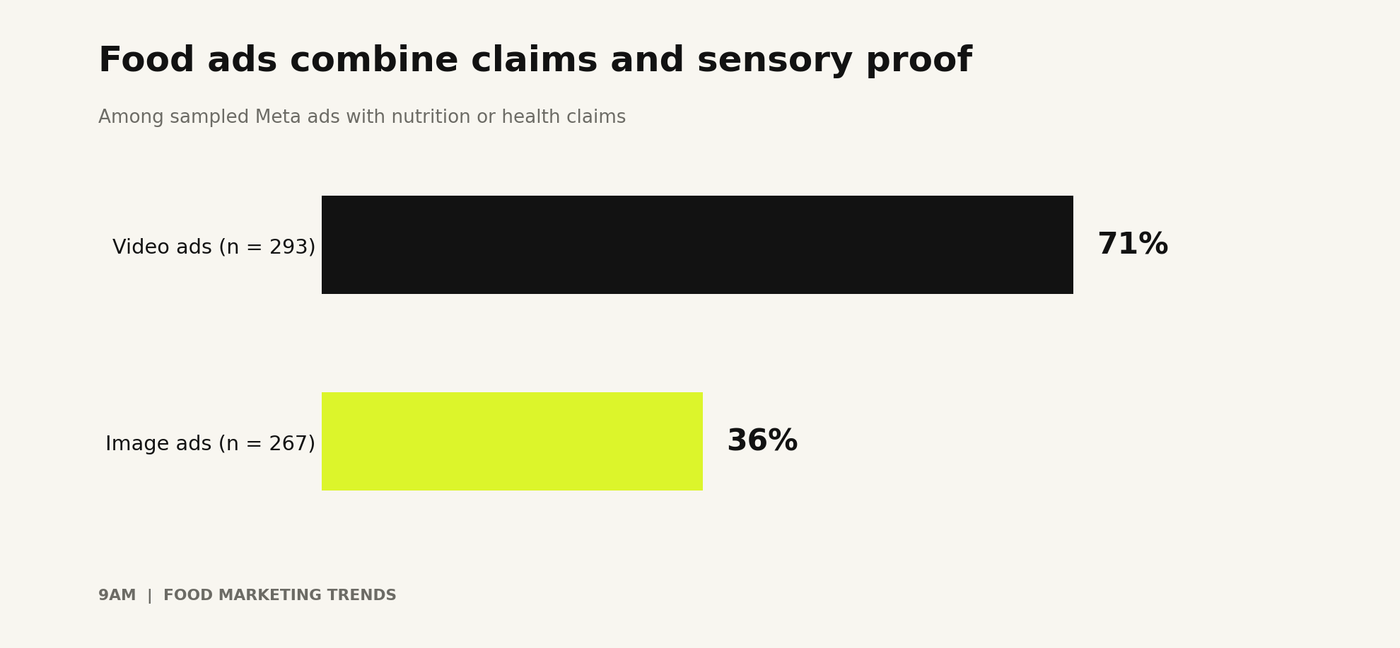
Share of sampled claim ads showing the product being enjoyed or in close-up, by format. Source: 9AM analysis of 930 active US Meta ads from 24 food and drink brands, November 2026.
P.S. If you want your 2027 food media plan built around where your products actually sell, our food and beverage media team can build it with you.
What Are the Top Food Marketing Trends for 2027?
The top food marketing trends for 2027 are:
Retail media moving off retailer sites and into fewer, bigger networks.
AI assistants shaping which grocery products shoppers consider.
Ads appearing inside AI assistants such as ChatGPT.
GLP-1 users shifting spend toward protein, fiber and produce.
Shoppable video and CTV closing the gap between viewing and buying.
Creator and social commerce reaching grocery products.
Price-sensitive shoppers pushing store brands to record share.
Subscriptions and repeat-purchase programs spreading beyond Amazon.
Stricter ingredient and claims rules changing what ads can say.
Why Food Marketing Trends Change Paid Media Budgets in 2027
Food marketing trends change budgets in 2027 because the places where shoppers discover and choose products are moving faster than media plans.
In fact, the shift shows up in a single statistic from Target: nearly half of purchases that start with ecommerce browsing are completed in physical stores, according to the retailer's vice president of digital product.
That means an ad can do its work on a phone and the sale can land in an aisle, where last-click reporting never sees it.
As a result, brands that judge channels only on attributed online sales will keep cutting the channels that create demand, a risk we see a lot in retail media brand building.
The trends below matter for the same reason: each one moves the point of discovery, the point of comparison or the point of purchase. When any of the three moves, the budget should follow.
Food Marketing Trends Paid Media Teams Should Watch in 2027
Nine trends meet the "close to the buyer" test for 2027. Each one below includes the evidence, why it matters for food brands, and what to test.
At 9AM we read trends through one filter: does this change where our clients' shoppers find, compare or buy their products? Most trend lists stop at what is new. A media plan needs to know what is new and close enough to the buyer to deserve budget this year, so that is the test each trend below has to pass.
Retail Media Networks That Reach Beyond Retailer Sites
Retail media is growing fastest where retailers do not own the screen.
US off-site retail media spending is forecast to reach $17.98 billion in 2026 and $35.57 billion by 2030, per EMARKETER.
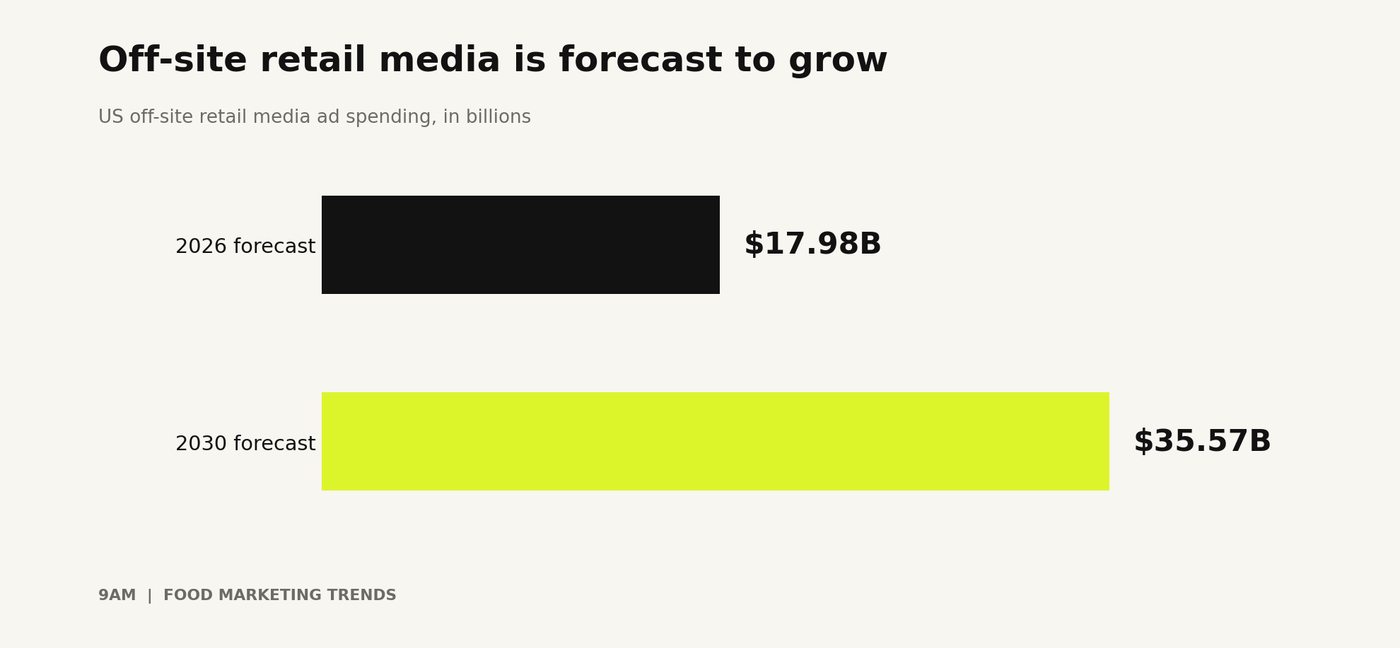
Forecast US off-site retail media ad spending in 2026 and 2030. Source: EMARKETER.
At the same time, the market is consolidating.
EMARKETER expects Amazon and Walmart to account for 81.0% of US off-site retail media spend in 2027, and in October 2026 DoorDash agreed to acquire Instacart for about $17 billion, a deal the BBC reports is expected to close by the end of 2027 or the first half of 2028.
For food brands, that combination means two things.
First, retailer data will follow shoppers into CTV, social and the open web, so retail media budgets will compete with brand budgets.
Second, fewer networks will control more of the buying, which raises the value of knowing which ones your shoppers actually use. Ranking grocery retail media networks by where your shoppers buy is the first step.
What to test in 2027: one off-site retail media campaign at your biggest retailer, measured on incremental sales in stores as well as online.
AI Shopping Assistants That Shape Grocery Choices
The retail media shift changes where ads run; AI assistants change how shoppers decide.
According to NIQ, AI-powered product recommendations are the most used AI shopping feature at 20% adoption, followed by personal shopping assistants at 16%, based on a monthly sample of about 500 US consumers.
Shoppers still want the final word, however.
In a YouGov survey for Pinterest, 92% of US adults said they want to make the final purchase decision themselves, and only 4% wanted an AI agent to decide for them.
That explains where the opportunity sits for food brands in 2027: the research and comparison stage, long before any automated checkout.
EMARKETER's analysis of the same data notes that accurate descriptions, pricing, reviews and availability can influence whether a brand appears in AI answers. In practice, that makes complete product listings a media asset.
What to test in 2027: audit your top 20 SKUs on Amazon, Walmart and Instacart for complete titles, nutrition details and reviews, then track whether AI assistants mention them for your category's common questions.
Ads Inside AI Assistants and Chat Search
Once shoppers use assistants to compare products, ads inside those assistants follow.
OpenAI began testing ads in ChatGPT in early 2026, and by October it said more than 100,000 advertisers had run campaigns, with ads available in 89 countries to people on its Free and Go plans.
The buying tools are also maturing quickly.
OpenAI has added cost-per-click bidding, a beta self-serve Ads Manager and conversion tracking through a pixel and API, which means advertisers can now measure what happens after a click.
For food brands, chat ads fit planning moments: meal ideas, recipes, diets and party planning. OpenAI's own example describes someone planning race-week meals who could discover a grocery delivery service through a relevant ad.
At 9AM, we plan these tests through our ChatGPT ads practice.
What to test in 2027: a small CPC campaign around recipe and meal-planning prompts that match your products, judged on cost per engaged visit and sales lift.
GLP-1 Users Changing What Goes in the Basket
AI changes how shoppers choose; GLP-1 medications change what they want to choose.
BCG estimates about 16 million active US GLP-1 users today and projects 30 million to 35 million by 2030.
So far, these users are moving their food spending around more than cutting it.
Users told BCG they plan to spend 15% more on fruits and vegetables and 11% more on high-protein foods, while planning to cut candy by 14%, prepared frozen sides by 12%, and salty snacks, soft drinks and chocolate by roughly 10%.
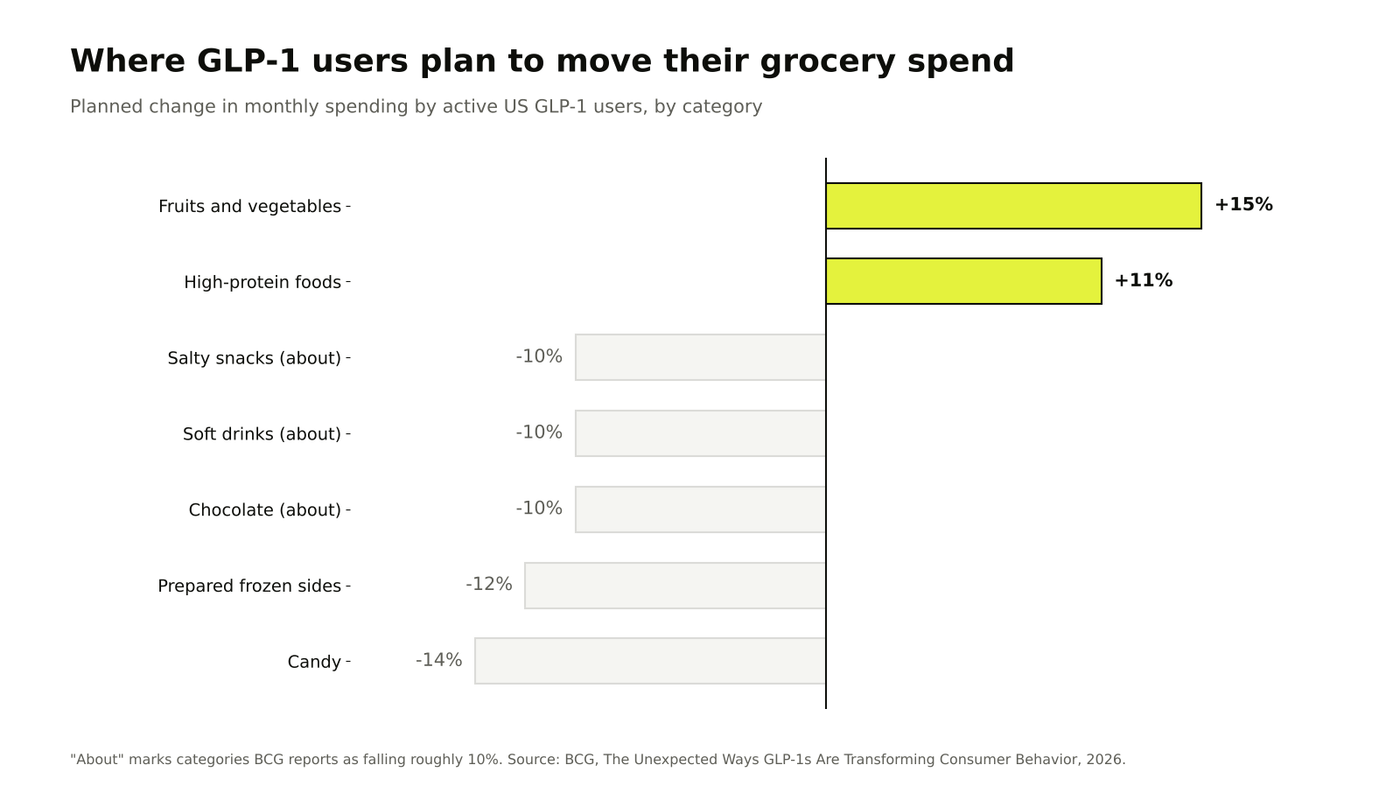
Planned change in monthly spending by active US GLP-1 users, by category. Source: BCG, 2026.
The effect also spreads past the user.
In fact, 70% of users reported changes in the eating habits of people they live with, which is why BCG puts the household-inclusive market about 50% above active users alone.
What to test in 2027: creative and targeting built around protein, fiber and portion size for products that fit, plus smaller-pack offers in indulgent categories.
Shoppable Video and CTV for Grocery Brands
As shoppers change what they buy, video formats are changing how quickly they can act on it. EMARKETER forecast that CTV spending inside retail media campaigns would grow 43.1% in 2026, as retailers add their shopper data to streaming inventory.
That growth matters because recall falls closer to the shelf.
In an Ipsos analysis cited by EMARKETER, ads on retail sites saw 47% lower recall than off-site ads, while video on ecommerce pages beat display for recall by 130%.
In other words, CTV and video do the remembering, and retail placements do the closing.
Shoppable formats now connect the two: Amazon reports that streaming TV ads with interactivity drove 36% more orders than those without.
At 9AM, we plan CTV for food brands with that full path in mind.
What to test in 2027: a retail-data CTV campaign paired with shoppable video on the same retailer, measured with a holdout.
Creator and Social Commerce for Grocery Products
Video also explains the rise of creator commerce, since much of it happens in short-form video feeds.
TikTok Shop's head of food told Retail Brew that food category growth more than doubled as overall TikTok Shop sales rose 120% year over year, with food making up nearly 14% of sales per Capital One Shopping.
Large brands use it as a test bed as well as a channel.
Mars, for example, launched Skittles Pop'd on TikTok Shop before the product reached store shelves, and affiliates drive the bulk of revenue for brands of all sizes on the platform, according to the same report.
That makes creators a sales channel as well as a content source.
Brands can run the best creator posts as paid ads through creator whitelisting, so proven content gets more reach.
What to test in 2027: a TikTok Shop listing for a bundle or variety pack, supported by affiliate creators and paid amplification of the top posts.
Price-Sensitive Shoppers and Record Store Brand Share
Creator and AI channels shape discovery, but price still decides many grocery trips.
Store brands reached a record 21.3% dollar share and 23.5% unit share in 2025, per PLMA and Circana, with store brand dollar sales up 3.3% against 1.2% for national brands.
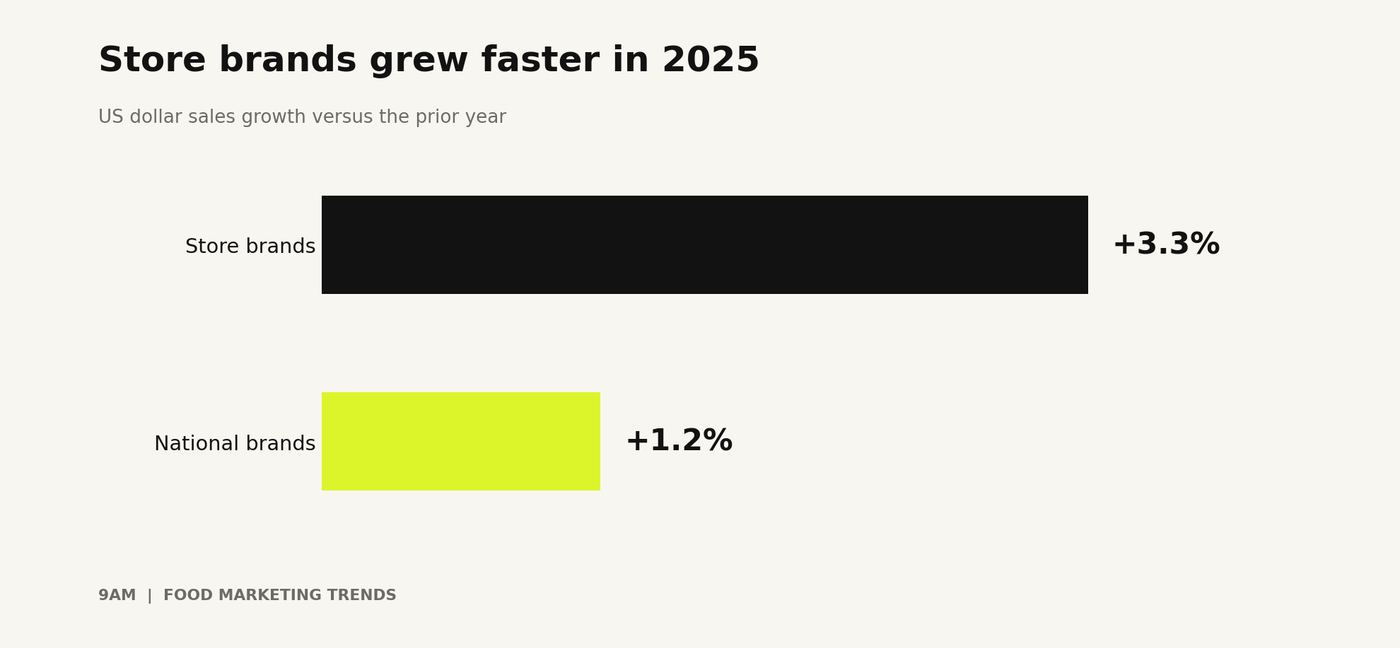
Store brand and national brand US dollar sales growth in 2025. Source: PLMA and Circana.
That puts pressure on national brands to prove their value in the ad as well as on the shelf tag.
As a result, promotions and media are drawing closer: coupon and price offers increasingly run through the same retailer systems as ads, which raises the stakes on splitting budget well between trade spend and retail media.
What to test in 2027: value-led creative (cost per serving, pack size, recipes that stretch a meal) against discount offers, both measured on incremental units.
Subscription and Repeat-Purchase Programs
If price pushes shoppers to switch, subscriptions are one way to keep them.
Amazon's Subscribe & Save is the best-known example, and TikTok Shop began rolling out its own subscribe-and-save feature in 2025, according to Retail Brew.
For food brands, the opportunity is consumable products with a predictable repurchase cycle, such as coffee, snacks and drinks. The challenge is measurement, because repeat orders can make old campaigns look like new wins.
What to test in 2027: report subscription sign-ups, first orders and repeat revenue separately, and credit repeat revenue to the campaign cohort that created it.
Stricter Ingredient and Claims Rules for Food Ads
The last trend affects every channel above, because it changes what the ads can say. The FDA has revoked approval of Red No. 3 in food, and manufacturers must reformulate by January 15, 2027.
The wider phase-out of six other petroleum-based dyes is voluntary, and the FDA now targets the end of 2027 for that effort, a year later than first announced.
Meanwhile, the updated "healthy" claim definition has a February 2028 compliance date.
Reformulations create new claims, such as "no artificial colors," and new claims need evidence and careful wording. That means creative teams should build claim reviews into 2027 launch calendars from the first brief.
What to test in 2027: a claim-to-evidence check on every reformulated product before its relaunch ads go live.
Taken together, the nine trends touch every stage of the shopping journey. The table below shows where each one changes it and the first test to run.
Trend | Where it changes the journey | First test |
|---|---|---|
Off-site retail media | Discovery on CTV, social and the open web | One off-site campaign at your top retailer |
AI shopping assistants | Research and comparison | Product listing audit for top SKUs |
Ads in AI assistants | Meal planning and recipe questions | Small CPC test on matching prompts |
GLP-1 basket shifts | What shoppers choose | Protein, fiber and portion-led creative |
Shoppable video and CTV | From viewing to cart | Retail-data CTV plus shoppable video |
Creator commerce | Discovery and trial | TikTok Shop bundle with affiliates |
Store brand pressure | Price comparison at shelf | Value-led creative against discounts |
Subscriptions | Repeat purchase | Cohort reporting on sign-ups and repeats |
Ingredient and claims rules | What ads can say | Claim check before relaunch ads |
Consumer Food Trends That Shape 2027 Food Ad Creative
The media trends decide where ads run; consumer trends decide what those ads should show. Four eating trends have the clearest data behind them for 2027.
Protein Beyond the Gym
Protein demand now reaches well beyond sports nutrition. Nine of the top 10 brands in MeAgain's Q3 2026 index of GLP-1 users offer protein-focused products, with fairlife ranked first.
For creative, that means protein claims need to sit next to taste and occasion. The same index shows seasonal flavors such as pumpkin spice protein shakes trending, so protein messaging works best when the product still looks like a treat.
Fiber and Gut Health
Fiber is following protein. GLP-1 users spend about 10% more on fiber and whole grains after starting medication, according to BCG data cited by EMARKETER, and products such as Smartfood Fiber Pop have entered the MeAgain trending list.
The trend is called fibermaxxing and it's increasingly becoming a consumer priority.
That gives brands with naturally high fiber a new message to test.
Claims such as "high in fiber" are nutrient content claims, though, so the wording needs to meet FDA definitions before it reaches an ad.
Smaller Portions and Pack Sizes
Portion size is the third shift, and it ties directly to pricing. BCG reports that GLP-1 users plan to eat indulgent products less often and in smaller portions, and it recommends that brands offer smaller pack sizes in premium and indulgent categories.
For ads, smaller packs change the value story from "more for less" to "the right amount," which also fits shoppers who are trading down on price.
Fewer Artificial Ingredients
The dye phase-out is a consumer trend as well as a regulatory one. A ClearShelf review of USDA records found that 12.6% of branded food labels listed at least one petroleum-based dye, mostly on labels from 2019 to 2023.
As brands reformulate, the change becomes an ad message. However, it only works if the claim is accurate for every version on shelf, which brings the regulatory trend back into the creative brief.
How to Plan a 2027 Food Media Budget Step by Step
Plan a 2027 food media budget by starting from where your products sell, then matching trends to your buyers and testing only what is close to them. The five steps below run in order.
1. Map Where Your Products Are Sold and Stocked
List your sales by channel and retailer, including in-store share. This map tells you which trends matter: a brand selling mostly through grocery stores needs retail media and store-level measurement before TikTok Shop. The split between DTC, Amazon and grocery also decides which food ecommerce ads can pay off at all.
2. Score Each Trend by How Close It Sits to Your Buyers
Rate each of the nine trends from one to three on how much it affects your shoppers today. For example, GLP-1 shifts score high for protein snacks and candy alike, since spend is moving into one and out of the other, while AI assistants score high for products shoppers research before buying.
3. Keep a Test Budget for One or Two New Channels
Set aside a fixed share of the budget for tests, and fund no more than one or two new channels at a time. Testing fewer channels means each test gets enough spend to give a clear answer.
4. Set the Metric Each Test Must Move
Decide before launch what success looks like for each test:
Retail media and CTV: incremental sales, in store and online.
Creator and social commerce: new-to-brand buyers.
Subscription programs: subscribers still active after three and six months.
Ads in AI assistants: cost per engaged visit and sales lift.
Store-level effects need a holdout, such as a geo-lift test that compares matched regions with and without the campaign.
5. Review Results Each Quarter and Move Budget to Proven Channels
Review each test every quarter against its metric, then scale winners and end the rest. Moving money in planned quarterly steps keeps tests from draining the core plan, and it gives each new channel at least one full quarter to show results.
Plan Your 2027 Food Media Mix with 9AM
The common thread across these trends is distance: discovery is moving further from the shelf, and the sale still often happens in it. Food brands that connect the two, with retailer data, store-level measurement and creative that fits each step, will spend 2027 budgets where they actually move product.
Start with step one this week: map where your products sell, then pick the two trends closest to those buyers.
Need help?
We plan retail media, CTV, TikTok Shop and ChatGPT ads for food brands as one media mix, measured on sales by retailer.
Book a strategy call today to build your 2027 food media plan and keep moving budget toward what sells.
Frequently Asked Questions
What are the biggest CPG marketing trends for 2027?
Off-site retail media, AI-assisted shopping, ads inside AI assistants and shoppable video lead the list for CPG brands. For food specifically, GLP-1 spending shifts, record store brand share and stricter ingredient rules add pressure on creative and pricing.
How will AI change grocery advertising in 2027?
AI will mostly change the research stage. NIQ found 51% of US consumers used an AI shopping tool in the past month, while 92% of adults in a YouGov survey still want the final say, so brands should focus on accurate product data and ads at the comparison stage.
Should food brands cut social spend to fund retail media?
No, not by default. Social and creator content build demand that retail media converts. In fact, EMARKETER expects only about $1.3 billion of 2026 social ad spend to flow through retail media networks, which shows the two budgets still do different jobs. Fund retail media from a planned test budget and compare both on incremental sales.
How do GLP-1 medications affect food marketing?
GLP-1 users shift spending toward produce, protein and fiber and away from candy, frozen sides and salty snacks, per BCG. Their households often follow, so brands should adjust product claims, pack sizes and targeting for a market BCG expects to roughly double by 2030.
About Corentin Grisoni
Corentin Grisoni helps DTC and wellness brands turn paid media into a connected growth system. As Retail Media Lead at inBeat Agency, he works across Amazon, Meta, TikTok, and Google to build omnichannel campaigns that are measurable, scalable, and tied to business outcomes.
His work brings together retail media strategy, paid social and search, attribution modeling, UGC, and performance creative. He focuses on helping retail, technology, and wellness brands understand where their media budget is working and create a system that compounds what performs.
More from Corentin Grisoni