Telehealth Advertising: Match Spend to Where Patients Can Book Care
Telehealth advertising that follows booking availability: map licensed states, clinician slots and booking paths, then set channel rules and budgets.

· 14 min read
Telehealth ads can reach patients almost anywhere, but a patient can only book where your clinicians can treat them and when they have open time. When campaigns are planned around just reach, budget flows to states and hours the care team can't serve.
The spending keeps growing.
Telehealth brands such as Ro and Hims & Hers spent $183.9 million on TV ads in 2025, almost three times their 2023 total, and $136.2 million in the first half of 2026 alone, according to Video Advertising Bureau data. That is before search, social and creator spend.
This guide covers what makes telehealth advertising different, why spend has to follow booking availability, and a nine-step process for matching campaigns to the states, services and slots you can actually offer.
P.S. If you'd like help building this planning process, our healthcare PPC team runs paid search for telehealth and digital health brands. Book a strategy call.
TL;DR
Telehealth advertising promotes virtual care, but the market is limited to states where clinicians are licensed and hours when they can see patients.
Build an availability map by region, service, clinicians, open slots and booking destination before setting budgets.
Give each region a status, Live, Limited or Paused, and set channel rules for each status.
Ad location targeting is an estimate, so eligibility checks belong in the booking flow.
Measure cost per booked visit by region, and update the plan whenever supply or rules change.
Pro tip: We plan telehealth media from the supply side first. A campaign is only as good as the booking it ends in, so the media plan, the creative and the measurement all start from where and when a patient can be seen. When those three sit in the same weekly review, a clinician leaving a state or a waitlist growing in one service shows up as a budget change within days. The rest of this guide is the process we use to keep spend and availability in step.
What Is Telehealth Advertising?
Telehealth advertising is paid promotion of virtual care services, such as online therapy, urgent care, prescriptions or specialist visits, across search, social, video, audio and partner channels. It is part of telehealth marketing, alongside organic channels like SEO and email.
Planning works differently from in-person clinic advertising, because the limits sit in licensing and schedules more than in geography and drive time:
Planning input | In-person clinic | Telehealth service |
|---|---|---|
Market | A drive-time area around each location | The states where clinicians are licensed to treat |
Supply | Rooms and staff at each site | Clinician hours by state and service, often across time zones |
Conversion | A booked visit at a named address | A booked virtual visit in an eligible state |
Eligibility check | The patient travels to the clinic | The patient's location must be confirmed before care |
That last row shapes everything after it. Because care is tied to where the patient is at the time of the visit, a telehealth campaign that reaches the wrong state produces a lead the business can't serve.
Why Telehealth Ad Spend Must Follow Booking Availability
Telehealth ad spend must follow booking availability because four constraints decide whether a click can become a visit, and none of them live inside an ad platform.
Patients Can Only Book Where Clinicians Are Licensed
Telehealth care is generally treated as delivered where the patient is located, so a clinician typically needs a license in that state. Rules vary by state and profession, and some states or plans add requirements such as a pre-existing relationship.
For advertising, that means the market is a list of approved states per service and clinician, set by your clinical and legal teams. This article treats that list as an input; it doesn't define the rules.
Clinician Schedules Limit Daily Booking Capacity
Clinician schedules decide how many visits a campaign can fill each day. HHS's guide to direct-to-consumer telehealth lists service hours, staffing and queue management as planning decisions to make before launch.
Capacity gaps block real patients, which is why it’s important for you to tackle it. In a 2026 secret shopper study of calls to mental health clinicians, limits such as not accepting new patients stopped 21.6% of evaluable calls from becoming appointments.
Ad Location Targeting Cannot Confirm Patient Eligibility
Ad platforms estimate where a person is, and Google says plainly that location targeting is a best effort with no 100% accuracy guarantee. A state-level target reduces wasted clicks, but it can't confirm a patient is in a state where you can provide care.
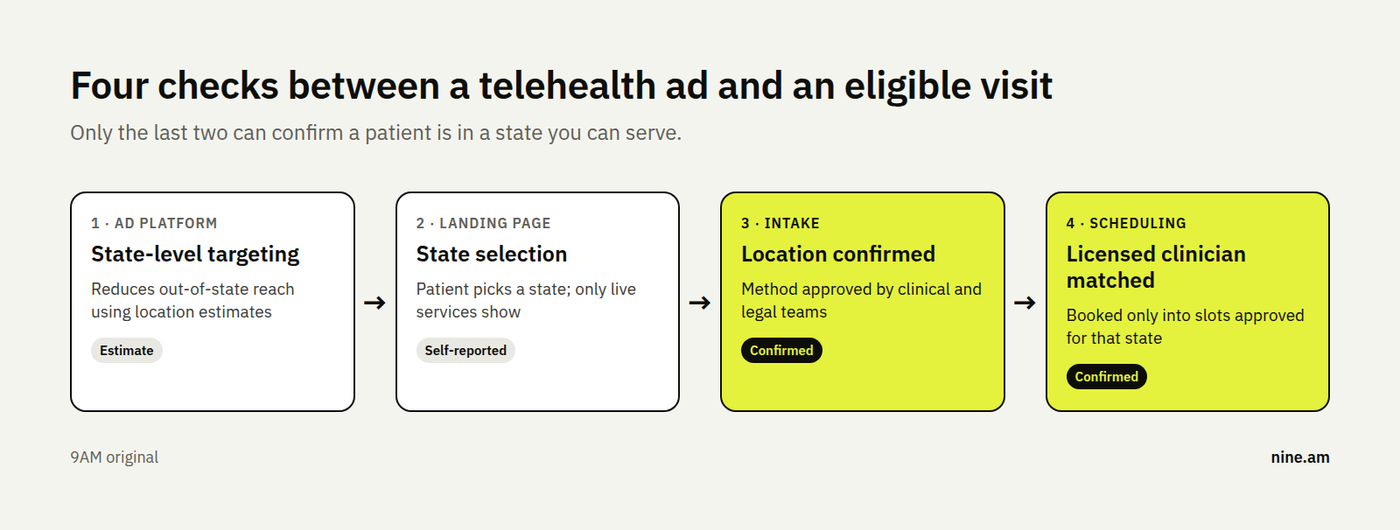
The four checks between a telehealth ad and an eligible booked visit, from ad targeting to clinician match. Source: 9AM original
Eligibility checks belong in the booking flow, where HHS advises providers to verify patient location before an appointment.
Telehealth Prescribing and Coverage Rule Changes
Telehealth rules can change what you can offer and where, at short notice.
Federal flexibilities that let DEA-registered clinicians prescribe controlled medications without an in-person visit are extended through December 31, 2026, and the DEA sent a final special registration rule for White House review in August 2026.
You don't need to predict the outcome to plan for it. You need a process that changes campaigns within a day once your legal team says a service or state has changed.
How to Match Telehealth Campaign Spend to Booking Availability, Step by Step
Match spend to availability by building one shared map of where and when patients can book, then tying every channel, ad and budget to it. Each step depends on the one before it.
1. Build a Telehealth Availability Map
Build one table that lists every service line by region, with the clinicians approved to treat there, open appointment slots and the booking destination. This is the readiness matrix every campaign decision reads from:
Region | Service | Approved clinicians | Open slots, next 14 days | Booking destination | Status |
|---|---|---|---|---|---|
Texas | Therapy | 14 | 210 | /book/therapy?state=TX | Live |
Florida | Therapy | 3 | 18 | /book/therapy?state=FL | Limited |
Georgia | Psychiatry | 0 | 0 | Waitlist form | Paused |
Fictional example.
Pull open slots from the scheduling system on a set cadence, daily for fast-moving services and weekly for stable ones. A map that is a month old is a guess.
2. Size Patient Demand in Each Approved Region
Estimate demand in each approved region, so budgets go where demand and open slots overlap. Useful inputs include:
Search volume by state for your service terms, from Google Keyword Planner or a keyword tool.
Past booked visits by state, from your scheduling system, as the strongest signal of real demand.
Insurance mix, since a state where you're in network with the main plans converts differently from a self-pay market.
Population and time zone, which shape how many patients can book in the hours your clinicians work.
Combine them into a simple demand score per state and service, then compare it with open slots.
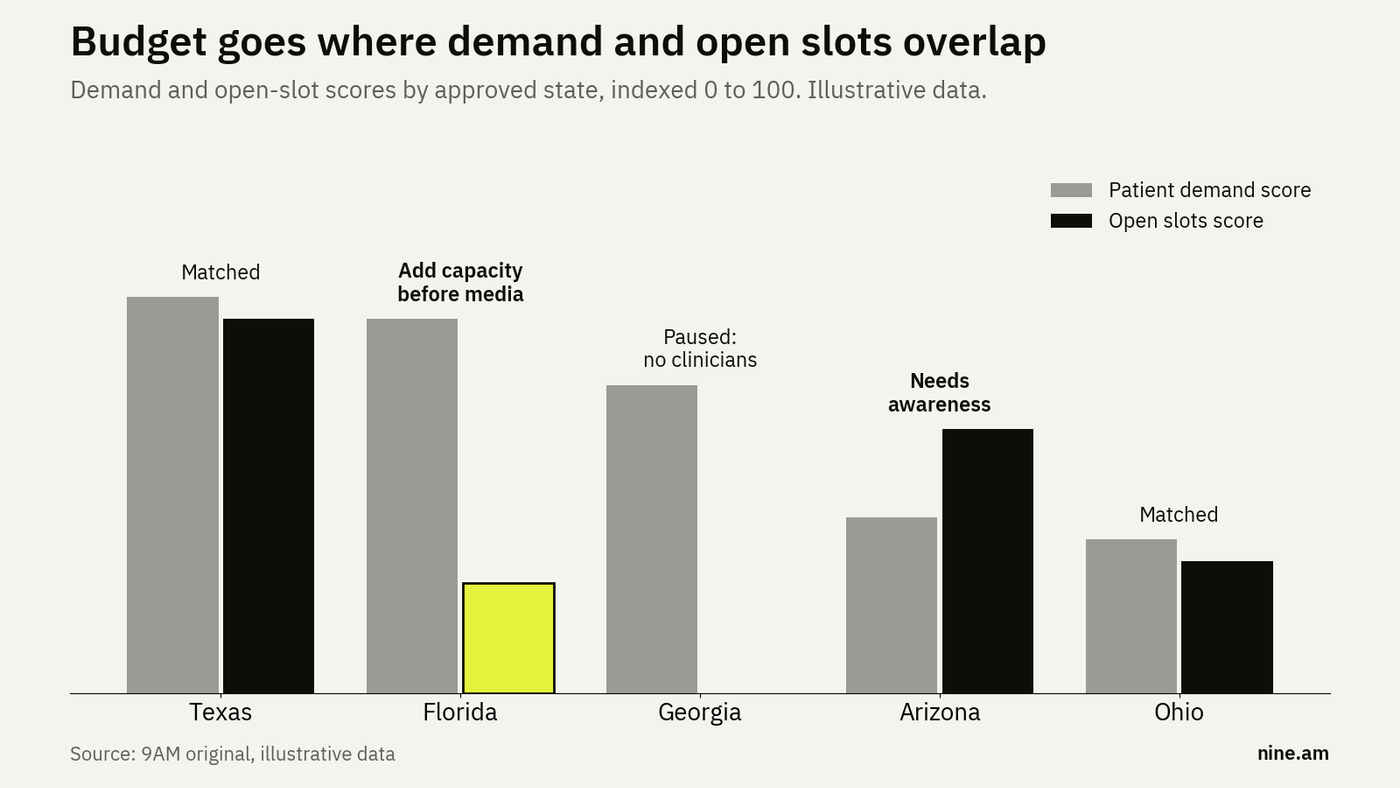
Patient demand compared with open appointment slots across five approved states. Source: 9AM original, illustrative data
A state with high demand and few slots needs more clinician capacity before more media. A state with open slots and low demand needs awareness spend. For choosing which new states or countries to enter at all, our guide to market prioritization covers the planning side.
3. Assign Owners for Availability Updates
Name one owner for each column of the map, and one person who changes campaigns when the map changes:
Clinical operations: clinician rosters, schedules and open slots.
Legal and compliance: approved states and services, and any rule changes.
Marketing operations: booking destinations and campaign status.
Paid media: applying status changes across every channel within an agreed time, such as one business day.
Write down the update cadence and the escalation path for urgent changes, such as a clinician leaving mid-month. A shared sheet or dashboard works if every owner edits their own columns and the change log records who changed what and when.
The weekly review should cover the map, spend by region and the exceptions from Step 9 together, so the team decides budget, capacity and messaging in one place.
4. Set Availability Rules for Each Ad Channel
Set a rule for each status in each channel, so a status change in the map turns into the same action everywhere. Channels differ in how precisely they can follow the map:
Channel | Live | Limited | Paused | What the channel can't control |
|---|---|---|---|---|
Paid search | Full budget, state-level campaigns | Capped budget, ad schedule set to clinician hours | Campaign paused for that state | Location estimates, so some out-of-state clicks remain |
Paid social and creators | Regional ad sets at full budget | Lower budget, waitlist messaging | Regional ad sets paused | Creator posts reach followers in every state |
TV, streaming and podcasts | National or regional buys | Messaging that names live states | Ads route to a waitlist page | Audience location, so routing happens on the landing page |
Current patients and referral partners | Email and partner outreach by state | Outreach limited to open services | Outreach paused for that state | Partner referrals can still arrive |
Paid search follows the map most closely, because campaigns can be split by state and scheduled by hour. Reach channels follow it least, so their landing pages carry more of the routing.
Current patients are the easiest channel to match to availability, since you already know where they are. Our guide to retention marketing covers how to plan email and repeat-visit outreach alongside acquisition spend.
5. Write Ads That State Where and When Patients Can Book
Write ad copy that tells patients where you can treat them and how soon they can be seen, so ineligible patients filter themselves out before they click. Useful details include:
Approved states, named in the ad or in the first line of the landing page.
Accepted insurance or the self-pay price.
Time to first appointment, when the map supports a promise like "visits this week."
What the visit includes, such as whether a prescription is possible.
Clear copy also answers the questions patients bring before they book. When we developed creative for Grow Therapy, we built concepts around affordability, insurance coverage and how to get started with therapy.
6. Point Every Ad to the Right Booking Destination
Send each ad to a booking path that matches its service and state, and confirm the patient's location at the start of intake. A clean flow usually runs in this order:
State selection on the landing page, before any long form.
Location confirmation at intake, using the method your clinical and legal teams approve.
Service and coverage questions, so the patient sees only options available in their state.
Live scheduling against real open slots, or a waitlist when none are available.
A patient in a paused state should reach a waitlist or a referral page, never a booking form that later rejects them.
Keep the landing page consistent with the ad: the same service, the same states and the same promise on timing. Our guide to landing page alignment covers matching the page to the ad.
7. Pace Budgets Against Open Appointments
Pace each region's budget to the open slots in the map, using cost per booked visit to translate slots into spend. If Texas therapy has 210 open slots over 14 days and a cost per booked visit of $80, the useful budget ceiling is roughly $16,800 for that period. Spend beyond it buys a waitlist. Leave some headroom for no-shows and same-day cancellations, which free slots back up.
Pace weekly for most regions, and daily for services where slots fill within a day or two. A cap that resets monthly will overspend early in the month and leave the last week without budget.
Recheck pacing whenever the slot count moves sharply. Our guide to budget pacing covers how to shift spend mid-month without breaking efficiency.
8. Pause or Shift Spend When Supply Changes
Agree in advance which supply changes trigger a status change, so the team acts the same day. Common triggers include:
A clinician leaves or reduces hours in a state.
A license or approval lapses, or a new state is approved.
Time to first appointment passes a threshold, such as ten days.
A rule change affects a service, confirmed by legal.
Booking or intake breaks for a state or service.
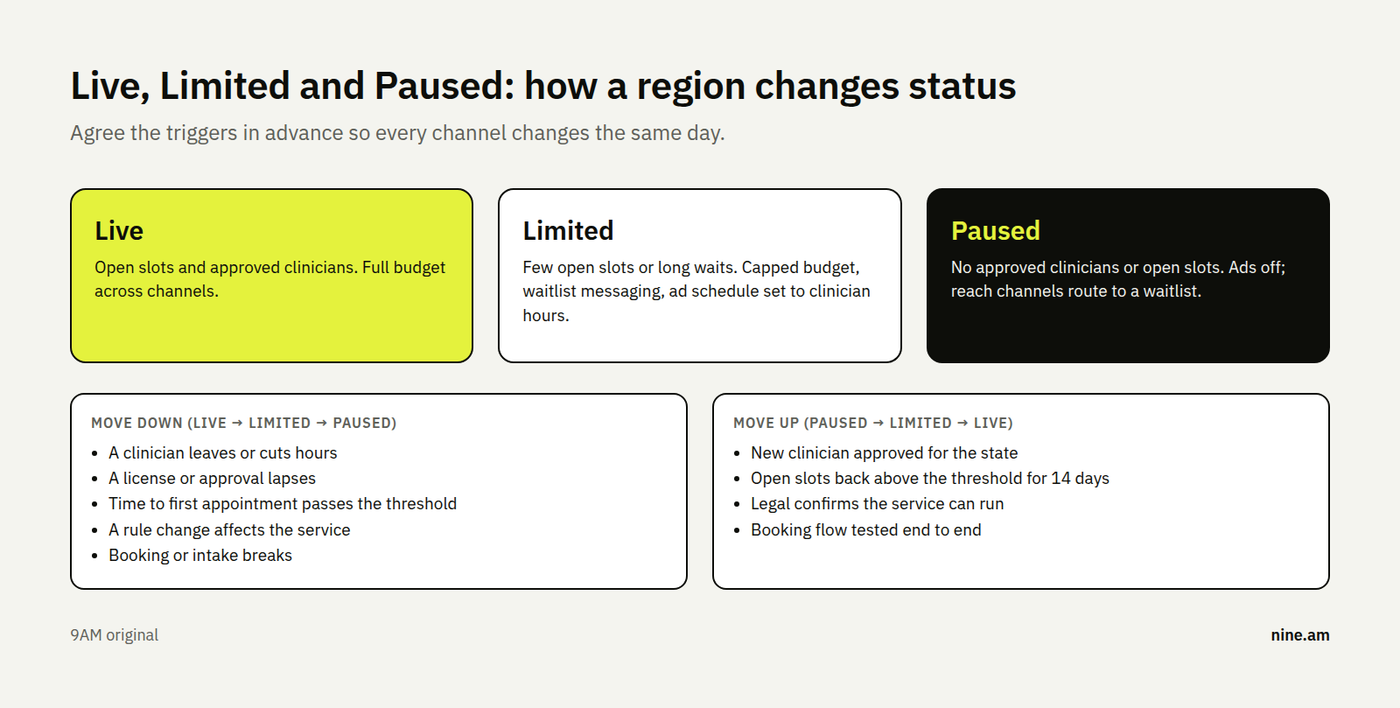
How a region moves between Live, Limited and Paused status, and the triggers for each move. Source: 9AM original
When a region is paused, move its budget to Live regions with open slots, or hold it. Spending it in the paused region produces leads you will have to turn away. Our healthcare media buying team sets up these triggers so status changes reach every channel the same day.
9. Review Exceptions and Out-of-Region Demand
Review the patients who arrive from outside your approved regions every week, because some always will. Sort them into three groups: patients in states you plan to add, patients you can refer to a partner, and patients you can't serve.
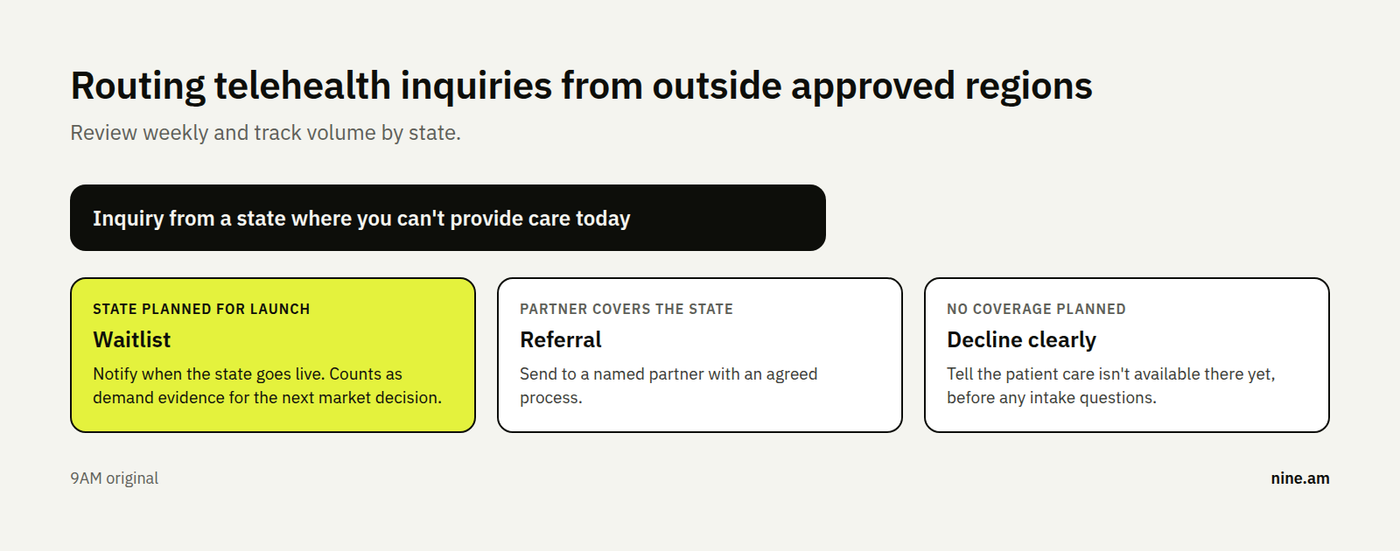
How to route telehealth inquiries from outside approved regions: waitlist, referral or decline. Source: 9AM original
Give each group a standard response: a waitlist with a notice when the state opens, a referral to a named partner, or a clear message that care isn't available there yet. Track the volume by state. A steady flow from one unapproved state is evidence for the next licensing or market decision, and it belongs in the same review as the availability map.
What Telehealth Advertising Compliance Reviews Should Cover
Telehealth advertising compliance reviews should approve the claims, data flows and platform requirements before campaigns go live, and recheck them when services or states change. For marketing teams, the review usually covers:
Claims: what ads promise about outcomes, speed and prescriptions, with substantiation.
Privacy and tracking: which events and data reach ad platforms and analytics tools.
Platform requirements: healthcare ad policies and any certification a platform requires for your services.
State and service rules: the approved list that feeds the availability map.
Our list of healthcare PPC compliance questions covers certification and policy questions in detail. Bring the availability map to the review as well: an approved-states list that lives only in a legal memo won't reach the campaigns.
How to Measure Telehealth Advertising by Booked Visits
Measure telehealth advertising by booked and attended visits in eligible regions, because clicks and form fills from ineligible patients look like results and aren't.
HHS suggests tracking measures like the number of new patients when evaluating a direct-to-consumer program, and these metrics tie that to ad spend.
Report them in aggregate by region and service; our guide to HIPAA-compliant marketing covers how to measure without sending patient data to ad platforms:
Metric | Definition | Why it matters |
|---|---|---|
Cost per booked visit, by region | Ad spend ÷ booked visits in eligible regions | Compares regions on what the business can actually deliver |
Slot fill rate | Booked slots ÷ open slots in the period | Shows whether spend is matched to capacity |
Time to first available appointment | Days from inquiry to first open slot | Predicts drop-off before the visit |
Show rate | Attended visits ÷ booked visits | Separates booking quality from scheduling issues |
Out-of-region share | Inquiries from unapproved states ÷ all inquiries | Measures how much spend reaches patients you can't serve |
Speed matters too: a patient who waits for a reply often books elsewhere. Our guide to lead response time covers how to connect paid inquiries to fast follow-up.
Plan Telehealth Patient Acquisition with 9AM
Telehealth advertising works when the media plan knows what the care team can deliver. The availability map, the channel rules and the booked-visit metrics turn a national reach problem into a set of regional decisions the whole team can act on.
At 9AM, our healthcare media team plans telehealth spend from the supply side: approved states, clinician capacity and booking destinations first, then channels, creative and budget.
Book a strategy call and we'll compare your availability by state with where your spend is going today.
FAQs
Should telehealth ads run nationally when clinicians are licensed in many states?
Use national campaigns when your service availability supports that reach. TV, streaming and podcast buys can offer geographic targeting, depending on the platform and placement. Target approved regions where possible, and confirm patient location in the booking flow. On search and social, split campaigns by state or region when availability differs.
How far ahead should availability be checked before raising telehealth ad spend?
Check at least the next 14 days of open slots for that region and service before raising spend, and longer for services with long booking lead times. Raise budgets in steps and watch time to first appointment after each one.
How should telehealth campaigns prepare for prescribing rule changes?
List which campaigns, ads and landing pages depend on each service affected by a pending rule, and prepare paused or reworded versions in advance. When legal confirms a change, the team switches statuses in the availability map and applies them across channels the same day.
Can geographic targeting keep out patients from states where you can't provide care?
No. Location targeting reduces out-of-state reach, but it relies on estimates and can't confirm where a patient is. Confirm location at intake and route ineligible patients to a waitlist or referral.
How can organic marketing help scale telehealth advertising?
Organic channels lower the cost of each booked visit by capturing patients paid media has already introduced. SEO pages for each service and state, educational content and email to past patients all convert demand that ads created, and our guide to blended and paid CAC shows how to read paid and organic together.
How much does telehealth advertising cost?
Search clicks for health categories average about $5 to $6, based on WordStream's 2026 benchmarks of $6.17 for health and fitness and $4.76 for physicians. High-intent telehealth terms cost more: keyword tools such as Ahrefs list around $12 per click for "online therapy" in the US. Plan budgets from cost per booked visit and open slots, as in Step 7, since click price alone says little about what a patient costs.
About Mustafa Alkhtab
Mustafa Alkhtab is Head of Performance Media at inBeat Agency, where he oversees paid media and performance creative results across the agency's accounts. Before inBeat Agency, he built growth programs for ecommerce, lead generation, and mobile app businesses in international markets. He writes about media buying, measurement, and conversion rate optimization.
More from Mustafa Alkhtab