Shoppable Video Ads for Food Brands: Test the Product-to-Cart Path
How shoppable video ads work for food brands on Instacart, Amazon, Walmart, YouTube, TikTok and CTV, and how to test the path from video to cart.

· 13 min read
Shoppable video now runs on almost every place a grocery shopper watches: Instacart, Amazon, Walmart, YouTube, TikTok and connected TV. Amazon reports that streaming TV ads with interactivity drove 36% more orders than streaming TV ads without it.
The video gets most of the attention in planning. The sales are decided in the few taps after it: the product card, the store, the cart.
This guide explains how the path from video to cart works for grocery products, what each platform offers, and how to launch and fix shoppable video ads before adding budget.
P.S. If you want shoppable video planned around where your products are actually stocked, our food and beverage retail media team builds that plan with you.
At 9AM we treat a shoppable video as a funnel with five steps, and we measure the drop-off at each one before judging the creative. A strong video that sends shoppers to an out-of-stock item or the wrong store looks like a creative problem in the dashboard. In many cases, though, it is a cart problem.
What Are Shoppable Video Ads?
Shoppable video ads are video ads with products attached, so a viewer can tap straight to the product, its price and a cart. On grocery platforms the cart is the retailer's own; on social and TV platforms the tap may lead to a retailer, a brand site or a native checkout.
If you also sell direct through your own Shopify store, this short video shows how to make those videos shoppable:
How Shoppable Video Ads Take a Grocery Shopper From Video to Cart
A shoppable video ad moves a grocery shopper through five steps. Each one can lose people, so plan and measure them separately.
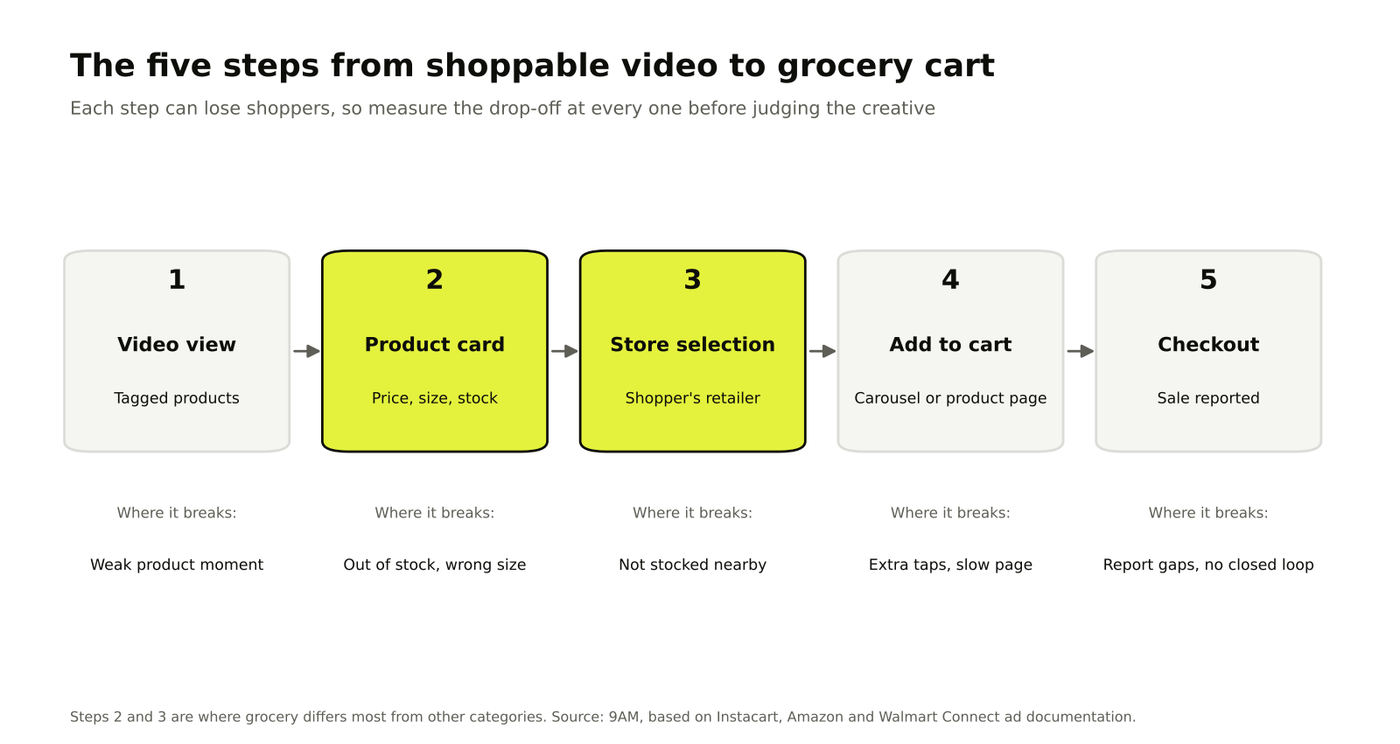
The five steps from shoppable video to grocery cart, and where each one breaks. Source: 9AM, based on Instacart, Amazon and Walmart Connect documentation.
1. Video View with Tagged Products
The viewer watches the video with products tagged on or beside it, such as Instacart's product carousel or Walmart's linked items. The video must show the same product and pack size the tag sells.
2. Product Card with Price and Availability
A tap opens a product card with the price, size and stock status. This is where an out-of-stock item or an unexpected price ends the journey.
3. Retailer or Store Selection
Grocery adds a step most categories skip: the shopper needs the product at their store. On Instacart the cart sits inside the retailer storefront the shopper is browsing; off-platform, the tap may need to route the shopper to a retailer that carries the item nearby.
4. Add to Cart
The shopper adds the item. On Instacart this happens from the carousel; on Amazon and Walmart search video, the click goes to the product detail page, where the shopper adds it.
5. Checkout and Sales Reporting
The order completes and the platform reports it back to the brand. Closed-loop platforms such as Instacart tie the sale to the ad; social and CTV platforms often report clicks and estimated conversions.
Why the Product-to-Cart Path Decides Shoppable Video Ad Results
The path decides results because the costliest losses happen after the video. Think about it this way: a viewer who taps has already shown interest.
If the next screen shows the wrong size, no stock or a long route to the store, the brand has paid for that interest and gets no sale. The creative did its job; the cart did not.
Grocery makes those drop-offs more likely, for two reasons.
First, most food sales still happen offline.
In-store purchases make up about 80% of CPG sales, so some viewers who tap are checking a product they will buy in an aisle later, and an online cart that fails them never shows up in the report.
Second, food shoppers split their spending across several retailers.
A tap that lands in the wrong store's cart is a lost sale even when the product sits on shelf at the shopper's usual store.
That is why the cart step deserves as much planning as the creative. The way your sales split between DTC, Amazon and grocery decides which cart each video should point to, and the same split shapes which food ecommerce ads can pay off at all.
Shoppable Video Ad Platforms for Food Brands
Seven platform types offer shoppable video for food brands. They differ most in where the cart lives and how they report sales.
Instacart Shoppable Video Ads
Instacart pairs a video with a product carousel that lets shoppers add items to their cart while they watch, bought on a cost-per-impression basis with keyword and behavioral targeting.
Reporting includes video completions alongside clicks and attributed sales.
Because the shopper is already inside a retailer's storefront, steps 3 and 4 of the path are handled for you.
In June 2026, Instacart also began piloting Immersive Feed, a vertical recipe video feed where shoppers add items inside their chosen retailer's storefront.
Shoppable video is one of several Instacart ad formats for food brands, so it can run next to search and display placements for the same products.
Amazon Sponsored Brands Video and Prime Video Ads
Sponsored Brands video runs in Amazon shopping results and on detail pages, charges per click, and sends shoppers to a product detail page or Brand Store.
Videos run 6 to 45 seconds, with 20 seconds or less recommended.
Prime Video ads add interactivity, letting viewers browse and shop with the remote or by scanning a phone.
For food brands, the cart question here is which storefront the item sells through, since Amazon Fresh and Amazon.com ads reach different shoppers and fulfill orders differently.
Walmart Connect Video Ads
Walmart's Sponsored Videos are keyword-targeted 5- to 45-second videos in search results, charged per click and linked to a product detail page, with ten items carrying shoppable links per campaign.
Walmart reports that 91% of sales attributed to these ads came from new-to-brand customers for small and mid-sized advertisers.
In other words, video in Walmart search mostly reaches shoppers who have not bought the brand before.
Setup follows the same steps as other Walmart Connect campaigns for CPG brands.
YouTube Ads with Product Feeds
Google's Demand Gen campaigns can attach a Merchant Center product feed to video ads on YouTube, including Shorts, and add promotion assets with discount tags. Reporting includes product-level results and conversion lift.
The catch for grocery brands is that a product feed usually points to a brand site, and many food brands do not sell direct.
That is where retailer partnerships help: Instacart has run Instacart-powered shoppable YouTube ads, where a click goes to an Instacart product page for same-day delivery.
TikTok Shop Video Ads
TikTok Shop lets brands attach products to videos, with checkout inside TikTok, so the whole path from video to cart stays on one app.
Food is growing fast there: TikTok Shop's head of food told Retail Brew that the food category's growth more than doubled as overall sales rose 120% year over year.
Bundles, variety packs and TikTok-exclusive products tend to do well, which makes the platform a better fit for new or giftable items than for everyday staples.
Meta Shops and Collection Ads
Meta's catalog-based formats, including collection ads, show a video or image with products pulled from a catalog.
The tap leads to the product link set in the catalog, usually a brand site or retailer page, so the cart experience depends on where that link goes.
Shoppable CTV Ads
Connected TV platforms now add buying to the big screen. Roku's Ok-to-Checkout overlay lets viewers browse and buy products with the remote, and Prime Video's interactive ads let viewers add items while streaming.
The interest is there: Roku's own survey found nearly half of its users were interested in buying advertised products directly from the TV.
For food brands, though, a TV checkout only works for items the viewer can get delivered, so we plan CTV for food and beverage brands with retail media data on where those shoppers actually buy.
Platform | Where the cart lives | Buying model | Sales reporting |
|---|---|---|---|
Instacart | Retailer storefront on Instacart | CPM | Closed loop, attributed sales |
Amazon Sponsored Brands video | Amazon product page or Brand Store | CPC | Amazon attributed sales |
Walmart Sponsored Videos | Walmart product page | CPC | Walmart attributed sales |
YouTube with product feeds | Brand or retailer site from feed | Click or conversion bidding | Product-level conversions, lift |
TikTok Shop | TikTok native checkout | Sales-objective campaigns | Shop sales in TikTok |
Meta catalog and collection ads | Site linked in catalog | Auction | Pixel and catalog conversions |
Shoppable CTV | Retailer or TV checkout | Varies by platform | Varies; often retail media matched |
Shoppable Recipes and Multi-Retailer Buy Buttons
Shoppable recipes and buy buttons solve the grocery problem of many retailers.
A recipe button adds every ingredient to a cart at the shopper's chosen retailer, and where-to-buy tools such as MikMak route shoppers to a retailer that carries the product, based on availability and location.
Recipe formats also reach shoppers outside the product's usual aisle.
Instacart reports that its recipe ads delivered an average of 43% new-to-brand sales and 78% of impressions outside the product's own aisle, based on Q3 2025 campaigns.
In other words, recipes put a product in front of shoppers who were not looking for it.
Here's a good example from Hurom:
https://www.facebook.com/ads/library/?id=1387080959919219
Off retailer platforms, a multi-retailer button does a similar job for store choice: it sends each shopper to a store they already use, so fewer taps are lost at step 3.
Shoppable Video Examples From Food and Grocery Brands
These campaigns show how food and grocery brands have handled the cart step:
Hellmann's, Kettle & Fire and Siete Foods on Instacart Immersive Feed (2026): the brands piloted short recipe videos inside retailer storefronts, so viewers add ingredients without leaving the store they shop, per Instacart.
Mondelēz, Smucker and Hormel sponsored recipes (2024): Chips Ahoy! Ice Cream Pops, Caramel Apple Pie Cold Brew and JENNIE-O Turkey Spinach Lasagna recipes let shoppers add every ingredient to their cart in one step, per Instacart.
Clorox on Instacart-powered YouTube ads (2024): for this household CPG brand, a click on the YouTube ad went to an Instacart product page for same-day delivery, with closed-loop measurement, per Instacart. Danone and Nestlé USA piloted the related Instacart-powered Google Shopping ads.
Skittles Pop'd on TikTok Shop: Mars launched the freeze-dried candy on TikTok Shop before it reached store shelves, using the native checkout to test demand, per Retail Brew.
How to Launch Shoppable Video Ads Step by Step
Launch shoppable video ads by fixing distribution and the cart path first, then scaling creative and budget. The eight steps below run in order.
P.S. We plan CTV for food and beverage brands alongside retail media, so streaming reach lands where your products sell.

The eight launch steps: prepare the path first, then launch, measure and scale. Source: 9AM.
1. Choose Products in Stock at the Retailers Your Ads Reach
Pick SKUs with strong distribution and steady stock at the retailers the platform serves. A product missing from many stores in the ad's reach loses the taps from shoppers at those stores.
Rank candidates by sales rate per store, since fast movers are the ones most likely to be on shelf when the ad runs.
2. Pick the Platform That Owns the Cart Your Shoppers Use
Start where your shoppers already buy you online: Instacart for grocery delivery, Amazon or Walmart for pantry stock-ups, TikTok Shop for new or giftable products.
Ranking grocery retail media networks by where your sales already happen shows which cart to test first.
3. Build the Product Feed with Current Price and Pack Size
Check that feeds and catalogs show the right size, price and image for each SKU.
A video showing a family pack while the card shows a single serving breaks trust at the product-card step, before the shopper ever reaches the cart.
4. Script Each Video Around One Product and One Use
Show one product in one moment, such as weeknight tacos or a game-day dip, in the first two seconds.
Recipe videos can carry several items, but the hero product should be clear.
5. Tag Products and Test the Tap-to-Cart Path on a Phone
Before launch, watch the ad on a phone, tap the product, pick a store and add it to the cart.
Record every screen and note anything that slows the shopper down.
6. Set Targeting and Budget by Retailer Coverage
Weight budget toward retailers and regions where the product is stocked.
National reach with regional distribution wastes impressions on shoppers who cannot buy.
7. Track Add-to-Cart, Purchases and New-to-Brand Sales
Set up reporting for each step of the path before spending, using the metrics in the next section.
Agree on attribution windows across platforms first.
8. Fix the Step with the Biggest Drop Before Adding Budget
Compare the drop-off at each step. If taps are high and add-to-cart is low, fix the product card or stock; if views are high and taps are low, fix the creative.
Add budget only after the weakest step improves.
Shoppable Video Ad Metrics Food Brands Should Track
Track one metric for each step of the path, plus in-store lift for products sold mostly offline.
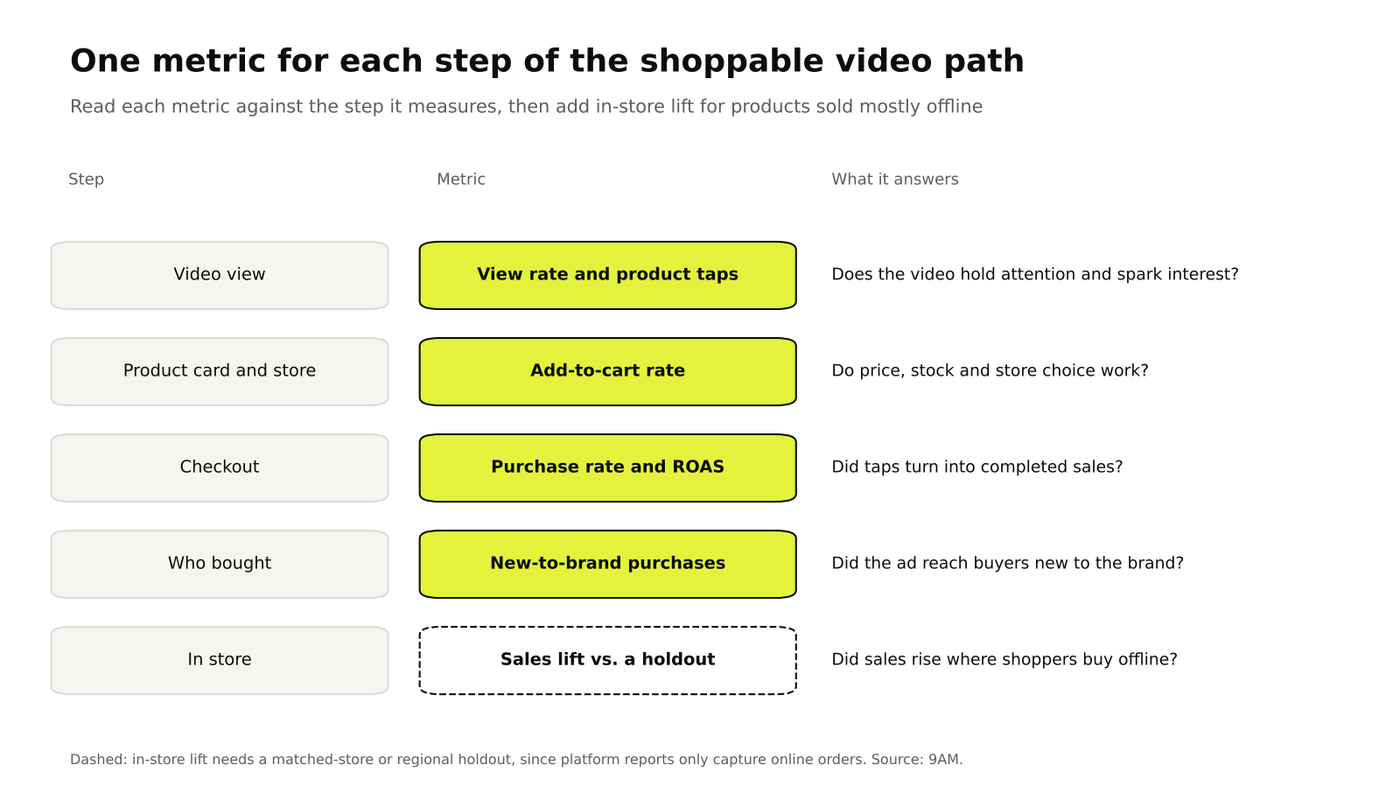
One metric for each step of the path, plus in-store lift measured against a holdout. Source: 9AM.
View Rate and Product Taps
View rate shows whether the video holds attention; product taps show whether it creates interest in the product. Low taps with high views point to a weak product moment in the video.
Add-to-Cart Rate
Add-to-cart rate divides adds by taps. It shows whether the product card, price, stock and store selection work.
Purchase Rate and Return on Ad Spend
Purchase rate and ROAS show completed sales. Compare them across platforms only when the attribution windows match, since a longer window credits more sales to the same ad.
New-to-Brand Purchases
New-to-brand purchases show whether shoppable video reaches new buyers. Walmart and Instacart report this directly: Walmart cites 91% new-to-brand sales for Sponsored Videos among small and mid-sized advertisers, and Instacart cites 43% for recipe ads, as covered above.
In-Store Sales Lift
For food brands, most sales still happen in store, so online reports miss part of the effect. Measure lift in matched stores or regions against a holdout, the setup behind a geo-lift test.
Common Shoppable Video Ad Mistakes Food Brands Make
Tagging out-of-stock or thinly distributed SKUs. Taps that end on "unavailable" are paid losses.
Running national video for regional products. Match targeting to where the product is stocked.
Showing one pack size and tagging another. The card should match the video.
Judging by views and clicks. Read add-to-cart, purchases and new-to-brand sales.
Skipping the phone test. Every shoppable ad should be tested end to end before launch.
Scale Shoppable Video After the Cart Path Works
Shoppable video works best when the cart path is treated as part of the creative. Testing the path first means more of the budget goes toward learning which videos sell, and less of it pays for taps that hit a dead end.
Start with one SKU on one platform: run the phone test, launch with a small budget, and fix the weakest step before scaling.
Book a strategy call with 9AM to plan shoppable video across retail media, TikTok and CTV, and keep moving budget to the carts that convert, quarter after quarter.
Frequently Asked Questions
How much do shoppable video ads cost?
Instacart sells shoppable video on a cost-per-impression basis, while Amazon Sponsored Brands video and Walmart Sponsored Videos charge per click. Budget for creative and for testing two or three videos per product.
What counts as a shoppable video on TikTok?
A TikTok video with a product link from TikTok Shop attached, so viewers can open the product and check out inside TikTok. Ads that only send traffic to a website work differently.
Can shoppable video ads drive in-store grocery sales?
Yes. A shopper can see a product in an app and buy it in store later. Measure this with a matched-store or geo holdout test, since platform reports only capture online orders.
Do shoppable video ads work for low-price grocery items?
Yes, if the item is bundled or shown as part of a basket. Recipe videos and variety packs raise the basket value, which is why recipe formats and multi-item tags suit low-price foods.
About Corentin Grisoni
Corentin Grisoni helps DTC and wellness brands turn paid media into a connected growth system. As Retail Media Lead at inBeat Agency, he works across Amazon, Meta, TikTok, and Google to build omnichannel campaigns that are measurable, scalable, and tied to business outcomes.
His work brings together retail media strategy, paid social and search, attribution modeling, UGC, and performance creative. He focuses on helping retail, technology, and wellness brands understand where their media budget is working and create a system that compounds what performs.
More from Corentin Grisoni